Quantcast

USTR Jamieson Greer Outlines Details of Misleading Talking Points by Canadian Trade Officials

In the first half of this CNBC interview with U.S. Trade Representative (USTR) Jamieson Greer, the Ambassador walks through the reasoning, purpose and intent of the recently announced 50% tariff rate against Canadian imported goods.

As noted by USTR Greer the Canadians are applying two separate metrics within their trade agreement with Europe and the USA.  Toward Europe there are no limits and quotas on dairy products, toward the USA there are severe limits and quotas applied by third party brokers (co-ops owned by Canadian dairy farms) leveraged by the Canadian government.  This is one example of Canadian duplicity.

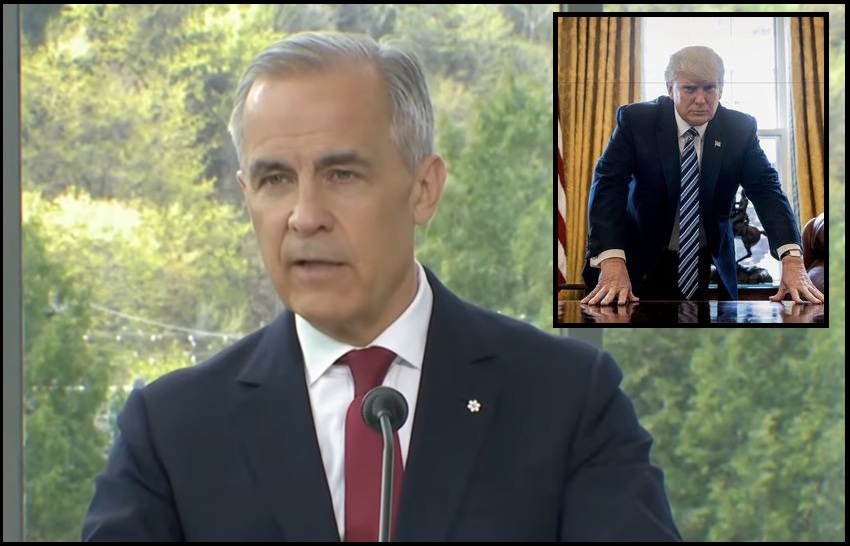
Additionally, by the various provincial governments of Canada banning the import and/or sale of U.S. products, and with Canada putting caps and limits on automobiles, these USA trade actions are being confronted by the 50% countervailing duties against Canadian imports.  Greer also calls ‘bulls**t’ on Carney’s double speak.  WATCH:

The trade discussion with Canada returns at the 10:00 minute mark. Jamieson Greer notes we have always had trade issues with Canada for decades. There was a significant percentage of the population who are against offshoring jobs, which is what NAFTA essentially did in North America.

It is also worth emphasizing that President Trump wants Canada to diversify. Both U.S. Ambassador Pete Hoekstra and President Trump have said, repeatedly, President Trump wants Canada to go make other bilateral deals with other nations.

Why? Two main reasons.
(more…)

Trump Administration Announces Section 338 Tariffs at Rate of 50% Across Wide Range of Canadian Goods and Imports

{Bumped – By Request More Analysis Added}

It is very obvious from the construct and details of this announcement that U.S. Trade Representative Jamieson Greer has completed a comprehensive review of the retaliatory action by Canada that followed the U.S. Section 232 tariffs on Steel and Aluminum. {FACT SHEET HERE}

Last year two countries retaliated against the U.S. for the 232 (steel and aluminum) tariffs, China and Canada. The USTR office has now quantified the tariff and non-tariff barriers triggered by Canada in 2025 and provided President Trump with a financial quantification of the trade impact.

The three Canadian retaliatory sectors highlighted include: (1) Alcoholic Beverages, (2) Motor Vehicles, (3) Dairy Products. These are the three segments quantified by USTR Greer that form the baseline for the U.S. to retaliate with countervailing duties.

Effective 30 days from now, August 16, 2026, President Trump has established a 50% tariff rate against a wide variety of Canadian imports. Essentially three major Annexes: {LIST 1 – LIST 2 – LIST 3} under the authority of Section 338.

♦ Section 338 authorizes the President, if he determines it will serve the public interest, to offset any burden or disadvantage placed on the commerce of the United States by an unequal imposition or discrimination by a foreign country by specifying and declaring additional duties not to exceed 50 percent ad valorem (or its equivalent) and not to take effect earlier than 30 days after the President’s proclamation finding that a foreign country imposes an unreasonable charge, exaction, regulation, or limitation that is not equally enforced on the like articles of every foreign country, or discriminates in fact against U.S. commerce in a way that places the commerce of the United States at a disadvantage compared to the commerce of any foreign country.

(more…)

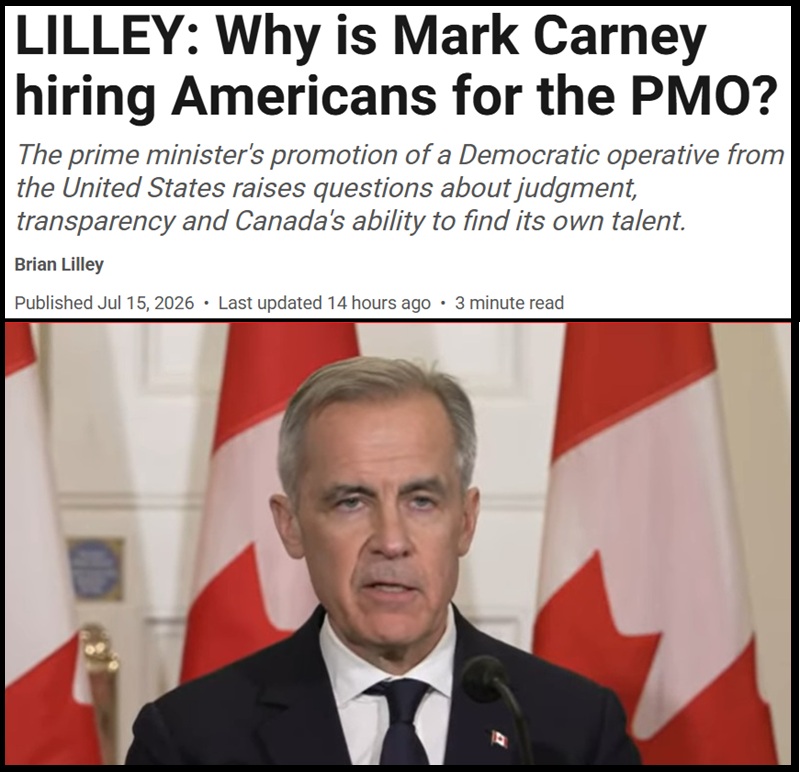
Canadians Perplexed – Mark Carney Hires American Political Operative as Chief Operations Officer

Previously, Mark Carney and the Canadian govt famously fired Air Canada’s CEO because he shamefully didn’t speak French. This week he hired American, Maia Johnson, as his Chief Operations Officer (COO), she also doesn’t speak French and the Canadians are perplexed.

Hired by Prime Minister Mark Carney, the role of Democrat party operative and former Michael Bloomberg associate, Maia Johnson, seems directly related to the strategy of leveraging U.S. Democrat resistance against the CUSMA (USMCA) termination.

[Note: Mark Carney and Michael Bloomberg connect through their banking and finance network with prior associations. This relationship also connects to U.K Mayor Andy Burnham who is likely to become the next U.K Prime Minister to replace Keir Starmer.]

Readers to CTH likely remember in 2018 former Prime Minister Justin Trudeau leveraged Democrat House Leader Nancy Pelosi to regain position in the USMCA negotiations (NAFTA elimination) with USTR Robert Lighthizer.

It appears that Carney is attempting a similar maneuver through the connections of Democrat operative Maia Johnson.

Specifically, because positioning American resistance to the CUSMA (USMCA) termination is a key part of the Carney strategy, a COO from U.S. Democrat politics is the best strategic approach. A Canadian in that role would be of far lesser value.

TORONTO SUN – […] This week, it was reported that Carney was promoting a woman unknown to most Canadians to the position of chief operating officer in the PMO.

It appears to be a first for Canada to have a COO in the PMO, but it’s who the woman is that is truly interesting.

(more…)

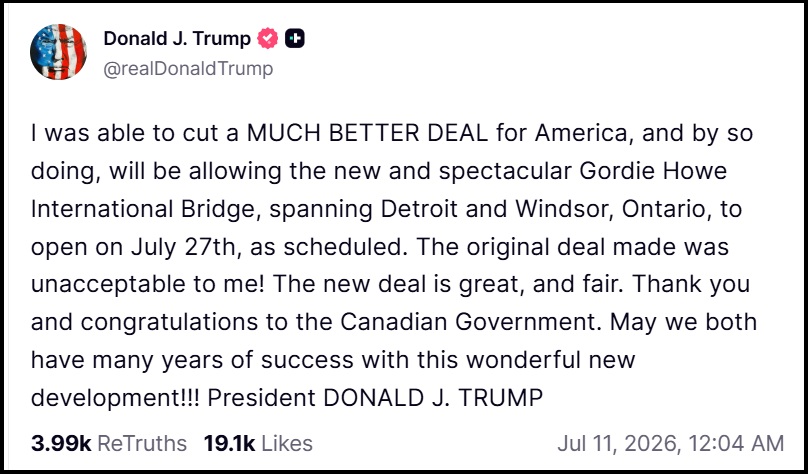
U.S-Canada Strike Deal on New Gordie Howe International Bridge – Opening Date July 27th

The issue was never really about Canada tolling; the real issue was about ‘cost overruns’ against the backdrop of how the tolling revenue was being used for repayment to the govt of Canada.  It’s a rather sticky situation.

The Canadian government backstopped the financing of the bridge construction.  The deal was that Canada would use tolling to pay the govt back and subsequent tolls would split 50/50 with U.S.  However, cost overruns made the Canadian payback a little less clear as the govt expected more revenue than originally proposed.  Sketchy.

[SOURCE]

The deal currently being revealed as a compromise includes an immediate 50/50 split where Canada gets 50 per cent of the toll profits — after operational expenses — and the other half will go to a U.S-run regional development project for a 15-year time frame.

According to Global News, “The agreement also requires the Windsor-Detroit Bridge Authority to consult the U.S. on any toll changes greater than 10 per cent, the source said, or if it’s looking to lower tolls below those of comparable regional averages.”  Additionally, in Politico “they will guarantee and ensure that we’re not pouring Chinese cars over that bridge.”

(more…)

Volkswagen Will Eliminate Almost Half of Production Models After Losing Market Share to China

The European auto industry is a case study on how short-sighted trade policy goals, results in consequences.

Previously, German auto companies like Volkswagen entered into trade agreements with China and began manufacturing their vehicles with immediate financial success in the market.  However, it did not take long for Chinese auto companies to reverse the engineering and begin to deliver the same quality vehicles at much lower prices.

The Chinese then stop purchasing the Volkswagen vehicles and purchase the cheaper version, while simultaneously begin exporting those same vehicles into the home market from where the technology originated.

Today, with a double-digit decline in production, Volkswagen announces they will cut almost half of their models due to diminished sales.

BLOOMBERG – BERLIN — Volkswagen reported weak sales numbers on Friday, a day after the giant German automaker announced plans to slash the number of models by nearly half as sales plunged, particularly in China.

The Wolfsburg, Germany-based company said group sales fell 8.6 per cent in the second quarter to just under 2.1 million vehicles, with sales in China alone plummeted by more than one-third.

(more…)

SURVEY: Many Canadian Manufacturers Considering Relocation to U.S.

An interesting report from Bloomberg following a survey conducted by KPMG of Canadian manufacturers.  Keep in mind this is a survey of companies within Canada that do traditional manufacturing of products; this is not a survey of companies that assemble foreign goods for export – there is a substantial difference.

As noted within the report, approximately 10% of Canadian GDP comes from Canadian manufacturing.  Within that sector there are multiple companies now planning or considering moving out of Canada into the United States.

Many will claim the trigger for the consideration is based on the potential elimination of the USMCA (CUSMA) trade agreement, and there is truth to that aspect.  However, the systemic issues within Canada -including energy policy, regulation and corporate tax burdens- represent the larger problem; the termination of the USMCA is the straw that breaks their back.

The domestic hurdles to manufacturing, are the bigger issues that cannot be negotiated away in U.S-Canada trade agreements.  Specifically, the low-price and stable energy policies are the core consistencies that are no longer present in Canada; that fundamental cannot be easily fixed.

BLOOMBERG – […] KPMG Canada said on Tuesday that 42 per cent of Canadian manufacturing companies indicated they have or are considering moving production to the United States. Of those considering relocating, 77 per cent expect to make the transition within the next two years.

[…] the issues go beyond the trade situation though, with Canada needing to create a competitive environment for manufacturers to grow.

(more…)

Toyota Positions – Shifts Truck Plant from Mexico to Texas

Both Toyota and Honda had previously warned the Canadian government that without the USMCA they would shift production from Canada to the U.S. to avoid tariffs and secure long-term manufacturing stability.  We presume a similar message was conveyed to Mexico.

Earlier today Toyota announced they were moving half of their Tacoma Truck production from Mexico to an expanded facility in Texas that will now encompass 5 million square feet in San Antonio.

(Bloomberg) — Toyota Motor Corp. is moving production of its popular Tacoma midsize truck from a plant in Mexico to San Antonio as part of a $3.6 billion investment in the Texas facility.

The Japanese carmaker will build a second production line in San Antonio, where it currently makes full-size pickups and SUVs, and add some 2,000 new jobs by 2030, it said Monday.

The shift, following Toyota’s pledge last year to spend $10 billion on its US manufacturing operations over the next decade, comes as talks between the US and Mexico to renew a North American free trade agreement have stalled. President Donald Trump, who has pressed Toyota to invest more in the US, let a July 1 deadline pass without a trade pact extension.

(more…)

A Shift Begins? Canadian Media Start Discussing Six-Month USMCA Termination Possible

The media and Canadian government discussions around the U.S-Canada trade and economic relationship, specifically as they pertain to the USMCA (CUSMA) continue to be fascinating.

As we noted over a year ago, the expressed perception from the Canadian side was remarkably disconnected from the most likely scenario.

The level of entrenched disbelief that the U.S. could completely separate from a trilateral trade deal in favor of a bilateral replacement has been remarkable to watch.

However, for the first time today Canadian media began admitting to themselves the USMCA can technically be terminated within six months; albeit buried at the end of the article.

GLOBAL NEWS – […] “I’m not in a position to guarantee anything. These decisions are made at the White House. They are made by the president,” Hoekstra said.

His comments come just days after the Trump administration declined to extend the trilateral pact with Canada and Mexico for a new 16-year term, citing what the U.S. calls “shortcomings” and “trade deficits.” Mexico and Canada both publicly pushed for a renewal.

U.S. President Donald Trump suggested last month that the U.S. is “better without” CUSMA, and that he’d even prefer to see it “terminated.”

When asked by Global News, Hoekstra would not say if the administration is considering ripping up the deal, which can be done by any party with six months’ formal notice. 

(more…)

Two Politically Pretentious Canadians Interview U.S. Ambassador Pete Hoekstra

I’ve said it before, U.S. Ambassador to Canada Pete Hoekstra is the most underpaid U.S. emissary sent to a hostile nation and constantly surrounded by threats, bitterness, anger and hatred.

It would be easier to be U.S. ambassador to North Korea.

There is so much nuance inside this interview, it is remarkable.

Ambassador Hoekstra tries in his best diplomatic form to tell the two Canadians Michael LeBlanc and Dr. Sylvain Charlebois about the underlying nature of the U.S-Canada trade conflicts.  However, in typical Canadian fashion both indoctrinated interviewers are curiously stumped by the points Hoekstra presents.  I am prompting this one because you also need to see the body/facial language. WATCH:

[SIDENOTE: The Canadians needed to turn off the comments on YouTube because Canadians are angry, bitter, abusive, vulgar and nasty in every comment section on the subject of U.S-Canada relations.]

Canada’s greatest strategic weakness is what Canadians call their greatest strength, pride.

There is a big difference between being proud and being prideful. The Canadian worldview is based on the latter.

(more…)

U.S Trade Representative Jamieson Greer Discusses Economy and USMCA

Appealing almost entirely to an audience that doesn’t recognize the issues that really matter, Fox News has the opportunity to discuss U.S. trade policy with Jamieson Greer yet flubs the entire interview.

Instead of asking about the USMCA withdrawal announcement and the ongoing trade discussions with Mexico, the Fox News pundits misdirect Greer’s expertise and ask questions about the jobs report, the Federal Reserve and the Democrat Socialists of America in elections.  Seriously, no joke.

When serious people remark that Fox News is nothing except propaganda for out of touch ‘boomers’ (a pejorative), this Fox News interview is a case study in why many people now hold that opinion. It’s difficult to argue they’re wrong.

That said, within the one minute where trade was actually discussed, USTR Jamieson Greer points out that many Democrats and many Republicans are completely in favor of eliminating the USTR and resetting the baseline of North American trade.  This is a key point, because within the economic policy issues the left-right dynamic should not be the prism that matters.  Remember, MAGA and the Bernie Bros agreed on 80% of the economic problem. WATCH:

.

(more…)