Quantcast

Beyond Ridiculous – EU Automakers Purchasing Carbon Credits from Chinese EV Makers to Avoid EU Climate Change Fines

Put this in the ‘beyond ridiculous’ file that explains the current situation of a contracting European economy; specifically, in the auto sector.

Europe has fines associated with the production of gasoline powered engines if the auto company doesn’t hit targets for sales of electric vehicles.  The fines triggered this year.  In order to avoid paying the European fines the auto makers are forming alliances with Chinese EV makers to purchase carbon credit offsets.

In essence, EU car companies buy Chinese car company carbon credits, to avoid the EU fines.  The Chinese car companies can then use the carbon credit revenue to subsidize lower priced Chinese EVs to the European car market, thereby undercutting the European EV car companies.  BRILLIANT!

MILAN, Oct 21 (Reuters) – Automakers have formed alliances to help them avoid hefty European Union fines on carbon emissions by purchasing credits from electric vehicle companies. Several legacy automakers face potential fines as the transition to EVs in Europe has proved slower than expected in recent years.

(more…)

EU Central Banker Christine Lagarde Outlines the “Trillions at Stake” Within President Trump’s Geopolitical Reset

Underpinning the contracting EU economy are two major forces.  First, the instability of their financial markets, thanks in majority to their catastrophic Build Back Better energy agenda.  Secondly, China exploiting the economic vulnerability and dumping massive amounts of cheap goods onto their consumer market.  Both forces are working against the EU economy.

To backstop the collapse, the EU is counting on expanded militaristic spending to get them out of their dead-end path.  Again, in majority, the economics of the thing is why they want expanded war with Russia – regardless of the detrimental outcome.  Without war they have to give up their Build Back Better green energy program.

In this interview, EU Central Bank President Christine Lagarde obfuscates both issues and points a finger at President Trump’s geopolitical economic and trade reset.  The only thing she accurately presents is the scale of the issue, the “trillions at stake” part.  WATCH (Transcript Below):

[Transcript] – MARGARET BRENNAN: We’re joined now by the President of the European Central Bank, Christine Lagarde. The ECB sets interest rates for many countries in the European Union, which is America’s largest trading partner. Good to have you here.

CHRISTINE LAGARDE: Lovely to be back, Margaret.

MARGARET BRENNAN: From where you sit, how would you describe the state of the global economy?

CHRISTINE LAGARDE: In transformation.

MARGARET BRENNAN: Transformation.

CHRISTINE LAGARDE: Transformation, I think caused by a couple of things. One is the tariffs, which have changed the map of trade around the world and reconstituted new alliances and reformed the way in which we trade with each other. I think the second major transformation is the impact of artificial intelligence on everything we do from data management to dating and everything in between.

(more…)

Former Canadian NAFTA Trade Negotiator Starts Noticing Trump Doesn’t Intend to Keep USMCA

In Canada they call the USMCA trade agreement “CUSMA” putting Canada first.  President Trump calls it the USMCA because that’s the order of sequence when the trade negotiations took place, the USA then came Mexico and much later, Canada.  However, Trudeau used his typical Alinsky gaslighting to pretend Canada was always participating; they were not, they came in at the end.

That said, the former NAFTA trade negotiator for Canada, John Weekes, has finally realized President Trump does not intend to renew or renegotiate the USMCA, he intends to dissolve it in favor of two bilateral free trade agreements; one with Mexico and one with Canada.

I’m not sure what finally, and I do mean FINALLY, triggered a Canadian to realize this, but perhaps they finally listened to President Trump telling Canadian Prime Minister Mark Carney [IN MAY] he intends to end it. DUH!  WATCH:

The reality of the U.S-Canada economic relationship and the position of President Donald Trump is not that difficult to understand if you take all the disparate datapoints and quotes from Trump and put them into context.

During a White House meeting with Mark Carney, President Trump essentially told the Canadian Prime Minister why he was in no hurry to get to a deal with Canada.  The 35% tariffs on non-USMCA goods triggered August 1st because the main priority of Trump -looking toward Canada- is to dissolve the USMCA.

(more…)

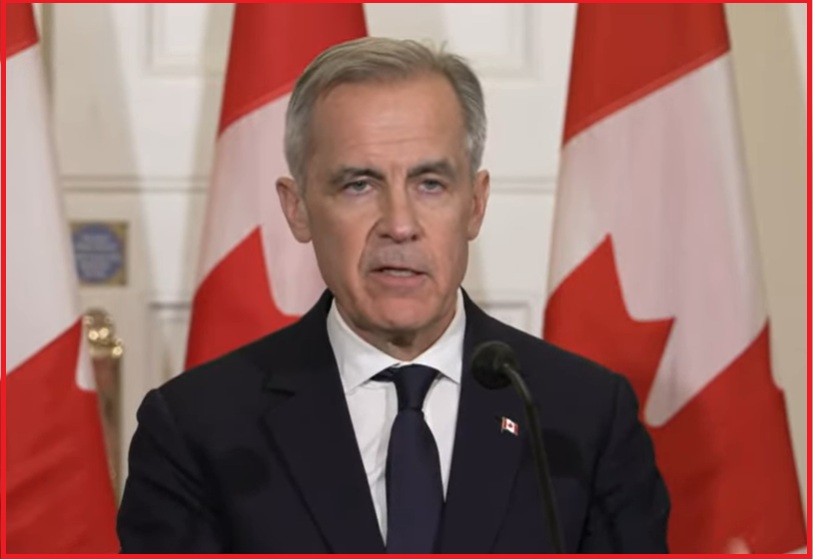
President Trump Holds a Bilateral Meeting with Canadian Prime Minister Mark Carney

Canadian Prime Minister Mark Carney travels to the U.S. for a White House meeting with President Trump.  The two leaders hold a press availability prior to entering negotiations.  WATCH:

.

(more…)

Mexico Is Doing What Canada Is Ignoring – Preparing for 2026 USMCA Renegotiation

There are going to be two major stories in 2026 that we will have full context to understand.  Yes, the 2026 midterm politics are going to lead the headlines, but two other issues will have considerable impact.

The first, is the FISA (702) reauthorization, and there is a lot that will surface in the next several months likely to upend the best laid plans of the administrative UniParty [Tulsi Factor].  The second, is the USMCA reauthorization – the end of the trilateral trade agreement, and the structural shift into two separate free trade agreements.

As to the latter issue, while Mexico and Canada are currently in a state of economic flux, only Mexico is preparing to deal with the seismic shift that is about to unfold.  Canada is going to be caught completely off guard.

While Canadian Prime Minister Mark Carney is trotting around Europe trying to establish his relevance amid the pro-Ukraine coalition,  Mexican President Claudia Sheinbaum is spending time focused on her domestic economy.

Mexico is preparing to drop significant tariffs on Chinese imports, a proactive move to position Mexico in advance of the upcoming bilateral discussion.

Sheinbaum knows that right now for every deportation ICE executes, her economy is hit as remittances recede. Simultaneously, for every mile of border wall that is completed, the financial dependency model increases.  President Trump’s leverage in the upcoming bilateral trade negotiation against Mexico increases each day, week and month.

Claudia Sheinbaum is smartly focused on trying to get ahead of the issues, while Mark Carney ignores his vulnerability and is about to make Canada naked to the economic weaknesses created by Justin Trudeau.

(more…)

Bureau of Economic Analysis Revises 2nd Quarter GDP Upward to 3.3 Percent Growth

From an initial report of 3.0% to a revised report of 3.3% second quarter growth. [BEA report HERE]  Not a surprise, when we factor in the prediction we presented after the first quarter GDP.

However, it is nice to see the BEA finally admit, “The increase in real GDP in the second quarter primarily reflected a decrease in imports, which are a subtraction in the calculation of GDP.”  I digress.

WASHINGTON (AP) — The U.S. economy rebounded this spring from a first-quarter downturn due to fallout from President Donald Trump’s trade wars.

In an upgrade from its first estimate in July, the Commerce Department said Thursday that U.S. gross domestic product — the nation’s output of goods and services — expanded at a 3.3% annual pace from April through June after shrinking 0.5% in the first three months of 2025. The department had initially estimated second-quarter growth at 3%.

(more…)

India Rejects President Trump Tariff Pressure, Pledges to Continue Purchasing Russian Oil

India is now facing a 50% import tariff against the majority of their goods (electronics and pharmaceuticals exempted). However, Indian Prime Minister Narendra Modi has vowed not to yield to the pressure. Modi said the world was witnessing a “politics of economic selfishness.”

For approximately a decade many western countries including the U.S. have heaped effusive praise on India as corporations viewed the massive Indian population, the world’s largest democracy, as both workers and consumers.  However, after the western sanctions against Russia were delivered, India -a BRICS nation- began pulling back from western alignment and influence.

Western sanctions map against Russia (yellow = agree with USA).

What we are witnessing now is one of the ramifications of the U.S. forcefully putting an “us or them” aspect into the strategic economic relationship, where “them” is Russia.  Currently, India is not flinching.

One could make the argument that undeveloped regions in Brazil, Russia, India, China and South Africa (BRICS) contain the majority of the valuable rare earth minerals and magnets the ‘western’ nations need for manufacturing.  BRICS has a pressure point to apply leverage, but no global trade currency, if the trade conflict escalates.

(more…)

Important Information from Treasury Secretary Scott Bessent

Treasury Secretary Scott Bessent appears on Fox Business to discuss some very important current issues in the world of finance, banking and trade.

Bessent begins by answering questions about the U.S. government taking equity interests in companies that come to the U.S. for support.  Bessent then notes the potential for the Trump administration to construct a taxpayer stake in Fannie and Freddie, before the Treasury Secretary moves on to talk about the trade issues with India.  WATCH:

.

(more…)

NEC Director Kevin Hassett Discusses Intel Deal, Trade and Powell’s Future

National Economic Council Director, Kevin Hassett, appears on CNBC to discuss the 10% govt stake in Intel, the status on U.S. trade agreements and other economic matters of interest. WATCH:

.

(more…)

German Chancellor Merz Says Entitlement Programs No Longer Sustainable

CTH noted several months ago, end the Marshall Plan for Europe and things will change quickly.

Germany is in a tight economic place as a result of: (1) former leftist Chancellor Olaf Scholz alignment with climate change policy, radically changing the German energy base and driving up costs; (2) the financial support for Ukraine; (3) the financial burden of mass African/ME migration, and (4) the new Trump-era EU tariffs that effectively end the Marshall Plan.

Put all four elements together and the German economic contraction is only forecast to worsen. This is the reality that current German Chanceller Fredrich Merz is facing. Thus, as a non-pretending former businessman, Merz recently told his party and the German electorate that current financial conditions no longer support the expansive entitlement state.

Pensions, benefits and even healthcare are potentially going to be impacted. Germans are not happy.

GERMANY – The German welfare state is no longer financially sustainable, Friedrich Merz said on Saturday. The chancellor argued for a fundamental reassessment of the benefits system as spending continues to soar past last year’s record of €47bn (£40bn).

In a state-level party conference meeting on Saturday, Mr Merz said: “The welfare state as we have it today can no longer be financed with what we can economically afford.”

Once the export champion of Europe, Germany’s economy has slowed dramatically since 2017, with GDP growing by only 1.6 per cent since then versus 9.5 per cent for the rest of the eurozone.

Germany’s economy shrank by 0.2 per cent last year following a 0.3 per cent dip in 2023 – the first time since the early 2000s the economy has retreated two years in a row.

Industrial production fell under the Left-leaning “traffic light” coalition of Olaf Scholz and continues to slide under the new government, with GDP declining by 0.3 per cent in the second quarter of 2025.

(more…)