Quantcast

Half of Germany’s Manufacturing Sectors Anticipate Significant Layoffs and Job Losses in 2026

In addition to being the main economic engine in Europe, Germany is the epicenter of the European Union’s overall goal to chase the green energy agenda.

For the past several years Germany has been deconstructing their fossil fuel energy production and replacing it with far more expensive alternatives.  This has led to large increases in overall energy prices, and downstream increases in manufacturing costs.

The consequences have been snowballing throughout 2025, while cheap competitive alternatives coming into the EU from China have compounded their problem.  Recently a survey of major industries was conducted in Germany to determine the forecast for 2026, the results are not good.

Approximately half of the industrial sectors in Germany are anticipating job losses, cuts or layoffs this year.

22 out of 46 business associations are preparing to downsize their labor force.  Only 9 of the 46 are expected to increase hiring.

At a top-line this looks bad.  However, when you look at the sectors contracting versus the sectors stable or expanding, you suddenly realize there is a bigger geopolitical problem within the forecast.

Job losses are expected in auto manufacturing, the textile sector, wood and paper fabrication.  Job gains are expected in aerospace, shipbuilding and defense production – i.e. the war machinery.

When the largest and most developed industrial economy in Europe is pinning its economic survival on war machinery, a particular momentum is created.  It is never a good outcome for Europe when Germany becomes reliant on war to maintain employment.

(more…)

Chinese Auto Sales to Europe Expected to Top 700,000 Units Sold This year

The geopolitical baseline for Europe is often determined by the economics of their situation.  In 2024 approximately 408,000 cars from China were sold in Europe.  For 2025 that number is now expected to exceed 700,000 units despite tariffs.

Previously we highlighted the short-term ramifications of the European Union push to force the sale of electric vehicle (EVs) upon the consumer base.  {SEE HERE} EU automakers unable to meet the compliance goal began purchasing carbon credits to avoid stiff EU fines.  Many of those carbon credits were purchased from Chinese automakers, who then turned around and started using the extra EU revenue to discount Chinese cars sold in Europe.

In essence, EU car companies started subsiding China to undercut their own market. An outcome of the EU chasing the ridiculous green energy project throughout the European free trade zone.

Now reports are beginning to surface of how the non-EV segment of the industry is being lost to less expensive Chinese hybrid autos that: (1) are much cheaper, (2) not bad in quality, and (3) are not subject to the 35% EV tariff rate.

The EU tariff applied to gasoline powered cars or hybrids from China is 10%.  That tariff is not enough to stop the imports. The Chinese hybrid autos are substantially less than European car brands, and there’s no financial incentive for China to build auto plants in the EU zone especially when you consider the EU is subsidizing those cars by purchasing carbon credits.

When analyzed from a cost and consequence, the entire EU dynamic toward car companies is a little funny.  However, for Germany this is a serious issue, and with the German industrial economy already stagnant – every impact to their auto industry only makes the situation worse.

(more…)

Strategic Positioning: Mexican Legislature Passes Trump-Level Tariffs Against Chinese Textiles, Shoes, Appliances and Autos

Taking a very significant step to be in alignment with President Trump’s North American trade bloc construct, Mexico has passed a sweeping set of tariffs against Chinese imports.

The motive for the move by President Claudia Sheinbaum and her political party, Morena, which controls both legislative chambers is clear.  Mexico is moving into direct alignment with President Trump as the likelihood for the end of the current USMCA trade agreement looms.

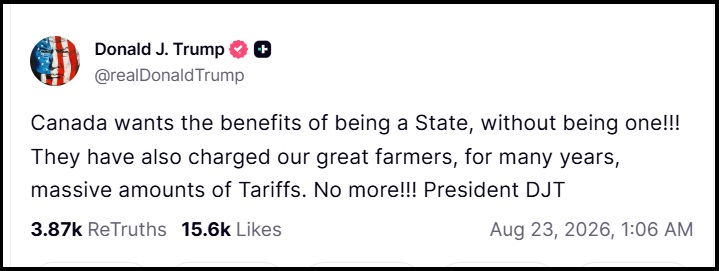
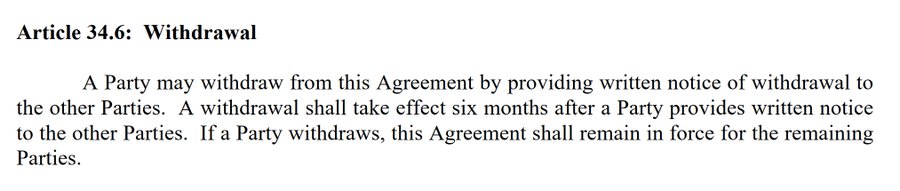
President Trump has sent clear signals expressing his intent to dissolve the USMCA trade agreement in favor of two bilateral agreements, one with Mexico and one with Canada.

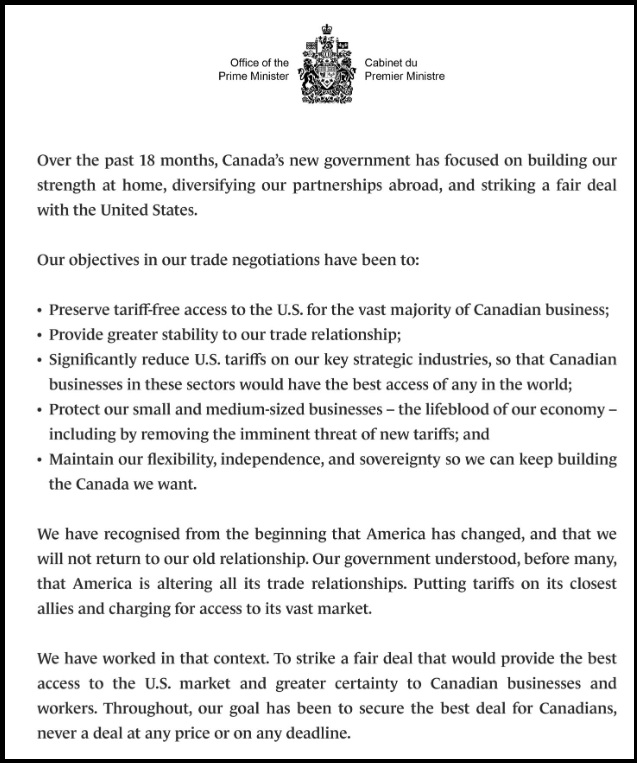
The Mexican government led by Sheinbaum have made moves throughout the year to stay in alignment with a favorable trade agreement, while the Canadian government led by Mark Carney has been more antagonistic toward any change.

The Mexican trade leadership seem to have long expected the change to the USMCA, and now there are indications Canada realizes what is about to happen, albeit reluctantly.

As a consequence of their proactive position, Mexico has now passed up to 50% tariffs against a host of imports, mostly textiles, shoes, appliances, cars and automobile parts.  The tariffs will apply to any imports that are not part of a previously organized free trade agreement, which has the practical outcome of hitting mostly imports from China. That approach aligns directly with the tariff rate applied by President Trump toward Beijing.

(more…)

Canadian Media Catch On, U.S Trade Rep Jamieson Greer Says Trump Likely to Exit the USMCA (CUSMA)

In the world of Trumpian geopolitical trade stuff, three issues are very interesting to watch. (1) The strategic reset with Russia which could break the official western construct of financial control. (2) The proactive and defensive positioning of Mexico (desperate attempt to retain economic attachment), and (3) the certain dissolution of the USMCA what Canadians call CUSMA.

Canadian media are starting to realize something we have talked about on these pages for years; President Trump intends to end the USMCA because the USMCA was used as a fracture point to eliminate NAFTA.

Wall Street, the U.S. Congress, the massive K-Street lobbying network around the U.S. Chamber of Commerce and the entire political apparatus of business and industry would never permit the end to NAFTA; too many trillions at stake. So, President Trump replaced NAFTA with the interim USMCA, which was better but factually more useful in elimination of the original.

Now, as we have discussed by highlighting President Trump’s no-so-subtle words on the issue, the Canadian media is realizing the USMCA will be dissolved in favor of two independently negotiated bilateral trade agreements; one with Canada and one with Mexico.

(CTV) – U.S. President Donald Trump could decide next year to withdraw from the Canada-United States-Mexico trade agreement (CUSMA), Politico reported on Thursday, citing U.S. Trade Representative Jamieson Greer.

“The president’s view is he only wants deals that are a good deal. The reason why we built a review period into CUSMA was in case we needed to revise it, review it or exit it,” Greer told Politico’s White House bureau chief Dasha Burns in a podcast episode that airs Friday.

Greer also raised the idea of negotiating separately with Canada and Mexico and dividing the agreement into two parts in the podcast, adding that he spoke with Trump about that possibility just this week.

(more…)

President Trump Cancels Joe Biden CAFE Standards Against Auto Industry

In an effort to return common sense, practicality and affordability to the American consumer base for automobiles, President Trump announced the elimination of Joe Biden’s Corporate Average Fuel Economy (CAFE) standards for manufactured cars and trucks.

Under the auspices of the “Green New Deal”, the Biden administration mandated ridiculous quotas for EVs and demanded lower power combustible engines, or pay a climate change tax. These CAFE standards resulted in a surcharge for large vehicles, large engine autos and SUVs, and essentially bifurcated the auto consumer into those who could afford to pay for efficiency and stability, and those who could not.

“We’re officially terminating Joe Biden’s ridiculously burdensome, horrible actually, CAFE standards that impose expensive restrictions and all sorts of problems, gave all sorts of problems to automakers,” President Trump announced from the Oval Office. “It put tremendous upward pressure on car prices, combined with the insane electric vehicle mandate. Biden’s burdensome regulations helped cause the price of cars to soar more than 25%,” President Trump said. WATCH:

(Via White House) – DELIVERING A WIN FOR AMERICAN FAMILIES AND AUTOMAKERS: Today, President Donald J. Trump is delivering major relief to American families by resetting the Biden Administration’s costly and unlawful Corporate Average Fuel Economy (CAFE) standards.

President Trump is returning CAFE standards to levels that can actually be met with conventional gasoline and diesel vehicles. The Biden Administration standards imposed unrealistic fuel economy targets that effectively resulted in an electric vehicle (EV) mandate.

(more…)

Interesting Development – Canadian Prime Minister Mark Carney Announces New Limits on Foreign Steel and Aluminum, With New 25% Tariff on Steel Derivative Components

This is a rather remarkable development that requires an understanding of what is true and accurate, versus what is stated as the justification.

In short, Prime Minister Mark Carney is conceding defeat to President Trump and positioning the Canadian economy to be compliant with U.S-Mexico trade regulations.

However, Carney is not saying that, indeed he cannot; he’s spent over a year telling Canadians that President Trump’s trade and economic demands are not going to be accepted by Canada.  However, what he is factually doing is exactly what President Trump has demanded.

Prime Minister Carney is saying he is restricting Steel and Aluminum imports from non-free trade agreement countries, and he is lowering the tonnage of Steel and Aluminum that will be permitted for import.  His claim is that this approach will help drive up “domestic demand” for Canadian Steel and Aluminum, but that’s ancillary to the real objective.

President Trump has demanded Canada stop importing cheap steel and aluminum mostly from China; including manufactured component goods that are made with steel and aluminum (think autos).  Canada would not stop, because they could not stop.  Their manufacturing base, green energy and climate change economy, is more of a component assembly system now.

So, President Trump hit Canada with a 35% tariff, and things got ugly.  In June Trump raised the tariff to 50%. The back and forth has gone on all year.

Carney now announces restrictions on imported steel and aluminum, as well as restrictions on imported derivative goods that come from steel and aluminum, in combination with a spending plan to bolster the Canadian steel and aluminum manufacturing base.  This ends up shifting the Canadian industrial sector to making steel and aluminum products without Chinese import dependency.

(more…)

Sunday Talks: Treasury Secretary Scott Bessent vs George Stephanopoulos – Video and Transcript

Treasury Secretary Scott Bessent appears on ABC This Week to combat the narrative engineering of DNC transcriptionist George Stephanopoulos.

Sometimes it’s worth watching Stephanopoulos, Bill Clinton’s former Chief of Staff, because he frames the political position, current and future, for the Democrat party. Video and Transcript Below:

[Transcript] STEPHANOPOULOS: And we’re joined now by the Treasury secretary, Scott Bessent.

Mr. Bessent, thank you for joining us this morning.

We’ve just heard about all these impacts from the shutdown — government shutdown right now. Are we starting to see — see a permanent impact on the economy?

TREASURY SECRETARY SCOTT BESSENT: Sure, George.

And good to be with you.

And we’ve seen an impact on the economy from day one, but it’s getting worse and worse. We had a fantastic economy under President Trump the past two quarters. And now there are estimates that the economy, economic growth for this quarter, could be cut by as much as half if the shutdown continues.

(more…)

Canadian Prime Minister Mark Carney Confirms He Apologized to President Trump for Reagan Ad Effort

On Friday President Trump noted (off-the-cuff) he was ambivalent to the trade interests of Canada and had no intention to restart discussions. However, Trump also said he holds no personal animosity toward Canadian Prime Minister Mark Carney for the stupid and antagonistic move they made in purchasing a manipulative television ad intended to undermine the Trump trade position.

On Saturday, Prime Minister Mark Carney confirmed he did apologize to President Trump for the Canadian effort.


GYEONGJU, South Korea, Nov 1 (Reuters) – Canadian Prime Minister Mark Carney said on Saturday he had apologised to U.S. President Donald Trump over an anti-tariff political advertisement and had told Ontario Premier Doug Ford not to run it.

Carney, speaking to reporters after attending an Asia-Pacific summit in South Korea, said he had made the apology privately to Trump when they both attended a dinner hosted by South Korea’s president on Wednesday.

“I did apologise to the president,” Carney said, confirming comments by Trump made on Friday.

(more…)

President Trump Participates in a Dinner Hosted by the President of the Republic of Korea

President Trump participates in a dinner hosted by Lee Jae-myung, the President of the Republic of Korea.

PRESIDENT TRUMP – South Korea has agreed to pay the USA 350 Billion Dollars for a lowering of the Tariff’s charged against them by the United States. Additionally, they have agreed to buy our Oil and Gas in vast quantities, and investments into our Country by wealthy South Korean Companies and Businessmen will exceed 600 Billion Dollars. Our Military Alliance is stronger than ever before and, based on that, I have given them approval to build a Nuclear Powered Submarine, rather than the old fashioned, and far less nimble, diesel powered Submarines that they have now. A great trip, with a great President of South Korea! (link)

(more…)

President Trump Arrives at Busan, South Korea – Welcoming Ceremony

President Trump arrives in South Korea to attend trade discussions and the APEC summit.

.

(more…)