President Trump departs the White House for an Asian circuit trip starting with the ASEAN summit in the Philippines and continuing to the APEC summit in China. As President Trump departed, he paused to speak to the assembled press pool. WATCH:
.
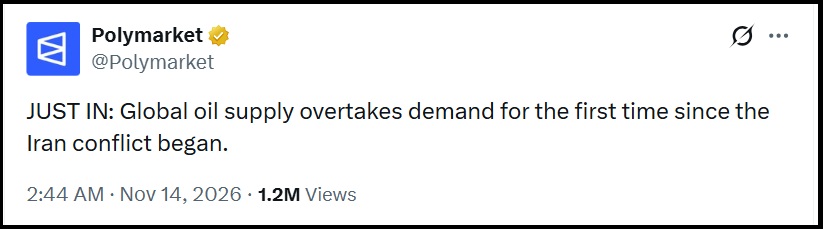
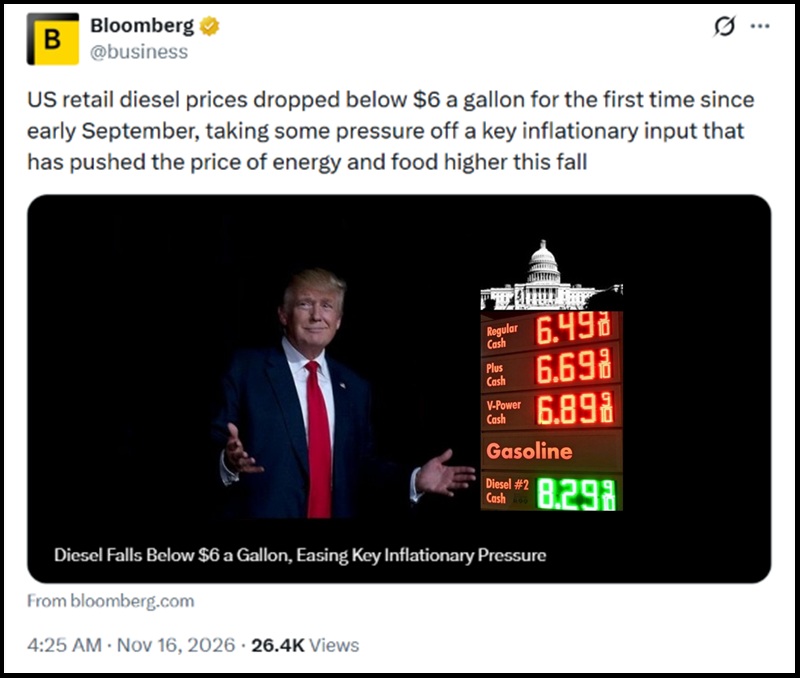
Well, there’s two ways to look at this. Following the U.S. midterm election, either London/EU energy exchange speculators and traders suddenly found eleventy million barrels of oil, or President Vladimir Putin was correct {GO DEEP}.
There’s no need to maintain pretenses here, although the ramifications to dropping those pretenses are far more consequential than any American wants to admit. You see, in reality the commodity prices are not market prices, nor are they determined by any market supply/demand scenario.
All of it -soup to nuts- is entirely manipulated by western banks, financial houses, exchange speculators and traders.
As noted by Russian President Putin {GO DEEP}, allowing central banks, trade exchange speculators, traders, hedge funds, financial interests and inorganic market forces to set the prices of any item disconnects that item from the economic principle of supply and demand. The prices that people suffer for oil and gas are being driven by the mechanisms set up by western financial interests. This is manipulative and creates pain on the consumer and ultimately manipulates politics.
It’s a rigged game, but thanks to the sheer hubris of the manipulators, ordinary people are starting to notice.
As a background to this statement by Carney, the Canadian Industrial Minister Mélanie Joly, recently announced that the Canadian government would subsidize Honda to keep them in Canada by paying $313 million for retooling the Alliston plant that makes the Honda CRV model.
The net result is Honda will spend $165 million; Canada will spend $313 million. There are roughly 4,000 auto-sector jobs associated. So, Canada is paying two-thirds of the cost for Honda to stay operating in Alliston. Honda will be producing a new hybrid CRV there.
Against the backdrop of this decision by the Carney government, a transparently visible bribe just to keep Honda from leaving the area, and against the backdrop of the U.S trade position that cars for the American market should be made in America, Prime Minister Mark Carney is questioned about the trade discussions.
Within his response Carney notes the auto-sector is a RED LINE for Canada, and the Canadian government demands access to the American market for cars made in Canada. WATCH:
The core of the issue is really simple. Canada has chosen to chase climate change energy policy. As a consequence, Canada no longer has heavy industrial manufacturing at scale. In the auto sector the heavy industrial part of making forged iron, steel and aluminum is not done in Canada. Instead, they import the component parts from heavy industrial manufacturing, then assemble those products into vehicles “made in Canada.”
This is a core part of the Canadian auto industry. Without the import, their ‘climate friendly’ economy doesn’t have the manufacturing capacity to create automobiles. The second aspect is they don’t have enough customers; Canada is dependent on the U.S. consumer base to purchase cars, trucks and SUV’s made in Canada.
A petition to reinstate Jensen Huang as the leader of NVIDIA now has over 100,000 signatures, including some big names of support like Elon Musk. As the situation unfolds, here’s what it looks like.
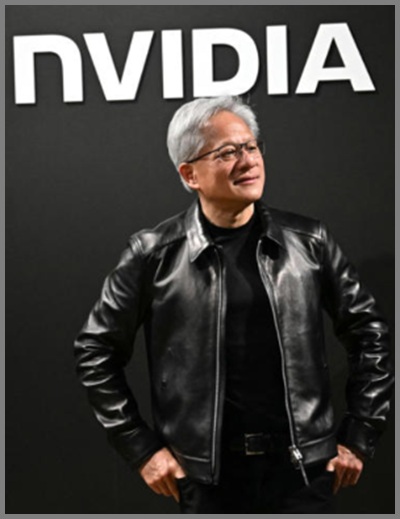 First, Jensen Huang is an exceptional pioneer leading the U.S. tech sector in the advancement of ever-faster compute power. Huang believes in free markets and global competition within the data processing field, and he believes in open source AI models that are transparent in their ability.
Huang led by building the fastest computational data processing microchips in the world, and his NVIDIA team continues to lead the world in the sector. His products drive some of the most critical computational infrastructure in the world; he is an excellent salesman for his products and well respected.
The issues with Alice Huang and Megaspeed in Singapore don’t look as much like a “spy” operation as they do old fashioned industrial espionage, where Singapore based Megaspeed was set up to purchase large amounts of microchips from NVIDIA and back channel the product to China, a country regulated and blocked from purchasing them.
Alice Huang formed a romantic relationship with Jensen Huang and leveraged that relationship to make the purchases.
Jensen Huang was publicly very pragmatic about his products and didn’t view Chinese competition as a threat to his business model because he believed he could always out-compete them technologically. It appears Jensen looked at China as likely to find a way to get the chips regardless of the regulatory limits the U.S. placed on Beijing. As a consequence, he likely didn’t view his relationship with Alice as any real risk because he viewed his company as being able to outproduce a better product even if China had access.
Because Huang had a founder’s perspective on his industry, he felt his position and company was strong enough to take on any competition. However, the board of directors at NVIDIA has a professional management perspective, born from business school outlooks and CEO training.
Business Schools teach that executive managerial skills are learned and transferrable from one company to the next. However, a founder mentality doesn’t lead by managing his industry. Jensen pushed frontiers and created dynamic technological advancements; he didn’t manage them.
A founder versus a corporation manager is an entirely different mindset and skillset. Without Jensen Huang leading NVIDIA the emphasis shifts and people are now starting to realize the entrepreneurial loss within the distinction. People are starting to rally around Huang and demand the Board of Directors reverse their decision to replace him.
Dept of Transportation Secretary Sean Duffy and FAA Administrator Bryan Bedford held a press conference today following a national ground stoppage on Friday. Secretary Duffy explains how an update of FAA infrastructure from analog to digital created a fault that broke the FAA communication system. WATCH:
.
As long as the Iran conflict continues, energy speculators have the justification for higher oil, gas, fuel and energy prices. Even if global oil and gas flows return to their pre-conflict levels, so long as the conflict itself is in place the market traders, speculators and manipulators have a justification for higher prices. The center for this global financial matter is London.
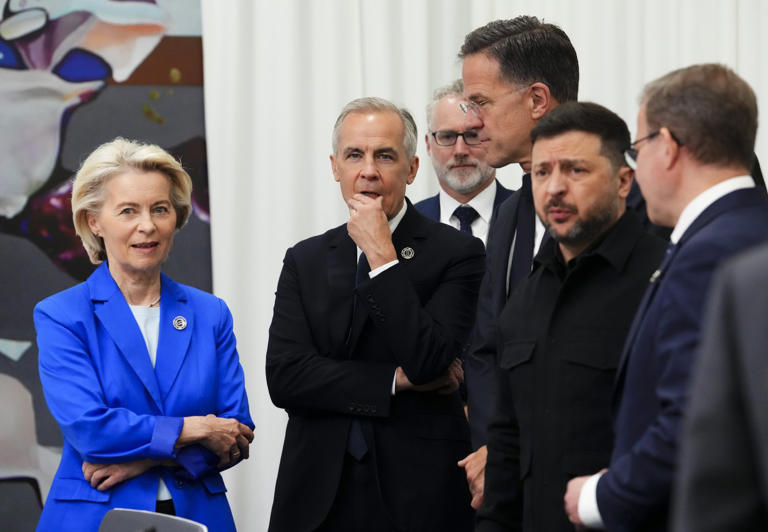
If you are an EU minded ‘climate change’ ideologue having constructed decades of fabricated net-zero objectives, the Iran conflict now serves your interests. The Iran conflict does not assist the interests of the people of Europe, but rather the interests of the political and powerful elite in finance control who benefit from higher prices of traditional energy.
The blame for higher EU energy costs now shifts from EU climate advocates to Trump.
Here’s where it takes a Machiavellian twist. One way to keep the Iran situation in place is to place ancillary pressure on the key to the solution, Russia.
So long as the EU keeps threatening Russia with expanded conflict, there is no motive for Russia to assist President Trump in the solution within Iran. Solving the crisis within Iran is against Putin’s security interests, as long as the EU threat holds some reasonable possibility, because Iran -a Russian ally- can strike Europe with their remaining ballistic missile inventory.
What we see is the creation of a Gordian Knot. You cannot resolve the Iran conflict so long as Russian security interests are threatened, and you cannot resolve the Russian security interests as long as the Ukraine-Russia conflict continues.
President Trump wants the Iran conflict resolved. Russia is the key; which is why President Trump has redirected diplomatic resources to resolve the Ukraine-Russia war. However, that war underpins the justification for expanded conflict espoused by Europe toward Russia. The EU take a hostile position toward Russia knowing a peaceful resolution is against their ‘climate change’ agenda. There are trillions of pre-positioned interests at stake.
Ukraine President Vladimir Zelensky (correct name) tells his western supporters that President Trump is too favorable toward the position of Russian Federation President Vladimir Putin. {SOURCE} This is not fully accurate, nor is it entirely false. The missing element is ‘why’.
Stephen A. Smith sits down inside the White House Roosevelt Room with President Donald Trump for a wide-ranging interview on the post-midterm landscape.
Topics include the GOP’s electoral losses, the ongoing conflict with Iran, rising gas and grocery prices, and the economic impact of sweeping tariffs. The conversation also dives deep into Trump’s record with Black voters, HBCU funding, criminal justice reform, border security under Chief of Staff Stephen Miller and Jensen Huang’s resignation from Nvidia.
Chapters:
0:00 Intro: Inside the White House Roosevelt Room
1:11 Analyzing the 2026 Midterm Election Losses
5:45 Ken Paxton, John Cornyn & GOP Primary Endorsements
8:47 The War with Iran, Nuclear Threats & Gas Prices
16:16 How Tariffs Are Bringing Back U.S. Manufacturing
I guarantee you two things. First, there are dozens of U.S. intelligence analysts feveriously watching this video of Russian Federation President Vladimir Putin engaged in discussion with U.S. envoys Steve Witkoff and Jared Kusher. Second, most of the analysts will get their interpretations wrong.
Beyond the unusual and remarkable transparency of Russia allowing the media to witness and record some very substantive points being made, the animated nature of Vladimir Putin [15:00 forward] is not customary for him. Putin is normally stoic in his body language and does not usually animate his words with his hands; in this discussion he does.
After the formalities and diplomatic niceties expressed by Putin, he gets right down to business asking both Witkoff and Kushner to summarize their perspectives on the recent Abu Dhabi talks. You can see Kushner caught off guard when asked to answer a question -specificicity- that would normally not be asked during public moments [14:45].
I can tell you from experience in studying Russian’s close up over a long timeframe, President Putin is frustrated at the remarks from the U.S. side because Russia doesn’t culturally engage in ‘blah, blah, blah.’ You see this when Putin talks about the “grey zones” that are stunningly antithetical to the mindset of any Russian.
In Russia there is Yes or No, there is not this western talk of ‘maybe.’
In Russia there are clear boundaries in almost everything. There is yours and mine, there is no ours. There is right and wrong, there is no “kinda.” When a Russian has something to say, they say it – and there is a point to it, a specific point.
Russians approach things with a ‘do’ or ‘do not’ perspective, it is just their culture.
President Putin, just like any other Russian, is not being curt or rude, he is being direct. Say or don’t say, but do not talk circles about maybe saying or maybe doing; it will piss off a Russian quickly. Do or do not, but don’t talk about doing for the sake of talking about doing. You either do, or don’t – that’s it.
The failure of Americans or western viewers to understand the Russian mindset leads to poor analysis of what Russia says and does. Russians seem rude to western eyes and ears, but they are not – they’re just very direct and they don’t engage in small talk about anything. Everything a Russian says has a point to it, or they just don’t say anything.
With that in mind, watch the video:
1. Vladimir Putin’s Opening Remarks [00:16]
Gratitude to the U.S. Administration: Putin welcomes Steven Witkoff and Jared Kushner and asks them to convey his gratitude to President Donald Trump for organizing contacts with the Ukrainian side.
Humanitarian Track & Prisoner Exchanges: He notes that positive results have been achieved on at least one track—the humanitarian exchange of detained persons between both sides—and mentions that another major step in this direction is upcoming.
When we traditionally think about Red states or Blue states we think about Red being republican, conservative or nationalist, and we think of Blue as being democrat, progressive or socialist. However, that is not the accurate prism, and it never was.
 What determines the political ideology of the state is the financial livelihood of the power centers, powerful people that control the political outcomes. The key words there are “financial livelihoods.” It is the money within the power center that determines the ideology.
The political ideology of Illinois, Minnesota and New York directly comes from how the power interests gain their affluence.
What is the driving element of the money within the state that funds the powerful people, and how is that money made? Those are the questions that determine the politics – Red or Blue it matters not. The critical question is where does the wealth of the powerful come from?
When an outside influence starts to challenge the wealth of the powerful, it is the retention of that finance that determines the political outlook. Let me give you examples.
For the powerful interests in California, New York, Illinois and recently -more specifically and visibly- Minnesota, you will notice the power brokers money is made from corruption of government finance. Take away the access of powerful interests to federal government money, eliminate corruption and you are hitting directly at the center of power.
Enforce lawfulness, target corruption and take away the ability to gain wealth from theft of government money and the powerful political interests who control political power lose wealth. The entire system is based on wealthy people engaged in fraud and corruption to remain wealthy. That dynamic applies to California, Illinois, New York and Minnesota.
However, the same dynamic, albeit under a different auspice, applies to Texas.
Texas industry, and more specifically the billionaires who live in Texas, control the industry and control the political power centers, rely on illegal aliens to achieve their wealth status. Start addressing the illegal immigration issue and you start threatening the wealth that underpins the powerful people who control political outcomes.
Because Texas billionaires rely on the industry of illegal aliens, enforcing immigration laws is against their interests. Deporting illegal aliens becomes a threat to the Texas wealth system in the same way that stopping fraud is a threat to the wealth system in NY, IL, CA and MN.
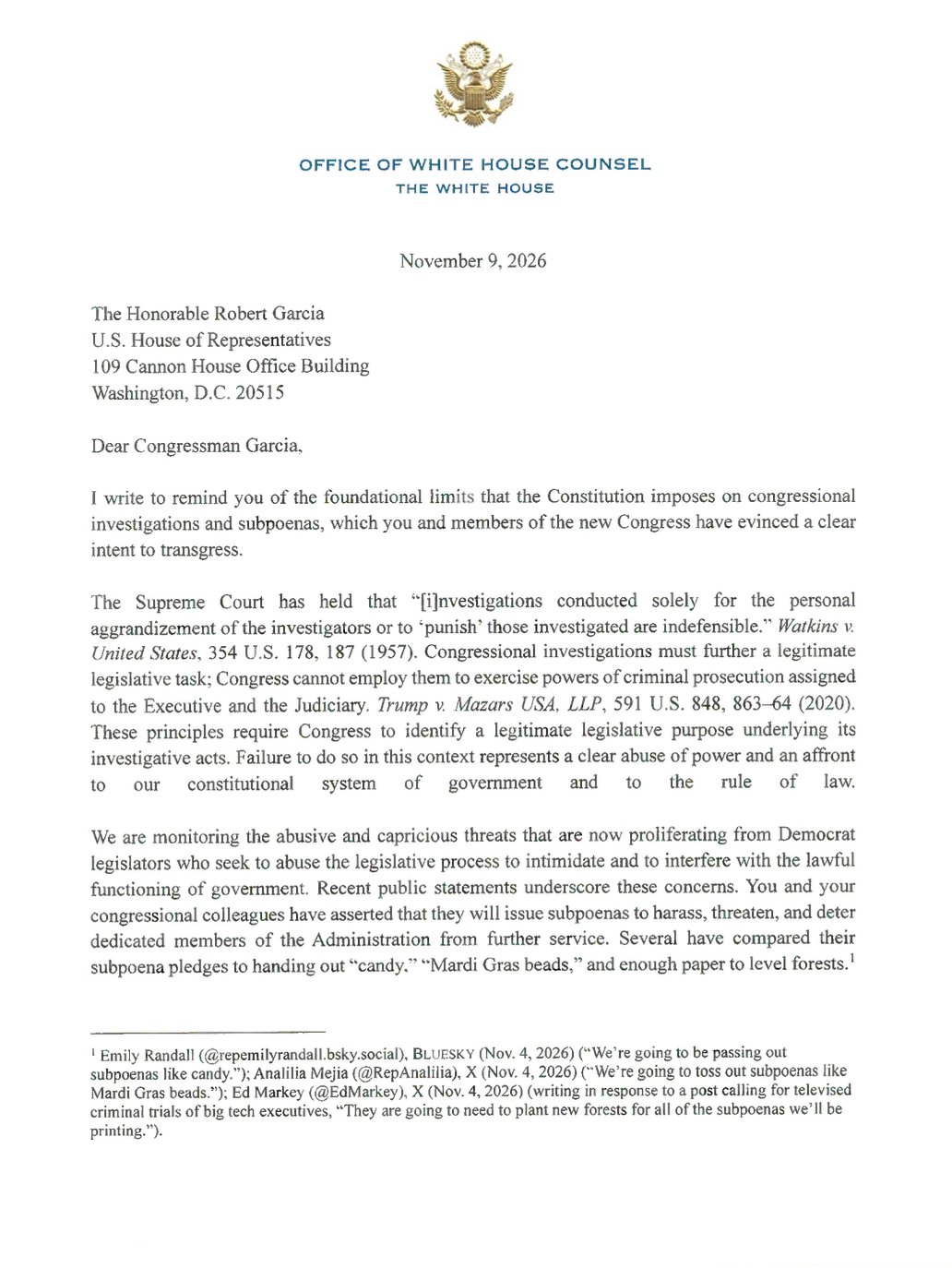
White House counsel Will Scharf, in a letter to incoming House Oversight Committee Chair Robert Garcia, says Democrats’ repeated public threats to use their new majority to investigate the president and his administration could cross constitutional limits — and amount to illegal threats.
[SOURCE]
At the heart of the White House’s complaint is a legal requirement that congressional subpoenas must be rooted in a clear “legislative purpose” and can’t be used simply to harass or intimidate.