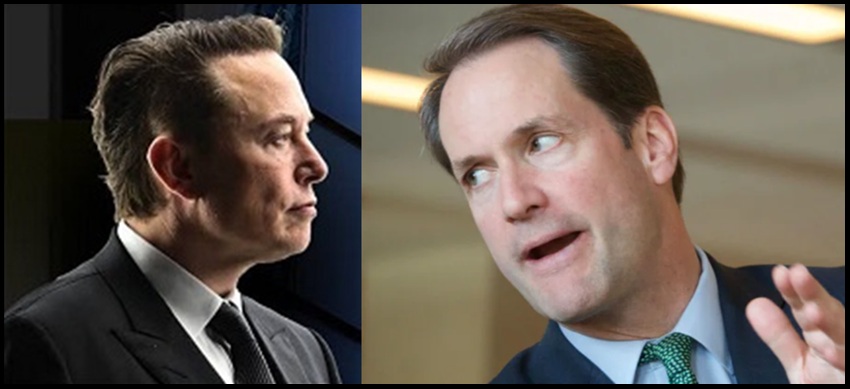
This one was easily predictable as we noted the day after the election. Democrats are going to target Elon Musk, SpaceX and Starlink over the Ukraine issue.
The incoming Chairman of the House Permanent Select Committee on Intelligence (HPSCI) Jim Himes, has sent a demand and threat letter to Director of National Intelligence Jay Clayton, demanding answers over how Ukraine has been impeded in their use of Starlink to conduct offensive military action against Russia.
(VIA CNN) – A top Congressional Democrat is warning that lawmakers will withhold government funding for systems developed by Elon Musk’s SpaceX if the Trump administration and tech billionaire refuse to disclose who is responsible for ordering the slowdown of Ukraine’s military-grade Starlink satellite service, CNN has learned.
In a classified communication sent to Director of National Intelligence Jay Clayton, Democratic Rep. Jim Himes — who will become chairman of the House Intelligence Committee in January — demanded clarity on what led to the slowdown of Ukraine’s Starshield connection speed on multiple occasions in recent months, according to an excerpt of the communication obtained by CNN.
“Simply, our committee cannot authorize funds for the development of government systems that the government will not fully control,” Himes wrote to Clayton. “I appreciate your assistance in obtaining transparency in this instance so we can have confidence going forward in authorizing funding for the development of systems using SpaceX as the primary vendor.”
There is a shift in the U.S-Canada trade negotiations that is now beginning to surface. In preparation for what comes next Canadian trade negotiator Dominic LeBlanc is informing Canadian media to prepare for tariff permanence.
This outline may be lengthy because there’s a lot to update. First, we need to remember what the difference is between Section 232 tariffs and Sec.338 tariffs.
♦ Section 232 tariffs are the national security tariffs on steel, aluminum, autos and lumber. Those sectors of the U.S. manufacturing base are considered critical industries vital to the national security interests of America. The steel and aluminum tariffs are based on the “melt and pour” rule. All steel and aluminum products not melted and poured in North America are subject to an import tariff. Canada doesn’t melt and pour much; instead, they import from China.
Section 232 tariffs are permitted within the USMCA trade agreement because they apply to national security interests. Additionally, Canada holds tariffs and quotas against U.S. steel, aluminum, lumber and cars. The United States finally put our foot down. The 232 tariffs were U.S. national security matters and issues of trade reciprocity.
The Sec.232 tariffs against Canadian steel, aluminum, autos and lumber are the issue that triggered tariff retaliation from Canada. Remember, the 232 tariffs are the ones that matter most. These are the tariffs that form the cornerstone of a renewed American manufacturing system.
♦ When Canada retaliated against the Sec.232 tariffs with a set of punitive tariffs against U.S. products intended to target political areas of the USA that support President Trump, the Trump administration responded with retaliation of our own. Those U.S. retaliatory tariffs are the Sec.338 tariffs.
The Sec.338 tariffs are U.S. tariffs in response to retaliatory trade actions taken by Canada, which included banning U.S. alcohol imports and similar retaliatory measures. This is critical to remember. The U.S. Sec.338 tariffs are not a priority to the USA; they were simply tariffs punching back at retaliatory Canadian trade action. At the core matter, the U.S. trade position really doesn’t care much about the Sec.338 tariffs, they represent hitting back at Canada against a sector of trade that represents 0.03% of total U.S. trade.
Summary: From a strategic USA position – Section 232 tariffs are important to MAGAnomics. Section 338 tariffs are simply not important; they are basically political gloves slapping political faces.
Representing the British Commonwealth perspective, Canadian Prime Minister Mark Carney is interviewed about the current status of U.S-Canada relations and expresses the U.K, EU concern about ‘middle powers’ no longer having control over the rules-based global order; where the rules were formerly determined by the commonwealth approach.
The interview itself is an interesting glimpse into the mindset of Carney, the current British government and the Europeans who have framed their global influence around rules that President Trump is no longer adhering to. I have prompted the segment to the 9:00 minute mark where you will hear Carney express his concern as the lead-in to his statements about the middle-powers’ reliance on Starlink.
Carney states the experience with Ukraine and Starlink frames his perspective; however, he falsely says Ukraine has been using Starshield and the interruption therein leads his decision-making. Carney is not a stupid man; he knows the truth of how NATO has never permitted Ukraine to use Starshield due to the ramifications surrounding conflict with Russia. Carney conflates the issue, furthering the lies told by Ukraine President Volodymyr Zelenskyy. WATCH:
There is also an important background story that is not yet in the public common knowledge. The current Canadian system known as Telesat “Lightspeed” is in serious financial trouble and on the cusp of a looming debt default. This is a problem for Carney because the Canadian pension fund is heavily invested in Telesat. {GO DEEP}
$1.71 billion in debt service is due on December 6th, and Canadian Telesat only has $200 million in reserve. The Canadian government is going to have to bail out Telesat or the investment by the Canadian pension fund will suffer. In essence, Carney is facing the need to nationalize their Canadian satellite industry or help them achieve financing relief from some other investment mechanism [Think CHINA?].
Palmer Luckey is best known for founding Oculus VR and designing the Oculus Rift, which helped revive consumer virtual reality. He sold Oculus to Facebook in 2014 for $2 billion before getting fired from META amid a political controversy related to his support for President Trump. In 2017, he founded Anduril Industries, a defense technology firm creating AI-powered systems, autonomous drones, and surveillance solutions for the U.S. and allies.
Luckey is a tech billionaire with a very pragmatic, patriotic and honest perspective about all things in relation to the tech sector, politics and overall philosophical outlooks. He maintains a perspective on AI that is very similar to my own in that he sees the future of AI being very bespoke in the U.S, managed by individual states, and not in alignment with a large, singular omnipotent computational outcome.
In this prompted segment of his recent interview, Palmer Luckey answers a question about NVIDIA and Jensen Huang that many readers will relate to. The entire discussion is pretty cool if you have time, but the segment on Jensen is prompted.
Within the AI sector there are basically two approaches. One looks at AI as something that seriously needs big government regulation and is a view supported by Democrats, DSA and tech leaders who desire legal protection (Anthropic). The other looks at AI as something of a global competitive advantage for the U.S. and doesn’t want to limit growth, allowing states to determine compute freedom, and making the frontier labs legally responsible for managing their own outcomes with legal liability if they do something wrong (Musk, Trump, Jensen). Luckey leans toward the latter.
Politically, AI is a sector about control. Allow the UniParty to influence or regulate it and Big Govt will decide. Or, allow more freedom in AI and let the ideology of the states decide the outcome. It’s an issue surrounding how AI is managed, currently in the headlines around the ancillary issue of microchips and compute power (data processing).
President Trump announced during his return from China that he would hold a press briefing today at 12:00pm at the White House. The media is predictably positioned to be very combative toward the opportunity, and openly on their social media accounts many are proclaiming their intent to engage in hostile questioning.
The anticipated start time is 12:00pm, with Livestream Links below.
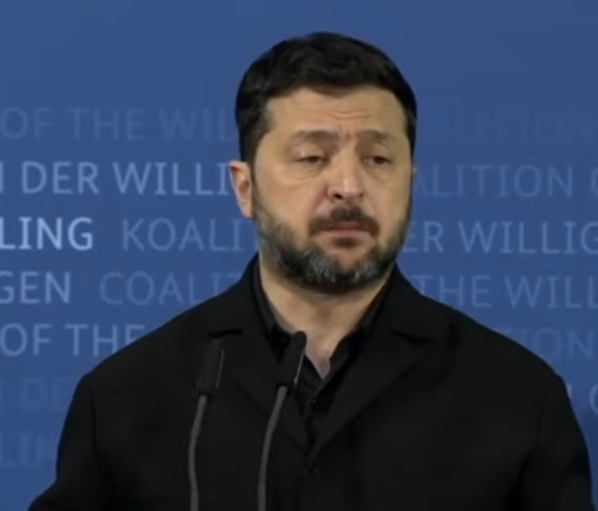
The press conference at the end of the EU “coalition of the willing” assembly today was a public display of hubris, elitism and arrogance. The presser was held by the U.K, Ukraine, Germany, France and Kushner/Witkoff. The U.S. guys were forced to participate from the end of the stage. It was a hot mess. Chancellor Friedrich Merz was in charge of the venue.
Zelenskyy then takes to the X Platform to pontificate and announce that seven more interests have been added to the dynamic, just so Zelenskyy can make it more complicated:
“Our American partners, Steve Witkoff and Jared Kushner took part in today’s Coalition of the Willing meeting. There is a decision that Europeans will participate in the negotiation formats with the Russians. This is important.
Europe will be represented by five countries plus the European Union and NATO, and America fully understands why strong and coordinated European participation in the negotiations is necessary.
Later today, we will speak separately with the American envoys about when the next meeting will take place and what its agenda will be. It must now be a four-party meeting – Ukraine, Europe, America, and Russia. We are really counting on this. The agenda for the meeting must be jointly developed and approved by all of us – Ukraine, Europe, and America.” (read more)
Palmer Luckey was not wrong when he said, “Nobody in the west actually want’s Ukraine to win; they just want them to not lose for as long as possible.” That group includes Zelenskyy.
Germany needs the war because they have lost their auto industry and need to keep their factories busy.
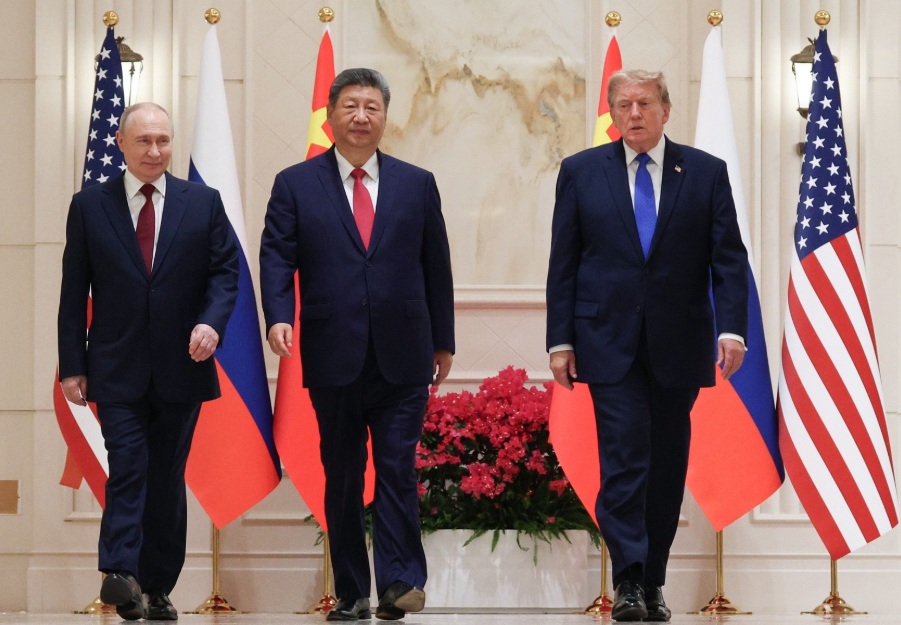
Following discussions between U.S. President Donald Trump, Russian Federation President Vladimir Putin and Chinese Chairman Xi Jinping, the following joint statement was released:
Donald J. Trump, President of the United States of America, Vladimir Putin, President of the Russian Federation, and Xi Jinping, State Chairman of the People’s Republic of China, met in Shenzhen on November 19, 2026. The U.S. and Russian heads of state expressed appreciation to China for hosting this historic trilateral Summit. The three heads of state had an in-depth exchange of views on the current international situation and committed to maintaining strategic stability and international security.
1. As permanent members of the United Nations Security Council, the United States, Russia, and China committed to reform the UN so that the UN can respond more effectively to global challenges and conform to its fundamental mission of international peace and security.
2. The three countries plan to increase the production and supply of refined petroleum products for the benefit of all nations. They reaffirmed the importance of stable energy flows.
President Trump, Chairman Xi Jinping and President Vladimir Putin held a historic meeting today on the sidelines of the APEC summit. This is the first time the leaders of China, Russia and the United States have sat down together for formal discussions of world events. The USA, China and Russia are the major nuclear weapon powers.
This is the meeting the international community has been discussing at length, and this is the meeting that has all the ‘middle power’ European leaders in a state of concern. Additionally, this is a meeting of the major world producers of goods, manufacturing materials and products that drive global commerce. These are, quite simply, the ‘hard powers.’
As noted by President Trump in these public remarks, there were background discussions that already took place before the three leaders came to the cameras. Additionally, following these public remarks the three leaders held another round of private discussion. There are multiple videos of the events surfacing; however, the video below gives the best encapsulation of the public moments along with audio translation in real time. WATCH:
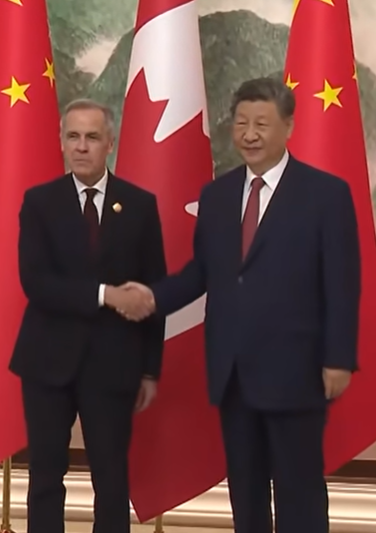
During a press conference for his domestic audience and traveling press pool, Canadian Prime Minister Mark Carney outlined his specific points of focus for an enhanced and collaborative Canada-China relationship. {FACT SHEET HERE}
China’s growing influence, what some may call forming a beachhead in Canada, has been a concern to many Americans. However, as noted in the response to the general question about President Trump’s statements toward Carney, the Canadian PM noted that as a general matter President Trump is not concerned about Canada-China trade and the subsequent influence therein.
From a U.S. perspective Trump’s pragmatic outlook makes a lot of sense. First, at the moment you start to worry about the influence of China in Canada, it’s too late. China operates a long-game approach, and factually China already has the most effective influence operation inside Canadian politics. Quite simply, that horse is out of the proverbial barn and will never get put back; the only option for the U.S. now is to mitigate how the China influence bleeds into the U.S.
Secondly, Canada is sending fish, beans, seed oil and non-rare minerals to China, that part is irrelevant. The imports from China into Canada are where the U.S. interests exist. Due to pre-existing leverage and financial ties inside Canada, Carney is open to Chinese steel, aluminum and autos. However, Chinese autos will never come into the USA and will, predictably, destroy the Canadian auto industry. Canada’s continued import of Chinese steel and aluminum is a core issue behind the U.S. tariffs. Carney has just made those “non-melt and pour” tariffs permanent.
Operating on behalf of the British Commonwealth, Mark Carney is trying to leverage China as a threat; but again, the Chinese industrial infection will not come south. Carney doesn’t have leverage on this issue and President Trump is seemingly just flipping him off. WATCH (prompted):
Canada is simply not in alignment with the interests of North America. Canada carries a European outlook in the approach toward China. Slowly, China is dominating Canada economically, as they are Europe, and trying -from the outside- to save a dying economy whose political interests exist as an outcome of their need to pretend they are not being dominated is a futile effort.
Carney has lots of prose but very little substance. He is selling off Canadian assets to prop up his own existence. Chairman Xi is a willing buyer, and President Trump understands the negotiations toward Canada are best directed at the new ownership of Canada, not the transitional tenants.
Lastly, what Carney says in response to that question is a little funny and entirely lost on the Canadian people who likely listen to it. Remember, the #1 complaint Carney had (falsely) was that the U.S. was interfering in Canadian “sovereignty.” That’s the entire “elbow’s up” movement. Yet what Carney outlines is an ambivalent U.S. President who, quite frankly, doesn’t give a darn about what Canada does. Think about it.
During the arrival ceremony and group picture at the APEC summit, President Trump was the final dignitary to present with Chairman Xi during the arrival. Following that moment, the group assembly begins, and it was interesting the first person to enter for the lineup was Russian Federation President Vladimir Putin.
This is the first moment the three leaders have assembled in the 2026 APEC summit. There is significant buzz about it.
You can tell Chairman Xi is very focused on President Trump almost to the exclusion of all other participants in this 2-minutes of video. In addition to formal diplomatic protocols Trump and Xi have spent considerable private time together during each of their last exchanged state visits. You can see the personal relationship dynamic as Xi is careful to guide President Trump throughout. Very interesting. WATCH: