President Trump special envoy, Steve Witkoff, outlines elements of the talks between President Trump and President Vladimir Putin in advance of a meeting tomorrow with Ukraine President Volodymyr Zelenskyy and EU leaders.
.
President Trump special envoy, Steve Witkoff, outlines elements of the talks between President Trump and President Vladimir Putin in advance of a meeting tomorrow with Ukraine President Volodymyr Zelenskyy and EU leaders.
.
EU President Ursula von der Leyen appears with Ukrainian President Volodymyr Zelenskyy to outline terms for a peace negotiation with Russia. Ursula gives Zelenskyy the specific rules and conditions; a new suit jacket wearing Zelenskyy fills in the color. WATCH:
.
Ursula von der Leyen will be accompanying Zelenskyy to the White House to ensure no mistakes are made.
Find someone who looks at you the way Zelenskyy looks at von der Leyen.
Apparently, the EU is worried that Zelenskyy could screw things up for their Ukraine interests, so handlers or minders are being dispatched along with him just in case. Finnish President Alexander Stubb and NATO General Secretary Mark Rutte are among the names being discussed as chaperones for the Ukraine President.
Additionally, French President Emmanuel Macron and U.K. Prime Minister Keir Starmer are planning a teleconference Sunday as the “coalition of the willing” brainstorms the best way to avoid a Zelenskyy capitulation to the terms and conditions outlined by President Vladimir Putin.
With BlackRock and J.P.Morgan prepositioned to control the Ukraine Recovery and Reinvestment Bank {LINK}, the coalition of the willing want U.S. troops to backstop the terms of a potential peace agreement. The banks and financial beneficiaries need the insurance provided by the U.S military.
Ultimately, banking interests are the stakeholders in the future, and the U.K, France and German political officials represent the strategists in place to protect the interests of the banks. Not coincidentally, this is classic -albeit inverted- fascism.
For months, the so-called “coalition of the willing” led by Great Britain, France and Germany, have been proposing a multinational group of peacekeepers on the ground in Ukraine – supported by U.S. military. However, after President Trump asserted he would not support a U.S. troop presence in Ukraine, things got sticky.
Without the U.S. military, the NATO members were not willing to put their troops into the meat grinder buffer zone between Russian and Ukrainian forces. The U.K, France and Germany continually demanded U.S. troops as protection, just in case things escalated. This insurance approach was expanded by Ukrainian President Zelenskyy who coined the term, “security guarantee” to encapsulate the EU demand.
However, President Trump cuts the Gordian knot in the “ceasefire plan,” by eliminating the “ceasefire plan.”
Instead, President Trump goes directly to a peace agreement, and somehow the EU members agreed to it. There will be no negotiation for a ceasefire; instead there will be immediate negotiations for a long-term peace agreement.
PRESIDENT TRUMP – “A great and very successful day in Alaska! The meeting with President Vladimir Putin of Russia went very well, as did a late-night phone call with President Zelenskyy of Ukraine, and various European Leaders, including the highly respected Secretary General of NATO. It was determined by all that the best way to end the horrific war between Russia and Ukraine is to go directly to a Peace Agreement, which would end the war, and not a mere Ceasefire Agreement, which often times do not hold up. President Zelenskyy will be coming to D.C., the Oval Office, on Monday afternoon. If all works out, we will then schedule a meeting with President Putin. Potentially, millions of people’s lives will be saved. Thank you for your attention to this matter!” (link)
President Trump does not publicly point out that the shift in plan negates the need for a ceasefire security force, but the reality is inside the unspoken change. A very smart and strategic approach that appears to have flown under the radar.
Treasury Secretary Scott Bessent appears with Maria Bartiromo to discuss the upcoming summit between Russian President Vladimir Putin and U.S. President Donald Trump.
Bessent notes the backseat demands from EU leaders with their position on the Trump negotiation strategy has worn thin amid their hypocrisy. “It’s time to put up or shut up,” Bessent says, when talking about how the EU is still facilitating the economic purchases of Russian energy products, while simultaneously demanding Trump do this and that. WATCH:
I am cautiously optimistic for a positive outcome from this summit.
DETAILS ON THE SUMMIT BELOW
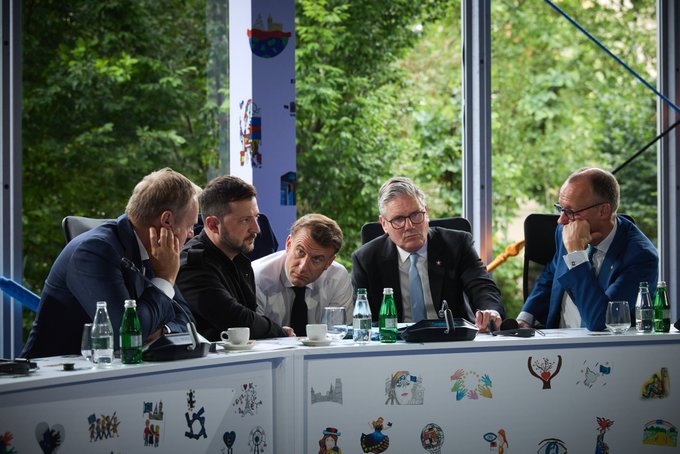
Today the leaders from Germany, France, Britain, Italy, Poland, Finland, the E.U. and NATO will be holding a conference call with President Trump and Vice President Vance to give instructions in advance of the Trump-Putin summit.
None of the European leaders were invited to the Alaska summit, yet all of the European leaders want to tell President Trump what to do at the summit with President Vladimir Putin. Because, of course they do…
EUROPE – […] The Europeans recognize that they can only do so much to influence a president who often veers off-script and likes nothing more than to declare a deal.
But on Ukraine recently they have met with some success, for example, by persuading Trump to allow them to transfer U.S. weapons to Ukraine and purchase replacements for themselves.
And in recent days, especially after a meeting with Vice President JD Vance in Britain over the weekend, they have found the U.S. administration receptive to some of their red lines.
I think many of us really like Hungarian Prime Minister Viktor Orban. He’s not generally a man who pretends things amid the EU coalition. Orban says things clearly, just like Trump.
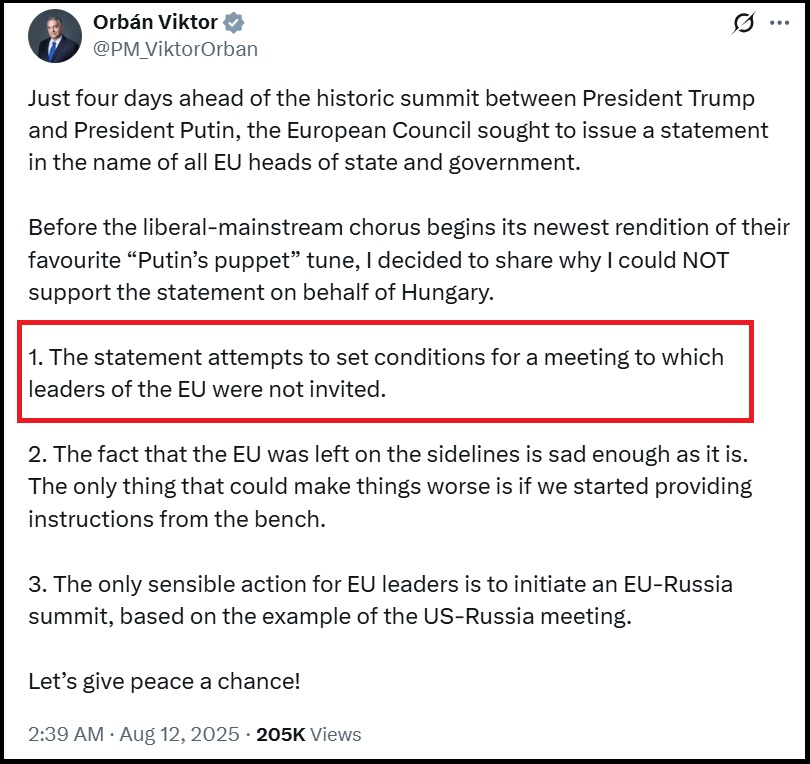
When Orban notes he will not sign a joint EU statement on the Trump/Putin summit because it “sets conditions for a meeting to which leaders of the EU were not invited,” he certainly hits the proverbial nail.
The hubris amid the EU collective is quite remarkable.
The intellectually honest political watcher knows that overall Ukraine represents the largest international money laundering operation to shift wealth from taxpayers to the politically connected institutions, since COVID-19. The money is the motive to continue the conflict.
With President Donald Trump and Vladimir Putin scheduled to meet in Alaska for a summit to negotiate a ceasefire, German Chancellor Friedrich Merz quickly organizes a meeting between EU leaders and the U.K to figure out how the keep the war going.
As the industrial capital of the EU, Germany has a lot at stake given the nature of their contracting economy. The EU military industrial complex is centered around the nation Merz represents. There are trillions at stake.
BERLIN — U.S. President Donald Trump will join European leaders including Ukrainian President Volodymyr Zelenskyy for an emergency virtual summit on Wednesday.
The call, organized by German Chancellor Friedrich Merz, comes ahead of Friday’s summit in Alaska between Trump and Russian President Vladimir Putin on the war in Ukraine.
The financial pundits are putting their customary spin on it, but overall as the reciprocal tariffs begin, things are going well.
China’s trade surplus with the US declined to USD 23.74 billion in July, down from USD 26.57 billion in June, as both exports and imports with the US declined, falling 21.7% and 18.9%, respectively. {LINK}
For Germany, exports to the U.S. slid 2.1% to 11.8 billion euros, the third consecutive monthly decrease and the lowest value since February 2022, Destatis said. They were 8.4% lower than the same month last year. {LINK} However, since imports from the U.S. increased at the same time, this narrowed Germany’s trade surplus in goods with the U.S.
Swiss President Karin Keller-Sutter left Washington empty-handed on Wednesday after a hastily arranged trip to avert a crippling 39% tariff on the country’s exports to the United States, its biggest market, three sources familiar with the matter said. {LINK}
Reciprocal tariffs begin today. “Before Thursday, virtually every country’s goods were subject to a minimum 10% tariff. Now rates vary substantially from country to country.”
The highest rates imposed are on goods from Brazil (50%), Laos (40%), Myanmar (40%), Switzerland (39%), Iraq (35%) and Serbia (35%).
Commerce Secretary Howard Lutnick describes some of the details within the new U.S-European trade agreement.
As noted, the $600 billion in regular trade products exported by the EU to the USA market will be subject to a 15% reciprocal tariff. This approach effectively ends the Marshall Plan, sets the trade terms to balance and should generate approximately $90 billion in revenue to the U.S. treasury.
U.S. tariffs on cars and auto parts are being reduced to the baseline 15 percent — a level that matches the deal notched earlier this month by Japanese automakers. In exchange, the EU has agreed to lower its car tariffs from 10 percent to zero, trade spokesperson Olof Gill said. The German companies are angry though, because the 25% tariff still applies to Mexico. So, German autos manufactured in Mexico (massive prior investment) will come to the USA with a 25% tariff.
In addition to the EU agreement to open their markets to U.S. products, private companies within the EU have committed to $600 billion in direct investment within the USA. Additionally, the EU will purchase $750 billion in U.S. energy products and with the NATO commitments previously agreed significant military purchases are anticipated. That is a major purchase agreement of $250 billion each year for the next three years.
.