Quantcast

Sunday Talks, Finland President Sauli Niinistö Indicates a Global Cleaving Behind Decision to Join NATO

BASELINE – Boil all international and geopolitical issues down to their common denominator and everything, E.V.E.R.Y.T.H.I.N.G., every issue, every discussion, every policy, every position, everything -all of it- circles around economics. Everything is secondary to the underlying economics of every single issue. Power or weakness, famine or war, peace or conflict, master or servant, culture or crisis, growth or collapse, the entirety of everything -including the foundation of freedom- centers around the economics.  There are trillions at stake.

In this interview Finland’s President Sauli Niinistö made some very interesting remarks when asked about his decision to reverse the long-established geopolitical position of Finland and join the “western alliance,” vis-a-vis NATO.

Listen carefully [01:44] when President Niinistö explains why.  Niinistö explains he did not, and does not, consider Russia a threat; however, “what we see now, Europe, the world, is more divided. There’s not very much room for ‘non-aligned,’ in-between. So that was also what we are thinking.”  WATCH:

In March of this year CTH noted, “this intentional global cleaving, using the opportunity created by the Ukraine crisis, is going to be the major story of this year.  This global splitting can be looked at in multiple ways, but the overarching story is the ramifications of two global trade relationships.”

Two world groupings.  One group, oil-based energy (traditional, grey on map below), and one group GREEN energy (the build back better plan, yellow on map).  It is not accidental these two groups hold similar internal geopolitical views and perspectives, hence, their alignment or lack thereof with the sanctions against Russia.

(more…)

India Reverses Prior Position and Will Now Block Further Wheat Exports, Triggering G7 Concerns

In April India said it was hoping to expand its wheat exports from 7 million tons to 10 million.  However, as precarious winter wheat harvests reflect lower outputs, they are reversing position and will now block any wheat exports in order to ensure their own supply.

INDIA – […] The announcement drew sharp criticism from the Group of Seven industrialized nations’ agriculture ministers meeting in Germany, who said that such measures “would worsen the crisis” of rising commodity prices.

“If everyone starts to impose export restrictions or to close markets, that would worsen the crisis,” German Agriculture Minister Cem Ozdemir said at a press conference in Stuttgart.

Global wheat prices have soared on supply fears following Russia’s February invasion of Ukraine, which previously accounted for 12% of global exports.

(more…)

Diesel Fuel Shortage Sets Stage for Next Biden Created Crisis

It has often been said that if you chase the global climate change ideology to its natural conclusion, we end up in communal groups sitting around a tepid campfire eating some form of sustainable algae cakes and picking parasites off each other…  Prior to Joe Biden that prediction might have seemed like hyperbole. Now, not so much.

Indeed, the Green New Deal energy policy of Joe Biden creates massive downstream consequences.  Unfortunately, the White House doesn’t seem to care. The high prices and scarcity of critical goods are a feature, not a flaw, as they chase their climate friendly Build Back Better agenda.

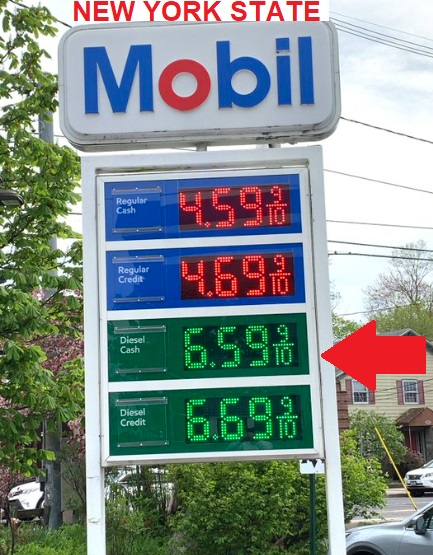
Following the continuum of intended consequence, now we have diesel fuel shortages beginning to hit the U.S. economy; and with scarcity comes higher prices of an almost astronomical scale. “The national average price of diesel is now $5.54 per gallon, which is an increase of 22 cents from last week, which was when the most recent record was set. Data shows there’s no state that’s currently seeing diesel prices below $5.12 per gallon.” (LINK)

Making matters even worse is a drop in available inventory of diesel fuel which is about to become a crisis for the east coast of the U.S.  Some Truck Stop operators like Love’s and Pilot are already warning their big rig customers they may not have fuel for truckers.

[…] “Love’s is monitoring the fluid situation on the East Coast, we have experienced minimal outages during low traffic hours,” Oklahoma-based Love’s Travel Stops said in an emailed statement. “The company has no plans to restrict purchases of diesel.”

[…] Earlier on Wednesday, the U.S. government’s Energy Information Administration said total inventories of distillates, which is mainly diesel fuel but also heating oil, fell last week to a 17-year low of 104 million barrels, which is 23% below normal.

(more…)

Fertilizer Prices Continue Rising, Increasing Fears of Global Grain Costs and Shortages

As CTH has noted since last October the rapid increases in fertilizer costs could potentially create a major issue for global food supplies later this summer.  As the farming costs continue escalating, including fertilizer and diesel fuel prices, this will eventually lead to major price increases on the harvests.   Field to fork inflation is looking increasingly severe later this year; what we have called the third wave of inflation.

Beyond prices, a primary impact in the U.S. market, concerns are now escalating about grain shortages {SEE HERE} and lower European crop yields which will lead to less food products on a global basis.   According to information shared by ZeroHedge, “We think it will take at least 2-3 years to replenish global grains stocks,” Illinois-based CF Industries Holdings Inc.’s president and chief executive officer Tony Will said in a statement in Wednesday’s earnings report.”

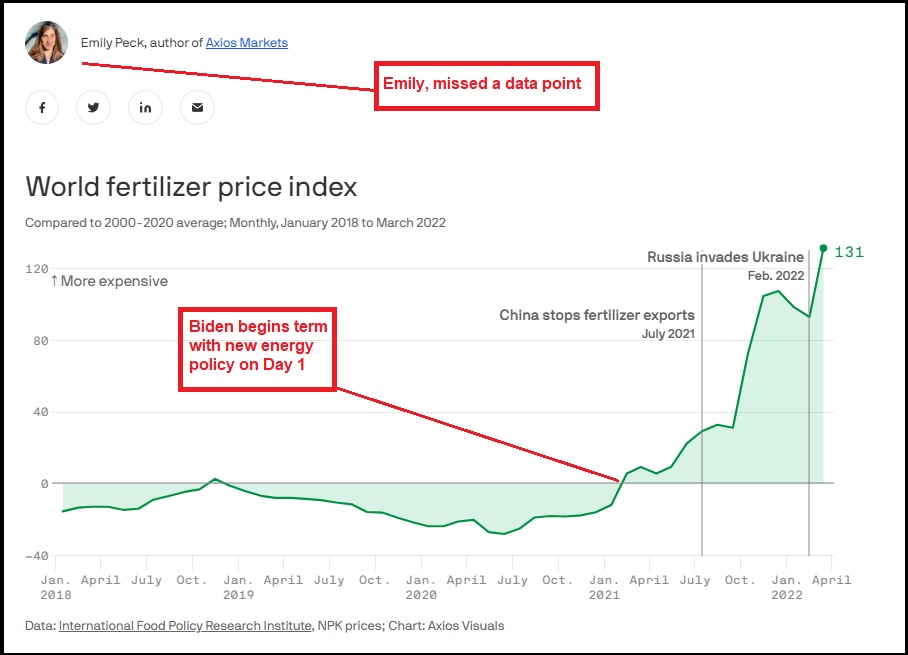
Axios is reporting on the continued escalation of fertilizer prices; however, they conveniently and purposefully avoid noting the origin of the problem in North America is directly the result of Joe Biden’s immediate energy policies that drove up the costs of natural gas (a critical component):

AXIOS – “Skyrocketing fertilizer costs — like those made from nitrogen, phosphorus and potassium (NPK) — are driving up food prices and, worse, threatening food security around the globe.

State of play: Prices for NPK were up 125% in January from a year before, and rose another 17% from the beginning of the year to March, according to data compiled by the International Food Policy Research Institute (IFPRI).

(more…)

Sunday Talks, Samantha Power Notes Scarce Food Presents Opportunity to Enhance Larger Goals of Climate Change and Other Weird Stuff

If you are not familiar with Cass Sunstein’s wife, Samantha Power, I would suggest spending some time on any search feature of the internet.  Power is the archetype ideological traveler within the academic peer group of the Obama team.  Former U.N. Ambassador Power is the person who takes the ideological theory [example Responsibility to Protect (R2P)], and then constructs the mechanisms and network to turn theory into applicable policy.

Samantha put down the filtered Brazilian rainwater coffee this morning and gave a few interviews, that are rather telling of what is going on in the background of the Biden administration.  Discussing Ukraine {Direct Rumble Link} Power let it slip that the absence of industrial fertilizer is a good thing because in the spirit of “never letting a crisis go to waste,” the transition of food growing to more “sustainable farming” through organic fertilizer is a key transition for the bigger picture issue of Climate Change.  WATCH:

Samantha is the prototype backpack, academic, Birkenstock traveler who all model U.N. types view as the person to emulate.  She’s a sustainable algae  cake eater, who bridges the space between the Kennedy Center ballroom crowd and the cross-legged, sitting on the grass, NYU commons activists.

A very dangerous mind, with no practical skills beyond very dangerous ideological theory.

(more…)

REPORT, U.S. Gas Exports are Triple U.S. Gas Production, Low Gas Reserves Now Sends Prices Soaring

Another item in the long list of ‘thanks Joe Biden‘ stuff.  Shortages in natural gas in windmill chasing Europe have driven up the prices significantly.  The conflict between NATO and their targeted villain in Russia is only making matters worse.

As the EU prices jump to $33/$34 per million British thermal units (BTU’s), the U.S. natural gas selling at $6 per million BTU’s is an absolute bargain.
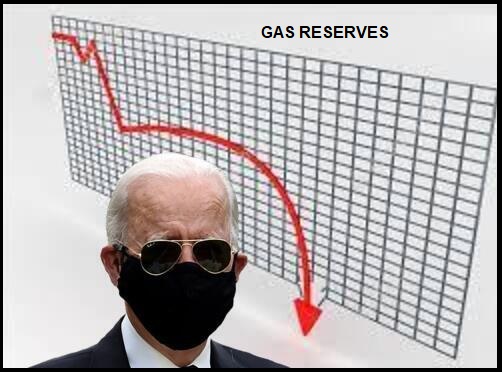
Liquify that stuff and send it across the pond says any smart energy capitalist.

However, that comes with a problem for us.  Our supplies of natural gas are depleting quickly, our exports are now almost three times more than our production.

LONDON, April 8 (Reuters) – U.S. gas prices have climbed to their highest level in more than a decade as strong demand from overseas has emptied storage and left inventories well below average for the time of year despite a mild winter.

Front-month futures for gas delivered at Henry Hub in Louisiana have risen to $6.40 per million British thermal units, the highest in real terms since 2010. Wholesale prices in the United States are still far below those prevailing in Northeast Asia ($33 per million British thermal units) and Northwest Europe ($34).

[…] U.S. LNG exports rose 13% in the three months from November to January compared with the same period a year earlier, while gas production was up by less than 5%.

(more…)

Increase in Industrial Accidents at Food Processing Plants Has Raised Suspicions

Several people have written to inquire about recent stories surrounding a wave of industrial accidents at food processing plants all over the U.S.  {Zero Hedge Article} {Twitter Questions, Suspicions} {List from Western Standard}

Indeed, there has been a significant increase in fires and explosions from furnaces, industrial fryers, boilers and some other rather odd incidents with aircraft hitting food processing.  The frequency even gathered attention from Fox News host Tucker Carlson.  WATCH:

Addressing the lesser frequent impact incidents from airplanes etc.  Keep in mind that major industrial food processing facilities are generally located around major transportation hubs – large arteries for commercial trucking and railway lines for inbound good deliveries.  These are the same zoned commercial regions where you find small regional airports.

So, let’s put those airplane ‘accidents” aside for a moment and look at the bigger picture.

(more…)

Fannie Mae More Than Triples Negative Forecast for Housing Sales

Lots of people talk about an inflation driven recession.  Essentially, that’s a total economic contraction in the value of goods and services produced, sold and purchased, due to rising prices.   However, as CTH has been pointing out for more than six months, if you subtract the federal COVID infusion money from the overall economy, we have been in a contracting demand economy for almost nine months.

A negative GDP outcome is quite possible, perhaps likely, when the first quarter GDP figures are released on the last Friday of this month.  The most recent sales and economic data shows that U.S. consumers are prioritizing spending and high priced durable good sales are negative.
Now, Fannie Mae is delivering a rather stunning shift in their economic forecast.  In addition to projecting a recession for 2023, these revised home purchase figures are remarkable:

...”We have downgraded our total home sales forecast for 2022 to a decline of 7.4 percent (previously a 4.1 percent decline) followed by a decrease of 9.7 percent in 2023 (previously a 2.7 percent decline).” (link)

That is a very significant change in home sales forecast to the negative position.

We already have serious energy inflation to contend with and low wage growth.  We already know a third inflation wave on highly consumable goods is coming this summer, likely around 30% or more in food prices at the grocery store.

The professional forecasts are always tilted toward the positive for this administration, so this new statement by Fannie Mae should be considered accordingly.  Remember, Boy Scouts motto.

(more…)

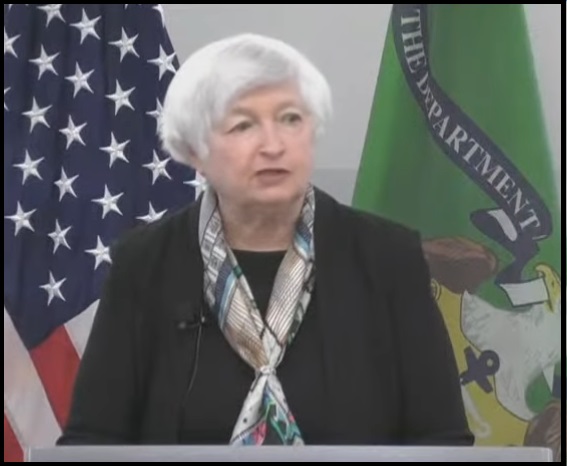
Treasury Secretary Janet Yellen Delivers Remarks Outlining “The future of Our International Order,” and Need to “Decarbonize Our Economies”

Treasury Secretary Janet Yellen delivered a remarkable speech today outlining “the future of the international order,” in the aftermath of the global pandemic and the current conflict in Ukraine.  Within the speech, Yellen outlines the priorities of the United States according to the current administration and the international financial mechanisms that she controls.

The speech is quite jaw-dropping when you consider the nature of her position, and the fact that she is an unelected bureaucrat within government.

As you read the speech {Transcript Here}, keep in mind she is not the President of the United States, or the commissioner of the New World Order, yet she presents herself as authorized to control the geopolitical constructs of the Biden administration.  The hubris is astounding.

Secretary Yellen: outlines the goals and objectives of the international order, predicts a concerning global famine, warns against the cleaving of financial mechanisms for international trade as an outcome of the Ukraine conflict, threatens any nation who does not support the western political alliance and outlines the need for decarbonization of the global economy.

Yellen expresses all of these powers from the position of a U.S. Treasury Secretary – the equivalent of a government financial minister.  Speech highlights with emphasis mine:

(Transcript) – […] “Russia’s horrific conduct has violated international law, including core tenets of the UN Charter—challenging countries to demonstrate where they stand with respect to the international order that has been built since World War II.  Therefore, when I speak about a changed global outlook, I’m not just talking about growth forecasts.  I’m also referring to our conception of international cooperation going forward.  

I will focus my remarks today on the significance of international cooperation in this current environment and for our future.

(more…)

Reports of Finland and Sweden Likely to Join NATO Highlight Global Financial Cleaving Underway

The Financial Times is reporting {link here, paywall} that Finland and Sweden are likely to join the NATO alliance.  According to the reporting {also in Reuters} the application from Finland is expected in June and Sweden shortly thereafter.

Adding Sweden and Finland would be a major escalation in both the western conflict and provocations against Russia, obviously, justified by western leaders as a consequence of the Russian invasion of Ukraine.  However, in the big analysis, the global financial system appears to be the larger issue.

From the outset of the Russian military operation into Ukraine, it was obvious the western alliance was intent on an almost ‘all or nothing‘ confrontation with Russia. The only limits to what the alliance was willing to do was trigger a nuclear showdown through direct military action against Russia to protect the non-NATO country of Ukraine.

The NATO and western government response was a fast system of financial sanctions intended to cripple the Russian economy.  However, Russia responded to those actions with countermoves on the trade front, beginning to establish the first ever non-Euro and non-dollar-based trade system.  In essence, a financial trading system created by the BRICS group (Brazil, Russia, India, China and South Africa).

Therefore, if we think about the current status of geopolitics and international finance, the NATO response now involves a priority of controlling and protecting the previously established financial structures of global trade.  A NATO effort to avoid the cleaving is now underway as an outcome of the sanctions against Russia.

As one person put it, “This is a fight for the dollar as reserve currency. Imagine trying to maintain our debt when nobody wants treasury notes. If BRICS succeed, US collapses as an economic power. On the other hand, if we win, Klaus Schwab’s nutty world wins.”  I tend to agree with this outlook because it parallels something we see domestically in the U.S.

(more…)