Quantcast

Finland Officially Joins NATO Creating the Largest NATO Land Border Directly Attached to Russia

CONTEXT:  There is no currently visible outcome where the Build Back Better collective western global alliance energy policy can succeed without escalating to a direct NATO war against Russia.

The economic outcomes of the BBB agenda are currently being felt via western, energy driven, supply side inflation.  The monetary countermeasures to that inflationary damage, raising central bank interest rates, creates instability in finance and subsequent banking collapse.

Simultaneous to the ‘western’ central bank intervention, the BRICS alliance members are withdrawing from dollar dependency as a trade mechanism.  When all those unneeded dollars return home, the dollar value collapses – and all western economies attached to the dollar as a trade currency collapse along with it.

The Western bankers need a war to generate the industrial economic activity that uses the returning dollars.  Unless and until the dollar is digitized, there is no currently visible outcome where the Build Back Better agenda is not dependent on an expanded war with Russia.

(Via Axios) – Finland became the 31st member of NATO on Tuesday — a once-unthinkable step that significantly changes the security landscape in Europe.

Why it matters: Finland’s membership more than doubles NATO’s borders with Russia and formally ends Helsinki’s decades of official nonalignment. It’s also a blow to Russian President Vladimir Putin who, in launching the Russian invasion of Ukraine, vowed to block the alliance’s eastward expansion. It’s the alliance’s ninth enlargement since its founding in 1949.

NATO Secretary-General Jens Stoltenberg sent a message to Moscow while officially welcoming Finland into the alliance: “President Putin wanted to slam NATO’s door shut. Today we showed the world that he failed, that aggression and intimidation do not work. Instead of less NATO, he has achieved the opposite: more NATO. And our door remains firmly open.”

(more…)

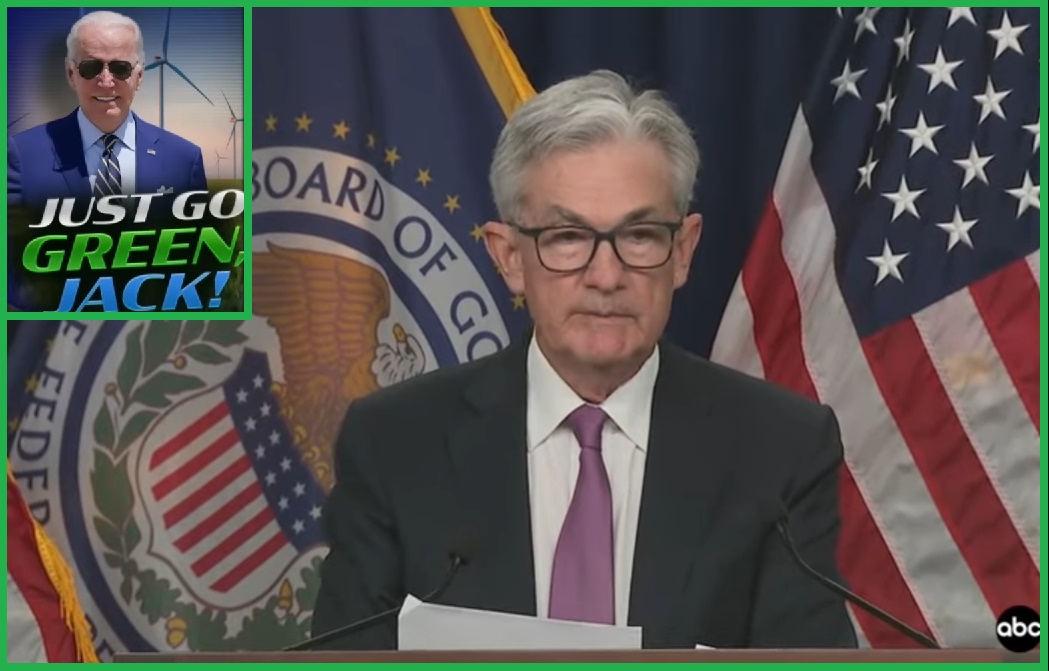
Pretending Continues – Fed Chair Powell Notes Banking Crisis Will Likely Restrict Credit and Borrowing on Main Street…

At a certain point in the economics of the great pretending cycle, one must wonder what circles they live in.

Fed Chair Jerome Powell announced another quarter-point interest rate hike and simultaneously noted the banking crisis will likely lead to tighter credit and borrowing for businesses on Main Street…. thereby further reducing the U.S. economic output.  Yet here we are again, and not a single economic or financial pundit is even talking about the origin of the inflation the Fed action is pretending to address, the spike in energy prices.

At the core of the Biden policy issue that creates inflation, is the energy policy that has driven oil, gas, home heating, electricity and manufacturing/farming costs through the roof.  The blocking of energy resource development/production is the top issue leading to massive increases in consumer prices overall.  The Biden energy policy is entirely ignored by a federal reserve attempting to shrink inflation.

Follow the bouncing ball of consequence.

Biden restricts energy development [Main St Suffers].  Prices skyrocket [Main St Suffers]. The fed raises interest rates in an effort to reduce the economic activity to meet the lowered production of energy resource development [Main St Suffers].  The result of the interest rate hike creates liquidity issues for banks holding treasury securities [Main St Suffers].  The banks then reduce credit lines, reduce lending and tighten borrowing to match their lowered liquidity [Main St Suffers].

The Fed then notes further increases in rates may pause as they await the outcome of restricted banking credit and lending from the rate hikes previously installed.  Nowhere in any of this is anyone talking about the nucleus of the issue – the stupid energy policy.  The great pretending continues in the West, while smiling panda lunches with Vladimir Putin.

(more…)

Mexican President AMLO Hits Biden Over Likely Arrest of Trump, While Pushing Back Against Dangerous Cartel Narrative

Let it not be said that Mexican President Andres Manuel Lopez-Obrador (AMLO) does not understand what the Biden administration is attempting in the recent criticism and passive aggressive posturing toward Mexico.

Yesterday, AMLO was outlining a specific set of infrastructure initiatives that are ongoing.  Three new oil refineries together with new railroads and highways are under construction as the government continues positioning itself for energy independence. [Video Here]  However, it’s what he said after the energy remarks that’s really stunning.

The energy plan, which runs counter to the expressed demands of Canada and the United States, includes two regional ‘green’ refineries that will have the ability of turning used cooking oil into fuel.  However, the plan also includes new oil refinery capacity that will permit cheap gasoline independent of the need for Mexican oil to be refined in Texas and returned.

All of the refinery projects are on schedule to be completed by the end of this year and into 2024.  In essence, Mexico will have very cheap gasoline and diesel fuel in the near future.  This was previously outlined as a goal by AMLO in July 2022, and is against the interests the Biden administration.  Now those plans are becoming a reality.  Mexico is not joining the North American suicide mission of windmills, solar panels and reliance on unstable green energy.

Ever since the July 2022 Oval Office press conference at the White House, CTH has been saying to keep an eye on Mexico, because these energy plans align more with the BRICS nation agenda than the goals and objectives of the World Economic Forum (western nations).   It is not accidental the U.S. government, including our intelligence agencies and DHS, has been seeding a negative overall impression of Mexico ever since.

(more…)

Swiss Central Bank Steps in to Backstop Credit Suisse Amid Financial Collapse – The Larger Geopolitical Dynamic Is Clear

Before getting to the details of the Credit Suisse issue, it is worth taking a bigger geopolitical context to the dynamic.  The initial backstop sought by Credit Suisse was from the Saudi National Bank; however, SNB Chairman Ammar Abdul Wahed Al Khudairy refused more lending {LINK}.

This is where we need to keep the BRICS -vs- WEF dynamic in mind and consider that ideologically there is a conflict between the current agenda of the ‘western financial system’ (climate change) and the traditional energy developers.  This conflict has been playing out not only in the energy sector, but also the dynamic of support for Russia (an OPEC+ member) against the western sanction regime.  Ultimately, supporting Russia’s battle against NATO encroachments.

Russia, Saudi Arabia and China are geopolitically aligned in interest against the western financial system.  As a consequence, when western banks find themselves in need of capital and cash, there is a layered geopolitical dynamic in the background to Saudi refusal that must be considered.

With multiple western banks now in trouble, Credit Suisse is also exposed, and, like U.S. Treasury/Fed intervention in America, the Swiss central bank has stepped in to backstop the looming collapse.

In the big picture, we are seeing the ramifications of the ‘Build Back Better‘ agenda impacting the banking and finance sector which spearheaded it.  I am not seeing this discussed anywhere, as the western governments of the collapsing banks are being forced to intervene.

(more…)

Real Wages Drop Again as Inflation Continues to Outpace Pay Increases

Knowing, not predicting – knowing – the Biden economic policies were going to create massive U.S. inflation in the years to follow, in 2021 I pinned a tweet thread to the top of my timeline on the CTH Twitter account that could be used as a reference. [You Can Read Here] Not a single month of statistical data has come in the past two years that was not entirely predictable.  Today’s report from the Bureau of Labor and Statistics (BLS) [DATA HERE] is no different.

Inflation is a measure of the change in a price. It is usually presented in terms of a percentage of change. When inflation starts to lessen, what that means is the rate of the price increase slows down. The price is still going up, but at a slower pace.

February prices overall increased 0.4% for the month, putting the current rate of annual inflation at 6.0%.  Meaning prices (on aggregate) are 6% higher than this exact same time last year.

Meanwhile, wages increased 0.2% for the month, and hours worked dropped 0.3% [DATA]. Wages only rising by half the rate of prices, and hours worked dropping, means the net ‘real wages’ declined, yet again, by 0.4%.

Workers are going backwards.

The very real impact on the working class is getting worse.  The blue collar team, who works for a living and does not take Instagram pictures of their lunches, are getting crushed in the Biden economy.  The divide between the ‘haves’ and the ‘have-nots’ is getting wider.

Put another way, Team MAGA, the entire continuum of normally apolitical working class, is watching the rust growing and feeling the worst part of the Biden economic outcome.  I have often spoken in my immediate circle of influence with the phrase, “financial anxiety is a very real concern the closer you get to the laundromat,” and many people have no idea what that means.

The biggest BS statement of the day goes to CNBC with this sentence:

“Inflation began rising in early 2021 due to a supply-and-demand imbalance. Now, it’s largely fueled by strong demand for labor, economists said.”  (link)

I challenge you to find a more encapsulating pile of horsepucky that represents the financial media era of great pretending.  When I read stuff like this, I begin to think the next great eruption of a violent war is getting even closer, and this war will have nothing to do with nations.

(more…)

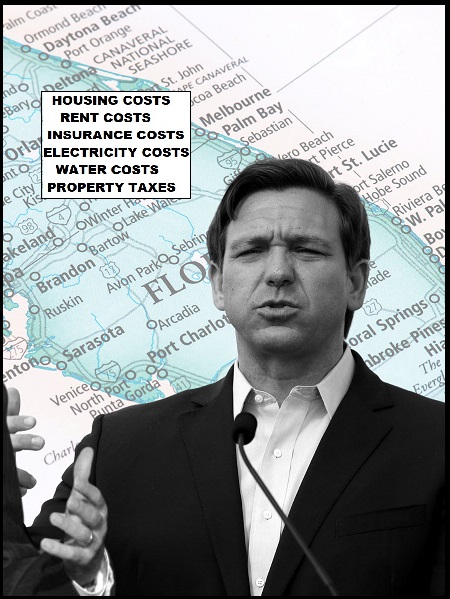
Hiding Data – DeSantis Staffed Public Service Commission Drops Requirement for Electricity Companies to Tell How Many Disconnections Due to Non Payment

It’s a local Florida story and multi-faceted. However, for the bigger national audience the issue that should be considered is that Ron DeSantis and the Florida Republican party took $9+ million in campaign contributions from state energy providers, then approved the biggest electricity rate hikes in Florida history.

Additionally, and more obscure in the outcome, the Public Service Commission (Public Utility Commission, or PUC), after being filled with DeSantis appointees, informed the electricity providers they no longer needed to report the number of residents who were disconnected from utility service due to nonpayment.

One could make the intellectual and political argument, the scale of disconnection -which is quite alarming- would be averse to the interests of Governor DeSantis seeking a higher office.

Like much of the country, electricity rates in Florida have skyrocketed with the increase in natural gas prices.  However, unlike much of the country, most Florida residents have only one option for electrical utility power.  The rate of disconnection in Florida amid lower income and working families is far greater than almost any other state.  Florida is quickly becoming a class-driven society with haves and have-nots.

FLORIDA –  […] In November 2021, Florida’s Public Service Commission (PUC) issued a memorandum allowing  electric utilities to stop disclosing their shutoff data. The memorandum, which reversed the commission’s September 2020 decision to collect the data to track the pandemic’s effects on utility customers, came after DeSantis stacked the board with his appointees. The move came less than a month after commission members approved the largest electric rate hike in Florida’s history, resulting in a 20 percent increase in costs to residential ratepayers.

(more…)

Manufacturing Indexes Continue Downward Trend as Consumers Leery of Big-Ticket Purchases

Coming out of the pandemic related disruption, the larger story of U.S. manufacturing has been an odd blend of good data and bad data depending on the sector.  While some manufacturing was growing as a result of clearing supply chains, other sectors of manufacturing remained soft.

In total, the full supply chain rebound should have completed around the end of the third quarter, beginning of the fourth quarter of 2022.

However, simultaneous with the correction within the supply chain(s), consumer purchase activity began contracting.

The consumer pullback led to very weak holiday sales last year, and a combination of increased inventories of finished goods.

Keep in mind that Maersk overseas shipping noted significant drops in orders for the movement of material in the third quarter of last year.  Considering the lag, the previously noted inventory buildup in combination with the drops in unit sales of durable goods, would generally mean lower manufacturing purchase order activity Q4 (’22) and Q1 (’23).   This reality is reflected in the actual data as reported by The Wall Street Journal:

(Via WSJ) – […] New orders for manufactured goods contracted for the sixth straight month through February, according to surveys by the Institute for Supply Management. Manufacturing output is down 1.7% from its postpandemic peak in May 2022, according to a three-month moving average of Federal Reserve data. And the Commerce Department’s measure of civilian capital equipment orders, excluding aircraft—the building blocks of business—was down 3.4% in January from its recent high in November 2021, after adjusting for inflation.

(more…)

Sunday Talks, Joe Manchin Wants Energy Permitting Reform He Was Promised in Order to Support Debt Ceiling and Budget

On July 31, 2022, According to Manchin a deal between himself, Chuck Schumer, Nancy Pelosi and Joe Biden included his support for the green energy spending bill, in exchange for two new items in future legislation: 1) Streamlined energy permitting/regulation; and 2) Increased development of Oil, Coal, Gas.  After getting his vote, Biden, Pelosi and Schumer reneged on the deal.

Today Senator Manchin inferred he wants that promise fulfilled in order to gain his support for a debt ceiling increase and a budget package. [Transcript Below]  Manchin also hedged on his own political aspirations for 2024, saying he will make a decision at the end of this year.   WATCH:

[Transcript] – SENATOR JOE MANCHIN: Good morning, Brennan. Thank — Margaret, thanks for having me.

MARGARET BRENNAN: I want to start on that derailment.

SENATOR JOE MANCHIN: Yes.

MARGARET BRENNAN: The president last week praised bipartisan railway safety legislation that would have new rules for trains carrying hazardous materials, increased fines for safety violations, phase in newer cars.

Will you vote for it? Is that sufficient?

SENATOR JOE MANCHIN: Yes, I’m going to be supporting that. We need to do it.

(more…)

Agenda 47 – President Trump Announces Quantum Leap Initiative to Build Modern Communities Across the Nation

Earlier today President Trump made a bold policy announcement, to create modern cities throughout the nation with the low cost use of a small portion of federally controlled land.  A massive investment in a new infrastructure initiative that would rebuild and reignite the America First economic engine. {Direct Rumble Link}

“President Trump unveiled his new Quantum Leap plan that will create a new American future and modernize communities across the country. By building new cities, investing in transportation, lowering the cost of living for everyone, and modernizing public spaces across the country, President Trump has laid out a bold strategy to revolutionize the American Standard of Living.” more

While almost every other political candidate debates the best process for dividing up diminishing economic pie, this initiative doesn’t make the pie bigger, it creates new ones.  This is bold leadership pushing the boundaries. WATCH:

.

[Transcript] – Past generations of Americans pursued big dreams and daring projects that once seemed absolutely impossible. They pushed across an unsettled continent and built new cities in the wild frontier. They transformed American life with the interstate highway system—magnificent it was. And they launched a vast network of satellites into orbit all around the earth.

(more…)

U.K Grocery Inflation Hits 17.1% as Energy Costs Embed in Supply Chain

It’s not just the United Kingdom, but as we await the latest figures from monthly U.S. data, the statistics from the U.K. are hitting the newswires.  According to Reuters, food inflation in the U.K. is currently 17.1%  The primary driver of the skyrocketing food costs is the energy cost associated with the fast turnover categories.

With prices increasing 17.1% yet net sales only increasing 8.1%, there is a substantial impact in unit food sales.  British customers are buying much less to offset the fact they are paying much more.   This trend is not just in the U.K. we have seen the same trend in U.S. data as families are being squeezed at the grocery store.

The prices on name branded products like Kraft and Heinz are leading the escalating food prices. Just last week I noticed 6oz Kraft Philadelphia cream cheese was $6.99, and a 24 oz. bottle of Heinz ketchup at over $8.  Dairy products are leading the way with the most rapid increases in price.  It appears that we are entering the fourth wave of food inflation currently.

LONDON, Feb 28 (Reuters) – British grocery inflation hit 17.1% in the four weeks to Feb. 19, another record high, dealing the latest blow to consumers struggling with a cost-of-living crisis, industry data showed on Tuesday.

Market researcher Kantar said prices are rising fastest in markets such as milk, eggs and margarine. It said UK households now face an additional 811 pounds ($978) on their annual shopping bills if they don’t change their behaviour to cut costs.

(more…)