Quantcast

The True and Visible Mission of DOGE – What to Expect

I have been waiting for someone to outline what the Dept of Government Efficiency (DOGE) is all about.  Unfortunately, perhaps due to the history of the matter, it appears few understand. So, with that in mind, and accepting the operators of DOGE may not have a fulsome comprehension of the dynamic, here is what it means.

The last Federal Budget that passed through “regular order” was for Fiscal Year 2008, signed by President George W Bush in September of 2007.  Every budget since has been outside regular order; a series of continuing resolutions, omnibus spending packages and short-term funding mechanisms.  {CITATION}

That is correct.  In the past 17 years, all federal spending has been ‘short-term’ or ‘stop-gap’ spending measures, generally known as “Continuing Resolutions,” where the govt (House and Senate) continue to perpetually resolve to fund the government.  The CRs as they are known, punt the spending debate by accepting a baseline of prior spending and tweaking around the edges.

The key takeaway to begin thinking about DOGE is to understand that REGULAR ORDER has not been used since Fiscal Year 2008.

Title III of the Congressional Budget Act outlines a legal timeline that each President and Congress must follow {SEE HERE}.  Prior to 2007, Continuing Resolutions were only used to resolve short term arguments about spending priorities.

♦ BACKGROUND – The President is required by law to submit his budget by the first Monday in February.  Yes, even when an election takes place and a President doesn’t assume office until January 20th, the first Monday in February is still the legal requirement for the new White House budget proposal.

The Presidents’ budget is then submitted to The House of Representatives, where two weeks later the Congressional Budget Office, reviews the budget and issues an opinion as to the cost of the budget.   No later than six weeks after the President submits his budget all House committees send the House Appropriations Committee their spending proposals [April 15].

Through May and June, each budgetary appropriations bill from the House is sent to the Senate.  The Senate receives the House appropriations bills, then reviews through the Senate Appropriations Committee (Thune just picked Susan Collins as Chair).  The Senate proposes their spending priorities based on the House bill because the House has constitutional authority to originate all spending [June 15].  The House and Senate budgets are “reconciled” using parliamentary procedures [June 30] and then sent to the President for signature.

The fiscal year begins October 1st.

That’s the regular order process.
(more…)

Tucker Carlson Discusses Russia and the Big Question, “Are We Being Played by Western Intel?”

Here’s the baseline context of my review on this discussion provided by Tucker Carlson, as he takes part in the “World Government Summit at What’s Next for Storytelling?”

Tucker is shocked, shocked to see with his own eyes that Russia is a modern, beautiful, safe, clean, well-run nation filled with generally happy people who are just like you and me – only they don’t pretend.  That’s it, that’s the major difference.

If you were to analyze all of the varying realities around the opinions of those few people from the West who have literally put boots on the ground in Russia, the major thing that everyone would have a hard time explaining is this non-pretense.  However, as soon as you say, “They don’t pretend,” anyone who has visited Russia in the last two years says, “Yes – that’s it; exactly that.”  Essentially, that’s what Tucker is trying to explain also.

Yes, we in the West are being played by Western interests in creating our opinion of Russia.  Yes, to just about everything Tucker Carlson is saying in this segment – only more.  Tucker didn’t even go to the beautiful places like St. Petersburg; he was limited by self-choice to being stuck in Moscow.  WATCH (prompted):

.

Any independent journalist who writes about the constructs in/around Russia, yet has not been there in the last few years, can be completely disregarded.   Yes, we are all getting played, and I have repeatedly said the same thing openly.

(more…)

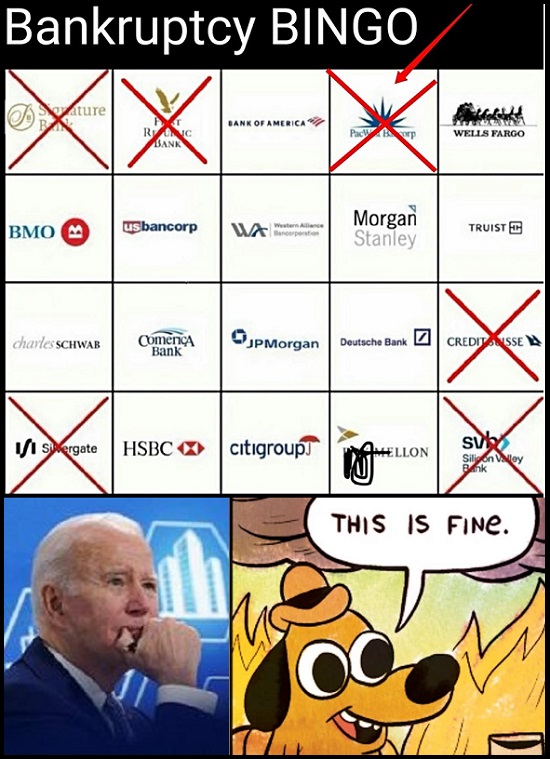
The California Contagion – PacWest Teters on Becoming the Next Regional Bank to Collapse as Regional Banking Stocks Continue Severe Drops

According to those who relish the Cloward-Piven strategy, things are proceeding swimmingly.

…”As long as the decisionmakers continue doing the things that are creating the crisis, the crisis will continue.”

Federal Reserve Chairman Jerome Powell said yesterday the “U.S banking system is sound and resilient,” insert uncomfortable snicker here.  However, uncertainty is continuing to pummel the banking industry, despite assurances from the Fed, Treasury, FDIC financial regulators and bankers such as Jamie Dimon who are all saying there is no crisis in the banking industry.

If you want to know the big picture source of the uncertainty, it’s the great pretending.  The average person can sense something is wrong, and the person who pays attention has the experience of institutional lying over the past several years.  The last ten years of lying and pretending has created the biggest collapse in institutional trust in U.S. history.

Russians interfered with the election – trust us. Stick this needle in your arm, it’s safe – trust us.  The FBI are the good guys – trust us. Biden won more votes – trust us. This inflation is merely transitory – trust us.

See the problem?

So, when the same voices shout, “the banking industry is sound, trust us,” well,… yeah, that suspicious cat sense that’s on high alert isn’t buying the chorus.

Reasonably intelligent people who accept things as they are, not as they would have us pretend them to be, can see the core connection to the World Economic Forum, Central Banks, and western globalist policy to change the entire dynamic of economics and finance around the “Climate Change” agenda, or Build Back Better, or Green New Deal.

Overlay that commonsense and pragmatic outlook with the logical consequences of the activity, and this banking collapse issue is a self-fulfilling prophecy.  As long as the decision makers continue doing the things that are creating the crisis, the crisis will continue.

(more…)

Against Backdrop of Inflation Continuing, Fed Set to Raise Rate Again Before Debating Pause

Everything about the process of cutting down energy exploitation, then driving supply side inflation, then raising interest rates to shrink demand (stem inflation) created by a desire to lower economic activity to the scale of diminished energy production, is a game of pretending.

The collateral damage from the rate hikes has been the banking destabilization, which shows the priority of the government officials and central banks to support the climate change agenda.  Into the game of pretending comes the second unavoidable consequence with inflation continuing as a result of the energy policy.

They simply cannot cut energy demand enough to meet the diminished scale of production.  There is no alternative ‘green’ energy system in place to make up the difference. That is the reality.  Now, the fed is scheduled to raise rates again, then begin to debate the collateral damage as they continue the pretending game.

(Via Wall Street Journal) – […] Another quarter-percentage point increase would lift the benchmark federal-funds rate to a 16-year high. The Fed began raising rates from near zero in March 2022.

Fed officials increased rates by a quarter point on March 22 to a range between 4.75% and 5%. That increase occurred with officials just beginning to grapple with the potential fallout of two midsize bank failures in March.

(more…)

March Housing Sales Drop 2.4%, Year Over Year Decline of 22% From March 2022

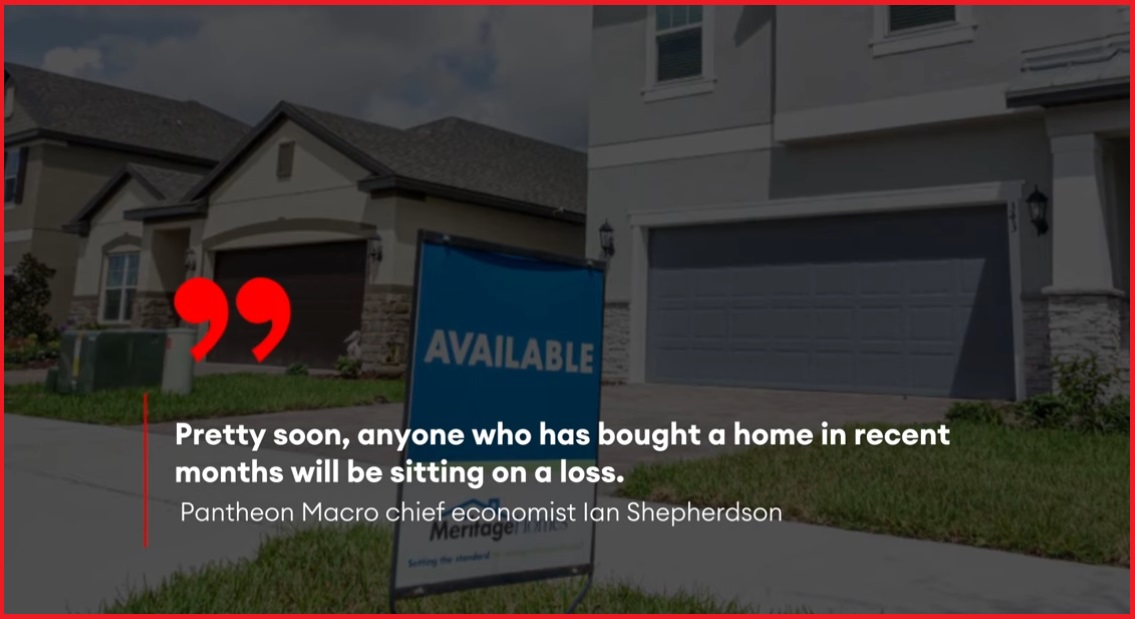
As higher interest rates continue to put pressure on borrowers, the ability of the average person to afford a mortgage diminishes.  Higher mortgage rates lead to downward pressure on residential home values as fewer borrowers can afford higher payments.  Simultaneously, commercial real estate is dropping in value as vacancies continue increasing.

Put both of these issues together and already tenuous banks holding mortgage bonds as assets can become more unstable.

This dynamic creates the continual tremors in the background of an economy already suffering from high inflation and low consumer purchasing of durable goods.

A perfect storm starts to realize.

(Wall Street Journal) U.S. existing-home sales decreased 2.4% in March from the prior month to a seasonally adjusted annual rate of 4.44 million, the National Association of Realtors said Thursday. March sales fell 22% from a year earlier.

March marked the 13th time in the previous 14 months that sales have slowed. The housing market had a surprisingly strong February, when sales rose a revised 13.75% from the previous month. But after mortgage rates ticked higher, March sales resumed the extended period of declines.

The housing market’s slowdown is now starting to weigh on prices, which have fallen on an annual basis for two consecutive months for the first time in 11 years. The national median existing-home price decline of 0.9% in March from a year earlier to $375,700 was the biggest year-over-year price drop since January 2012, NAR said.

(more…)

Tucker Carlson Outlines SVB Collapse and Ponders Impact of Cultural Marxism on Outcome

For his opening monologue Friday night, Fox News host Tucker Carlson outlined the collapse of Silicon Valley Bank and ponders the deeper story that lay underneath the sudden failure. WATCH:

.

(more…)

Kamala Harris Explains Social Equity Behind Student Loan Bailout

Kamala Harris was asked today about who will be paying for the massive student loan forgiveness and bailout program.  She never answered the question but chuckled her way through a social justice and equity response, or something…. WATCH:

.

(more…)

Fed Chair Announces Addition 0.75% Increase in Interest Rates and There will be More, After They Assess How Much Damage This Creates

While admitting that consumer spending had dropped; and while admitting that production of goods and services had “slowed significantly”; and while admitting that consumers have “lower real disposable incomes and tighter financial conditions; and while stating that “activity in the housing sector had weakened”, housing purchases have fallen; and while accepting that “business fixed investment seems to have declined in the second quarter,” Fed Chairman Powell announces his intention to continue targeting excessive demand.

If we accept that monetary policy can only impact the demand side of the economy (regulatory policy impacting the supply side); and if we accept all off the currently existing realities of a declining demand side, as outlined by Powell; then you might wonder what excessive demand is it that he’s targeting?   The answer to that question is the secret sauce.  They want less energy demand.   WATCH (2 mins):

The federal reserve, just like all the central banks around the collective western alliance, is trying to reduce the economy in order to reduce energy use.   This is the monetary policy side supporting the Build Back Better, Climate Change, regulatory policy side. {Go Deep}

They cannot admit openly what they are doing, but the bankers are trying to help the globalist politicians by shrinking their economy.  Raising interest rates into preexisting economic contraction is against their legislative mandate, because it only leads to unemployment and a smaller economy.

Powell is using the pretense of demand side inflation as a justification to raise interest rates.  It’s not demand driving inflation, it’s the energy policy.

(more…)

Used Car Repossession Rates Double for Both Sub-Prime and Prime Borrowers, Indicates Trouble on Main Street

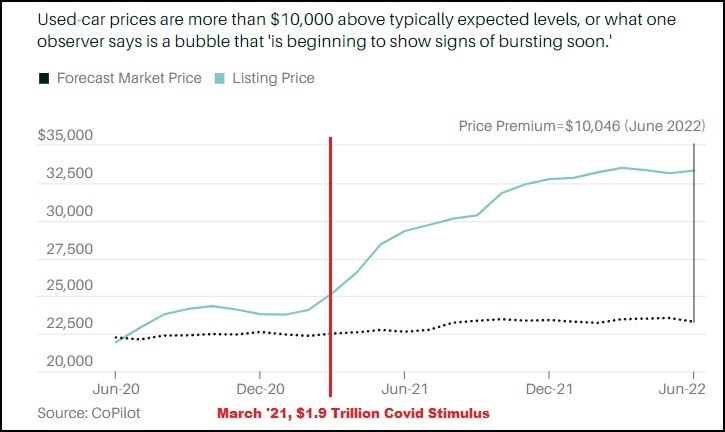
Barrons has an interesting article on an increase in bank auto repossession rates connected to defaults [see here].  Essentially, used car prices have surged significantly and the timeline seems to indicate the temporary covid-19 stimulus spending had a lot to do with the increase in demand.

According to data assembled by CoPilot, used cars are currently priced approximately 10,000 higher than they would be without any pandemic related influence, supply side or demand side.  Banks and financial institutions loaned money into the climbing market price.  However, the artificially inflated car prices now create a bubble where the liability on the books is significantly higher than the repossessed asset is worth.

A higher rate of auto loans are now defaulting for both sub-prime and prime borrowers (double for both), indicating the former buyers are under financial pressure and can no longer make their car payments.  The loan to value ratio was as high as 140% when the banks made the loans, a more traditional or normal ratio is 80%.

The banks have a vested financial interest in limiting the number of repossessed vehicles they allow into the used car auction market in order to keep the book value of the cars as high as possible.  Those banks and financial institutions have recently rented more storage space for the vehicles being repossessed.

(more…)

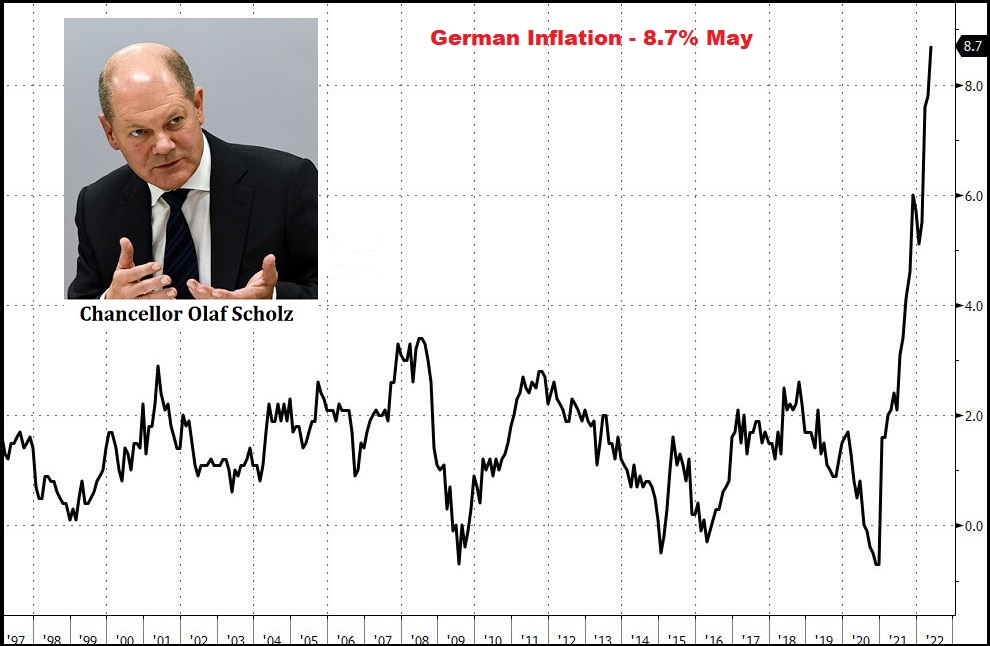
Central EU Economy, Inflation Rate in Germany Jumps Far Beyond Expectations in May to 8.7 Percent

Germany is the central and largest economy within the European Union; it is also the most influential for anything related to the response from the European Central Bank and EU Central Bank President Christine Lagarde.   Today, Germany is reporting a massive (unexpected) jump in overall inflation for May of 8.7%, up from the previous month’s 7.8%.

Ironically, it was a little more than a month ago when EU Central Bank President Christine Lagarde said she did not expect the EU inflation to be quite as bad as the U.S. inflation crisis due to the EU spending less on COVID relief and focusing on employment retention.  This was the ECB justification for not raising interest rates until later this summer.  Obviously Lagarde has joined Jerome Powell in the room filled with bad financial decisionmakers.

Germany is the largest and most influential economy inside the EU. If the German economy falters, the entire EU slips into a recession.  The massive inflation now being reported by Germany, that continues climbing each month, will increase the urgency for of Lagarde to raise rates.  They too are in the inflation spiral, and this issue will quickly fracture the EU response to Ukraine.

(Via Reuters) – […]  German consumer prices, harmonised to make them comparable with inflation data across the European Union, increased to 8.7% from 7.8% a month earlier, well ahead of expectations for 8%, data from the Federal Statistics Office showed on Monday.

(more…)