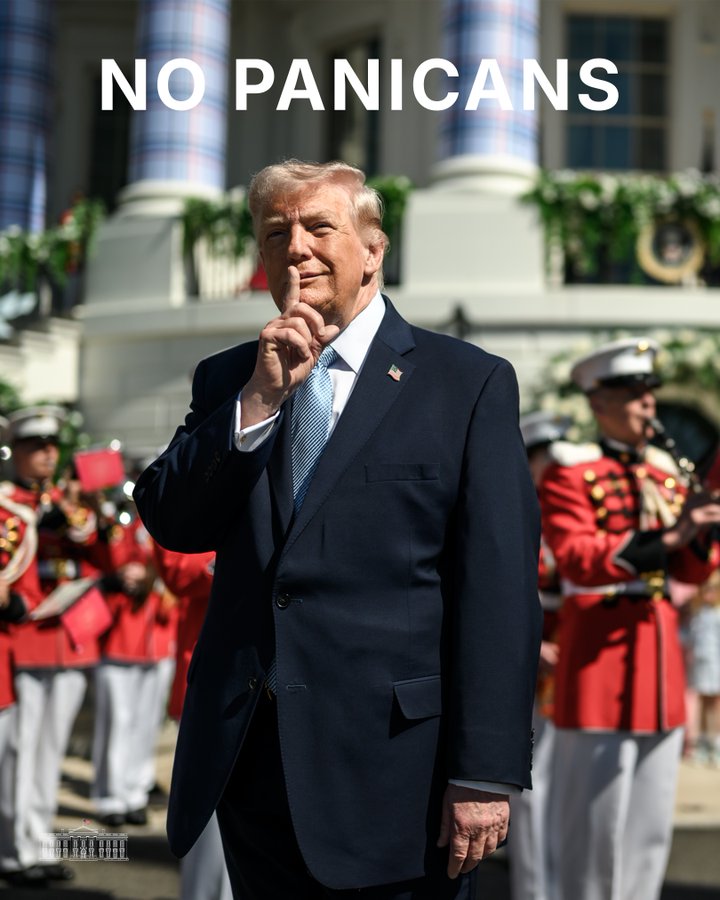
While flying to Joint Base Andrews, President Trump gives remarks to the travelling press pool and answers questions.
.
While flying to Joint Base Andrews, President Trump gives remarks to the travelling press pool and answers questions.
.
Secretary Marco Rubio went out of his way in this joint presser to emphasize the personal relationship between Hungarian Prime Minister Viktor Orban and U.S. President Donald Trump. Orban is facing a serious election challenge this April and all of the EU/NATO systems are actively trying to create pressure points to remove him.
Secretary Marco Rubio is in Budapest today for meetings with Prime Minister Viktor Orbán and his government to include the signing of a civilian-nuclear cooperation agreement heralded by the Trump administration. Hungary is one of the few voices within the European Union who is pushing back against Brussels efforts to go to war against Russia.
Prime Minister Orban has been very critical of Ukraine, openly stating his opposition to EU membership for the embattled country. In response President Zelenskyy has weaponized Ukraine’s geographical stewardship of oil and gas pipelines to shut down Hungarian energy and drive-up prices. VIDEO:
[Transcript] – MODERATOR: (Via interpreter) Good morning, ladies and gentlemen. May I extend my most cordial welcome to all of you, and may I extend my most special welcome to His Excellency Mr. Marco Rubio, Secretary of State of the United States of America, at the press conference and signing ceremony organized on the occasion of his visit to Hungary. Let me also extend my warm welcome to Mr. Viktor Orban, Prime Minister of Hungary, members of the U.S. and Hungarian delegations, and all our esteemed guests.
At today’s event, the agreement between the Government of the United States of America and the Government of Hungary to facilitate cooperation on the civilian nuclear program in Hungary will be signed. The signatories to the agreement on behalf of the United States of America, Secretary of State Marco Rubio, and on behalf of Hungary, Minister for Foreign Affairs and Trade Mr. Peter Szijjarto.
Through the years I didn’t really have much of an opinion of Steve Bannon, I approached any story of interest that surrounded him by simply looking at the factual details of the current event in question.
CTH well understood that Bannon, and subsequently his expressed opinion and objective, was simply an outcome of his position – downstream from the billionaire of the moment who paid him.
In essence, Steve Bannon always seemed to be, much like Kellyanne Conway, an advocate for whoever was financing him. From Robert/Rebekah Mercer at Breitbart forward to any endeavor thereafter, it always just appeared the same.
That said, with the release of the Epstein files, the relationship between Steve Bannon and Jeffrey Epstein is something CTH did not expect. {HERE} Bannon and Epstein were very close and talked to each other about seemingly everything.
I can never unsee what I have read. Nor will CTH ever entertain the possibility that Bannon was ever a good element within the MAGA effort. There is a solid argument to be made that the Bannon War Room was funded, or organized in the funding mechanisms, by Jeffrey Epstein. {HERE}
The files of messages between them contain some shocking stuff happening in the background while Steve Bannon was in very close proximity to candidate and President Trump. The level of disdain Bannon had for Donald Trump’s family and for Donald Trump himself is really something CTH did not expect to see. {examples: HERE and HERE}
I am left to wonder now how much of the vitriol against Jared Kushner and Ivanka Trump, ie. “Javanka hatred”, actually originated from the Braintrust behind Bannon and the assembly of people in his immediate orbit. {HERE}
Initially, I saw some Twitter accounts attempt to defend Steve Bannon by saying Epstein did all the talking in their text exchanges and Bannon was less communicative. However, that only applied to the first batches of files reviewed. As a few days went along and people started citing files, reading them gives a much more fulsome picture of the relationship.
Steve Bannon may have been focused on the financial gains and perhaps networks of people in his association with Epstein; but he certainly got deep into it and expressed extreme praise for Epstein, even going so far as to call him a god. {LINK} These were two men in a very close friendship. There is no political or ideological distance between Bannon and Epstein.
Border Czar Tom Homan appears on CNN for a friendly discussion about Minnesota ICE operations, deporting illegals with the help of Democrat governors, the looming DHS shutdown and other matters.
CNN’s Jake Tapper dropped his customary combative technique during the interview and heaped praise upon Mr Homan for being a great DHS official and working collaboratively with Democrats. The polite nature of the questions and conversation seems odd coming from Tapper who heaped effusive praise on Mr Homan.
.
I find this statement by Andrew Wilson to be generally accurate: “The Epstein files create so much emotional charge that having rational discourse about them is basically impossible. People want arrests but don’t know who they want arrested. They want justice but don’t know who they want justice for. Totally Incoherent outrage. Mob panic.”
A mass formation psychosis has fallen upon the Epstein matters and clouded the judgement of reasonable people.
It’s the “reasonable people” facet that became the challenge that Thomas Massie and Ro Khanna needed to control.
Led by financing from the anti-Trump administrative state allies, they created a controversy. Thomas Massie needed to create a political crisis he could manufacture, exploit and manage. Something his political paymasters could benefit from and simultaneously use as a pivot issue maximize his income capacity. His wife is dead; this is the payday opportunity to relaunch his mid-life masculinity and gain Instagram celebrity status to align with his physical makeover.
Together with Ro Khanna, Massie thirsts for the viral dopamine hit of “fighting the deep state.” They mounted a full-court press: public letters, hearing grandstanding, coordinated X and TikTok outrage campaigns, the whole performative circus. Algorithmically boosted appearances via social media allies, then promoted by content creators and influencers who adhere to the financial control dials within the algorithm.
Visibility looks organic, but it’s not. The consuming public, the mob, are mice with their head in a vice, gaze affixed to the content of a screen with images on a repeat pattern they do not control. Swipe – swipe, there it is again. Why, this must be trending or something.
“Release EVERYTHING immediately!” the mob shrieked. Implying that any delay, any careful review, was proof of a cover-up protecting whichever boogeyman the algorithmic boosters hated that week. Trump, Clinton, Gates, Trump, Musk, Bannon, Trump, Lutnick, take your pick. Psychologically, the screenplay is textbook narcissistic projection fused with political opportunism.
Institutional caution must be defined as corrupt, because institutional credibility has been shattered. Like classic narcissists they weaponized a crisis they created because their motives are impure: sway, clout, money – influence and affluence – and the delicious thrill of wielding moral superiority over faceless bureaucrats. Even Ted Cruz and Casey DeSantis blush at the scale they never attempted.
Yes, they whipped the social media mob into a frothing “transparency or treason” frenzy, leaving the DOJ with two choices: take the time to do it right and be accused of obstruction, or just dump it all and tell Massie to FU.
Pam Bondi and Todd Blanche just gave Thomas Massie the middle finger.
Marco Rubio appears for an interview with John Micklethwait of Bloomberg News. The interview was pre-scheduled as a follow up to the rather historic speech in Munich at the security conference. Within the interview {video and transcript below} Rubio expands on the baseline of the speech, the ‘why‘ is the U.S-EU alliance important.
Beginning with the end in mind, Rubio reminds the interviewer that an alliance must first accept the purpose of the assembly. There are common values and common social components to the relationship that sit at the core of the decision to be allies.
We have a shared civilization based on shared values, and within that central component the Trump administration is staring at the Europeans and saying they have lost focus on these values. Europe is diminishing itself; it is fracturing its culture and has lost its sovereign identity. The United States wants to stay partnered with Europe, but we are not going to be a partner anchored to a collective mindset that has lost its identity.
This culturally Marxist status, a gathering of nations infected with political correctness, pontificating wokeness and apologetic self-flagellation, is the core problem the Europeans are not willing to face. President Trump and Marco Rubio are essentially telling the EU to shake it off, quit being woke, get proud of your heritage, institute political systems that give benefit to the population and regain pride in themselves and their identity.
The process begins with national security, but that is not just about military spending. Their energy industry needs to support economic independence; they cannot outsource component manufacturing; they need to reestablish economic baselines that are not dependent on Russia, China, India or any other risk vector that could be used to manipulate.
QUESTION: Marco Rubio, Secretary of State, thank you for talking to Bloomberg. You’ve just made this rather remarkable speech where you talked about the destiny of Europe and America always being intertwined. You talked about the alliance which has stretched all the way, culturally, from Michelangelo to the Rolling Stones – a first, I suspect, for a secretary of state – but a culture that has bled and died together. But the very common theme of your speech was the need to share the burden, the need for Europe and America to do things together, which was slightly different from the Vice President last year. Were you kind of offering a carrot where perhaps he was offering a stick?
SECRETARY RUBIO: I think it’s the same message. I think what the Vice President said last year very clearly was that Europe had made a series of decisions internally that were threatening to the alliance and ultimately to themselves, not because we hate Europe or we don’t like Europeans but because – what is it that we fight for, what is it that binds us together? And ultimately, it’s the fact that we are both heirs to the same civilization. And it’s a great civilization and it’s one we should be proud of. It’s one that’s contributed extraordinarily to the world and it’s one, frankly, upon which America is built, from our language to our system of government to our laws to the food we eat to the name of our cities and towns – all of it deeply linked to this Western civilization and culture that we should be proud of, and it’s worth defending.
And ultimately, that’s the point. The point is that people – people don’t fight and die for abstract ideas. They are willing to fight and defend who they are and what matters and is important to them. And that was the foundation he laid last year in his speech – and we add on into this year – to explain to people that when we come off as urgent or even critical about decisions that Europe has failed to make or made, it is because we care. It is because we understand that ultimately, our own fate will be intertwined with what happens with Europe. We want Europe to survive, we want Europe to prosper, because we’re interconnected in so many different ways and because our alliance is so critical. But it has to be an alliance of allies that are capable and willing to fight for who they are and what’s important.
This is a critically worded speech that is very important to listen to with great deliberation. Within his remarks Rubio is telling Europe that we want to remain allied in our interests, but we are no longer going to allow the system of “globalism” to destroy our uniquely American life.
The United States is separating from the madness; this is not up for debate. The only question is whether Europe is too far gone, or whether they will join us.
The euphoria that followed the collapse of the Berlin Wall, “led us to a dangerous delusion. That we had entered quote the end of history. That every nation would now be a liberal democracy; that the ties formed by trade and by commerce alone would now replace nationhood. That the rules-based global order, an overused term, would now replace the national interest, and that we would now live in a world without borders where everyone became a citizen of the world. This was a foolish idea that ignored both human nature and it ignored the lessons of over 5,000 years of recorded human history, and it has cost us dearly.”
[Transcript] SECRETARY RUBIO: “Thank you very much. We gather here today as members of a historic alliance, an alliance that saved and changed the world. When this conference began in 1963, it was in a nation – actually, it was on a continent – that was divided against itself. The line between communism and freedom ran through the heart of Germany. The first barbed fences of the Berlin Wall had gone up just two years prior.
And just months before that first conference, before our predecessors first met here, here in Munich, the Cuban Missile Crisis had brought the world to the brink of nuclear destruction. Even as World War II still burned fresh in the memory of Americans and Europeans alike, we found ourselves staring down the barrel of a new global catastrophe – one with the potential for a new kind of destruction, more apocalyptic and final than anything before in the history of mankind.
At the time of that first gathering, Soviet communism was on the march. Thousands of years of Western civilization hung in the balance. At that time, victory was far from certain. But we were driven by a common purpose. We were unified not just by what we were fighting against; we were unified by what we were fighting for. And together, Europe and America prevailed and a continent was rebuilt. Our people prospered. In time, the East and West blocs were reunited. A civilization was once again made whole. ”
The pundits, economists and financial media are shocked, perplexed, befuddled and flummoxed. The Bureau of Labor and Statistics has released the January inflation data [SEE HERE] and the results are much better than they expected.
Overall inflation is 2.4% year-over-year, and there are zero indications that tariffs are having any impact on consumer prices [See Apparel].
CORE inflation, which removes food and energy, comes in at 2.5% year-over-year, the lowest number since March 2021. This is like reliving 2018 all over again, when the pundits proclaimed with absolute certainty that Trump’s tariff approach was going to cause inflation; it never happened.
VIA ABC – Inflation cooled in January, dropping price increases to their lowest level in nine months, new data from the Bureau of Labor Statistics showed. The lower-than-expected reading defied fears of a tariff-induced hike in overall costs.
Prices rose 2.4% in January compared to a year earlier, according to the Consumer Price Index.
It’s a strange time within the Intelligence Community. You can tell it’s all in flux when you see the New York Times giving a version of the story that is positive toward DNI Tulsi Gabbard, and the Wall Street Journal continuing with debunked/fake information still trying to get DNI Tulsi Gabbard removed.
The New York Times version appears to be the most truthful, factual and cited. It also makes the most sense.
In essence, two foreign nationals were having a phone call about Iran and discussing Jared Kushner’s role and influence in the policy of Trump toward Iran. The phone call was intercepted by a foreign intelligence agency, who then relayed their interpretation of the discussion to the U.S. National Security Agency (NSA).
NEW YORK TIMES – […] It was a discussion last year between two foreign nationals about Iran, not an unusual topic for American spies to study. But an intercept of that communication, collected by a foreign spy service and given to the United States.
[…] Mr. Kushner’s name was redacted in the original report from the National Security Agency, but people reading it, including the whistle-blower, were able to determine that the reference was to him.
[…] The foreign nationals, they said, were commenting on Mr. Kushner’s influence with the Trump administration. At a time last year when Mr. Kushner’s role in Middle East peace talks was less public than it is now, the foreign officials were recorded saying that he was the person to speak to in order to influence the talks.
[…] The intercept also included what officials described as “gossip” or speculation about Mr. Kushner that was not supported by other intelligence.
U.S. Secretary of State and National Security Advisor, Marco Rubio, departs from Joint Base Andrews en route to Germany, where he will attend the Munich Security Conference.
Giving brief remarks to the traveling press pool, Secretary Rubio notes, “this conference is at a defining moment.” Further stating, “the world is changing very fast in front of us. The old world is gone, frankly; the world I grew up in, and we live in a new era in geopolitics. And it’s going to require all of us to reexamine what that looks like and what our role is going to be.” WATCH:
Within the notes about the current geopolitical stakes of the world, Rubio alludes to his own reset and way of thinking or approaching U.S. national security issues and policies.
As new alliances form, new national viewpoints and sovereign discussions take shape, multinational globalism has ended, and a new world of strategic national alliances has risen. The era of Bush and John McCain has ended, and with-it Marco Rubio accepts the sovereign state framework of President Trump.