Quantcast

Gas Prices on the Rise Again, Biden Corporate Media Concerned About Political Impact

One of the biggest and most frequently stated lies in American media and financial punditry; motivated entirely by their alignment with the hoax of global climate change; is that a United States President can do nothing about gasoline prices.  This is an oft familiar claim by the political left, media pundits, financial media and leftist economists.  It is one of the more transparently false assertions in their arsenal of deceit.

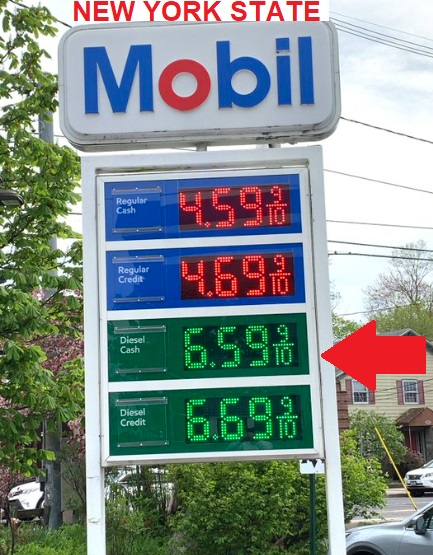
CNN reports that gas prices are rising again as the White House occupant’s inflation and supply chain crises persist, during a segment on CNN’s “New Day” with John Berman and Brianna Keila.  WATCH:

So, what can a U.S. President and administration specifically do?  We have abundant U.S. energy resources.  Quite literally the strongest in the entire world.

  • Permit the use of preexisting approved leases in ANWAR (Alaska) to put more volume into the Alaskan oil pipeline that is severely underutilized.
  • Finish the Dakota access pipeline.
  • Re-approve the preexisting energy leases in New Mexico, Arizona, NE Atlantic and Gulf of Mexico.
  • Retract the stoppage of the Keystone pipeline to permit efficient oil transport shipments from Canada.
  • Stop blocking the expansion of coastal oil refineries in Texas, Louisiana and Alabama (regulatory issue), as well as Northwest, Northeast and Southeast Seaboard.
  • Continue to develop natural gas as a clean burning fuel.
  • Drive Liquefied Natural Gas (LNG) as an export.

Unfortunately, this would mean reversing the entire energy policy of the current administration.  The existing energy inflation and high prices of oil, natural gas and gasoline are a direct and intentional part of Joe Biden policy.  That policy is driven by the leftist demand for a “green new deal.”

(more…)

Glenn Beck Interviews President Trump

Whoever said God doesn’t have a sense of humor did not foresee Glenn Beck broadcasting a President Trump interview at the same time that Texas Senator Ted Cruz is saying the January 6th protesters are “domestic terrorists who need to be jailed for a very long time.”   LOL

President Trump granted Glenn Beck a lengthy interview on the anniversary of January 6.  The best part of this interview is President Trump saying all this sh!t that Biden is doing can be fixed quickly.  [He’s right]  WATCH:

(more…)

Biden Views on Main Street Economics Make No Sense, Even When He Shouts About Them

Joe Biden makes no sense, and unfortunately Joe Biden doesn’t know he makes no sense.  Instead, the current installed occupant in the White House just shouts about talking points the champagne socialists bring up at their cocktail parties.

Overall inflation is crushing the middle class on a cross-sectional scale I have never before witnessed in my lifetime.  Every sector of the economy on Main Street is simultaneously under fire from unavoidable massive increases in prices on all types of goods.

Food, fuel, energy, gasoline, transportation, raw materials, every single sector is under massive inflationary pressure.  Biden believes that he can offset these massive costs to the average American worker by providing subsidies for some childcare, some education and some prescription costs.  He really believes this, yet everything about this subsidized cost approach is wrong.   Listen to the longer version of his explanation (3 minutes):

Despite the popularity of these leftist talking points, there’s no truth to them.

The government cannot subsidize its way to prosperity by redistributing the wealth of workers.  The government cannot stop inflation and simultaneously print money. The high cost of childcare is not keeping women out of the workforce.  Nothing is free from the federal government.  The federal government earns no income, it confiscates the income of workers.

The “17 Nobel Laureate” economists he proclaims support his Build Back Better deal to reduce costs for the middle class are the same “17 Nobel Laureate” economists who claimed, wrongly, inflation was “transitory” six months ago.  They have since retracted their prior claims, because it was all based on nonsensical Wall Street propaganda.

(more…)

Lower Than Expected November Retail Sales Shows Inflation Impact and Reduction in Consumer Spending

The Commerce Department November retail sales data was release today [DATA HERE] – [DETAIL pdf HERE].  The top line issue is a shocking drop in retail sales for November in key categories that align with previous discussion of inflation spending priorities for all U.S. consumers.

Before getting to the data, one point is critical to remember.  The commerce department sales figures are based on dollars spent. This point is important, because the items being purchased have inflation within them.  When prices are higher due to inflation, sales figures should be higher due to higher prices.  Ex. If there is an 8% increase in retail price, but only a 4% increase in retail sales, that means less stuff is being sold.  [Less units sold at a higher price gives the illusion of an increase in sales.]

Despite the start of the traditional holiday sales and shopping period, the total sales growth in November was 0.3% over October [Column A].  Factoring in inflation during the same month to month comparison at 0.9%, you can tell that overall in November there was a drop in units sold across the total of retail sales outlets.

A drop in sales at a time when holiday shopping should be taking place is concerning.  However, the sales reality aligns with the employment data last week showing a drop of 20,000 workers in the retail sector for November.  Put them together, and the picture shows retailers did not need employees, because consumers are not spending.

If we look deeper into the November sales figures, we can see that a contraction in discretionary spending is the primary issue. Electronics (-4.6%), Department Stores (-5.4%) and even online sales at ZERO.  We can also see a direct correlation in comparative inflation impact within the sales data for November 2021 when compared to November 2020 [Column B].

(more…)

November Producer Prices Rise Record Breaking 9.6 Percent Year Over Year, Biggest Single Month in History, as Massive Inflation Builds Within The Supply Chain – Again, No Signs of Slowing Down

We said it was happening {Go Deep}, and it is.  Last month CTH put the preparation window at 60 days +/- depending on region.  That window is now around 30 days before the next spike in inflation shows up from cumulative costs snowballing throughout the supply chain. The “producer price index” is essentially the tracking of wholesale prices at three stages: Origination (commodity), Intermediate and Final.

The final product inflation rate in July (reported in August) was alarming at 7.8%. However, we warned it would get worse. The Bureau of Labor and Statistics (BLS) then released stunning price data for October [DATA Here], showing an even more dramatic 8.6% price increase in final demand. More intense warnings shared.

Today, we get the November BLS Result [DATA Here], and unfortunately the results are showing what was expected.  The cumulative costs of massive increases in energy prices are building into the supply at an astonishing rate.  The November data shows a rate of wholesale final goods inflation at 9.6%, the largest single month comparative rate increase in history.

The bureau even went back and revised/increased the August price index from 7.8 to 8.4 percent, and revised/increased the October figure from 8.6 to 8.8 percent.  The average monthly price increase is almost a full percent… every month.  It looks like the BLS backward revisions are an attempt to smooth down the rate of increase.

(BLS) – “The Producer Price Index for final demand increased 0.8 percent in November, seasonally adjusted, the U.S. Bureau of Labor Statistics reported today. Final demand prices moved up 0.6 percent in each of the 3 prior months. (See table A.) On an unadjusted basis, the final demand index rose 9.6 percent for the 12 months ended in November, the largest advance since 12-month data were first calculated in November 2010.” (more)

I modified Table A (final demand product pricing), taking out some of the noise to make it a little easier to see the big picture of what is happening.

When you see the wholesale level of prices almost double the increase in consumer level inflation rate, you can predict that consumer prices will likely go even higher.  Future finished goods, at a retail level, will carry the current wholesale price increase.

Stuff costs a lot now… and because the inbound stuff to make the finished goods is still climbing in price…. stuff is about to cost even more.   You can see this in the inflation rate of intermediate goods which I have highlighted below.

(more…)

Senator Joe Manchin Not Convinced to Vote For Massive Build Back Better Spending Bill – Curiously WaPo Launches Investigation of Joe Manchin Finances

I’m not confident that Joe Manchin will ultimately hold the line on more spending; however, it is interesting that on the same day Manchin is reported to be casting doubt on more Joe Biden social spending {LINK}, the Washington Post published a hitjob on him around his family finances {LINK}.

Accepting there are no coincidences in politics, it would appear the intelligence agencies are firing a warning shot against Senator Manchin based on his financial connections to the West Virginia coal industry.

(New York Times) – WASHINGTON — Senator Joe Manchin III of West Virginia, the most prominent Democratic holdout on President Biden’s $2.2 trillion social safety net, climate and tax bill, cast fresh doubt on Monday on his party’s plans to speed the measure through the Senate before Christmas, saying he still had grave concerns about how it would affect the economy.

Mr. Manchin outlined his skepticism before speaking by telephone about the bill with Mr. Biden, a discussion that aides to both later characterized as positive. After the call, Mr. Manchin, who represents West Virginia, did not rule out the possibility of supporting the measure this month. He said that “anything is possible here” when asked about a vote before Christmas, and that he was still “engaged” in conversations with the White House.

(more…)

Sunday Talk Warning, Mohamed El-Erian Concedes His Economic Views Are Now Contingent Upon Climate Change Driving Policy

Well, there’s another “economist” who can be set into the folder of ‘no longer useful’.  During his appearance today on CBS Face The Nation, Mohamed El-Erian, chief economic adviser for Allianz, finishes his segment by revealing his underlying precept: Climate Change policy is now the economic policy driver of all his investment advice.

Within the interview, El-Erian said the “characterization of inflation as transitory is probably the worst inflation call in the history of the Federal Reserve.”  Additionally, El-Erian said inflation is likely to remain high into the next year and perhaps beyond.  Unfortunately, other than those two points of generally well educated accuracy, everything else is wrapped up in the political correctness of climate change…. which, you don’t really discover until the very end of the interview. WATCH:

The baseline for El-Erian saying the Build Back Better spending fiasco is a good thing, is based on accepting the pretense that massive amounts of federal spending will be needed to structurally change the U.S. economy from fossil fuel use to the Green New Deal.   If you do not believe in this transformation, there is no merit to any component of the BBB spending proposal. It really is that simple.

As a consequence, El-Erian is staking the position that climate change agenda politics is now the focal point from which all other economic policy will be determined.  He has conceded in his mind and worldview, perhaps based on his associations and peer discussions, that any forward economic analysis must therefore establish itself from the alternative fuel position.

(more…)

MAGAnomics vs JoeBamanomics, a Simple to Understand Graphic

President Trump economic policy -vs- Joe Biden economic policy

When wages (blue line) are above inflation (red line) our income is growing, life is good and the working class has more disposable income to enjoy life.  However, when wages (blue line) are lower than inflation (red line) our income is shrinking, life is a struggle and the working class has less disposable income to enjoy life.

♦ Point One – Nothing happens accidentally. The road to a “service-driven economy” is paved with a great disparity between financial classes. The wealth gap is directly related to the inability of the middle class to thrive.

♦ Point Two – There is nothing of value behind the obtuse term “service-driven economy.” The multinationals are paying for this administration, just like they paid the Obama administration; paying for economic policy that advances their interests.  Congress goes along with the K-Street demands, because Wall Street is now the primary benefactor of legislative intent. Nothing about their effort is done with American interests in mind.

To go deep, keep reading.

(more…)

Foreboding – U.S. Productivity Declined 5.2 Percent in Third Quarter, Largest Quarterly Drop in 61 Years

U.S. nonfarm productivity is a measure of economic activity within the engine of the U.S. economy.  The U.S. productivity rate is a measure of how much value is produced by the economy through demand for the products and services, and the labor associated with the creation of those products and services.

I have often used the example of making bread {Go Deep}.  If you are making 10 loaves of bread, there is a set amount of cost associated with each loaf created.  The total cost of each loaf is the total cost to produce the entire batch divided by ten. However, if you have customers demanding 15 loaves of bread, you make more profit on the last five because it doesn’t cost 50% more in material or labor to make 50% more loaves.

Your productivity in the last five loaves is higher because the fixed costs of production (raw materials, energy) barely change, and the labor is only slightly higher.  The opposite is also true.  It costs more per loaf to make fewer than ten loaves because the fixed costs and your labor are pretty consistent, yet the finished value of 7 loaves is less than the finished value of ten.

Anecdotally, it has looked for quite some time that around May of this year the economy peaked, plateaued for a few weeks, and then began a slow downward progression.  Today the Bureau of Labor statistics puts some revised data to that third quarter (July, August and Sept) economic activity {data here}.  The quantified results align with what we sensed was taking place.

(more…)

What The Heck – Joe Biden Shouts at The Audience, He Wants Americans To Pay Even More For Gasoline

This is nuts.  The White House occupant doesn’t have any idea what they are loading into his teleprompter at this point, he just shouts it at the audience as if it’s supposed to make some kind of bizarre sense.   This doofus is totally off his rocker.  What does this even mean?  WATCH (20 seconds):

I’ll look for a more expanded explanation as to what this idiot is supposedly saying.  Good grief, what a knucklehead.

This stuff is just nuts.  This guy is truly a meme of himself….

(more…)