Quantcast

First Major German City Turns Off Hot Water and Public Building Electricity to Save Gas

Hanover, a city in the northwest of Germany, has become the first major metropolitan area to try and reduce the use of natural gas by removing hot water from public buildings.  The move comes as natural gas supplies from Russia are reduced to 20% of capacity.  Germany is attempting to fill up storage facilities of natural gas in order to survive the winter.

Germany, together with several European countries, are telling their citizens to expect large increases in their electricity bills as energy costs continue to skyrocket.

Germany does not have any LNG terminals to receive shipments of natural gas into ports, they are dependent on pipelines from Russia.  They are urgently trying to reduce the current amount of natural gas being consumed.

(Via Daily Mail) – […] Other desperate gas-saving measures include switching off public fountains and blacking out night-time lights on major buildings such as the town hall and museums. The city’s mayor, Belit Onay, spoke of an ‘imminent gas shortage’ that meant they had to reduce the city’s energy consumption by 15 per cent.

[…] There will also be a ban on portable air conditioners, heaters and radiators among the general populace as the average German begins to pay a price for standing up to the Russian dictator.

[…] Germany, like most of Europe, has been enjoying a hot summer which should soften the blow of the cold showers, but public officials are introducing the measures now in fear of what awaits them when the season turns.

(more…)

To Lower Natural Gas Use World’s Largest Chemical Company Announces Making Less Ammonia, Fertilizer Production Will Shrink Further

The energy crisis in Germany is now a confluence of terrible events that will snowball well into next year.

The world’s largest chemical company, BASF, has announced they will cut down the production of ammonia in order to use less natural gas.

In the short term this will help Germany build up natural gas supplies to survive a cold winter with predicted rationing still planned.  However, in the long term the shortage of ammonia means less fertilizer which will mean future shortages and increased costs for farmers; ultimately creating lower yields next year.

FRANKFURT, July 27 (Reuters) – Germany’s BASF (BASFn.DE), the world’s largest chemical company, is cutting ammonia production further due to soaring natural gas prices, it said on Wednesday, with potential ramifications from farming to fizzy drinks.

Germany’s biggest ammonia maker SKW Piesteritz and number four Ineos also said they could not rule out production cuts as the country grapples with disruption to Russian gas supplies.

Ammonia plays a key role in the manufacturing of fertiliser, engineering plastics and diesel exhaust fluid. Its production also yields high-purity carbon dioxide (CO2) as a byproduct, which is needed by the meat and fizzy drinks industries.

(more…)

Straight Economic Data from Bartiromo

There is less pretending in this segment, but the core of intent is still missing.   As soon as Ms. Bartiromo can admit the monetary policy is specifically designed to create lower economic activity, she will be able to reconcile the policy conflicts which she still views as hypocrisies.

While not outlining the motive, in the segment beginning at 1:07 Ms Bartiromo does a good job outlining the current state of the economy. WATCH:

Comrades, prior to the Joe Biden economy the average American worker was earning 29 onions per hour.  After, the Biden economic policies were put into place, the average American worker is now earning 11 onions per hour.

(more…)

Pretending Continues, However El Erian Admits U.S. Economy Weakening Faster Than Expected

The great pretending continues in order to protect the Federal Reserve from sunlight upon them.  Central banks (U.S. Fed Reserve included) are raising interest rates into a recession, which is specifically against their legislative mandate. Therefore, in order to protect the bankers, the pundits and politicians must deny a recession exists.

Pundit Steve Liesman spins the data, says we need to wait longer, and circles the wagons to protect the policy makers, specifically the White House.  Mohamed El-Erian tries to split the baby (02:00 video); while not admitting directly that the economy is in a recession, he states the “economy is weakening much faster than expected.”  WATCH:

At a certain point all of this pretending and denial is going to come crashing down.  The “economic transition” to a new “green future” they are all pretending not to see as the root cause of the economic collapse, has unavoidable consequences.

The dam is breaking around them and they are running out of fingers and toes to stop the inevitable collapse.  Meanwhile the Davos crowd has purchased all the scuba gear and awaits the final outcome.

(more…)

FUBAR, Second Quarter GDP Contracts 0.9%, The U.S. Economy is Officially in Recession

Jumpin’ ju-ju-bones, CTH did not expect the BEA to admit the U.S. economy was in recession.  CTH originally predicted the BEA would use lower import data as the primary tool to modify the GDP result.

Factually, in this report, import data -in combination with lower consumer spending- was the primary sector that led to the result.  However, even with drops in the valuation of imports which lift GDP calculations, the economy still contracted.

Things must be much worse than officially admitted (details below), if the BEA is going to admit things are bad.

Gross Domestic Product (GDP) is the dollar value of all goods and services produced in the economy, minus the dollar value of goods and services we import. The percentages discussed are percentages of change over time.

The Bureau of Economic Analysis (BEA) released their first estimate of the second quarter GDP [Data Here] reflecting a 0.9% drop in U.S. economic activity. The second quarter contraction follows a 1.6% drop in the first quarter, which means we now have two consecutive quarters of declining economic activity, the technical definition of a recession.

The two primary data points which show the economic contraction are: (1) Lowered consumer spending; and (2) much lower imports as a result of lower consumer spending on durable goods and non-essential items.  High Q1 inventories of goods were also flushed out by companies and not replaced.  Starting with the consumer spending, here’s the data [Table-2, BEA report]:

Consumer spending, also called “personal consumption expenditures” declined 1.08% for goods overall in the second quarter.

Consumer spending represents two-thirds of all GDP in the United States.  Americans buy lots of stuff, and when Americans stop spending on goods the economy stalls.  As you can see in Table-2, consumer spending on goods dropped 1.08% and spending on services increased 1.78%.  The net difference is 0.70%, a massive drop in consumer spending compared to prior quarters/years.

The next component with major impact is the result of the drop in spending.

(more…)

Joe Manchin and Chuck Schumer Strike a Deal, $370 Billion for Green New Deal Energy Transition, Tax Increases to Pay for it and More IRS Agents

Two weeks ago, CTH warned everyone that Joe Manchin’s torpedoing of the $500 billion Green New Deal senate spending program was a head fake; he was always going to sign up to expand the control of the federal government over energy use.  Today Manchin and Chuck Schumer made it official.

The people operating the “energy transition” levers will get $370 billion to spend on bigger windmills, more solar panels and new energy programs to eliminate coal, oil and natural gas.  They will pay for it by raising taxes and hiring a new army of IRS enforcement officials.  In exchange for his vote, the federal government will pay increased health insurance subsidies for West Virginians and pass out lower priced medications.

There you go. Exactly as predicted.  Energy inflation will continue as the energy transition becomes a permanent feature.  Ironically, Joe Manchin made them change the name to “The Inflation Reduction Act,” and pushed the effective dates for all renewals past the 2024 election (where he plans to be a candidate against Gavin Newsom).

WASHINGTON – Joe Manchin and Senate Majority Leader Chuck Schumer on Wednesday reached a deal on a bill that includes energy and tax policy, a turnaround after the two deadlocked earlier this month in talks on Democrats’ marquee party-line agenda. In a joint statement, the two Democrats said the legislation will be on the Senate floor next week. It includes roughly $370 billion in energy and climate spending.

(more…)

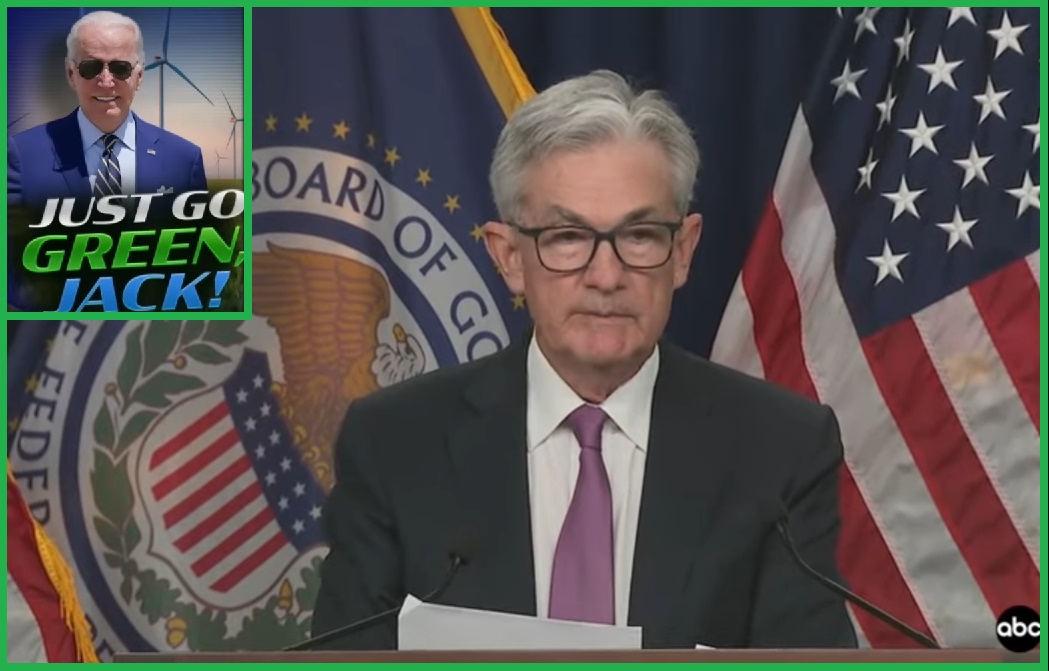
Fed Chair Announces Addition 0.75% Increase in Interest Rates and There will be More, After They Assess How Much Damage This Creates

While admitting that consumer spending had dropped; and while admitting that production of goods and services had “slowed significantly”; and while admitting that consumers have “lower real disposable incomes and tighter financial conditions; and while stating that “activity in the housing sector had weakened”, housing purchases have fallen; and while accepting that “business fixed investment seems to have declined in the second quarter,” Fed Chairman Powell announces his intention to continue targeting excessive demand.

If we accept that monetary policy can only impact the demand side of the economy (regulatory policy impacting the supply side); and if we accept all off the currently existing realities of a declining demand side, as outlined by Powell; then you might wonder what excessive demand is it that he’s targeting?   The answer to that question is the secret sauce.  They want less energy demand.   WATCH (2 mins):

The federal reserve, just like all the central banks around the collective western alliance, is trying to reduce the economy in order to reduce energy use.   This is the monetary policy side supporting the Build Back Better, Climate Change, regulatory policy side. {Go Deep}

They cannot admit openly what they are doing, but the bankers are trying to help the globalist politicians by shrinking their economy.  Raising interest rates into preexisting economic contraction is against their legislative mandate, because it only leads to unemployment and a smaller economy.

Powell is using the pretense of demand side inflation as a justification to raise interest rates.  It’s not demand driving inflation, it’s the energy policy.

(more…)

IMF Data, Global Output Contracted in Second Quarter

According to the International Monetary Fund (IMF) global economic activity, as measured by economic outputs, contracted in the second quarter.  However, when it comes to identifying the cause of the issue, the IMF joins western financial leaders and central banks in playing the game of pretending.

The radical new energy program contained within the Build Back Better agenda, is the root cause of the supply side inflation.  The drop in the production of oil, gas and coal in the same western nations that are following the BBB agenda is origin of the massive spike in energy prices.

Inflation is a major issue, geographically consistent and virtually identical in all the nations who are following the Build Back Better climate change agenda, which is the justification for the energy ‘transition.”  However, not a single leader, central bank or multinational financial institution -including the IMF- will admit the energy policy is the cause of the issue.

(IMF) – The world’s three largest economies are stalling, with important consequences for the global outlook. Inflation is a major concern.

The global economy, still reeling from the pandemic and Russia’s invasion of Ukraine, is facing an increasingly gloomy and uncertain outlook. Many of the downside risks flagged in our April World Economic Outlook have begun to materialize.

(more…)

Wal Mart Lowers Profit Expectations and Highlights Recession Shift in Consumer Behavior

A key metric in the data released by Wal Mart is not their upfront sales and profit. The recessionary KPI (key performance indicator) is a significant increase in same store sales of 6% (excluding fuel), yet the outcome of that increase in customers is a decrease in profit because the purchases are food.

[Keep an eye on this and we will likely see a similar increase in foot traffic at Aldis]

(VIA NBC) […] Walmart, which is the biggest grocer in the U.S. and often considered a bellwether for the overall economy, said more customers are turning to its stores, which are known for low prices, to fill their pantries and fridges. But they are skipping over general merchandise that they can live without.

Walmart said it now expects same-store sales in the U.S. to rise by about 6% in the second quarter, excluding fuel, as customers buy more food at its stores. That’s higher than the 4% to 5% increase that the company previously expected.  However, that merchandise mix will weigh on the company. Groceries have lower profit margins than discretionary items, such as TVs and clothing.

(more…)

Weber Manufacturing Announces Layoffs Due to Collapsed Sales, U.S. Economy Shrinking, CEO Resigns

It is only one U.S. company; however, the makers of Weber Grills and products released their sales data, and the background shows a severe economic contraction that has resulted in their operating loss of $51 million in the quarter that ended March 31, 2022NOTE THE DATE.

July 25 (Reuters) – Weber Inc (WEBR.N) on Monday replaced top boss Chris Scherzinger with an insider and warned that mounting inflationary and supply chain pressures could hit the grill maker’s financials and workforce, sending its shares down 20% in premarket trading.

The company withdrew its fiscal 2022 net sales and core earnings forecasts, saying higher consumer prices and geopolitical uncertainty were squeezing store traffic as well as margins.

Weber, which also suspended its quarterly cash dividend, said it was pursuing a number of initiatives, which may include job cuts, reducing expenses and tightening its inventory levels.

(more…)