Most people will not read the Inspector General Report in full [SEE PDF HERE]. But if you did, you might come to the same conclusion as myself. The entire FED and IG Michael Horowitz should be fired, arrested and prosecuted for corruption at a level that is simply jaw dropping.
The issue is really simple if you cut through the fog of the report. The FED Board awarded a no-bid contract to the contractor, without an agreement on the building renovation project and the construction costs associated with it until President Donald Trump began drawing attention to it. This is gross corruption at a massive scale.
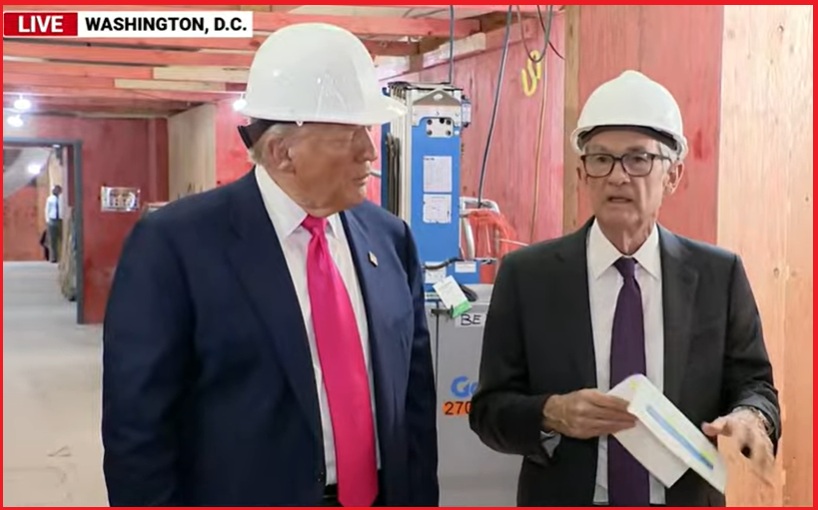
To use the terminology of the report, start with this aspect:
…”the Board selected a different project delivery method, construction manager at risk (CMAR), for the Eccles-1951 renovation project. A well-managed CMAR contract allows a building owner—in this case, the Board—to transfer certain construction risks, including those related to cost and schedule performance, to its construction manager (also known as a construction manager as constructor, or CMc). To effect this risk transfer, a CMAR contract provides for the owner and CMc to agree on a guaranteed maximum price (GMP) for the project, usually around the time construction begins or building design is substantially complete. Once the GMP is set, the owner has greater cost certainty and the CMc is incentivized to carefully manage costs. If costs exceed the GMP, the CMc absorbs them with limited exceptions, such as when the GMP may be increased to account for change events like owner directed changes or other adjustments like unforeseen site conditions“… {Source pg, 5}
So, the FED board established, at least with themselves, that they would have an agreement on cost for the project. However, if you go to page 60 of the report you find this:
…” in connection with a multibillion-dollar contract, the Board did not ask its CMc for a construction cost estimate or a GMP until December 2025—about 3.5 years after construction began and after the Board had already awarded more than $2 billion. Specifically, the Board did not take advantage of several key opportunities to request a cost estimate from the CMc”…. (Source pg, 60}
It wasn’t until President Trump drew attention to the FED having spent over $2 billion, that FED Chair Jerome Powell, and the FED board requested the construction manager and construction company to provide a cost estimate. This is unreal, especially considering that IG Michael Horowitz finds no unlawful decision-making in the overall fiasco.