President Donald Trump sits down with Bret Baier to discuss the results of his trip to the middle east. President Trump discusses investments in America, trade negotiations, the ongoing discussions with Iran and plans to solve the conflict between Hamas and Israel in Gaza.
President Trump outlines Israeli Prime Minister Benjamin Netanyahu as an “angry man,” albeit rightly angered by the attack on Israel on October 7th. President Trump’s remarks about Iran come as the Iranian regime is beginning to indicate a willingness to concede to Trump’s requirements. It’s all about the economics of the thing, the Trump Doctrine. WATCH:
.
THE TRUMP DOCTRINE – What you will notice from President Trump’s responses to questions during foreign leader engagements is the unique nature of his honesty. In the most consequential of ways, President Trump is the most consequential foreign policy leader in generations. We forget that during Trump’s first term in office, the headlines about North and South Korea were not about conflict, but rather about the possibility of unification on the Korean peninsula.
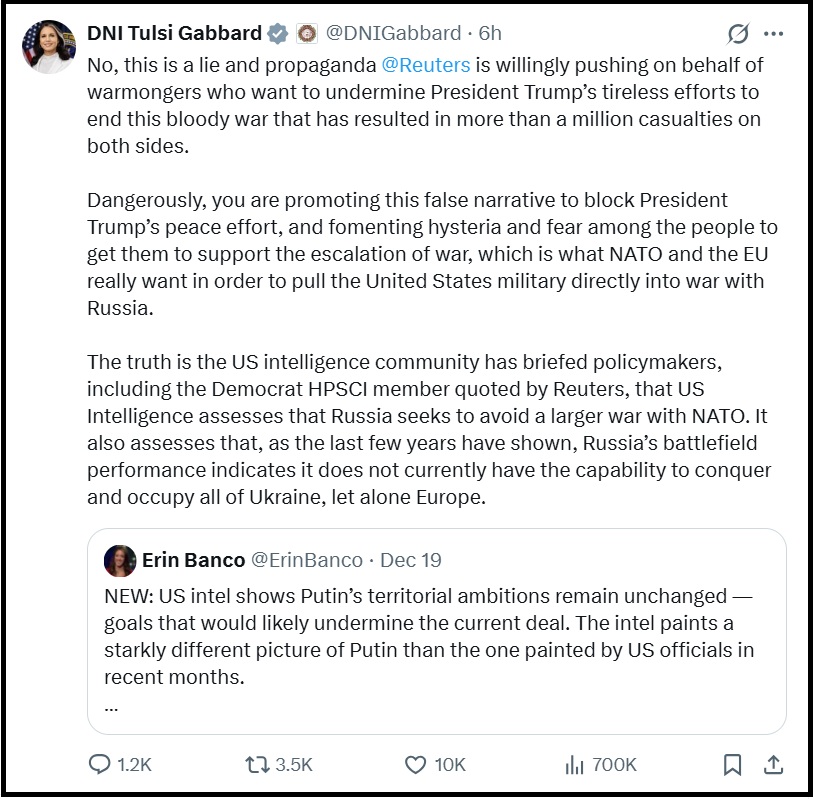
A meeting between President Trump and Russian President Vladimir Putin brings with it the focus of the entire world. For a myriad of geopolitical reasons both domestically and abroad, there are ‘trillion-dollar’ interests who want to keep them apart.
Earlier today, fearing that President Trump might actually travel to Turkey, NATO Secretary Mark Rutte and Senator Lindsey Graham quickly arranged dispatch to intercept and participate. The global intelligence apparatus wants to keep Trump and Putin apart, so too does the NATO alliance, the CIA, the U.K and every other influence agent in partial control of the USA proxy war against Russia using Ukraine.
A decade of carefully scripted narratives against President Trump and any forward leaning Russian foreign policy sits in the background, with an almost incalculable number of opposition elements aligned against President Trump forming any positive USA-Russia relationship. There’s quite literally almost no place on the planet where President Trump and Vladimir Putin could meet without hearing the drumbeat of opposition against their assembly. Almost….
For President Trump and Vladimir Putin to join in strategic interest is to disrupt the global order of things, and I do mean everything. The military industrial complex, the global banking system, the World Economic Forum assembly, the multinational stock markets, the world trade system, the entire European continent, Asian continent, Australian continent, African continent and North American continent, as well as every conflict therein, could be impacted by joint decisions between Vladimir Putin and Donald Trump. To say the stakes are high, would be to understate the scale of the dynamic.
In this interview, Secretary of State Marco Rubio seems to nurture the seeds placed by President Trump in his earlier remarks about sitting down with Vladimir Putin to hammer out the details of a ceasefire agreement between Ukraine and Russia. The entire world pretends not to know that all of the military engagement within Ukraine and around Ukraine, is essentially a proxy war between the USA and Russia. A potential meeting between President Trump and Vladimir Putin destroys that framework. This is heavy stuff. WATCH:
Keep in mind that President Trump has been speaking to Vladimir Putin directly via phone, and consequentially through his emissary Steven Witkoff. Vladimir Putin has been speaking to President Trump through the same channel.
A face-to-face meeting was always going to happen, the only part of the dynamic we were awaiting was how the two presidents were going to coordinate the meeting of consequence, and how would President Trump ditch the U.S. control elements.
The honors and grand receptions for U.S. President Donald J Trump continued today with an Arrival Ceremony at Qasr Al Watan in Abu Dhabi, United Arab Emirates. The UAE is the third stop on President Trump’s tour of the region. WATCH:
Emphasizing the need for President Trump and President Putin to come together and cut the gordian knot, Secretary of State Marco Rubio holds a press conference from Turkey explaining the background situation. WATCH:
President Trump previously stated that Secretary of State Marco Rubio, and U.S. emissaries Steve Witkoff and Keith Kellogg would be traveling to Turkey as part of the U.S. support group to assist in negotiations between Ukraine and Russia. However, the Kremlin has announced the delegation that will represent Russia’s interests and President Vladimir Putin is not attending.
Ukraine President Volodymyr Zelenskyy previously said he would be attending the negotiations, yet doubted Russian President Putin would be present. It appears that prediction by Zelenskyy is accurate. The Kremlin announcement IS HERE.
Russia is sending: Vladimir Medinsky, Aide to the President of the Russian Federation (Head of the delegation), Mikhail Galuzin, Deputy Minister of Foreign Affairs of the Russian Federation; (member of the delegation), Igor Kostyukov, Chief of the Main Directorate of the General Staff; of the Armed Forces of the Russian Federation (member of the delegation), Alexander Fomin, Deputy Minister of Defence of the Russian Federation (Member of the delegation). {link}
WASHINGTON DC – Russian President Vladimir Putin will not travel to Turkey to attend peace talks with Ukraine that he himself suggested, the Kremlin announced Wednesday evening.
Departing Saudi Arabia, President Trump holds a press briefing aboard Air Force One while on route to Qatar the second stop in the trip.
President Trump was asked about his meeting with Syria’s President Ahmad al-Sharaa. Trump told reporters he found the country’s new leader to be “very good,” adding that he’s a “young, attractive guy.” “He’s got a real shot at pulling it together. I spoke with President Erdogan, who I’m very friendly with. He feels he’s got a shot of doing a good job. It’s a torn-up country,” Trump added.
President Trump said that he thought that Syria would join the Abraham Accords after Syria “gets themselves straightened out,” but he added that the nation has “a lot of work to do.” When asked whether he’d consulted Israel before lifting the sanctions on Syria, President Trump said his administration simply told Israel they would do it. “The reason I did it is because I spoke with the President Erdogan and I spoke to Mohammed, as you know, and they thought it was very important to do, it gives … them a much better chance of survival as a country,” Trump said. WATCH:
President Trump also said that Russia President Putin wanted Trump to attend the talks in Turkey, though Trump remained noncommittal on attending, citing his schedule and foreign trip obligations. “He would like me to be there, and that’s a possibility. If we could end the war, I’d be thinking about that,” Trump said.
Wait,… wha? Prices were supposed to skyrocket, so said the experts, pundits, Wall Street analysts and all the ‘talking heads.’ Alas, the Bureau of Labor and Statistics (BLS) releases the April consumer price index [SEE HERE] and, shocker, prices on the critical consumer goods that matter most are dropping.
The rate of inflation dropped to a four-year low in April. Overall consumer prices increased 2.3% from a year earlier, down from 2.4% rise in March. However, inside the number’s things get better. Prices for groceries, food at home including eggs, used cars and gasoline all fell.
Meats, poultry and eggs dropped 1.6% overall. The price of eggs dropped 12.7% for the month. [SEE TABLE 2] Fuel Oil dropped 2.6%, propane dropped 4.7%. If it’s a food product grown and harvested in America, the price dropped. Remember that popular boycott by the Canadians on Orange Juice and citrus from Florida? Oranges dropped 3.7% in price for American consumers; Citrus overall -2.8%.
The items that are critical to a middle-class or working-class family, all dropped in price. This is exactly the same pricing outcome we experienced in 2017 that continued for two years. Energy prices drive farm prices and the total food supply chain; the energy prices have dropped substantially since President Trump took office.
Keep an eye on the “Relative Importance Index” [first column table, 2], because this is where the BLS statisticians will start to play with the data in order to stop President Trump from getting credit for lower prices. The BLS manipulating this index point is why CTH stopped using their data reports in 2022. Many people were perplexed at the end of 2021 when suddenly the inflation data no longer made sense. The BLS changed the priority weighting in order to assist Biden.
Appearing on CNBC this morning, Treasury Secretary Scott Bessent gives an outline of the discussions between the USA and China. Bessent and U.S. Trade Representative Jamieson Greer held meetings with the Chinese delegation in Geneva, Switzerland this past weekend.
Pay attention to Secretary Bessent describing [05:40] how Chinese ‘overproduction’ is now reaching the shores of partnered nations, that is the element CTH previously outlined {SEE HERE}, which is a rather significant issue right now. The goods themselves are not ‘generic’ in nature, they are branded high-end products awaiting labeling and distribution once their component part of the global tariff is determined. This is part of the ‘urgency’ motive for Beijing to seek some understanding of the timeline.
Indeed, if you listen to the wording from Treasury Secretary Scott Bessent and U.S. Trade Rep Jamieson Greer, there is no talk of an actual deal in their language. Methinks whoever wrote the White House headline, that is (not accidentally) currently manipulating the markets, will be soon given the exit. Here’s the remarks from Bessent and Greer:
President Donald Trump is confronting the dragon behind the panda mask with precision. It’s very obvious the prior reconnaissance, trade probes and tariff tests of ’17, ’18, ’19, are paying dividends.
President Trump has cut off the transnational shipping lanes by globalizing the tariffs against China. Beijing is in a forced holding pattern waiting to see the outcome of Southeast Asia and European trade agreements.
Having spent some serious time in the field in advance of ‘Liberty Day’ all of my contacts have the same message; China is trying to find position.
In a little reported reality, in order to offset the problem, many Chinese manufacturers have actually continued the production of several branded product lines (very well-known and established brands) despite the absence of orders for the finished goods from the companies.
Several shipments of those finished goods have started to arrive at China-partnered ports. This is very interesting, because it may lead to market dumping of a higher quality product than most anticipate.
Within the apparel sector, ASEAN consumers cannot afford the fashion branded product at the prices determined by the actual brand owners. However, there is now a strong likelihood -based on what is being reported by the receivers- that the product itself will be marketed -likely dumped- without the brand label. This is actually high-quality apparel distributed for a fraction of the price of the brand.
I’ll be getting more details on this soon, however, it looks like the broad outlines are verified by multiple sources. I’ll use some fake names to explain.