Quantcast

EUREKA, Someone Finally Points Out The Obvious

Finally!  Good grief, it’s been a long wait to see someone on the TV pointing out the obvious.

CNBC’s Steve Liesman points out what all the financial pundits keep ignoring.

The price of raw material at origination is still climbing…. which means the prices of intermediate manufacturing goods will keep climbing… which means the prices of finished goods (to wholesalers) will keep climbing…..  which means consumer prices will keep climbing.   WATCH:

♦Here’s the kicker.  The rate of raw material price increases are still higher than the rate of intermediate price increases, which are still higher than the rate of price increases in finished goods, which are still higher than the rate of price increases in consumer goods (retail).

As long as the rate of price increase for raw material, the very first step in the supply chain, remains higher than the rate of the price increase for the next step in the process, then you can guarantee future prices will go up.  It’s a simple and commonsense way to look forward when evaluating inflation.

If the stuff starts at a higher price (day one), the end product at day 90 will be at a higher price than today.  This is how you can tell that inflation is not slowing down.  The first sign of inflation easing is when the rate of inflation for raw material is lower than the rate of inflation in the next step.

(more…)

November Producer Prices Rise Record Breaking 9.6 Percent Year Over Year, Biggest Single Month in History, as Massive Inflation Builds Within The Supply Chain – Again, No Signs of Slowing Down

We said it was happening {Go Deep}, and it is.  Last month CTH put the preparation window at 60 days +/- depending on region.  That window is now around 30 days before the next spike in inflation shows up from cumulative costs snowballing throughout the supply chain. The “producer price index” is essentially the tracking of wholesale prices at three stages: Origination (commodity), Intermediate and Final.
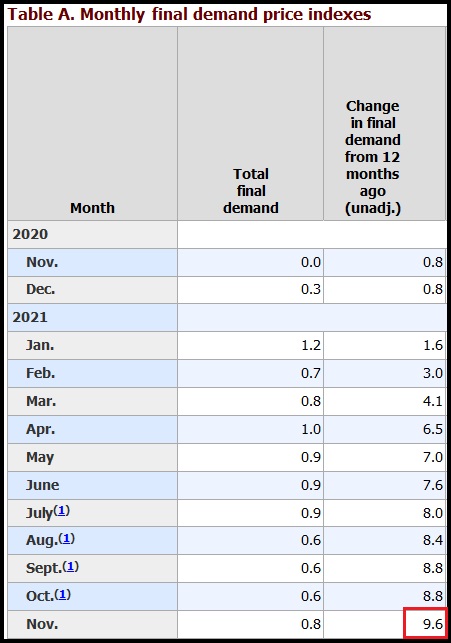
The final product inflation rate in July (reported in August) was alarming at 7.8%. However, we warned it would get worse. The Bureau of Labor and Statistics (BLS) then released stunning price data for October [DATA Here], showing an even more dramatic 8.6% price increase in final demand. More intense warnings shared.

Today, we get the November BLS Result [DATA Here], and unfortunately the results are showing what was expected.  The cumulative costs of massive increases in energy prices are building into the supply at an astonishing rate.  The November data shows a rate of wholesale final goods inflation at 9.6%, the largest single month comparative rate increase in history.

The bureau even went back and revised/increased the August price index from 7.8 to 8.4 percent, and revised/increased the October figure from 8.6 to 8.8 percent.  The average monthly price increase is almost a full percent… every month.  It looks like the BLS backward revisions are an attempt to smooth down the rate of increase.

(BLS) – “The Producer Price Index for final demand increased 0.8 percent in November, seasonally adjusted, the U.S. Bureau of Labor Statistics reported today. Final demand prices moved up 0.6 percent in each of the 3 prior months. (See table A.) On an unadjusted basis, the final demand index rose 9.6 percent for the 12 months ended in November, the largest advance since 12-month data were first calculated in November 2010.” (more)

I modified Table A (final demand product pricing), taking out some of the noise to make it a little easier to see the big picture of what is happening.

When you see the wholesale level of prices almost double the increase in consumer level inflation rate, you can predict that consumer prices will likely go even higher.  Future finished goods, at a retail level, will carry the current wholesale price increase.

Stuff costs a lot now… and because the inbound stuff to make the finished goods is still climbing in price…. stuff is about to cost even more.   You can see this in the inflation rate of intermediate goods which I have highlighted below.

(more…)

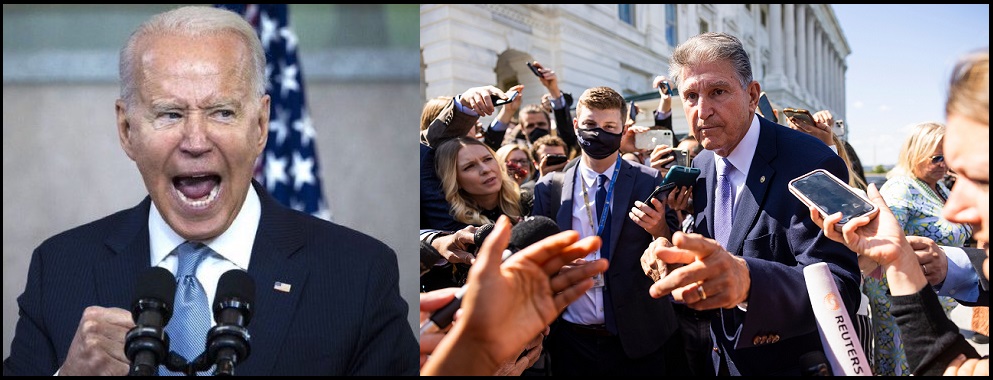
Senator Joe Manchin Not Convinced to Vote For Massive Build Back Better Spending Bill – Curiously WaPo Launches Investigation of Joe Manchin Finances

I’m not confident that Joe Manchin will ultimately hold the line on more spending; however, it is interesting that on the same day Manchin is reported to be casting doubt on more Joe Biden social spending {LINK}, the Washington Post published a hitjob on him around his family finances {LINK}.

Accepting there are no coincidences in politics, it would appear the intelligence agencies are firing a warning shot against Senator Manchin based on his financial connections to the West Virginia coal industry.

(New York Times) – WASHINGTON — Senator Joe Manchin III of West Virginia, the most prominent Democratic holdout on President Biden’s $2.2 trillion social safety net, climate and tax bill, cast fresh doubt on Monday on his party’s plans to speed the measure through the Senate before Christmas, saying he still had grave concerns about how it would affect the economy.

Mr. Manchin outlined his skepticism before speaking by telephone about the bill with Mr. Biden, a discussion that aides to both later characterized as positive. After the call, Mr. Manchin, who represents West Virginia, did not rule out the possibility of supporting the measure this month. He said that “anything is possible here” when asked about a vote before Christmas, and that he was still “engaged” in conversations with the White House.

(more…)

U.S. Consumer Survey Expectations of Inflation at Least Doubling Wage Gains – Middle Class Storm Building

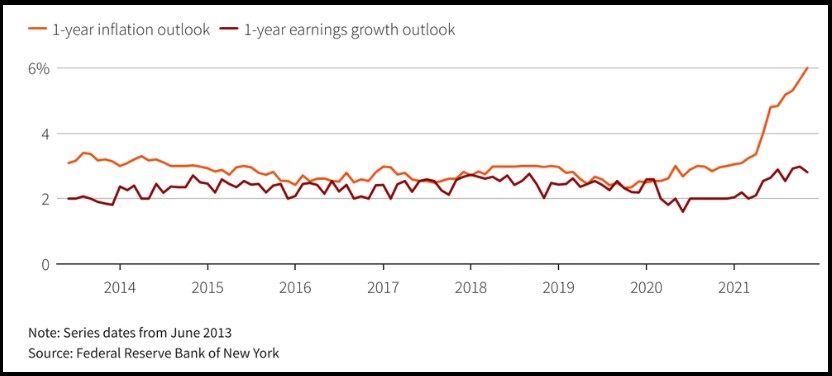
The New York Federal Reserve survey reflects the obvious.  Consumers see staple food and energy price increases far outpacing any wage gains, and the outlook moving forward does not show signs of improvement.

The distance between the inflation line and the wage line is the intensity of the hurricane coming our way.

We are in this very weird place where the politically motivated Fed cannot stop purchasing debt created by legislative spending.  At the same time, the political Fed is going to have to raise interest rates or we will enter an impossible spiral of policy caused inflation.  There are three options:  (1) stop buying debt; (2) increase interest rates; or (3) deploy some COVID mechanism to shut down people and hit the demand side.

Considering that Omicron didn’t work, and further panic pushing does not seem politically viable, that only leaves the two options of the Fed stops buying debt, and/or the Fed raises interest rates. Now, considering that these same political ideologues will not stop pushing the Build Back Better legislative agenda, that means the Fed cannot stop buying debt.  That leaves one option remaining, increase interest rates.

(more…)

Sunday Talk Warning, Mohamed El-Erian Concedes His Economic Views Are Now Contingent Upon Climate Change Driving Policy

Well, there’s another “economist” who can be set into the folder of ‘no longer useful’.  During his appearance today on CBS Face The Nation, Mohamed El-Erian, chief economic adviser for Allianz, finishes his segment by revealing his underlying precept: Climate Change policy is now the economic policy driver of all his investment advice.

Within the interview, El-Erian said the “characterization of inflation as transitory is probably the worst inflation call in the history of the Federal Reserve.”  Additionally, El-Erian said inflation is likely to remain high into the next year and perhaps beyond.  Unfortunately, other than those two points of generally well educated accuracy, everything else is wrapped up in the political correctness of climate change…. which, you don’t really discover until the very end of the interview. WATCH:

The baseline for El-Erian saying the Build Back Better spending fiasco is a good thing, is based on accepting the pretense that massive amounts of federal spending will be needed to structurally change the U.S. economy from fossil fuel use to the Green New Deal.   If you do not believe in this transformation, there is no merit to any component of the BBB spending proposal. It really is that simple.

As a consequence, El-Erian is staking the position that climate change agenda politics is now the focal point from which all other economic policy will be determined.  He has conceded in his mind and worldview, perhaps based on his associations and peer discussions, that any forward economic analysis must therefore establish itself from the alternative fuel position.

(more…)

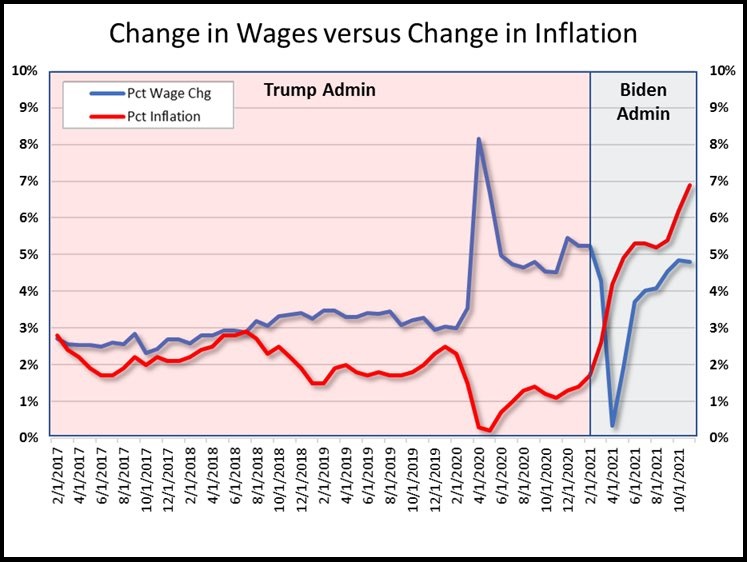
MAGAnomics vs JoeBamanomics, a Simple to Understand Graphic

President Trump economic policy -vs- Joe Biden economic policy

When wages (blue line) are above inflation (red line) our income is growing, life is good and the working class has more disposable income to enjoy life.  However, when wages (blue line) are lower than inflation (red line) our income is shrinking, life is a struggle and the working class has less disposable income to enjoy life.

♦ Point One – Nothing happens accidentally. The road to a “service-driven economy” is paved with a great disparity between financial classes. The wealth gap is directly related to the inability of the middle class to thrive.

♦ Point Two – There is nothing of value behind the obtuse term “service-driven economy.” The multinationals are paying for this administration, just like they paid the Obama administration; paying for economic policy that advances their interests.  Congress goes along with the K-Street demands, because Wall Street is now the primary benefactor of legislative intent. Nothing about their effort is done with American interests in mind.

To go deep, keep reading.

(more…)

Clueless Joe Says Federal Spending Doesn’t Increase Inflation, Reality Begs to Differ

At the most troubling level, Joe Biden believes what people tell him to say for the reason they tell him to say it.  This reality underscores the reason why Barack Obama’s network selected Biden as their disposable front man in 2020.  Biden sounds convinced, because Biden is convinced.  He’s wrong, factually and fundamentally wrong, but he believes what he repeats in public.

The most painfully obvious examples of this dynamic are present when Joe Biden explains economic things based on what other people have told him.  The guy really is the modern personification of the naked emperor parading around to show off an invisible coat that he genuinely believes he’s wearing. The self-deception would be embarrassing except for the fact he is only deceiving himself; so people laugh…. but this is dangerous.

Questioned today about inflation, Joe Biden starts talking about his Build Back Better program.  It really is worth watching to see how oddly emphatic he is in the belief that if government pays for a thing (childcare, healthcare, prescriptions) the cost of that thing somehow mysteriously disappears.

Biden believes that if government subsidizes something there is no longer a cost associated with it.  He believes this.

Setting aside the historic fact/truth that anything government pays or subsidizes ultimately costs more, the real cognitive dissonance in Biden’s worldview is that any cost associate with a ‘thing‘ disappears if the government pays for that ‘thing’.   From that bizarre viewpoint, the disappearance of public expense for that government subsidized thing then creates “deflation”, or a lowering in overall prices.

This claim is abject nonsense.  Truly and genuinely batshit crazy nonsense.

Example.  According to Joe Biden’s talking point: if government pays for college education, the price of a college student’s car drops.  It doesn’t.  To make that claim is absurd in the extreme.   The college student may have more money to pay for a car if they are not paying for tuition, but the car itself doesn’t change in price.

A person may have more money to pay for groceries if they are not paying for childcare expenses, but the price of the groceries doesn’t change.   The inflation on the prices of products at the grocery store does not change just because some families no longer have daycare expenses.   But Joe Biden believes it does.   (more…)

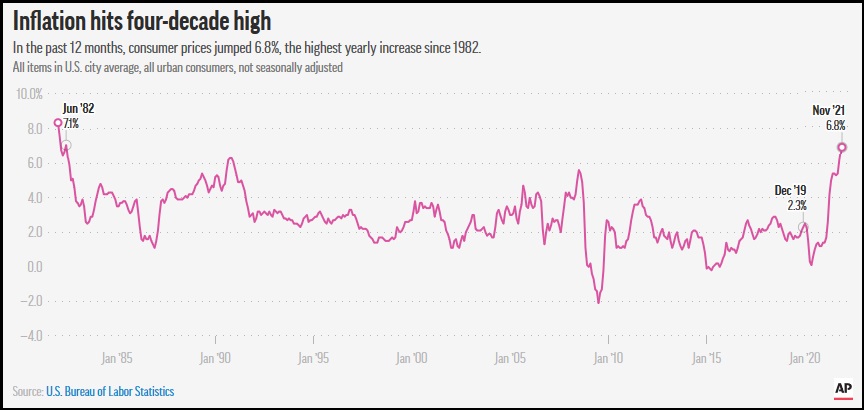
He Did It – White House Celebrates Joe Biden Reaching Inflation Milestone Set By Jimmy Carter, 6.8 Percent and Rising

Joe Biden may be celebrating his historic achievement in reaching an inflationary milestone previously set by Jimmy Carter, but the working class is paying the price for their economic stupidity.

The Bureau of Labor Statistics releases the November inflation rate today [DATA HERE] showing another rise in the annualized rate of inflation of 6.8 percent.  As you review the data, ask yourself this question: ‘Is there anything in the current economic landscape to indicate this is going to stop?’  The honest answer is no.  Here’s why…

As the BLS accurately (albeit briefly) notes, their inflation data reflects the cumulative increases in costs of products and services at all stages in the supply chain.  Raw materials cost more (extraction, regulation impact), processing costs more (energy impact), transport costs more (fuel impact), final goods assembly costs more and handling costs more.  From field-to-fork or mining-to-showcase, the total cost to create stuff costs more. [AP Interactive Chart]

Yes, the inflation data is backward looking. Meaning, it is looking back toward the previous period to compare costs.  However, despite the White House protestations to the contrary, that’s not a good thing, because it is going to get worse.

The contracted price for goods delivered (depending on sector) are net terms in 30, 60 or 90 days.  Meaning, the purchase price on final goods wholesalers are receiving now, were agreed upon months ago.  Those terms for current arriving goods are no longer valid.  The new terms (purchase orders) carry higher costs, and as an outcome higher prices to consumers are still coming.

(more…)

Elon Musk Two Word Response to Congress About Biden’s Build Back Better Spending Bill: “Delete It”

Tesla CEO Elon Musk was seemingly channeling his inner Galt during a video interview with Joanna Stern of the Wall Street Journal at the CEO Council Summit.  Apparently Mr. Musk can see what’s on the other side of this spending horizon and doesn’t want to experience it.  WATCH:

.

The Full Interview is below:

(more…)

Foreboding – U.S. Productivity Declined 5.2 Percent in Third Quarter, Largest Quarterly Drop in 61 Years

U.S. nonfarm productivity is a measure of economic activity within the engine of the U.S. economy.  The U.S. productivity rate is a measure of how much value is produced by the economy through demand for the products and services, and the labor associated with the creation of those products and services.

I have often used the example of making bread {Go Deep}.  If you are making 10 loaves of bread, there is a set amount of cost associated with each loaf created.  The total cost of each loaf is the total cost to produce the entire batch divided by ten. However, if you have customers demanding 15 loaves of bread, you make more profit on the last five because it doesn’t cost 50% more in material or labor to make 50% more loaves.

Your productivity in the last five loaves is higher because the fixed costs of production (raw materials, energy) barely change, and the labor is only slightly higher.  The opposite is also true.  It costs more per loaf to make fewer than ten loaves because the fixed costs and your labor are pretty consistent, yet the finished value of 7 loaves is less than the finished value of ten.

Anecdotally, it has looked for quite some time that around May of this year the economy peaked, plateaued for a few weeks, and then began a slow downward progression.  Today the Bureau of Labor statistics puts some revised data to that third quarter (July, August and Sept) economic activity {data here}.  The quantified results align with what we sensed was taking place.

(more…)