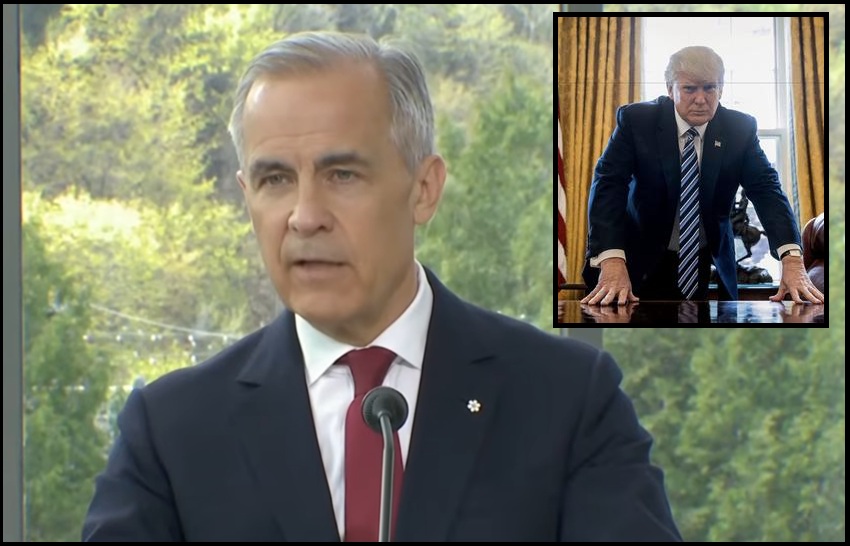
Susan Kokinda from the Promethean Action PAC believes the USMCA tariff and trade issue is not a simple U.S–Canada dispute; rather it’s a broader conflict about U.S. sovereignty vs the British empire.
Kokinda points to how Canadian Prime Minister Mark Carney is staffing his government with figures tied to the British Crown and globalist institutions: trade minister Dominic LeBlanc also leads King Charles’s Privy Council, new Chief Operating Officer Maia Johnson is an American Democratic operative linked to Clinton and Bloomberg networks, and new the Governor General Louise Arbour comes from UN legal roles associated with the International Criminal Court.
Promethean Action believes that under Prime Minister Mark Carney, Canada is not a nation, it’s the new front for the British Empire, and President Trump’s new Canadian tariffs should be viewed through this prism. WATCH:
Ontario Premier Doug Ford has a message to President Trump and to all Americans. Premier Ford promises to dismantle the U.S. economy if President Trump continues to threaten tariffs and trade sanctions.
Considering the economy of the USA is ten-times larger than Canada, that’s quite a threat from Premier Doug Ford. WATCH:
.
Personally, I think all this back-and-forth banter is no longer worth the surface effort. It would be much easier, and now affirmed as constitutionally appropriate by the Supreme Court, if President Trump just executed a full trade embargo against all Canadian goods for a period of 60-days.
Perhaps that way Canada will recognize just how vulnerable they are. Perhaps not, but it’s worth the effort. Just ban all imports and exports for 60-days and let’s see what happens.
Things are going to escalate very quickly now as the midterm election looms closer and various interests start to take their lane against President Trump and the economic position of the United States. There are trillions at stake.
Canadian Prime Minister Mark Carney was asked about the latest Sec.338 tariffs levied by President Trump and USTR Jamieson Greer. Carney said he and U.S. President Donald Trump agreed to intensify trade negotiations following a phone conversation earlier this morning.
While the phone call likely did contain that sentiment, USTR Greer was clear on CNBC today that Mark Carney is simply not telling the truth. The babble from the Canadian side is nothing of substance and just repeats the same nonsensical claims about agreeing to things that are not in conflict.
Speaking to reporters in Ottawa, Prime Minister Carney said both sides would step up discussions in the coming weeks despite Trump’s latest tariff threat against Canada. He added that all options remain on the table if the United States proceeds with new tariffs. WATCH:
.
Below is how President Trump responded to questions about the motive for the new tariffs.
In the first half of this CNBC interview with U.S. Trade Representative (USTR) Jamieson Greer, the Ambassador walks through the reasoning, purpose and intent of the recently announced 50% tariff rate against Canadian imported goods.
As noted by USTR Greer the Canadians are applying two separate metrics within their trade agreement with Europe and the USA. Toward Europe there are no limits and quotas on dairy products, toward the USA there are severe limits and quotas applied by third party brokers (co-ops owned by Canadian dairy farms) leveraged by the Canadian government. This is one example of Canadian duplicity.
Additionally, by the various provincial governments of Canada banning the import and/or sale of U.S. products, and with Canada putting caps and limits on automobiles, these USA trade actions are being confronted by the 50% countervailing duties against Canadian imports. Greer also calls ‘bulls**t’ on Carney’s double speak. WATCH:
The trade discussion with Canada returns at the 10:00 minute mark. Jamieson Greer notes we have always had trade issues with Canada for decades. There was a significant percentage of the population who are against offshoring jobs, which is what NAFTA essentially did in North America.
It is also worth emphasizing that President Trump wants Canada to diversify. Both U.S. Ambassador Pete Hoekstra and President Trump have said, repeatedly, President Trump wants Canada to go make other bilateral deals with other nations.
It is very obvious from the construct and details of this announcement that U.S. Trade Representative Jamieson Greer has completed a comprehensive review of the retaliatory action by Canada that followed the U.S. Section 232 tariffs on Steel and Aluminum. {FACT SHEET HERE}
Last year two countries retaliated against the U.S. for the 232 (steel and aluminum) tariffs, China and Canada. The USTR office has now quantified the tariff and non-tariff barriers triggered by Canada in 2025 and provided President Trump with a financial quantification of the trade impact.
The three Canadian retaliatory sectors highlighted include: (1) Alcoholic Beverages, (2) Motor Vehicles, (3) Dairy Products. These are the three segments quantified by USTR Greer that form the baseline for the U.S. to retaliate with countervailing duties.
Effective 30 days from now, August 16, 2026, President Trump has established a 50% tariff rate against a wide variety of Canadian imports. Essentially three major Annexes: {LIST 1 – LIST 2 – LIST 3} under the authority of Section 338.
♦ Section 338 authorizes the President, if he determines it will serve the public interest, to offset any burden or disadvantage placed on the commerce of the United States by an unequal imposition or discrimination by a foreign country by specifying and declaring additional duties not to exceed 50 percent ad valorem (or its equivalent) and not to take effect earlier than 30 days after the President’s proclamation finding that a foreign country imposes an unreasonable charge, exaction, regulation, or limitation that is not equally enforced on the like articles of every foreign country, or discriminates in fact against U.S. commerce in a way that places the commerce of the United States at a disadvantage compared to the commerce of any foreign country.
Secretary of State Marco Rubio speaks to reporters ahead of his trip to Manila, Philippines. Secretary Rubio is departing from Joint Base Andrews to attend the 59th Association for Southeast Asian Nations (ASEAN) Foreign Ministers’ Meeting set to take place this week.
Secretary Rubio spoke about a number of topics and was questioned about the ongoing Iran conflict in the Middle East. This comes as the United States continues to launch attacks on Iran through the weekend. WATCH:
.
Within the interview there was a question about the FIFA World Cup attendance by President Trump, Prime Minister Carney and President Sheinbaum; essentially about relations. Secretary Rubio interestingly notes that Sheinbaum attended despite having significant challenges in Mexico right now. The tone and intonation of the remark imply something much more significant happening in the background than is currently visible to the general public. Worth watching.
Something serious is happening within Mexico that is straining/complicating our broader geopolitical support for the Sheinbaum administration. Recent events have not made headlines, but what Rubio notes is likely related to a significant shift in cartel activity. {SEE HERE} and {SEE HERE} and {SEE HERE}.
Smoke from the wildfires in Ontario is blanketing parts of the U.S, creating a serious problem for Americans. President Donald Trump said Canada will be held responsible for the air pollution drifting into the U.S., adding he would “call the Prime Minister during the day to find out what they are going to do about it.”
In an interview with an avowed Canadian leftist, U.S. Ambassador to Canada Pete Hoekstra affirms President Trump’s latest tariff threat is the position of America and describes Trump’s comments as a call to action to address the issue of forest fires and smoke. Additionally, Hoekstra notes FIFA is currently evaluating air quality to determine their position on allowing the World Cup final match in New Jersey to continue. WATCH (Prompted):
President Trump pointed out Canada’s forestry mismanagement and their failure to follow through with previous promises of investment that have led to catastrophic wildfires now producing smoke streams making U.S. Northern cities and states live under dangerous conditions.
Prime Minister Mark Carney was asked about the U.S. government position, and he immediately hit back by saying the cause of Canada’s wildfires is ‘climate change’ and President Trump’s unwillingness to support the Paris Climate Treaty has created the problem that Canada is now dealing with.
In short, according to the official policy of the Canadian government, their wildfires are caused by Trump’s refusal to accept global “climate change” policies. WATCH:
It should be noted that Canada clutches its pearls, claiming the USA should send “support” to assist Canada fighting wildfires instead of blaming them for mismanagement. However, reciprocity is a big problem.
Most of the firefighting takes place as an outcome of private-public contracts for costs. {SOURCE} The Canadian government blocks U.S. companies from fighting fires in Canada because the Canadian government wants to only pay Canadian companies and workers. U.S. firefighting is not allowed to assist in Canada and get reimbursed.
Conversely, the Canadians quickly want to come to the U.S. to fight fires because the USA reimburses firefighting companies at a higher rate than Canada. [SOURCE] The USA has no federal restrictions on Canadian firefighting assistance.
Canadian firefighting professionals would rather fight forest fires in the USA because they make more money. There is no incentive for U.S. firefighting professionals to volunteer their time and effort without getting reimbursed; which is the position of Canada.
In essence, come to Canada and fight our fires for free because we will only pay Canadians. However, also, let our Canadian firefighters come to the USA and make money. {SOURCE} It is a very Canadian argument.
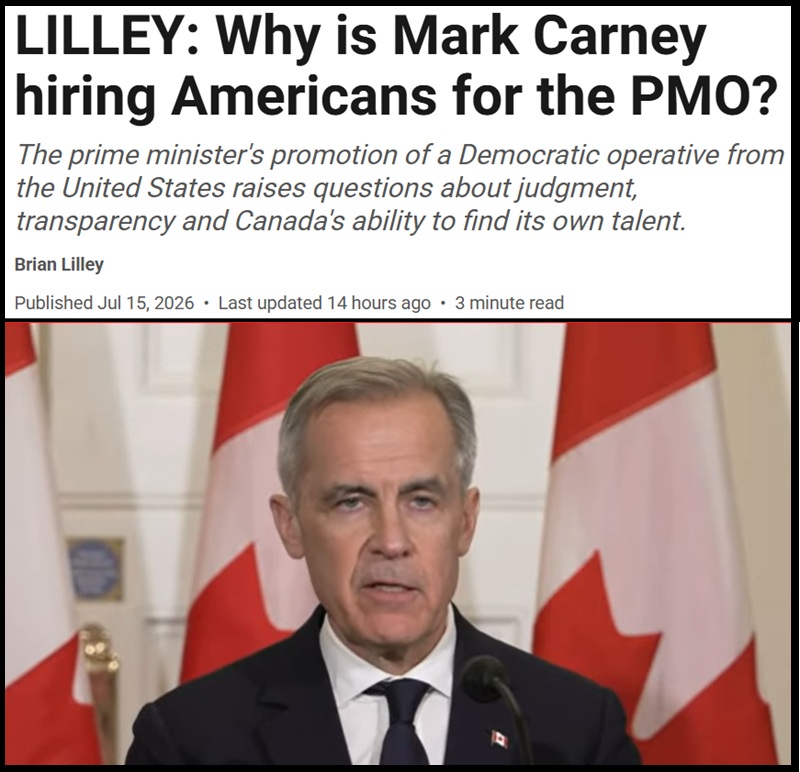
Previously, Mark Carney and the Canadian govt famously fired Air Canada’s CEO because he shamefully didn’t speak French. This week he hired American, Maia Johnson, as his Chief Operations Officer (COO), she also doesn’t speak French and the Canadians are perplexed.
Hired by Prime Minister Mark Carney, the role of Democrat party operative and former Michael Bloomberg associate, Maia Johnson, seems directly related to the strategy of leveraging U.S. Democrat resistance against the CUSMA (USMCA) termination.
[Note: Mark Carney and Michael Bloomberg connect through their banking and finance network with prior associations. This relationship also connects to U.K Mayor Andy Burnham who is likely to become the next U.K Prime Minister to replace Keir Starmer.]
Readers to CTH likely remember in 2018 former Prime Minister Justin Trudeau leveraged Democrat House Leader Nancy Pelosi to regain position in the USMCA negotiations (NAFTA elimination) with USTR Robert Lighthizer.
It appears that Carney is attempting a similar maneuver through the connections of Democrat operative Maia Johnson.
Specifically, because positioning American resistance to the CUSMA (USMCA) termination is a key part of the Carney strategy, a COO from U.S. Democrat politics is the best strategic approach. A Canadian in that role would be of far lesser value.
TORONTO SUN– […] This week, it was reported that Carney was promoting a woman unknown to most Canadians to the position of chief operating officer in the PMO.
It appears to be a first for Canada to have a COO in the PMO, but it’s who the woman is that is truly interesting.
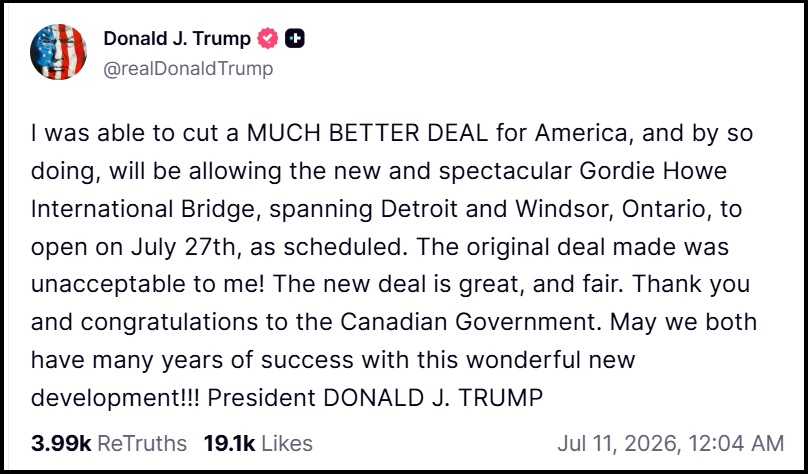
The issue was never really about Canada tolling; the real issue was about ‘cost overruns’ against the backdrop of how the tolling revenue was being used for repayment to the govt of Canada. It’s a rather sticky situation.
The Canadian government backstopped the financing of the bridge construction. The deal was that Canada would use tolling to pay the govt back and subsequent tolls would split 50/50 with U.S. However, cost overruns made the Canadian payback a little less clear as the govt expected more revenue than originally proposed. Sketchy.
The deal currently being revealed as a compromise includes an immediate 50/50 split where Canada gets 50 per cent of the toll profits — after operational expenses — and the other half will go to a U.S-run regional development project for a 15-year time frame.
According to Global News, “The agreement also requires the Windsor-Detroit Bridge Authority to consult the U.S. on any toll changes greater than 10 per cent, the source said, or if it’s looking to lower tolls below those of comparable regional averages.” Additionally, in Politico“they will guarantee and ensure that we’re not pouring Chinese cars over that bridge.”