Quantcast

Worsening Food Price Increases Gain Global Attention – UN Food and Agriculture Organization Tracks Highest Prices Ever Recorded

The UN Food and Agriculture Organization reported on Friday they are recording the highest Food Price Index since they started recording thirty years ago. With record highs in prices for cereals, vegetable oils, dairy and meats

This issue has been a slow burning fuse toward the biggest powder keg in modern history, and it is about to get very serious.  We have been warning about it since last fall {Go Deep}.  In the most deliberate and painstaking ways possible, we have been urging everyone to take this issue seriously.

The background cause is complex and started with the 2020 government response to the pandemic.  U.S. and international government intervention in the food supply process has been FUBAR from the beginning. Every action taken since early 2020 has been one bad policy after another; building failure upon failure, crisis upon crisis, bad decision upon bad decision, bringing us to a precipice summed up by saying “the absence of food will change things.”

Some will say the food prices we are about to experience –and the crisis it will create– was deliberate.  Others will say this was the cumulative outcome of major failures on the part of the government.  At this point the former makes more sense, and the latter looks like a justification and excuse, because if government entities were really serious about food prices and shortages, they would be taking pragmatic steps to mitigate the problem; they are not.

There are simple things government could do, such as helping farmers offset targeted fertilizer costs, providing relief for diesel fuel and energy costs, and taking other simple steps that would help the agricultural industry.

Instead of responding with the urgency this would demand, the collective government action has been to ignore the problem (talk soundbites), and give speeches about using subsidies to offset the end result (consumers) – without ever addressing the root cause.  All this while fueling conflict in Ukraine and chasing radical energy policies under the guise of global climate change.

The UN Food and Agriculture Organization (UNFAO) keeps track of food prices and projections using a global index [SEE HERE].  What they are calculating, and what they are projecting based on the current calculations, is a major increase in food prices combined with a major increase in food scarcity due to the unaffordability of food products.

(more…)

Sri Lanka Inflation and Food Crisis Results in Widespread Social Chaos

I have stated for the past year ‘the absence of food will change things‘.   The inflation and food affordability crisis has now surfaced in Sri Lanka. Global media is paying attention, even sending out warnings about what this might represent for other nations.

Sri Lanka has a debt to GDP ratio of 120%, approximately the same as the United States.  However, Sri Lanka does not have the benefit of their currency being supported as the global trade currency; therefore, the debt and domestic inflation rate are directly tied together.

The rate of food inflation in March has exceeded 30%…. the absence of the public being able to afford food has now surfaced and the government is collapsing.  Read the news from Sri Lanka through the prism of what could happen in U.S. cities if we lose the dollar as the global trade currency.

(Via Reuters) – Reuters Breakingviews) – Sri Lanka’s collapse is front of mind for many. Protesters fed up with crippling shortages of essential food and fuel items are on the streets, prompting multiple members of Prime Minister Mahinda Rajapaksa’s cabinet to offer to resign late on Sunday.

Social unrest will probably accelerate a restructuring of some $44 billion of international sovereign debt. Though Sri Lanka’s problems follow years of mismanagement, its speedy unravelling is a warning to sturdier economies from Europe to Asia suddenly grappling with a spike in the cost of living.

(more…)

MSM Catching On, Now They Call It Food Protectionism as Hungary, Argentina, Moldova and Turkey Ban Grain Exports

Again, they are blaming this on the Ukraine-Russia conflict, but the origin of the issue goes back much further.

Last year, CTH was one of a small number of people talking about the very real possibility of food shortages due to the cumulative effects from regulatory COVID mitigation and the fracturing of the food supply chain that government intervention created. {Go Deep}

What we are witnessing now is not as much attached to the Ukraine crisis, as it is the continued ripple effects in that same supply chain.

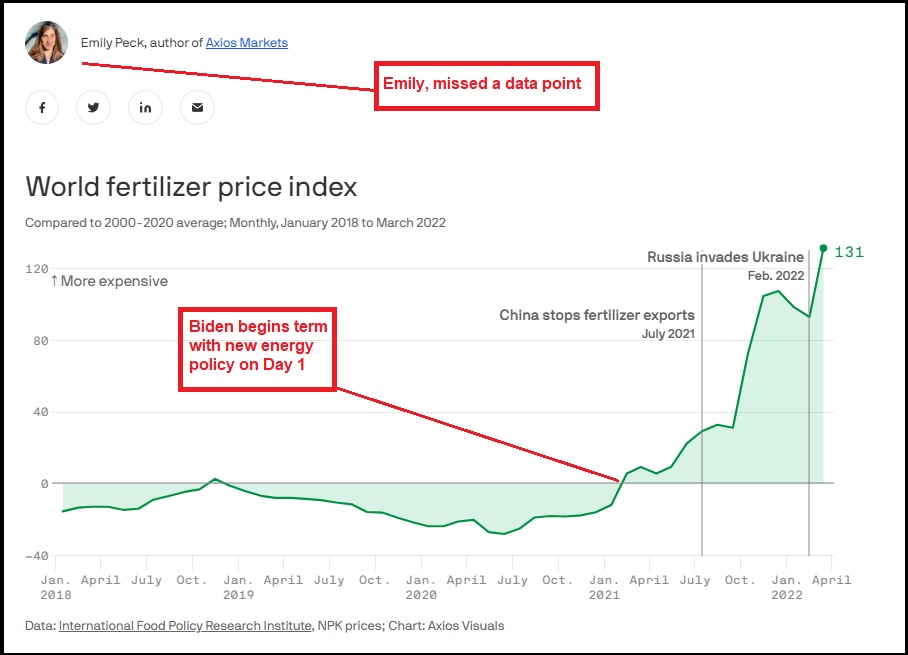
The current grain issues are an outcome of a major supply chain disruption on the manufactured and processed food side, which is now exacerbated by higher replenishment costs and lower yields. Fertilizer costs have skyrocketed due to energy cost increases.

It is a perfect storm.

Without the Ukraine crisis surfacing, the grain (wheat, corn, soybean) and supply chain issues were already going to be a problem, and many of these current mitigation efforts -wrongly being attributed to Ukraine- would have taken placed without any regional conflict.  That’s why we predicted these issues last year, long before Ukraine-Russia was in the headlines.

The thing to keep in mind is that some smart governments, especially those nations where the government controls and monitors the food industry, can see these issues long before they surface.  If CTH could see these multinational food issues last year, you know the governments of China and Russia could also see them coming.  Some might even argue they gamed out the problem and are taking advantage of it right now. {Go Deep}

(more…)

Fed Hopes Inflation Moderates As Interest Rate Hikes Are Triggered

Whenever we discuss inflation, it is absolutely critical for people to understand that inflation itself is the measure of the percentage increase in a price over a period of time.

It is entirely possible, I would say absolutely guaranteed, that prices will increase even more this year as inflation begins to drop. This will be the economic story on the backside of the inflation hurricane as the Fed starts to increase interest rates. Example:

2021: A loaf of bread increases in price 50¢ from $1.00 to $1.50, a rate of inflation of 50%.

2022: That same loaf of bread increases in price by 60¢, from $1.50 to $2.10, a rate of inflation at 40%.

The price of the bread increased more in 2022 than 2021, but the rate of inflation dropped from 50% to 40%.

The White House and Federal Reserve state, correctly, that inflation is likely to drop.  However, the actual prices of the products are rising at a greater rate. This is the critical component of the inflation story that will remain with us throughout 2022.  Inflation is not measuring the increase in the price of an item.  Inflation is measuring the rate of the price increase as a percentage.

This is the context for the Federal Reserve to state today, they “hope” inflation slows down, because they are going to raise interest rates regardless of what is happening with the price of goods and services:

(more…)

Multinational Controls Over Commodity Inventory Continues to Drive Inflation Even Higher

People are starting to catch on.  First, how it is surfacing:

(Zero Hedge) ...”traders are paying bumper premiums for immediate supply” … “Commodities are severely undersupplied” … “The shortage of, well, everything has translated into record price of virtually all commodities: the Bloomberg Commodity Spot Index, which tracks 23 energy, metals and crop futures, has touched a record this year. That has been driven in part by surging oil prices, which have hit their highest level since 2014.” (read more)

CTH readers are specifically well positioned to understand what is happening in the background we have discussed two specific issues:

(1) In any era of hyper-inflation, we always see the advanced purchasing of inventory for profit.  Meaning, when prices are quickly rising multinationals use their size and power over commodity goods to store, physically or through contracted future purchases, goods that are held until a specific target price is reached and then sold for a bigger profit.  In 2022 the “supply chain disruption” is being used as a cover.

(2) In the modern era, the major multinationals control the supply of originating products.  There’s no such thing as a free market. In the modern era it is a controlled market.

Long before the word “inflation” hit the 2021 headlines, April/May of last year, CTH specifically identified where we are right now.

In the background right now, the multinationals are exploiting the two issues above.  The Zero Hedge article “Shortages of Everything” is discussing the surfacing symptom, i.e. goods traders willing to pay premium prices to secure inventories, not necessarily the root cause.

(more…)

Another 4.3 million U.S. Workers Quit in December

The latest BLS Job Openings and Labor Turnover (JOLT) report [DATA HERE] reflects a headline of 4.3 million U.S. workers quitting in December.  However, that number is 161,000 fewer quits than November. The job openings are starting to fill up.

While there is evidence the mandatory vaccine requirements are still working through the job market, we are still about another month away before the fog clears from the private sector employment data.

This Friday we will see the unemployment data from December, but in the interim this JOLT’s report is tracking with CTH expectations.

The primary driver of the quits rate has been inflation.  Workers seeking higher wages in an effort to deal with inflation can get faster paycheck results by switching jobs rather than asking current employers for more money.

We have been watching this trend for several months.  However, the rate of job-jumping is slowing down as the available jobs to jump into are fewer, and the vaccine mandate impact is settling down.

Despite the number of job openings, blue collar workers are starting to see job vacancies decreasing.  The service industries around accommodation, food services and basic dirty fingernail positions still have many vacancies; this is the epicenter of where the job jumping takes place. Employment in durable goods manufacturing is at that phase where things are about to get sketchy for tradespeople and union workers.

The white collar jobs are static and/or slightly downsizing.  The total number of hires was 6.3 million for December, a drop of 333,000 from prior month.  The number of people hired in professional and business services dropped by 159,000.

(more…)

Not a Joke, U.S. Govt Takes the Official Position There Is No Food Inflation

The same people who told us to appreciate saving $0.16 on our July 4th BBQs last summer are now taking the official position there is no massive food inflation.  [DATA HERE]

Those skyrocketing prices you think you see at the grocery store are not real.  Those announcements of forecasted price increases by the food producers, well, those are not real either.  So sayeth the United States Dept of Agriculture (USDA).

In their update to the USDA pricing forecast and analysis dated January 25, 2022, the USDA claims: “2021 retail food price inflation continued at same pace as 2020 but varied among food categories.”  Oh, but it gets even more stupid:

“USDA, Economic Research Service (ERS) researchers project that prices for food-at-home, or food purchased typically from grocery stores or other food stores, will increase between 1.5 and 2.5 percent in 2022, lower than the 3.5-percent increase that occurred in both 2020 and 2021. Forecasts for all food categories for 2022 are available in ERS’s monthly Food Price Outlook data product, updated January 25, 2022.” (link)

If there was ever an argument that every single institution in the U.S. government was corrupt, manipulative and ideologically bent, this claim by the USDA would be a case study in the supportive evidence.

Apparently, if you are to follow the outlook of the USDA – and reconcile their institutional hypocrisy, Joe Biden increased the rate of food stamp assistance by 25 percent for some unknown reason.  Because according to the Dept of Agriculture, “Retail food prices increased by a mere 3.5 percent in 2021, equal to the rate in 2020.”

3.5% ?

You just cannot make this up.

(more…)

Kraft Heinz Announce Next Wave of Fulfillment Price Increases Up to 30 Percent

Last year, when CTH discussed the original Kraft-Heinz wholesale notification for January 2022, we warned it was only the first round.  The reason for waves of price increases is specifically, because each of the processed food categories is impacted differently depending on the amount of processing involved.  Each category is different.

This understanding is why we warned everyone in October of last year to make as much preparation as possible for waves of food inflation.  The original notification for contracted terms in 30, 60 and 90 days was +20%.  Meaning this month, on those group and sectors, prices to retailers went up by 20%, and you are seeing that in the supermarket now.

For the next wave, Kraft-Heinz is telling wholesalers the fulfillment shipments arriving in March will be up to +30% on the next categories.  Oscar Mayer proteins will be the biggest increase at the top end (+30%), Maxwell House coffee on the lower end (+5-10%) and the juice and drink category around +20%.  [A $5 beverage pack will cost $6 in a few short weeks.]

The processing sector is still dealing with cumulative cost increases.  The fulfillment terms are still catching up with the increased costs.  These announcements are ON TOP OF the current price increases we are feeling.  We are entering hyper-inflation.

If you look at the notification timing from Kraft foods, January 24th, you will see the categories we predicted to come next are the exact categories being outlined in this wave.

(more…)

Working Class Americans Expect Higher Inflation, Fed Announces March Rate Hike, Economy in Quagmire

A Gallup news survey [DATA HERE] indicates that eight out of ten Americans expect higher prices and continued rising inflation, as the working class can see the through the smoke and mirrors of the Biden economy.

Overall, there are multiple datapoints that show the economic quagmire that is taking place right now.  Gasoline continues to rise in price, as oil costs continue to skyrocket as an outcome of Biden energy policy.  Food store prices have only just begun to show the higher prices that are built into the replenishment process.

Newly arriving goods overall are at a much higher price that previous inventory.  The 30, 60 and 90-day terms of purchase order fulfillment are now reflecting the cumulative cost increases at every stage in the supply chain.  Inbound prices to retail are still climbing. This is an economic quagmire created by inflation that cannot be avoided.

Fuel, food, home energy and home prices overall are rising.  As a result, durable good spending has contracted.  CTH has pointed out this dynamic for almost five months; however, the actual data is difficult to extract, because the scale of government spending in 2021 has clouded all of the economic indicators.

The official government inflation statistics at 7 to 9% do not accurately reflect the real inflation being felt by consumers, which is in the 25 to 40 percent range for highly consumable products.  If you look around your local community, it is not difficult to see that working class Americans have modified all of their spending priorities to deal with the food, energy and housing inflation that cannot be avoided.

(more…)

Calgary Starts to Feel the Pain of U.S-Canada Government Vaccine Mandate on Truckers

It has only just begun.

Effective today, all U.S. and Canadian cross-border truckers must show their vaccination passport in order to deliver their loads.  Approximately 15% of Canadian truckers and approximately 50% of U.S. truckers are not vaccinated.   The logistics and distribution of food supplies into and out of Canada are collapsing.

Pay attention to the scale of impact in this example.  It will only take a few days for this to go from a problem to a full-blown crisis of epic proportions.

CALGARY –  “For the product to be right there and not being able to touch it, we’ve never seen it before in the 12 years that we’ve been open,” he said. “The U.S. is full of product, and we just can’t get it up here.”

The produce warehouse in Northeast Calgary routinely received two or three trucks a day to restock their shelves. Now, when they are attempting to import 80 to 90 per cent of their stock from the U.S., they are lucky to get one truck every two or three days.

(more…)