Quantcast

August Wholesale Inflation Drops -0.1% as Manufacturers and Suppliers Absorb Tariff Costs

The financial punditry are verklempt, puzzled and perplexed as the wholesale inflation rate calculated by the Bureau of Labor and Statistics Producer Price Index [DATA HERE] shows a drop in PPI of -0.1% for August.

Despite the pundits claiming the Trump tariffs were going to drive up prices, the data shows the manufacturers of products are absorbing the majority of the tariff costs, the importers are absorbing the remnants and the consumer prices are not reflecting the tariff.  Go figure!

[DATA HERE]

Exactly as expected, the wholesale price of tariffs are being offset by production cost reductions by the export dependent manufacturing companies overseas.  This is exactly what took place in the first term, and the situation is duplicating even with higher tariff rates.

Export dependent nations are squeezing their own productivity, their governments are subsidizing the critical industries and the tariffs are being absorbed before they even leave the docks.   This is the USA “rust belt” in reverse.  The same scenario played out in the USA for decades as domestic manufacturers tried to retain U.S. industry.  Now the foreign countries are experiencing their own economic squeeze.

(more…)

Trump Administration Files IEEPA Tariff Appeal to U.S. Supreme Court – Asks for Expedited Review

U.S. Solicitor General D. John Sauer has asked the Supreme Court to accept the case by next week, hear arguments in early November and “expedite” its ultimate ruling “to the maximum extent feasible.” [Appeal Here] with [Expedited Review Request Here]

[SOURCE]

From the request for expedited consideration, “The en banc Federal Circuit’s erroneous decision has disrupted highly impactful, sensitive, ongoing diplomatic trade negotiations, and cast a pall of legal uncertainty over the President’s efforts to protect our country by preventing an unprecedented economic and foreign-policy crisis,” Sauer notes.

Adding comments from Treasury Secretary Scott Bessent, “The recent decision by the Federal Circuit is already adversely affecting ongoing negotiations. World leaders are questioning the Presi-dent’s authority to impose tariffs, walking away from or delaying negotiations, and/or imposing a different calculus on their negotiating positions.”

(more…)

U.S. Attorney Jeanine Pirro and Federal Officials Announce Massive Bust of Precursor Chemicals Bound for Mexico

U.S. Attorney Jeanine Pirro joined multiple members of local, state and federal law enforcement agencies to announce what they’re calling “the largest law enforcement bust of precursor chemicals bound for a foreign terrorist organization.”

The press conference is below, and this is the underpinning of the IEEPA. WATCH:

.

(more…)

Peter Navarro Discusses Stakes with Upcoming Supreme Court Review of IEEPA Tariffs

Peter Navarro, President Trump’s top trade and manufacturing policy advisor, speaks to pool reporters outside the White House.

Within his remarks about the economy overall, Navarro then breaks down the issues soon to come before the Supreme Court surrounding the use of the IEEPA (International Emergency Economic Powers Act) to enact defensive trade tariffs.

Navarro also addresses the false premise that tariffs create imported inflation.  As reflected in the 2018 tariff outcome, the exporting country absorbs the majority of the tariff impact.  Additionally, the tariff rate is applied to the wholesale price as contracted by the importing company in the USA.   WATCH:

.

(more…)

Federal Appeals Court Rules 7-4 IEEPA Tariffs Unlawful, Decision Qualifiers and Narrow Application – Tariffs Remain Pending SCOTUS Review

There are trillions at stake. The current 7-4 decision from the U.S. Court of Appeals for the Federal Circuit surrounds a May decision by the U.S. Court of International Trade. The original case concluded that President Trump exceeded his authority under the 1977 law he invoked to impose both the fentanyl trafficking tariffs and his worldwide tariffs, the International Emergency Economic Powers Act (IEEPA). [SEE RULING HERE]

We are not addressing whether the President’s actions should have been taken as a matter of policy. Nor are we deciding whether IEEPA authorizes any tariffs at all. Rather, the only issue we resolve on appeal is whether the Trafficking Tariffs and Reciprocal Tariffs imposed by the Challenged Executive Orders are authorized by IEEPA. We conclude they are not.”

It is obvious the Democrat appointed majority are tenuous in their position.  No one doubts the presidential power to declare a national emergency.  To wit, the ruling highlights a very nervous court with much of the language straddling the fence trying not give the impression they are interfering in Article II presidential powers to make foreign policy decisions.

Unelected judges restricting the power of the Executive Branch, and by extension restricting a President elected by the majority of the nations’ citizens to address a national emergency, is not a construct supported by the Supreme Court.  The six activist judges on the federal appeals court panel seemingly know this; however, the power of the political -and I would guess financial- pressure compels them.

The court deferred their ruling which will not take effect until Oct. 14, giving the Trump administration time to appeal the decision to the Supreme Court.  President Trump responded via Truth Social.

(more…)

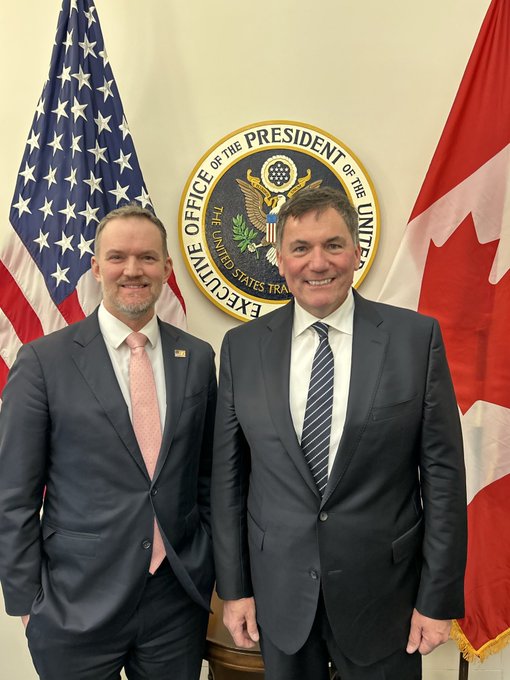
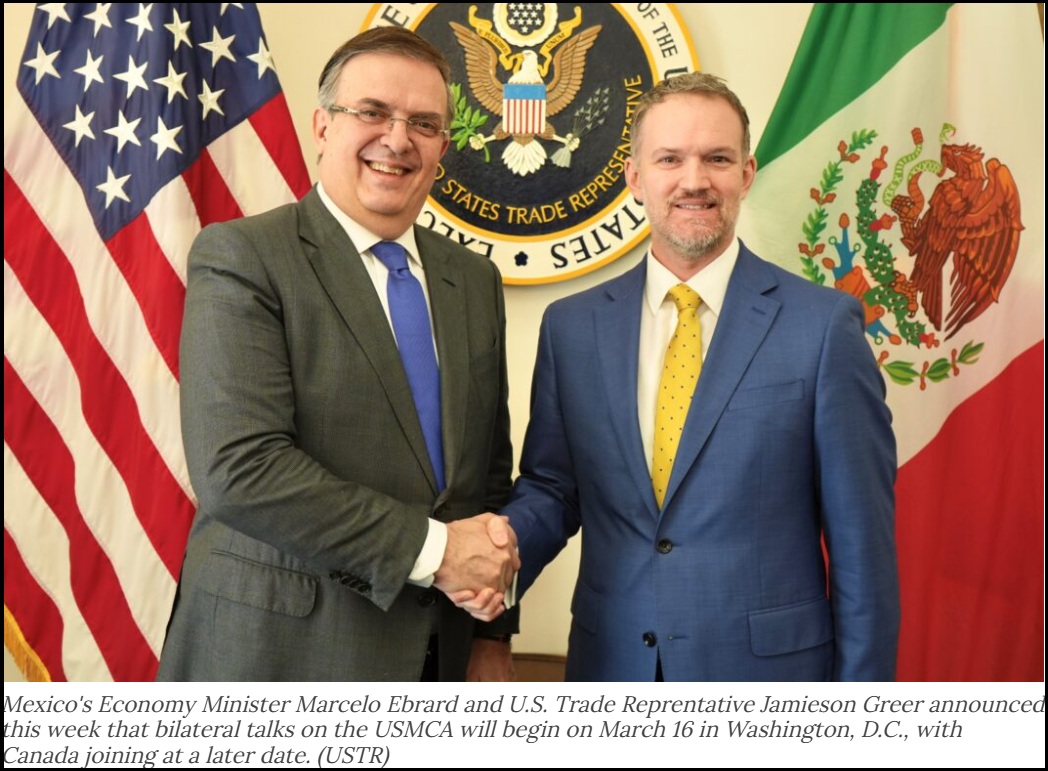
Mexico Is Doing What Canada Is Ignoring – Preparing for 2026 USMCA Renegotiation

There are going to be two major stories in 2026 that we will have full context to understand.  Yes, the 2026 midterm politics are going to lead the headlines, but two other issues will have considerable impact.

The first, is the FISA (702) reauthorization, and there is a lot that will surface in the next several months likely to upend the best laid plans of the administrative UniParty [Tulsi Factor].  The second, is the USMCA reauthorization – the end of the trilateral trade agreement, and the structural shift into two separate free trade agreements.

As to the latter issue, while Mexico and Canada are currently in a state of economic flux, only Mexico is preparing to deal with the seismic shift that is about to unfold.  Canada is going to be caught completely off guard.

While Canadian Prime Minister Mark Carney is trotting around Europe trying to establish his relevance amid the pro-Ukraine coalition,  Mexican President Claudia Sheinbaum is spending time focused on her domestic economy.

Mexico is preparing to drop significant tariffs on Chinese imports, a proactive move to position Mexico in advance of the upcoming bilateral discussion.

Sheinbaum knows that right now for every deportation ICE executes, her economy is hit as remittances recede. Simultaneously, for every mile of border wall that is completed, the financial dependency model increases.  President Trump’s leverage in the upcoming bilateral trade negotiation against Mexico increases each day, week and month.

Claudia Sheinbaum is smartly focused on trying to get ahead of the issues, while Mark Carney ignores his vulnerability and is about to make Canada naked to the economic weaknesses created by Justin Trudeau.

(more…)

Bureau of Economic Analysis Revises 2nd Quarter GDP Upward to 3.3 Percent Growth

From an initial report of 3.0% to a revised report of 3.3% second quarter growth. [BEA report HERE]  Not a surprise, when we factor in the prediction we presented after the first quarter GDP.

However, it is nice to see the BEA finally admit, “The increase in real GDP in the second quarter primarily reflected a decrease in imports, which are a subtraction in the calculation of GDP.”  I digress.

WASHINGTON (AP) — The U.S. economy rebounded this spring from a first-quarter downturn due to fallout from President Donald Trump’s trade wars.

In an upgrade from its first estimate in July, the Commerce Department said Thursday that U.S. gross domestic product — the nation’s output of goods and services — expanded at a 3.3% annual pace from April through June after shrinking 0.5% in the first three months of 2025. The department had initially estimated second-quarter growth at 3%.

(more…)

India Rejects President Trump Tariff Pressure, Pledges to Continue Purchasing Russian Oil

India is now facing a 50% import tariff against the majority of their goods (electronics and pharmaceuticals exempted). However, Indian Prime Minister Narendra Modi has vowed not to yield to the pressure. Modi said the world was witnessing a “politics of economic selfishness.”

For approximately a decade many western countries including the U.S. have heaped effusive praise on India as corporations viewed the massive Indian population, the world’s largest democracy, as both workers and consumers.  However, after the western sanctions against Russia were delivered, India -a BRICS nation- began pulling back from western alignment and influence.

Western sanctions map against Russia (yellow = agree with USA).

What we are witnessing now is one of the ramifications of the U.S. forcefully putting an “us or them” aspect into the strategic economic relationship, where “them” is Russia.  Currently, India is not flinching.

One could make the argument that undeveloped regions in Brazil, Russia, India, China and South Africa (BRICS) contain the majority of the valuable rare earth minerals and magnets the ‘western’ nations need for manufacturing.  BRICS has a pressure point to apply leverage, but no global trade currency, if the trade conflict escalates.

(more…)

Important Information from Treasury Secretary Scott Bessent

Treasury Secretary Scott Bessent appears on Fox Business to discuss some very important current issues in the world of finance, banking and trade.

Bessent begins by answering questions about the U.S. government taking equity interests in companies that come to the U.S. for support.  Bessent then notes the potential for the Trump administration to construct a taxpayer stake in Fannie and Freddie, before the Treasury Secretary moves on to talk about the trade issues with India.  WATCH:

.

(more…)

Commerce Secretary Howard Lutnick Discusses Parameters for U.S. Govt Stakes in Private Companies

Against the example of the U.S. Government taking a 10% stake in Intel, a private technology company who manufactures microchips, Commerce Secretary Howard Lutnick outlines the parameters where the Trump administration would consider taking a stake in private sector companies.

Secretary Lutnick notes that when a company comes to the U.S. government for assistance or benefit, the government -ultimately the taxpayer- should gain an equity stake in that company.  WATCH:

.

(more…)