In April India said it was hoping to expand its wheat exports from 7 million tons to 10 million. However, as precarious winter wheat harvests reflect lower outputs, they are reversing position and will now block any wheat exports in order to ensure their own supply.
INDIA – […] The announcement drew sharp criticism from the Group of Seven industrialized nations’ agriculture ministers meeting in Germany, who said that such measures “would worsen the crisis” of rising commodity prices.
“If everyone starts to impose export restrictions or to close markets, that would worsen the crisis,” German Agriculture Minister Cem Ozdemir said at a press conference in Stuttgart.
Global wheat prices have soared on supply fears following Russia’s February invasion of Ukraine, which previously accounted for 12% of global exports.
As we contemplate the massive $40 billion transfer of U.S. taxpayer funds to Ukraine, a few things need to be emphasized.
First, congress has decided to pay the salaries, benefits and pensions of Ukraine political officials and citizens. As U.S. citizens try and figure out how to afford housing, gasoline, food and basic goods, congress has decided to subsidize another country. That’s the first point.
Second, as to the pragmatic question of “to what end?” There was a critical point made last week by Defense Intel Agency (DIA) Director Lt. Gen. Scott Berrier, that not a single media outlet or politician discussed. During his briefing to the Senate Armed Services Committee, Berrier was asked “can Ukraine win” the conflict against Russia?
Lt. General Berrier replied: “That is a difficult predication to make. I think where the assessment is at, is a prolonged stalemate should no factor change on either side. In other words, the Russians continue to do what they’re doing, and we continue to do what we are doing for the Ukranians.” WATCH:
The Pentagon assessment is the best that can be achieved is a stalemate. Billions of billions of dollars being poured into Ukraine, and the most likely outcome is a stalemate. More people killed, an endless need for continued money to be poured into the ‘war’, and the best possible outcome is a stalemate.
So, riddle me this, why isn’t the U.S. policy position advocating for Zelenskyy and Putin to enter negotiations for a resolution?
What possible U.S. interest can be advanced, knowing the only outcome is a stalemate, where people are killed on either side and money spent on a proxy conflict that ends in loggerheads at some distant point months from now?
Also, why has no U.S. media outlet or pundit played the remarks and assessment from the Defense Intelligence Agency, so that the American people can understand the intent of U.S. policy?
Comrade taxpayers, as the glorious and esteemed senate move through the procedural hurdles to pass a massive $40 billion spending bill for the U.S. altruistic Ukraine money laundering operation, a fabulous diplomatic envoy consisting of Mitch McConnell, John Barrasso, John Cornyn and Susan Collins travel to Kyiv to meet the magnanimous defender of the international treasury and wealth transfer operation, Volodymyr Zelenskyy.
The magnificent republican leaders went to visit the nicest war zone their bipartisan efforts have created in the past four decades. As the angels of abundance parted the clouds, many congratulations were shared from the delegation toward their generous host and the expressions of appreciation and respect for the generosity were reciprocated. WATCH:
No U.S. border security, no gas money, no grocery money, no infant formula, no voting integrity…. Meh, no problem comrades. We’ve got Ukrainians to support. We are paying the pensions and benefits of Ukraine government officials and Ukraine citizens.
Keep in mind, the politicians are not tone deaf, out of touch or disconnected; they simply do not care. We The People are irrelevant to them.
We are in an abusive relationship with our own government.
The Bureau of Labor Statistics (BLS) released the inflation data from April today [DATA HERE] showing 0.3% increased inflation in April and a continued 8.3% ‘sticky’ inflation year-over-year.
CTH is going to say something slightly unusual, this data is actually worse than expected. The hidden canary in the mine is within this BLS sentence which shows in the statistics, “the index for gasoline fell 6.1 percent over the month, offsetting increases in the indexes for natural gas and electricity.” Remember, these are backwards reflections of price captured in early/mid-April.
The actual price of gasoline dropped 1% in April during the timeframe captured. Yes, there was an actual 18 days in April when gasoline prices moderated and slightly ticked down; however, those prices immediately jumped again late April through today.
Because the BLS puts a 5x weight on the importance of gas [Table A], the 1% temporary drop in gasoline led to 6.1% downward “seasonally adjusted” price pressure.
All of that said, and with the heavy weighting of the gasoline prices considered, the net inflation results barely moved from March (8.5%) to April (8.3%). I modified Table-A to take out the noise. You can see the downward pressure from gasoline and simultaneously the upward price pressure from food, specifically food at home.
This outcome is a reflection of what we have been seeing in the supermarkets and grocery stores.
Texas Representative Chip Roy (CD-21) goes full ultra-MAGA after the House democrats created a $40 billion Ukraine spending bill and then demand an immediate vote for support, or else you’re a Russian sympathizer. WATCH (1 minute):
The republican senate leadership team held a press conference today announcing their support for the priority agenda of Joe Biden and the White House.
As Leader Mitch McConnell noted at the beginning of his remarks, “we all agree, the most important thing going on in the world right now is the war in Ukraine,” and with that statement McConnell announced he and Joe Biden have agreed to advance a massive package of $40 billion to pay the salaries and retirement benefits of the Ukrainian government.
Comrades, you must put aside any stress about how to afford groceries and still fill your gas tank, there are people in the government of Ukraine who need your tax dollars more. WATCH (45 seconds):
No gas money, no grocery money, no infant formula, no voting integrity…. Meh, no problem. We’ve got Ukrainians to support.
Even with dementia I doubt seriously Joe Biden believes the nonsense he read from his prepared script today. Every economy policy the Biden administration has triggered, specifically including the Green New Deal energy policy, has caused massive inflation.
The national average price per gallon of gasoline was $2.33 in January 2021, according to the U.S. Energy Information Administration (EIA). It has increased nearly 84% when compared to the current national average price of $4.28 per gallon {link}. Petroleum and refined gasoline costs are embedded in every aspect of the production economy. Additionally, Biden’s restrictions, and later policies, on natural gas and coal have caused overall energy costs to skyrocket. Again, these are cornerstones of economic inflation.
During a ridiculously obtuse speech today [Full Speech Here], part of which is in the excerpt below, Biden claims there are only two sources of inflation: (1) the pandemic (covid-19); and (2) Russia’s invasion of Ukraine. I often accuse democrats of pretending not to know things, however these false attributions are far beyond pretense, they are purposeful lies. WATCH:
Beyond the claims about inflation, a visible pile of bovine excrement is noted in the sentences around Ukraine grain supplies. Notice there is no supply chain issue pushing thousands of tons of military hardware into Ukraine; however, Biden claims they cannot get grain supplies out of Ukraine. He cannot even see the hypocrisy in his own script.
Sending more than $50 billion in U.S. taxpayer money to Ukraine while those same U.S. taxpayers are crushed under the weight of the inflation that type of spending creates, is beyond blood-boiling. We are currently in an abusive relationship with our own government and Joe Biden is the cognitively challenged, disposable front man sent to the cameras to gaslight the American people.
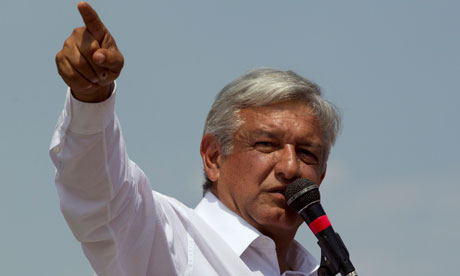
Mexican President Andres Manuel Lopez-Obrador (AMLO) is not wrong on this one. AMLO is calling out Joe Biden for sending $33 billion more to Ukraine, while doing nothing financially in central America which would alleviate the migration pressure.
The article, as written, and general tone from President Lopez-Obrador, are expressed from the perspective that Biden has his foreign policy problem solving emphasis on the wrong syllable.
Put that level of subsidy into support within Central America and the migration issue would correct. Unfortunately, as more people are becoming aware, the location of Biden’s financial emphasis is a feature of the White House plans, not a foreign policy flaw.
Ukraine is viewed as a priority because the DC politicians and corporations gain financial benefit from Ukraine spending. If Biden were to drop $30 billion in central America, it would impede the White House agenda to keep the southern border crisis going. The border collapse is a goal of the White House, not a mistake.
GUATEMALA CITY — Mexican President Andrés Manuel López Obrador started a five-day tour to four Central American countries and Cuba on Thursday by lashing out at the U.S. government.
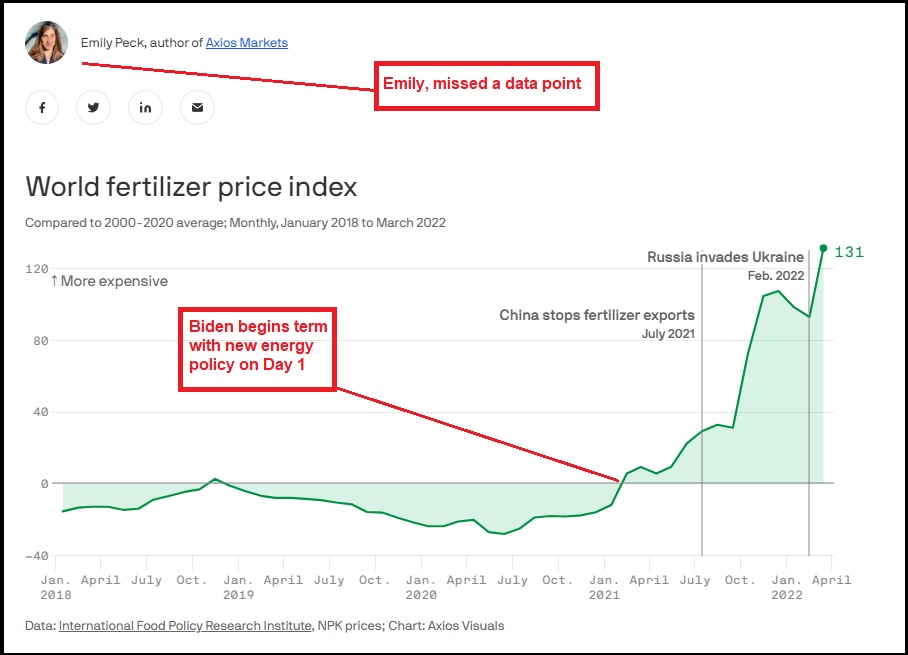
As CTH has noted since last October the rapid increases in fertilizer costs could potentially create a major issue for global food supplies later this summer. As the farming costs continue escalating, including fertilizer and diesel fuel prices, this will eventually lead to major price increases on the harvests. Field to fork inflation is looking increasingly severe later this year; what we have called the third wave of inflation.
Beyond prices, a primary impact in the U.S. market, concerns are now escalating about grain shortages {SEE HERE} and lower European crop yields which will lead to less food products on a global basis. According to information shared by ZeroHedge, “We think it will take at least 2-3 years to replenish global grains stocks,” Illinois-based CF Industries Holdings Inc.’s president and chief executive officer Tony Will said in a statement in Wednesday’s earnings report.”
Axios is reporting on the continued escalation of fertilizer prices; however, they conveniently and purposefully avoid noting the origin of the problem in North America is directly the result of Joe Biden’s immediate energy policies that drove up the costs of natural gas (a critical component):
AXIOS – “Skyrocketing fertilizer costs — like those made from nitrogen, phosphorus and potassium (NPK) — are driving up food prices and, worse, threatening food security around the globe.
State of play: Prices for NPK were up 125% in January from a year before, and rose another 17% from the beginning of the year to March, according to data compiled by the International Food Policy Research Institute (IFPRI).
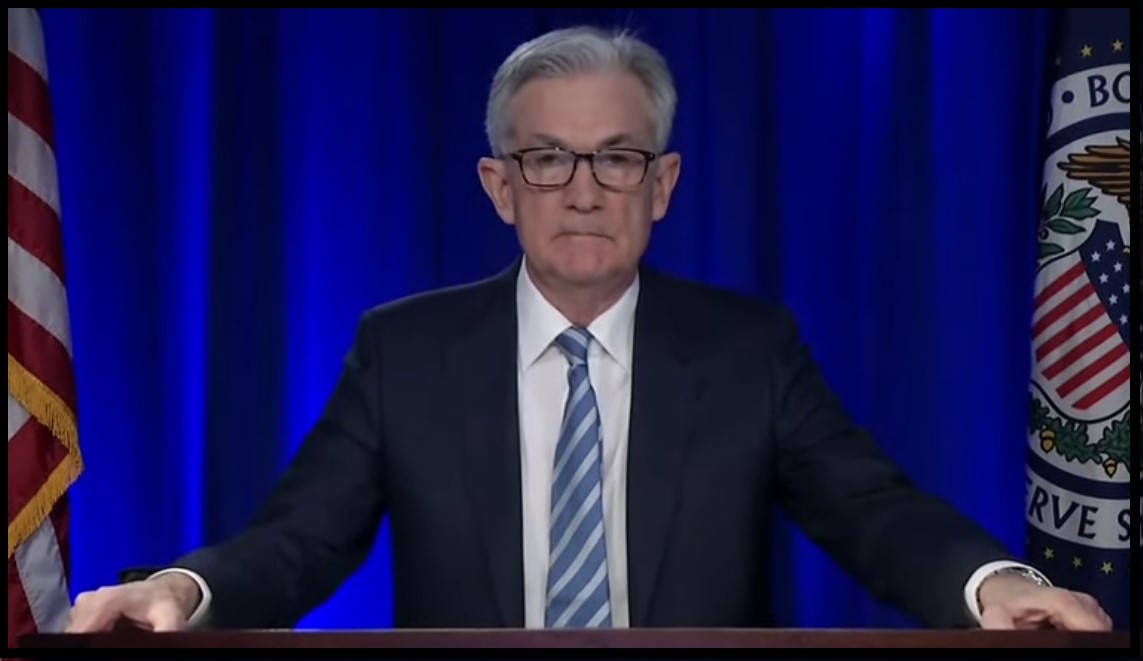
As expected, the Federal Reserve has raised interest rates .50%. However, inflation is expected to remain high as prior spending debt bubble remains in place.
WASHINGTON, May 4 (Reuters) – The Federal Reserve on Wednesday raised its benchmark overnight interest rate by half a percentage point, the biggest jump in 22 years, and the U.S. central bank’s chief made an appeal to Americans struggling with high inflation to be patient while officials take the hard measures to bring it under control. (read more)
Within hours of the announcement, major U.S. banks including JPMorgan Chase & Co, Wells Fargo Bank and Citibank raised their prime rate to 4%, effective Thursday.
The timing of the rate increase is what was expected. Last year’s inflation spikes started appearing in June of 2021. By delaying the 2022 FED response until right now, the political operatives in control of U.S. monetary policy create a scenario where the Fed impact will appear to surface in June of 2022. Exactly one year from the date of the first wave of inflation from the prior COVID spend.
Year-over-year inflation will statistically begin to give the appearance of moderation, once the June (’21) to June (’22) comparison cycle arrives. The Fed and White House will use the intentionally timed statistical outcome to claim inflation is diminishing. It’s a political trick we expected.

 The actual price of gasoline dropped 1% in April during the timeframe captured. Yes, there was an actual 18 days in April when gasoline prices moderated and slightly ticked down; however, those prices immediately jumped again late April through today.
 The article,