Quantcast

President Trump Gives Remarks and Opinion on Three Supreme Court Decisions

During an oval office event to highlight President Trump signing three executive orders informing all agencies of government that federal officials will not be enforcing any rule that blocks citizens from repairing or modifying their own vehicles, President Trump took questions from the media on today’s Supreme Court rulings.  WATCH (prompted):

.

(more…)

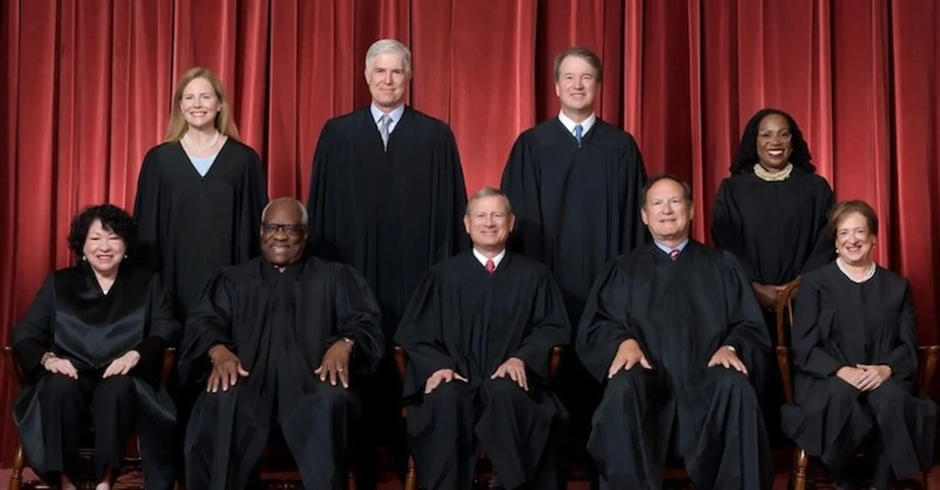
Supreme Court Rules 6-3 That President Can Remove Any Agency Head in Executive Branch

Now the good news. As noted by Justice Thomas, this decision when contrast against the Lisa Cook decision does not find alignment.

By a vote of 6-3, the justices struck down a federal law that bars the president from firing members of the Federal Trade Commission except in cases of “inefficiency, neglect of duty, or malfeasance in office.” [PDF Ruling Here] That law, a majority of the justices ruled, violates the constitutional separation of powers between the three branches of government.

This lengthy 108-page decision supports the Unitary Theory of government in that the President can remove any agency head within the Executive Branch through plenary power, and the Legislative Branch and Judicial Branch cannot interfere.  This is a major win for President Trump and beyond.

(6-3) Chief Justice ROBERTS delivered the opinion of the Court, in which ALITO, GORSUCH, KAVANAUGH and BARRETT joined, and in which THOMAS joined as to all but Part III–B. [GORSUCH filed a concurring opinion.] Justice SOTOMAYOR filed a dissenting opinion, in which KAGAN and JACKSON joined.

SCOTUS Blog – […] “Monday’s decision was a major victory for proponents of the “unitary executive” theory – the idea that the president should have complete control over the executive branch. Under this theory, the president should be able to fire any member of the executive branch, and laws – like the one that the court struck down – that restrict his ability to do so violate the separation of powers. Writing for the majority, Chief Justice John Roberts contended that “the President must have the assistance of officers he can trust. Although it is up to the Senate to decide whether to confirm those with whom the President would prefer to work, neither Congress nor the courts may saddle him with those with whom he cannot work. Subordinates who exercise the President’s power are subject to removal by him. Then, and only then, can they remain accountable to the President, and the President to the people.” (more)

(more…)

Supreme Court 5-4 Ruling Creates Fourth Branch of Government – Trump v Cook

At issue in Trump v Cook is not whether Lisa Cook can appeal her removal, but rather where her position rests while the appeal is underway.  Does she work for the govt? Or is she technically removed from govt, pending appeal?

The Supreme Court ruled in favor of Lisa Cook remaining in her position as a member of the Federal Reserve’s Board of Governors whom President Donald Trump had attempted to fire. By a vote of 5-4 [PDF HERE] [the court says Cook can continue to remain in her job while her challenge to Trump’s removal moves forward.

Chief Justice John Roberts delivered the opinion of the Court, and SOTOMAYOR, KAGAN, KAVANAUGH and JACKSON concurred.

Justice Clarence Thomas filed a dissenting opinion. ALITO filed a dissenting opinion, in which GORSUCH joined, and BARRETT also filed a dissenting opinion.

This is a rather goofball decision when you consider the previous issues with the Consumer Financial Protection Bureau and the high court prior ruling that President Trump can remove the head of the agency.

Additionally, if Lisa Cook does not work for the President of the United States, meaning if she doesn’t work for the Executive Branch, then who exactly is she working for?  She doesn’t work for the legislative branch, and she doesn’t work for the judicial branch. Therefore, a de facto mysterious 4th branch of government is created.

(more…)

Supreme Court Rules States Can Decide How Long After Election Day Ballots May Be Received

The Supreme Court has ruled 5-4 in favor of Mississippi -vs- RNC that state legislature can decide how long after election day that qualified election ballots cast may be received.  [PDF HERE] Essentially, federal election day is election day, but ballots can be received after election day for the length of time determined by state law.

Justice Barrett delivered the majority opinion, joined by Roberts, Sotomayor, Kagan and Jackson.

Justice Alito dissented along with Thomas, Gorsuch and Kavanaugh.

The Hight Court outlined that congress could change the ability of the states by changing the statutory language of the federal election law to require ballots be received by election day.  As long as federal law does not outline the deadline for ballot reception, states can extend that process at their legislative discretion.  THIS IS A HOT MESS FUBAR!

[5-4 Ruling Here]

“The federal election-day statutes do not prevent Mississippi from counting absentee ballots postmarked by election day but received up to five days thereafter; nothing in the federal election-day statutes requires ballots to be received by election day.”

(more…)

USMCA Status – Canada in Recession, Mexico GDP Grows Double Expectations

You might remember recent reports outlining how the economy of Canada has slipped into a recession, posting two consecutive quarters with a negative GDP outcome.  There are multiple reasons for this shrinkage, but the dominant factor is, well, quite frankly, Canadian politics and economic policy.

Meanwhile, in Mexico the opposite is happening.  Mexico’s economic activity grew 1.2% in April from the prior month, the national statistics agency said, compared with a revised increase of 0.6% in March and beating a forecast of a 0.9% increase in a Reuters poll of analysts. {source}

It is not coincidental to see the Mexican economy performing well, while the Canadian economy is contracting.  Despite their identical proximity to The United States, each nation is currently executing a fundamentally different set of economic policies.

The Canadian government has been exceptionally combative with the U.S.A, leading to friction, tariffs and economic back-and-forth measures between the two nations.

The Mexican government has expressly understood the nature of their dependency, admitted it, taken no action to diminish it, and purposefully set out to align itself with the interests of America.

Canada is combative. Mexico is collaborating.

It seems unlikely that the three nations can agree on major economic policies, as a trilateral partnership would need alignment in core areas like energy policy. Canada’s energy policy is fundamentally separate from those of the U.S. and Mexico, and this is an issue that can’t be resolved through a trade agreement alone.

A large part of Mexico’s economy relies on remittances from Mexican workers in the U.S. sending money back to their families. As long as the U.S. job market stays strong—and it’s only getting stronger in the industries where many Mexicans work—Mexico will continue to benefit from America’s economic growth.

(more…)

Barbara Boyd Outlines The DSA New York Communist Program

Barbara Boyd discusses three Democratic Socialists of America-backed candidates endorsed by New York City Mayor Zohran Mamdani winning upset victories in New York congressional primaries, framing the results as part of a long-term cultural project rather than a purely economic platform. She argues the DSA’s internal education centers on communist theorist Antonio Gramsci and his strategy of revolution through cultural “hegemony,” citing a deleted Instagram post from a group tied to one winner that called for the “total eradication of Western Civilization.”

Boyd highlights a newly published DSA platform proposing major constitutional changes, then links Gramsci to the Council on Foreign Relations’ “post-Trump world” series, noting CFR fellow Charles Kupchan opens with a Gramsci quote and attacks reindustrialization and tariffs. She claims British imperial networks historically sponsored Marx and later Gramsci, using communism and counterculture against rivals, and urges promoting Trump’s “American System” economics and an optimistic national culture ahead of the midterms. WATCH:

.

(more…)

Trump’s Social Media Advisor Alex Bruesewitz -vs- Tucker Carlson

In my opinion, Tucker Carlson is no longer an option for the intellectually honest or stable-minded person.  In the past several months as he has increased his anti-MAGA efforts Carlson and/or his production team have intensely avoided any guest who might challenge the outlandish nonsense he has been creating on his podcasts.

Occasionally CTH glances to see who Tucker is interviewing and generally check in on Carlson only to gain an understanding of the political network he represents.  I find the dishonesty in his monologues now repellant. However, that said, President Trump Social Media Advisor Alex Bruesewitz stated he appeared on the Carlson podcast in order to finally push back against some of the malicious narratives the former Fox News host was promoting.

I watched to see how this ‘confrontation’ might unfold.

Alex Bruesewitz is a 29-year-old consultant who specializes in social media.  He is reported to be the closest thing to a Charlie Kirk voice who intersects with the White House and President Trump directly to share Gen-Z policy perspectives. Thus, it would be interesting to finally see some reasonable confrontation with Tucker.

Unfortunately, this interview is deficient on pushback.  It’s clear that Alex Bruesewitz is friends with Tucker Carlson and reluctant to firmly and appropriately challenge the falsehoods Carlson has been promoting.  To be fair, Alex Bruesewitz did offer some gentle correction -key word ‘gentle‘- but allowed the majority of antagonistic Carlson points to remain unaddressed.

My takeaway from watching the entire podcast back and forth encapsulates into two main points:

(more…)

Bookmark and Reference Point – June 2026

Events in 2027 and 2028 are likely to be very confusing.  As a consequence, CTH needs to establish datapoints in real time that can later be referenced and reviewed to make sense of things when CTH starts to put the data into a very difficult to accept storyline.

This process is similar to setting the 2012 election “splitter strategy” as a reference; that leads to the 2014 RNC winter meeting and rules changes; that led to the 2015 lineup of RNC candidates; that led to our ability to show how the ‘splitter strategy’ was being deployed for the 2016 GOP nomination.

The defeat of Jeb didn’t happen in New Hampshire 2016; his defeat was an outcome of assembling years of previous datapoints which proved the illicit roadmap and made the RNC scheme very clear from the outset.

Elon Musk purchased Twitter for $44 billion ¹($54.20/share) [April through October ’22].  He sold Tesla shares, leveraged more and assembled a $25 billion investment group to cover the remainder.   When the financing dust settled Musk controlled Twitter and investors were in for around $25 billion.

Musk later created the ancillary company xAI and when the deadline terms of the Twitter investment were due, he essentially repaid the $25 billion debt by transferring the investors into $25 billion worth of xAI holdings.

[Key Point – the originating $25 billion investment was not repaid, just modified]

In 2026, Musk then did an IPO on SpaceX. This culminated in stock sales, valuations and generating $100 billion in cash on hand.  A few weeks later Musk then sold 7 tranches of SpaceX bonds worth $25 billion to generate liquidity.  He then used the $25 billion offering as the financial mechanism to repay the $25 billion remaining in investor debt.

Summary: Twitter’s $25 billion debt transferred to $25 billion xAI stock, then transferred to $25 billion in payout or bond holdings; the option is for the original Twitter investment group to take (cash out or hold SpaceX bond paying 5% annually).

[Key point – the originating $25 billion to purchase Twitter is now inside the SpaceX bonds]

This was a smart financial gameplay over the past roughly 5 years.  This is how it developed and this is the reality in June of 2026.  The originating $25 billion borrowed to purchase Twitter is now either: (a) fully repaid, or (b) sitting in long term SpaceX bonds (depending on investor choice).

(more…)

Why is The Ukraine War Hardest to End?

Mike Steger from Promethean Action PAC argues the reason the Ukraine war is hardest to end is simply because Ukraine represents the proxy state of all the globalist stakeholders who need another large conflict in order to eliminate the problem of a moral-based Christian perspective within the ‘West.’  Essentially, without Russia as the enemy, the factional war they need to retain power is much harder to achieve.

Promethean Action PAC YouTube: “Mike Steger explores the concept of “color revolutions” and argues that the same strategies used to influence governments abroad are now shaping politics across the West.

From Ukraine and the Arab Spring to Brazil, Europe, and the United States, Mike examines how non-governmental organizations, media networks, political activism, and government institutions have evolved into powerful geopolitical tools.

The discussion also explores President Trump’s efforts to reshape U.S. foreign policy, dismantle longstanding government programs, push election reforms, and challenge what Mike describes as the political establishment ahead of the 2026 midterm elections.” WATCH:

.

Information is just that, information.  Review, consider and evaluate.  Things are likely to get increasingly uncomfortable and the way we view the world can change with new information.

(more…)

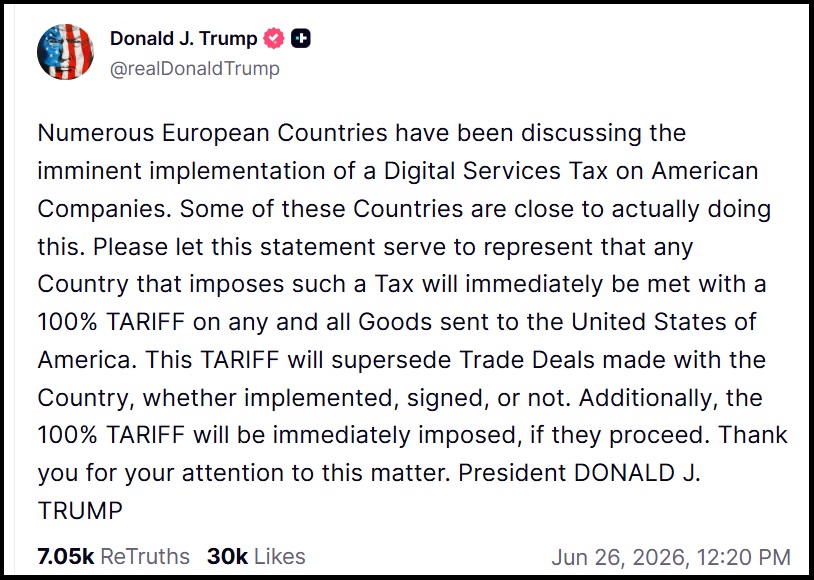
President Trump Outlines Retaliatory U.S. Tariffs Against EU Nations Who Implement Digital Services Taxes

Multiple countries have proposed ‘digital service taxes’ which are taxes on the domestic use of American tech platforms like META, Twitter, Amazon etc.  EU countries are planning to tax U.S. based tech platforms for the revenues generated by operations within EU countries.

President Trump announces retaliatory action via reciprocity taxes, in essence leveraging the entirety of the U.S. consumer market, if the EU proceed with this new tax revenue scheme against U.S. companies.   Canada was on the cusp of a digital services tax last year when Trump made a similar announcement forcing Canada to abandon the plan.

[SOURCE]

WASHINGTON DC – […] Trump’s promise to raise tariffs threatens to complicate trade talks with the European Union. Trump’s threat comes one day after EU member states approved an agreement that would slash tariffs on U.S. industrial goods and some agricultural products. In return, the U.S. would cap most tariffs on the European Union at 15 percent.

(more…)