Quantcast

Global Recession Spreads, European Factory Activity Contracts in July, Japanese Factory Activity Also Drops

In addition to the contraction in South Korean manufacturing announced last night, European manufacturing and factory activity is also contracting with less output, higher buildup of inventory and fewer orders for finished goods.  The global recession is being measured fast and furious.

Every economic outcome is connected to a purposeful decision by the leaders of western industrialized nations to follow the Build Back Better climate change agenda.  Higher energy costs, an outcome of the collective policy to stop new production of coal, oil and gas, which has transferred into higher food prices, farm prices, gasoline prices, heating and cooling prices as well as electricity rates, is forcing consumers to stop purchasing non-essential products.

The sale of durable goods collapsed in the first half of this year; however, no policymakers or bankers wanted to admit it and they kept saying there was an excess of demand.  Now, with fewer customers for durable goods in the market, global manufacturing and factory outputs are dropping fast.  Eventually the central planners are going to have to admit their pretended demand does not exist.

While there is a natural lag in the activity, the rate of factory contraction will be proportionate to rate of the drop in demand.  Meaning we have only just begun to see the manufacturing decline that lags a few months behind consumer activity.

LONDON, Aug 1 (Reuters) – Manufacturing activity across the euro zone contracted last month with factories forced to stockpile unsold goods due to weak demand, a survey showed on Monday, adding to concerns the bloc could fall into a recession.

(more…)

Sunday Talks, Fed Chief Kashkari Says High Inflation Spreading More Broadly Throughout Entire Economy

The pretending from the federal reserve chairs continues.  In this interview, Neel Kashkari, the head of the Federal Reserve Bank of Minneapolis, says “we keep getting surprised” by data on inflation, which continues to be “higher than we expect, across the broad range of the economy.”  Yet, notice that Kashkari refuses to outline the single cause of the broad inflation is the intentional lack of energy production. [Transcript]

Kashkari continues the selling point that demand side inflation is being targeted because demand still exceeds supply.  That’s essentially true, however, it is the supply of energy that is fundamentally disrupted by Joe Biden energy policy.  It is not consumer demand for goods and services, it is the structural need for consumers to have consistent, affordable energy resources.

The collapse of energy production from domestic coal, oil and gas development is the problem.  Everything else is ancillary to the origination problem.  However, in order to support the climate agenda, the Federal Reserve must pretend not to know this. WATCH:

Kashkari notes a serious problem can arise when wage inflation starts to catch up with inflation overall.  THAT just happened last month.  The combination of wage inflation to match the high consumer inflation then drives an even higher cost for goods and services.  This is the inflation storm that leads to hyper-inflation, structurally high inflation that cannot be controlled by any monetary measure, and unfortunately, we just entered the first outer bands of this inflation hurricane last month.

A personal sidenote: when we were going through the pandemic crisis and response in 2020/2021, CTH took heat for saying the real objective at the end of the pandemic path was the global climate change agenda.  Well, here we are.  At the end of this climate change path is full control over human activity using digital currency.  Hunger games.

(more…)

Sunday Talks, Senator Manchin Says His Energy Deal Will Bring Windmills to West Virginia Faster, With Batteries Made in Mexico and Canada

In a remarkable interview attempting to justify his agreement with the senate Build Back Better climate change bill (fraudulently labeled ‘inflation reduction act’), West Virginia Democrat Senator Joe Manchin says the massive energy spending and tax bill will bring green renewable energy much quicker.  In essence, the windmills and solar panels for West Virginia will arrive faster now, and that will improve energy production.  [Transcript Here]

When discussing the new energy origination provisions, Senator Manchin catches himself mid-sentence saying, “the battery better be made in America.”  He quickly corrected himself knowing the claim was false and followed up with, “better be sourced in North America, it better be processed,” because he is well aware the largest employment and investment beneficiaries for his deal will be Mexico and Canada, not American workers.  WATCH:

BRASS TACKS – Canadian Prime Minister Justin Trudeau was gleeful last week promoting Manchin’s new green energy proposal because, with steel and aluminum tariffs removed, Canada will be one the biggest beneficiaries of $370 billion congressional spending package.  Canada has no heavy industry left, they are the assembly economy for foreign manufacturing that uses loopholes, and the senate bill creates a USMCA loophole for this exact purpose.

The West Virginia windmills and solar panels will be shipped as raw materials from China and the EU into Canada.  Canada will assemble the parts and ship the finished goods into the United States for placement by illegal alien workers employed by the contractors.  The batteries to store the solar and windmill power will come from Mexico, after they receive the raw materials from Africa and Asia.

Canadian workers, Mexican workers, Chinese Workers, African workers and ASEAN workers will all benefit from the generous Joe Manchin spending package.

Unemployed West Virginia coal miners will watch Joe Manchin run for office in 2024 on Japanese televisions powered by China, while eating cheese puff flavored cricket snacks sourced from Canada.  Brilliant plan, Joe.

(more…)

The Biggest Problem

People often wonder why few solutions are presented for the significant challenges we face.  Perhaps it is worth reminding everyone what the biggest challenge really is, and it has nothing to do with Joe Biden or our political system abusers.

The biggest problem we face as a nation is our unwillingness to admit our current condition is the result of purposeful action.

Cue example # [you_fill_in_the_ blank], a visual demonstration:
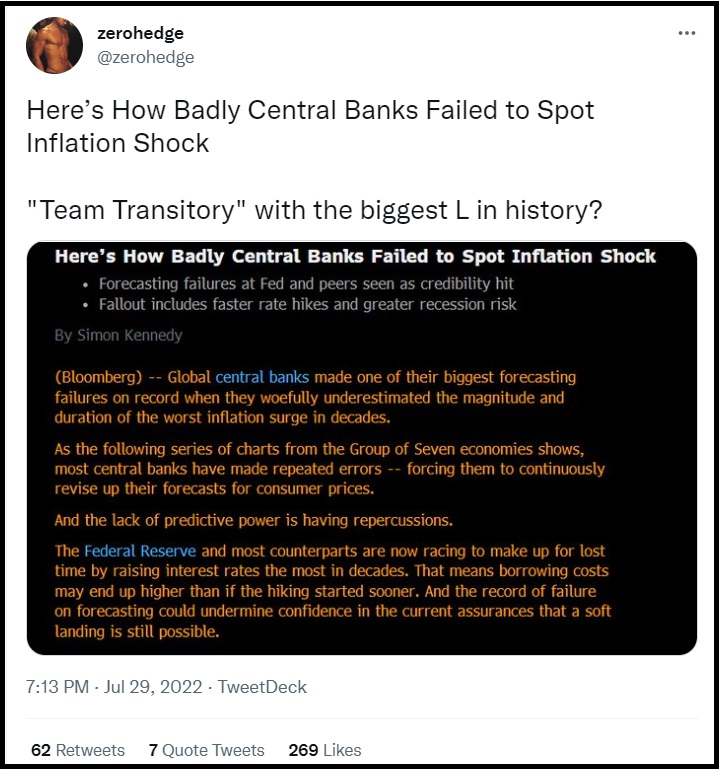
The central banks did not “fail to spot” the source of inflation.  The monetary policy makers did not make mistakes. The hands that guide the economic system did not screw it up, make mistakes or fail to recognize the consequences of the policy they put into place.

When they meet together at Davos for collective discussions around opportunities presented by the pandemic, the guidebook known as Build Back Better did not just organically materialize.  Nor did all the western governing central bankers make the same mistakes when they followed the agreed consensus.  They knew from the outset the climate change agenda would be a radical transformation of the global energy system, and as a result, the global economy.

The central banks did not collectively “fail to spot” the inflation they were creating by lowering energy production, disincentivizing energy investment, limiting energy development, shifting policy away from new production, and generally breaking the traditional energy system finances.  They knew precisely what they were doing, and they did it -and continue to do it- with forethought and purpose.

This is where people mistakenly view ‘prior justifications‘ as ‘mistakes.’  When they said inflation was transitory, they were not lying about what they created. They were, however, obfuscating the length of the term “transitory.”   Inflation is transitory, from where and when it started in 2021, all the way to where and when windmills, solar panels and clean energy will take over on (fill_in_date_).  That is the “transition.”

(more…)
Fed Preferred Inflation Index Jumps 6.8% in June, Largest Increase in Four Decades

The federal reserve looks carefully at the Personal Consumption Expenditures (PCE) price index when weighting inflation data.  The Bureau of Economic Analysis just released the PCE index for June [DATA HERE] and the results show a 6.8% increase in June from a year ago, the largest jump in four decades.

Wage growth in the second quarter (April, May, June) was generally strong, rising 1.6%.  However, it now looks like the consumption index and the wage indexes are creating their own inflationary spiral.  In addition to supply-side inflation, driven by Joe Biden’s energy costs, the labor costs are now increasing substantially which adds costs on the production side of the economy.

As wages go up to keep pace with supply side inflation, the prices of goods and services produced/handled by those workers also increases.  This is the inflation spiral that can get out of hand quickly.  The major concern (not necessarily expressed by pundits) is the inability of any institutional economic response to offset the originating inflation caused by the energy policy.  The economic team is pretending supply-side inflation created by energy policy doesn’t exist. They are only directing attention to demand side inflation.

As long as energy policy keeps driving the price of electricity, gasoline and petroleum products higher, workers need higher wages.  Those wage increases, while significant in scale, still lag the rising originating prices of the goods; and the wage growth adds to the final costs. Inflation then becomes structurally embedded, hyper-inflation begins.  This looks like the current situation.

(more…)

First Major German City Turns Off Hot Water and Public Building Electricity to Save Gas

Hanover, a city in the northwest of Germany, has become the first major metropolitan area to try and reduce the use of natural gas by removing hot water from public buildings.  The move comes as natural gas supplies from Russia are reduced to 20% of capacity.  Germany is attempting to fill up storage facilities of natural gas in order to survive the winter.

Germany, together with several European countries, are telling their citizens to expect large increases in their electricity bills as energy costs continue to skyrocket.

Germany does not have any LNG terminals to receive shipments of natural gas into ports, they are dependent on pipelines from Russia.  They are urgently trying to reduce the current amount of natural gas being consumed.

(Via Daily Mail) – […] Other desperate gas-saving measures include switching off public fountains and blacking out night-time lights on major buildings such as the town hall and museums. The city’s mayor, Belit Onay, spoke of an ‘imminent gas shortage’ that meant they had to reduce the city’s energy consumption by 15 per cent.

[…] There will also be a ban on portable air conditioners, heaters and radiators among the general populace as the average German begins to pay a price for standing up to the Russian dictator.

[…] Germany, like most of Europe, has been enjoying a hot summer which should soften the blow of the cold showers, but public officials are introducing the measures now in fear of what awaits them when the season turns.

(more…)

To Lower Natural Gas Use World’s Largest Chemical Company Announces Making Less Ammonia, Fertilizer Production Will Shrink Further

The energy crisis in Germany is now a confluence of terrible events that will snowball well into next year.

The world’s largest chemical company, BASF, has announced they will cut down the production of ammonia in order to use less natural gas.

In the short term this will help Germany build up natural gas supplies to survive a cold winter with predicted rationing still planned.  However, in the long term the shortage of ammonia means less fertilizer which will mean future shortages and increased costs for farmers; ultimately creating lower yields next year.

FRANKFURT, July 27 (Reuters) – Germany’s BASF (BASFn.DE), the world’s largest chemical company, is cutting ammonia production further due to soaring natural gas prices, it said on Wednesday, with potential ramifications from farming to fizzy drinks.

Germany’s biggest ammonia maker SKW Piesteritz and number four Ineos also said they could not rule out production cuts as the country grapples with disruption to Russian gas supplies.

Ammonia plays a key role in the manufacturing of fertiliser, engineering plastics and diesel exhaust fluid. Its production also yields high-purity carbon dioxide (CO2) as a byproduct, which is needed by the meat and fizzy drinks industries.

(more…)

Pretending Continues, However El Erian Admits U.S. Economy Weakening Faster Than Expected

The great pretending continues in order to protect the Federal Reserve from sunlight upon them.  Central banks (U.S. Fed Reserve included) are raising interest rates into a recession, which is specifically against their legislative mandate. Therefore, in order to protect the bankers, the pundits and politicians must deny a recession exists.

Pundit Steve Liesman spins the data, says we need to wait longer, and circles the wagons to protect the policy makers, specifically the White House.  Mohamed El-Erian tries to split the baby (02:00 video); while not admitting directly that the economy is in a recession, he states the “economy is weakening much faster than expected.”  WATCH:

At a certain point all of this pretending and denial is going to come crashing down.  The “economic transition” to a new “green future” they are all pretending not to see as the root cause of the economic collapse, has unavoidable consequences.

The dam is breaking around them and they are running out of fingers and toes to stop the inevitable collapse.  Meanwhile the Davos crowd has purchased all the scuba gear and awaits the final outcome.

(more…)

Joe Manchin and Chuck Schumer Strike a Deal, $370 Billion for Green New Deal Energy Transition, Tax Increases to Pay for it and More IRS Agents

Two weeks ago, CTH warned everyone that Joe Manchin’s torpedoing of the $500 billion Green New Deal senate spending program was a head fake; he was always going to sign up to expand the control of the federal government over energy use.  Today Manchin and Chuck Schumer made it official.

The people operating the “energy transition” levers will get $370 billion to spend on bigger windmills, more solar panels and new energy programs to eliminate coal, oil and natural gas.  They will pay for it by raising taxes and hiring a new army of IRS enforcement officials.  In exchange for his vote, the federal government will pay increased health insurance subsidies for West Virginians and pass out lower priced medications.

There you go. Exactly as predicted.  Energy inflation will continue as the energy transition becomes a permanent feature.  Ironically, Joe Manchin made them change the name to “The Inflation Reduction Act,” and pushed the effective dates for all renewals past the 2024 election (where he plans to be a candidate against Gavin Newsom).

WASHINGTON – Joe Manchin and Senate Majority Leader Chuck Schumer on Wednesday reached a deal on a bill that includes energy and tax policy, a turnaround after the two deadlocked earlier this month in talks on Democrats’ marquee party-line agenda. In a joint statement, the two Democrats said the legislation will be on the Senate floor next week. It includes roughly $370 billion in energy and climate spending.

(more…)

IMF Data, Global Output Contracted in Second Quarter

According to the International Monetary Fund (IMF) global economic activity, as measured by economic outputs, contracted in the second quarter.  However, when it comes to identifying the cause of the issue, the IMF joins western financial leaders and central banks in playing the game of pretending.

The radical new energy program contained within the Build Back Better agenda, is the root cause of the supply side inflation.  The drop in the production of oil, gas and coal in the same western nations that are following the BBB agenda is origin of the massive spike in energy prices.

Inflation is a major issue, geographically consistent and virtually identical in all the nations who are following the Build Back Better climate change agenda, which is the justification for the energy ‘transition.”  However, not a single leader, central bank or multinational financial institution -including the IMF- will admit the energy policy is the cause of the issue.

(IMF) – The world’s three largest economies are stalling, with important consequences for the global outlook. Inflation is a major concern.

The global economy, still reeling from the pandemic and Russia’s invasion of Ukraine, is facing an increasingly gloomy and uncertain outlook. Many of the downside risks flagged in our April World Economic Outlook have begun to materialize.

(more…)