Mercedes is willing to begin military and weapons production. Historically speaking, this did not work out so well for Europe the last time; however, as with all things German, the expanded backstory is a little more complicated.
 Due to a combination of terrible political decisions related to the German and EU energy sector, the German industrial economy is contracting rapidly. Germany is the heart of the EU economic engine.
At the same time as the German economy is contracting, the economic footprint of China in the EU is growing. The core issue centers around a declining auto sector but extends to all ancillary manufacturing outputs.
By following the WEF’s “Build Back Better” program, Europe as a whole has ended up making itself energy-dependent and vulnerable. The Gulf oil and gas crisis, the looming 25% Trump tariffs on EU cars, and the withdrawal of U.S. troops from German NATO bases only add to their growing economic troubles.
Around the same time as this economic convergence, Germany began ramping up its commitments, support, and spending for Ukraine in the conflict with Russia. Subsidy outflows rose just as GDP was falling, a clear example of an economic spiral that can easily spin out of control.
German Chancellor Freidrich Merz is trying to deal with the consequences of exceptionally short-sighted and damaging policy, but reversing the trend would require Germany to focus all policy operations inwardly away from Brussels and the demands of the collective European Union. This is now the core issue in German politics driving bold dividing lines between political power structures.
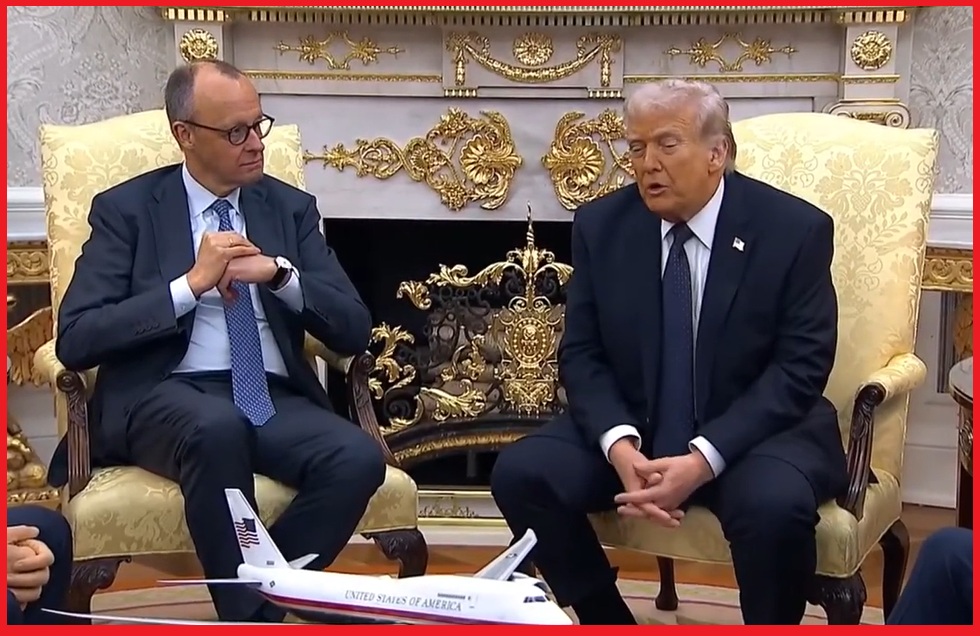 One of the problems for Germany is the United States presence in the country historically meant they did not need to spend on their national defense. Instead, for decades they spent that money on subsidy programs and expanded German benefits. All was okay until President Trump started to pressure the German government to be self-sufficient. That means Germany had to change government policy.
President Trump has refused to put Tomahawk cruise missiles into U.S/NATO bases within Germany, and Germany has no medium to long-range missile systems. Now, they need to either purchase them or develop their own.
At the same time President Trump is drawing down U.S. military troop levels in Germany, and Germany has changed their conscription laws while requiring all fighting age men to register any extended external travel.
SUMMARY: The economy within Germany is shrinking, revenues to the government are less, the energy crisis means German citizens need subsidies, the promised payments to Ukraine are more painful, and at the same time the “coalition of the willing” are more confrontational toward Russia yet they realize they can no longer hide behind America’s apron. A hot mess.
Now, before getting to the point of this latest development, remind yourself that China owns a ten percent stake in Mercedes and the vehicles produced by the Chinese auto brand Geely are essentially the outcome of China extracting technology from that stakeholder share. This brand specific datapoint sits on the sidelines of Europe’s shrinking market share of automobiles as the Chinese share of the market grows.
May 15 (Reuters) – Mercedes-Benz (MBGn.DE), opens new tab CEO Ola Kallenius told the Wall Street Journal on Friday that the German automaker was willing to move into defense production as long as it made “business sense”.
[…] Earlier this week, German defense group Rheinmetall announced a partnership with Deutsche Telekom to develop a defense shield against drones. (source)
Germans, with a panda in the pocket of their overalls, are willing to start making military hardware to retain employment in the shrinking all-critical auto sector, that is being lost to China. Think about it.
History may not always repeat; but yes, it certainly does have a tendency to rhyme.
Add Hungary to their list of dependants following that dubious election. It may take President Trump a little longer to do the impossible but the difficult he does at once.
While he was a true realist, Orban was, domestically, a bit of a strict ruler in many areas. I’ll wait to see how Magyar uses the bucks coming their way now from the EU that had been held because Hungary was against EU bucks going into the Ukraine commode. Magyar is, to Hungarians, a bit of a center-right guy but time will tell. Admittedly the Witch of Brussells is happier now.
The EU funds that were withheld from Hungary was because Orban refused to accept muslim migrants.
Magyar has said that he won’t be accepting any migrants either though, right?
That is my understanding.
Well, That ought to turn well for everyone.
“Willing to enter military production” strikes me more as a political threat than a real policy decision.
Probably not.
Get past the headline and read the content from Sundance. You will gain a fuller understanding.
The noise is declining vehicle production
The signal is military vehicles. . .
Tanks are weaker than drones
Autonomous Vehicles are their goal
Follow this money until it intersects with who has majority interest
(controlling %)
in Mercedes. . .
Mercedes-Benz Group AG is not currently engaged in weapons production, but its CEO, Ola Källenius, has stated the company is **willing to consider** defense projects if they make “business sense,” citing Europe’s need to strengthen its defense capabilities. The focus of any potential military involvement would be on leveraging its expertise in manufacturing high-precision, high-volume vehicles and logistics solutions, not on developing weapons systems.
The primary entity within the Mercedes-Benz ecosystem already active in the defense sector is **Daimler Truck Holding AG**, the independent company that controls the heavy truck business.
Connectivity to Chinese Entities
Mercedes-Benz Group AG has a significant presence in China through joint ventures like Beijing Benz Automotive Co., Ltd., but its recent strategic moves highlight a growing caution regarding technology transfer and control:
Strategic Investment: In 2025, Mercedes-Benz Group took a 3% stake in Chongqing Qianli Technology, a Chinese battery manufacturer, to secure its EV supply chain. This is a commercial investment focused on civilian technology.
Pushback on Control: A major point of contention arose when Chinese authorities demanded that the Communist Party secretary of its Beijing joint venture sit on the board of directors. Mercedes-Benz rejected this demand, citing violations of German corporate governance and the risk of sensitive technology (like its electric platform and operating system) being compromised.
Shift in Strategy: This standoff led to a significant strategic shift, with reports indicating Mercedes-Benz was winding down production at the Beijing plant rather than cede management control. This demonstrates a clear prioritization of protecting intellectual property and operational independence over unconditional expansion in China.
Collaboration vs. Military Tech: While the company promotes cooperation with Chinese technology firms on areas like intelligent driving systems (as highlighted during Chancellor Merz’s visit), there is no indication of collaboration on military technology or dual-use applications that could be weaponized. The focus remains on civilian automotive R&D.
In summary, while Daimler Truck is the established entity within the Mercedes-Benz structure for military vehicle production, the parent Mercedes-Benz Group AG is only considering a potential, limited expansion into defense. Any such move would be strictly for logistics and would be governed by a strong imperative to protect its technology, as evidenced by its firm stance against political interference in its Chinese operations.
It’s just a few military vehicles,
What’s the worst that could happen ?
It’s not like they would invade poland or something. . .
Can’t really see the U.S. acting any differently under the circumstances (i.e. being on the losing end of a war after which the UN awarded New Mexico or California to Mexico for “historical” reasons).
There will be repeat of a Blitzkrieg. The parasitic drawdown of the Mercedes batteries will results in today’s Rommels calling for Roadside Assistence.
since they seem so nostalgic to get back to fighting russians, perhaps they could also open up the volkswagen plants with slave labor?
Arbeit Macht Frei as they say.
They are going to get the weak German men to fight the Ruskies? The weak men who can’t even protect their women from getting raped by the Muslim hordes.
The Nazi literally oozes from Chancellor Merz.
He looks the part. Could have been chosen by central casting. His rhetoric matches the image.
That’s the operative part. We’re all still living in a world dominated by leftover WWII propaganda, though PDJT is starting to dismantle its foundations.
So true!
With a Nazi-like Chancellor, a rising Muslim population, and a burgeoning relationship with Communist China—what could possibly go wrong?
Maybe that’s the plan for the Muslim men?
Germans never change. Ever.
Their reliance on American largess as an entitlement has given them a false sense of security in their idiotic, socialist choices. A military “build up” is far too late to rescue them. They’ll build weapons again? Who will use them? Islamic invaders?
It will be a horse race to see if they are destroyed, economically, by their self-destructive, globalist policies, their suicidal immigration invasion or by Chinese production. And if they fall, so does the globalist EU.
In any event, good riddance.
Will this impact car parts for used Mercedes here in US?
Depends, all the spare parts for older vehicles that are no longer in production are sitting in a warehouse somewhere NiB. (New in Box)
As long as there are no import or export restrictions by Germany or the USA you can still buy them until they run out of stock.
Some common parts may still be in production that are used on a current model and some might be 3rd party made parts which will still be available. (depending on the agreement between them & M-B)
GM’s policy was parts available for 10 years then, just a guess here but the remainder of NiB parts are sold to 3rd parties for availability. (think Ebay sellers & Rockauto) once those are gone, someone in Chyna might make a copy if enough demand for it. (or currently do make)
Saw in the John Deere video I posted in today’s O/T that body parts are being patented so only available from manufacturer but at some point they will not make them anymore if insufficient volume/profit. I doubt Chyna ever cares about patents & will still make a bad copy anyway.
MAGA Americans should boycott German autos.
“Due to a combination of terrible political decisions related to the German and EU energy sector, the German industrial economy is contracting rapidly.”
“By following the WEF’s “Build Back Better” program, Europe as a whole has ended up making itself energy-dependent and vulnerable.”
These two Sundance quotes are the money quotes. Germany need read nothing more, because within them the solution presents itself to anyone with more than two brain cells to rub together: abandon the failed green energy policies and the build back better theories that caused the economic meltdown in the first place.
If you stop hitting yourself in the head with a hammer, the pain will stop. Go figure.
And, get the heck away from the WEF. Siding with Klaus, Soros and Bill Gates is a huge recipe for worldwide disaster. Enough of their bs. It is painful to think that so many world leaders are agreeing to these crazy policies.
Events outside of their control have arrived…including one Donald John Trump who has withdrawn the US from the delusional, absurd Climate Initiative. Daddy War(big)bucks has left world stage to these reprobate frauds. And many other stages besides. Their reality is not what was carefully planned.
There will be no “mea culpas” from a Euro cabal who see themselves as environmentally virtuous and still worship at the altar of Gaia, no matter how sotto voce they recant when faced with what was guaranteed to be the end result and the destructive folly when confronted with irrefutable evidence they were wrong, wrong, suicidally wrong.
The beatings will continue until morale improves.
Yes the beatings will continue until the delusional pretending stops and the EU is dumped into the trash bin of history. Once again communism has failed.
It’s what happens when free thinking and the open, uncensored discussion of ideas is banned.
Both antithetical to the New Reich and its adherents.
“But we can do it better this time” is always the refrain.
Pretty crazy that people are still trying to make Marxism work. I guess the prideful desire to try and rebel against God springs eternal.
Classic example of FAFO and well deserved. Their people are good, their politicians bad.
Build Back Better was a control vector backed by the WEF/Globohomo. Now with the rise of AI as the preferred control vector for the elites, we see the UN scrapping climate change models and the rise of coal consumption across Asia. Yet, team Green Scam remains silent as to the vast and unprecedented energy requirements to fund AI data centers.
What a colossal waste of economic value the burden of which, as always, falls to us Deplorables.
But meanwhile all the Green Idiot Lemmings sold on the CO2 scam the past 35ish years continue to scream about climate change, net-zero, ending fossil fuels, carbon sequestration and other moronic ideas.
It would have been nice if German industry and Mercedes Benz had the inexpensive and unlimited natural gas from The Nordstream Pipelines? 😎
Germany to begin military and weapons industrialization.,
Am I the only one with the heebie geebies?
Now look for the rise of a German or Austrian maniacal socialist leader…..
Building weapons does not improve your economy unless you have arms buyers lined up on a list….who might that be?
I think Ford kicked started the Reich off, back in the day. Before Spper completed their underground armament factories.
I guess that depends on the degree to which everyone else has (or hasn’t) bought into the generational Anglo-Jewish propaganda about “The Hun” being the Eternal Enemy.
Or the eternal the Jew is the eternal enemy…..and I am not Jewish.
Can you show us on the doll where Merz touched your eternal Jews?
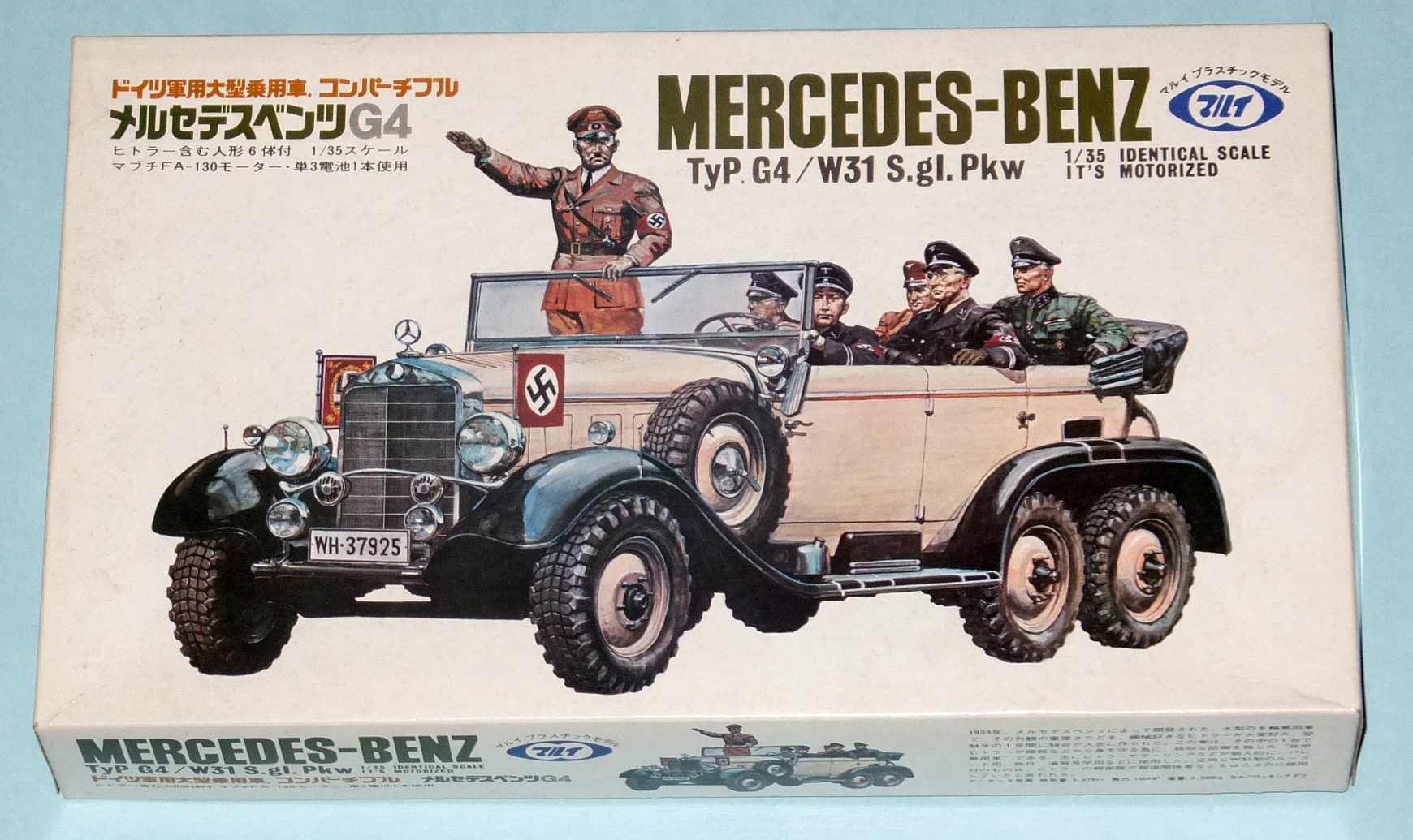
Was that an actual ‘model’ kit sold at that time? Looks very authentic.
It’s a model of the Mercedes Benz W31, Type G4
Six wheels with a 6×4 drivetrain (the four rear wheels were powered)
Used mainly as a parade and staff vehicle for senior Nazi leadership
Large open-top touring body, designed to look imposing in public appearances
Powered by a large inline-8 engine
Only a small number were built, and very few survive today
There is a propaganda film of German troops entering Austria during the Anschluss.
They were riding in those big 6X4 Mercedes G4s.
I read somewhere that maybe 50 were made.
We have been buying German automobiles exclusively for 20+ years. Hopefully the quality of their military products fares better than their cars as of late!
See Trapper’s line about the hammer above. Works for cars, too.
Late 70’s for decent German cars. Why have you stuck with a sinking ship? Personally we should all hope the military products they build are garbage.
Why doesnt Germany drop their idiotic policies concerning energy and China this only makes sense if their leadership is to survive….it’s his neck too.
The EU bureaucracy in Brussels is a millstone around their necks.
German bureaucrats, being (ostensibly) big-hearted, empty headed and wholly dependent on outside help, are looking for heart, lung and brain transplants “t’day” (as the magnificent Dr. Ron Paul says). And no donors to be found. Nary a one. Hmmm…
Yep. In the 1930s they even looked at an Austrian for leadership with devastating results.
Not only will they be responsible for their own defense, but they will also loose the USA dollars
spent by the USA military in their country.
The Germans have always been a problem. Always.
Yet they sit upon the largest industrial base in the entire EU.
For England.
The Iran situation is what the net-zero, carbon-trading class wanted.
Who needs oil? Keep it in the ground.
Conscription, nobody will bother, after 80 years of gelding their men, they just arent in the mood.
Maybe they will recruit all those muslim alpha males to herd the feminized German males.
The invaders can have all the women and children they want. It’s the same deal the UK offered their muslims.
Feast on our girl children, just vote for us.
Why would Russia want any part of Europe? No resources, disappearing manufacturing, a massive muslim and African parasitic welfare class.
This can’t end well or without violence.
That 6 wheeled car is what popped into my head before I got to it in the article.
I’m not too worried. Germany couldn’t win either WWI or WWII.
Just so long as Germany doesn’t believe or attempt a “third time is the charm”. Genetic troublemakers.
Eugenicist BS.
France was set to sue for peace in early 1917 until America entered. And had Germany started the invasion of Russia a month earlier in 1941, they may very well have taken Moscow and knocked the Soviets out of the conflict. Submarine warfare almost brought the English to their knees, and had the Germans continued to bomb critical infrastructure in Britain instead of switching to terror bombing cities, the outcome could have been quite different. Victory was not assured in either conflict.
Doesn’t Mercedes have plants here in the US?Will those plants be fitted for military weapon production as well? Didn’t President Trump ask other auto manufacturers to do the same?
https://group.mercedes-benz.com/company/locations/production-network-tuscaloosa.html
Large manufacturing plant in Alabama.
He has and it is being discussed. GM has been building Army’s Infantry Squad Vehicle for 4 years now. It is basically a 9 man jeep replacing Humvees built on a Chevrolet Colorado ZR2 chassis.
“reversing the trend would require Germany to focus all policy operations inwardly away from Brussels and the demands of the collective European Union.”
So, will they – or won’t they?
(give the EU/Brussels the middle finger)
Straights of Hormuz are never opening. Iran could accede to every demand and more, but they are not opening. Iran is not the threat to America and Western Civilization. The Threat comes from The WEF. Elites Leftism. Wokeness. A severe energy shortage is the way to defeat the suicidal ideology. Stone Age Living will wake them.
First, Iran is under orders from the UK Crown agencies to continue their belligerence as much as possible. It was the Bank of London and MI6 agency that installed the mullahs in the first place, and they thought they could keep the mullahs on a leash for their own financial windfall.
Iran driving for nukes not only proved the Crown could not keep the mullahs on a leash, but placed Iran as a genuine threat to the Muslim and Jewish worlds. Only with the missile launch toward Diego Garcia was Iran forced to confess they’ve been a genuine threat to every major European capital over the last decade.
Iran won’t give up their nuclear ambitions, because they’ve combined nukes with their Islamic Republic drive to take over the world for their version of Islam. They give up nukes, they give up their global dreams.
They do the Crown’s bidding, they get paid for it.
Until the Strait of Hormuz is rendered all but moot, Iran will continue to do the Crown’s bidding here.
This means 10% owner China can get the Mercedes defense technology as they are being developed. Stupid.
As they steal everything else.
I’m sure Ursula Von der Leyen has everything under control. 🙄
She sure looks like an evil, pretentious WITCH, doesn’t she?
lol,,, the woke EU, Brittan, canadough and the germs have destroyed their culture and now want to build an army to destroy ours…
Instead of going to the light when you die they make a uturn to HELL
Germany became energy-dependent in WWII also. Germany/Europe has coal but no substantial natural oil or gas resources. In WWII the germans developed coal-to-oil hydrogenation to fuel their military needs. Which isn’t very effective overlall. You would think they would be ‘sensitive’ to this issue? The Germans aren’t stupid, but must be highly suggestive to propaganda (like hypnosis).
They were subjected to extremely intensive propaganda by the Allies (“De-Nazification”) after WWII. It’s highly disturbing to observe the effects at first-hand, even however many generations later. They’re like an entire nation with invisible electro-shock collars locked around their necks and set to activate should the wearers entertain even mildly nationalist thoughts.
That, and losing 2 intensive wars within 30 years has probably emasculated the warrior genes for a few generations.
The reality is that Germany is committing intentional suicide. By any means necessary. They hate Russia for different reasons now. But they will still lose.
Education was always the key to Germany’s success. After the war, they lost many of their top scientists and engineers to the US which made us great. Now their education system is suffering the same woke trends that are infecting the US which doesn’t bode well for them or us.
Very true, sadly.
Made us great… by infecting the entire education system with marxism.
That was a god awful trade.
Different time/circumstances. Tax2much is referring to Werner von Braun and his fellows who were brought over as part of “Operation Paperclip” after the war. You’re probably thinking of the Frankfurt School radicals, who emigrated to the U.S. in the 1930s because the German government saw them (quite rightly) as dangerous subversives.
/Users/Liz/Downloads/524e98ed-3e66-46d9-b36d-b3e856b7269f.jpg
You cannot post local files from your PC,
upload to <postimages.org> it is free & anonymous
once uploaded, use the DIRECT link to post here.
Either set the file to expire or save the delete link that is at the very bottom of the share usage links.
Xi is Winnie and Mertz is Col. Klink!
Every country should be able to defend itself against an attack. But every country has its own personality and the Germans have theirs, will they return to that arrogant god complex, hard to say.
They could make military weapons and do like the Russians did with the AK’s and flood the world with all sorts of fire power, money to be made. The Germans have the industry to do it.
When countries do become Sovern, they will do whatever they want. It is always that ‘two edge sword’.
Saying that the Germans have a god-complex is rather the pot calling the kettle black, I think. They’re definitely prone to being arrogant and proud, but much the same could be said of Americans (or the British, or Canadians, for that matter).
“Because we excel in building over engineered and overpriced stuff that blows up regularly, we expect to begin at the top of the military market..” – Mercedes Marketing Department
Don’t forget that a significant number of Americans have German ancestry.
Friedrich, not Freidrich.
Will Merz permit Mercedes to produce equipment for the German military without having to purchase carbon credits, or does this mean Mercedes will simply be the middleman for purchasing Chinese military equipment? There are so many government regulations involved that it is hard to tell how this will work.
It takes a fool not to see that the “Ukraine War” is Europe’s War when the leaders put another Country before their own in the name of, “take your choice”, anything but Sanity, lol
All the hardware will be extremely expensive to work on. There will be idiot lights that come on and will not go out unless you take it to MB techs.
Canadian Norm MacDonald discusses German militarism …
Or German military excellence, depending on how you look at it. Granted, Germany wasn’t exactly carrying the wars single-handedly as Norm (jokingly) suggests (being allied with the Austro-Hungarian Empire, the Ottoman Empire and Bulgaria in the first, and Hungary, Romania, Slovakia, Czechia, Bulgaria, Finland, Croatia and Thailand of all places in addition to Japan in the second one) but even Israeli military historian Martin van Creveld has said that, pound for pound, the Wehrmacht was one of the best fighting forces of all time.
MY OPINION
No government ought to buy any vehicle from Mercedes. The electronics in their vans are so fouled up, even Mercedes dealerships can’t repair
Stay clear of Mercedes. Coasting on its reputation for about forty-five years.
Paul Joyce
On a positive note, that Zilt kit pictured is valued at $175 plus….. I’ve never built a Zilt kit but the quality of the Tamiya kits were always outstanding.
I remember taking some visitors to RAF Hendon aviation museum, and they were surprised seeing the BMW badge on the Ju-88 night-fighter’s engine cowlings.
So is Daimler going to make those tanks that shut the engines off every time they come to a stop? And then you’re sitting at the intersection wondering if the prematurely worn starter will fire up again..
Pretty sure MB Unimogs, G Wagens and Actros trucks would be counted as ‘defence production’?!
I’ve spent decades going to Europe and just came back k from 5 weeks in Spain and Portugal. I can honestly say, the EU is in the process of destroying Europe.
Now, before getting to the point of this latest development, remind yourself that China owns a ten percent stake in Mercedes and the vehicles produced by the Chinese auto brand Geely are essentially the outcome of China extracting technology from that stakeholder share.
Thus, the Panda is likely to extract military technology as well…
Mercedes-Benz is experiencing a sharp decline in performance despite a booming global luxury market. The company shifted to a pure high-end luxury strategy under CEO Ola Källenius, which delivered record results in 2022 but has since collapsed.
Key Financials
Core Problems
Current Actions & Risks
Outlook
Mercedes is caught in a dangerous downward spiral: falling volumes → weaker supplier leverage → higher costs → further margin pressure. The company that once led luxury and innovation is now at risk of becoming an expensive, less relevant brand unless it quickly restores emotional appeal, improves residual values, and adapts to Chinese competition.
Bottom Line: A textbook case of a successful strategy becoming a trap when market conditions changed. Temporary chip-shortage windfall was mistaken for structural success.
What if the Euroweenies run out of Ukrainians to use all the new German weapons?
The picture tells the story.
Who will be the next Hitler?
And how are going to finance this military expenditure? By taxing the crap out of overseas firms like X that run afoul of their censorship laws and use the unpaid fines as collateral?
Does this mean that EVERYONE isn’t willing to jump into the U.S.’s production processes? No, it means Germany is willing to avail themselves of our military production to help give their newly minted Muslim rapists plenty of non-working money to hunt their victims with. Can’t recall them willing to help the U.S. extend their help given to Germany with their socialistic bent in the strait of Hormuz.
I had a friend who back in the 80’s went to Germany to see the camp where hIs father was held.
He told me that the Mercedes Benz symbol was on one of the structures. Either the gas chamber or the oven.
I don’t recall which camp he went to.
But since that moment, it galls me to see my Jewish brothers & sisters driving their cars.
History gets buried, and truths along with it.
But this will stir the pot for sure anyway.