Quantcast

Mike Steger Recaps Current State of “Fortress America” – President Trump’s American Manufacturing Surge

Mike Steger takes less than 20-minutes to walk through a year of President Trump’s multifaceted U.S. manufacturing policy initiatives that have positioned the U.S. economy for a massive surge in growth. Steger recaps several consequential moves by President Trump and his cabinet to fundamentally change economics in the Western Hemisphere. Each point is well delivered and well presented.

Steger then overlays the economic moves with the geopolitical moves in Venezuela (oil), Cuba (communism ended), Mexico (cartels, traffickers and corruption), Canada (globalism confronted) and finally Greenland (a new consulate is created). Put together, Steger notes how all of these move’s work together with a massive surge in energy, technology and productivity to create a hemispheric powerhouse within the United States. WATCH:

TIMESTAMPS
00:00 Intro
01:10 Volcker and the Origins of Globalization
02:30 NAFTA and the Collapse of Industrial America
04:05 Liberation Day and the Tariff Battle
05:30 China’s Rare Earth Weapon
06:45 Rebuilding American Industry

(more…)

U.S. and Mexico Conclude First Bilateral Round of USMCA Review

Remember last weekend when we outlined how the sudden sense of urgency from Europe toward a trade agreement with Mexico? that agreement had little to do with purchasing row crops from Mexico, and everything to do with what Europe needs as access to the United States {Go Deep}.

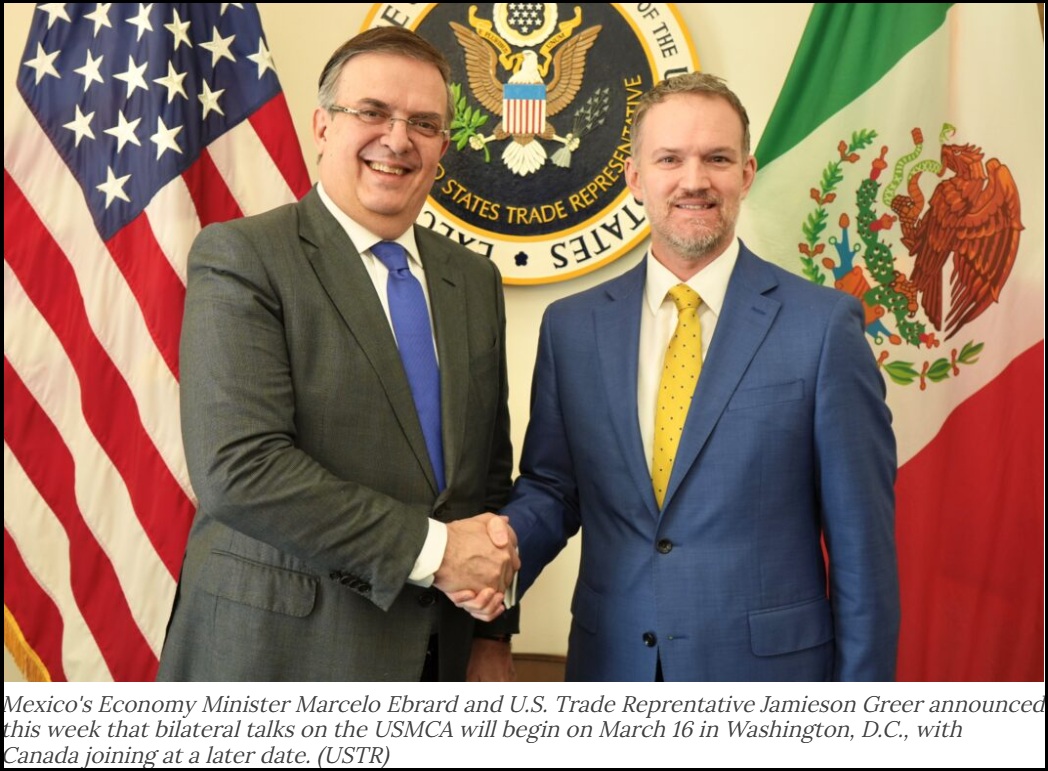
The language being used by the United States trade office is specific. [SEE HERE] The first bilateral round of negotiations between the United States and Mexico for the USMCA free trade agreement has concluded. (Emphasis mine)

PRESS RELEASE – “MEXICO CITY — “Today, the United States and Mexico concluded the first bilateral round related to the Joint Review of the United States-Mexico-Canada Agreement (USMCA).

The United States concluded discussions with the goals of reducing the trade deficit with Mexico and strengthening American supply chains. During this first round, negotiators discussed priority issues related to automotive rules of origin, steel and aluminum, and economic security.

The United States and Mexico recognize the importance of advancing cooperation to enhance regulatory compatibility to strengthen sectors, including medical devices, pharmaceuticals, cosmetic products, and others.

We will continue advancing these discussions on June 16-17 in Washington, D.C., in addition to agriculture and a level playing field. The third round will be held during the week of July 20 in Mexico City.

The United States continues to emphasize the importance of ensuring the Agreement benefits U.S. manufacturers, farmers, ranchers, workers, service suppliers, and businesses of all sizes, and of addressing free-riding from third countries.” (source)

Currently, European automakers have billions invested in Mexican auto plants.  Much of the component material for those vehicles comes from Europe for assembly in Mexico.  That was the primary focus of the Europeans in their trade agreement with Mexico.

(more…)

Secretary of Treasury Scott Bessent Delivers Economic and National Security Remarks to Reagan Economic Forum

Speaking to an audience at the Ronald Reagan National Economic Forum in California, Treasury Secretary Scott Bessent outlines how flawed trade, financial and economic policies of the past have brought us to a critical moment where President Donald Trump needs to reset the entire system in order to protect American interests.

This is a powerful and well delivered speech certain to gain attention from those who understand the challenge.  Secretary Bessent pulled no punches as he outlined how members of the audience themselves have contributed to a system that has eroded the national security of our nation state by advancing short-term interests disconnected from the American workforce and American industrial base.

The message was simple, “economic security is national security” and a failure to recognize how corporations chasing profits only contributed to the diminishment of internal American wealth.  The patriotic priority must be to return economic strength to the U.S., and all Americans must benefit from renewed economic nationalism.  The American system must be restored.  WATCH:

.

(more…)

Canada Officially Enters a Recession After Two Consecutive Quarters of Negative GDP Growth

The technical definition of a “recession” is two consecutive quarters of negative GDP growth. The 4th quarter of 2025 and 1st quarter of 2026 have identified exactly that problem, negative GDP growth in Canada. [-1% and -0.1% respectively] The pretending is fierce, and again CTH warns everyone to be careful about exposure to the Canadian sector in their investment holdings.

As customary, whenever the economic policy of a political leftist delivers a bad outcome, the media contort themselves in order to avoid defining the situation accurately.  Instead, the financial media project -without merit- that the current situation is more positive.  Unfortunately, the data doesn’t provide much room to arbitrarily change the definitions.

Keep in mind this announcement today comes on the heels of the Bank of Canada warning that a “cascading series of events could cause a sharp loss of investor confidence and lead to a spike in demand for liquidity or rapid asset sales.”  This is a particularly pertinent phrase given one of the common reasons being attributed to the negative GDP, increased import values – specifically Canadians purchasing gold.

Several financial outlets have noted the increase in the value of Canadian imports, a negative in the GDP calculation, is being driven by Canadians (institutions and individuals) purchasing gold as a hedge.  The Canadians are buying gold as a hedge against both inflation and currency devaluation.

This activity puts additional context onto the statements from the Bank of Canada, who would likely have advanced notice of this issue.  Hence, the Bank of Canada also saying, “In normal times, hedge fund activity helps keep markets running smoothly. But if conditions become strained, this activity could amplify stress and disrupt core funding markets.”  The Wall Street Journal:

WSJ – OTTAWA — Canada’s economy unexpectedly shrank for a second consecutive quarter as activity stalled at the start of the year, raising the likelihood the country dipped into a recession.

Gross domestic product, a broad measure of goods and services produced across Canada, edged down 0.1% in seasonally adjusted annualized terms in the January-to-March period, Statistics Canada said Friday.

The economy also contracted a larger-than-previously-estimated 1% in the final quarter of last year. Back-to-back quarterly declines typically define a technical recession.

(more…)
Canadian Central Bank Warns of “Cascading Series of Events” Leading to “Spike in Demand for Liquidity”

…”A cascading series of events could cause a sharp loss of investor confidence and lead to a spike in demand for liquidity or rapid asset sales”…

That’s a diplomatic way for the Bank of Canada to say the current financial situation in Canada is tenuously at risk, if the economic relationship with the United States severs as a result USMCA points of conflict becoming irreconcilable.  An interesting statement against the backdrop of Prime Minister Mark Carney having just visited New York making a pitch to American investors {citation}.

The Bank of Canada released their 2026 Financial Stability Report {see pdf here}, and Senior Deputy Governor Carolyn Rogers and Deputy Governor Toni Gravelle delivered remarks today about the analysis.  I’ve prompted the video below to the point of interest, as well as the transcript for the portion being highlighted [7:12 to 9:15].  WATCH:

[Transcript]  – […] “However, vulnerabilities have increased in some parts of the system. Stock and corporate debt valuations have risen and are high relative to historical norms. This makes markets more vulnerable to a sharp correction.

The issuance of global sovereign debt is also rising, and hedge funds are playing a bigger role in buying that debt, often using borrowed money. In normal times, hedge fund activity helps keep markets running smoothly. But if conditions become strained, this activity could amplify stress and disrupt core funding markets.

(more…)

Context for U.S. Oil Production

Sky News economics and data editor Ed Conway has produced another short and information filled segment looking at how the U.S. become the biggest oil producer in the world.  Well worth the 5-minutes and helps to contextualize many of the geopolitical shifts currently underway.  WATCH:

.

When you factor in the U.S. control over Venezuela oil production, well, things look even stronger.

(more…)

U.S. Ambassador to Canada Pete Hoekstra Discusses Trade Friction and USMCA Likelihood

I never quite understood just how controlled the information flow is inside Canada until about two years ago when we began closely monitoring Canadian positioning for the upcoming USMCA (CUSMA) renegotiation/cancellation.  It quickly became obvious the majority of Canadians have no idea why it is almost a certainty the U.S. would exit the trilateral arrangement and position for a bilateral free trade agreement.

In the two years that have passed, now we see a few Canadians starting to realize the core issues of trade conflict that make any FTA between the U.S. and Canada almost impossible.  The largest issue centers around Canada’s net-zero carbon legislation that now completely disconnects them from aligned North American energy policy between the U.S. and Mexico.

A trilateral agreement requires core alignment on industrial manufacturing, and that requires similar abilities & similar energy policy.  You cannot make steel, iron and aluminum without coal and gas.  You need joules for heavy industrial manufacturing that cannot be achieved without exploiting coal, gas or oil (carbon materials).  Canada’s energy policy no longer aligns with industrial manufacturing. This core issue cannot be resolved at the current level of energy policy in Canada.

There are other issues like Canadian trade deals with China, non-tariff barriers, legislated rules over intellectual property and other points of significant friction that make alignment within North America challenging. However, the energy component makes compatible trade impossible.

In the interview below, U.S. Ambassador to Canada Pete Hoekstra appears on a podcast with David Leis, for a blunt conversation about trade, pipelines, critical minerals, China, and why the U.S. is growing frustrated with Canada’s direction.  At the end Hoekstra even explains why he is doing Canadian podcasts; because information within Canada is restricted by the government control of media – and that explains why most Canadians are clueless about the issues.

I’ve prompted the interview to the point that gets into the details. If you are interested to be fully understanding of what is coming, this is a solid reference point. Also, if you have financial investments associated with Canada or any system that is connected to the economic relationship between the U.S. and Canada, you need to watch this interview to proactively defend your financial interests.  VIDEO PROMPTED:

.

Watch it or listen to this roughly 30 minutes (prompted) as you cook, drive or go about your day. But listen to it and see the disconnect between Canada and the USA as outlined.  Things are going to get much worse in this relationship as the finality of it all suddenly starts to sink in north of the border with the average Canadian.

(more…)

Vice President JD Vance Holds State AG Roundtable on Federal Investigation into Fraud Cases

Andrew Ferguson is the Chairman of the Federal Trade Commission (FTC), which actively investigates and warns against fraud and scam. Andrew Ferguson is also the Vice Chair of the Federal Anti-Fraud Task Force.

Vice President JD Vance was joined today by White House Deputy Chief of Staff Stephen Miller and Vice Chair Andrew Ferguson, as they held brief public remarks before a closed-door meeting with several state attorney’s general.

Both Miller and Ferguson emphasized that the benefits within our nation were constructed on the ‘honor system’ for people who need financial support. Unfortunately, this system collapses when tens-of-millions of illegal alien migrants are permitted to just cross the border and start applying for assistance. The results surface not only in billions of fraudulent payouts, but also in the smaller visible indicators of “deodorant being locked behind plexiglass shields to prevent theft.” WATCH:

.

(more…)

Sunday Talks – Defeated Thomas Massie Promises to Keep Shouting at Trees Until MAGA is Defeated

Appearing on NBC’s Meet the Press to promote his character and principled superiority to all other congressional representatives, the professional political narcissist, Thomas Massie, pledges to create as much turmoil as possible in his final seven months. Video and Transcript Below:

{TRANSCRIPT} – KRISTEN WELKER: And joining me now is Republican Congressman Thomas Massie of Kentucky. Congressman Massie, welcome back to Meet the Press.

REP. THOMAS MASSIE: Thanks, Kristen.

KRISTEN WELKER: Thank you so much for being here. I do wanna get to your race in just a moment, but I have to start with that developing news on Iran, President Trump posting on Saturday that an agreement with Iran has, quote, “largely been negotiated.” It’s unclear what exactly has been agreed to, whether any deal would directly address the issue of the nuclear program, which of course is at the center of the war with Iran. So far no final deal has been announced, but, Congressman, would you support a short-term deal with Iran?

REP. THOMAS MASSIE: Well, I was the author of the first War Powers Resolution to get us out of Iran. My constituents are hurting. Gas is almost $5 a gallon. Diesel’s almost $6 a gallon. And the farmers here in Kentucky can’t afford the fertilizer to put on their fields, so heck yes, I would support it. We don’t know what the terms of it are, but if Lindsay Graham and Ted Cruz are crashing out last night, I’d say it’s probably a pretty good deal.

(more…)

With USMCA Exit Looming, Urgency Arrives – Mexico Signs Trade Deal with European Union

It’s not Mexico that needs a trade deal with Europe, it’s the opposite.

For almost two decades Europe has been investing heavily inside Mexico, particularly noted in the auto industry, as they positioned themselves to take advantage of NAFTA and later the USMCA as an entry to the U.S. market.

European auto companies spent billions on assembly plants in Mexico, where they could ship EU manufactured component goods to be assembled into NAFTA/USMCA compliant vehicles.  As President Trump and USTR Greer begin focusing on eliminating the USMCA trade agreement in favor of two bilateral deals (U.S-Canada and U.S-Mexico), Europe now needs to protect prior investment.

The prior Mexico-EU trade agreement has existed since 2000 (NAFTA timeframe).  In 2025 they agreed to a revised Free Trade Agreement (FTA) and finalized the terms and conditions yesterday.

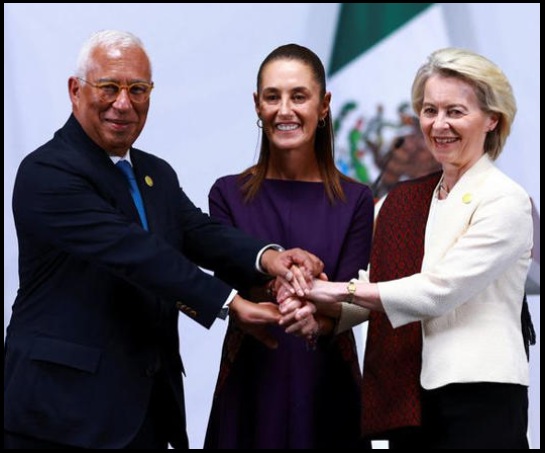
MEXICO CITY, May 22 (Reuters) – Mexico and the European Union signed a long-stalled free trade agreement on Friday as they seek to decrease dependence on the U.S. and partially insulate themselves from U.S. President Donald Trump’s tariffs.

The accord, which they reached broad agreement on in 2025 but have delayed signing, expands a Mexico-EU trade accord from 2000, which covered only industrial goods. The new pact adds services, government procurement, digital trade, investment and farm produce.

Mexico’s President Claudia Sheinbaum, European Commission President Ursula von der Leyen and European Council President Antonio Costa are to sign the deal in Mexico City in their first summit in over a decade.

(more…)