Another facet not discussed in the BBB background is data released by the US Office of Personnel Management showing a reduction of approximately 23,000 federal employees since the Trump administration took office. [LINK HERE] OPM adds that hundreds of thousands will drop from payroll in October 2025. [link]
Office of Management and Budget Director Russel Vought appears on CNBC to discuss the non-pretending facts within the Big Beautiful Bill as it passed through the Senate. The House now needs to reconcile, support the bill and send it to President Trump’s desk by July 4th.
The key notation from Vought comes at 06:07 of the video below as he explains the BBB is just one facet of a larger cost-cutting initiative (tariff revenue, recission cuts, discretionary spending reductions etc.). WATCH:
.
I’ve got two words for the Musk fanboys, Tech bros, CONservatives, Massie/Paul/Roy fools, and those who clutch pearls on the false budget apoplexy; those two words are not ‘Merry Christmas.’
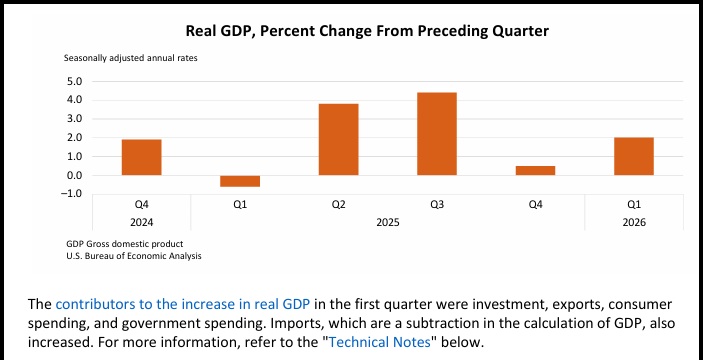
Musk has previously said his opposition to the bill stems from the fiscal spending and aggregate, unsustainable national debt issue. However, as President Trump and NEC Director Kevin Hassett have noted, the debt issue is a combination of spending and growth. The economic goals of the administration are to grow the economy at a GDP rate larger than 3%, while simultaneously using the Office of Management and Budget to curtail spending allotments from congress.
White House National Economic Council Director Kevin Hassett appears on Fox News to outline some of the background details of the Big Beautiful Bill. Interestingly, after happy Hassett outlines the specifics of the benefits within the bill, he dodges a question about possibly becoming the next Fed Chairman. 🤔… A Happy Fed Chair?
I was unaware until this interview the July 1st digital services tax that Canada is going to apply to U.S. tech companies is retroactive in application. Over a billion dollars will be due on Monday as a result of Canada’s targeting. Duplicitous Snow Mexicans.
Treasury Secretary Scott Bessent outlines the details of what Canada did and why President Trump is responding so forcefully. Bessent also explains that the EU doesn’t have a digital services tax, but some European countries do. President Trump is factoring in those targeted tariffs against our tech industry as he seeks to execute new trade agreements with the EU. WATCH:
As we have noted from the beginning, the overwhelming majority of the Canadian people genuinely have no idea what the final goal is for President Trump; this includes Prime Minister Mark Carney. A few Canadians can see the big picture, but only a very few.
Today, President Trump announces that all trade negotiations with Canada are halted, effective immediately, because Mark Carney and his team are trying to target the USA with a Digital Services Tax. When you know the end-game for Trump, you can clearly see how this positioning from Canada once again plays directly into his hands.
PRESIDENT TRUMP – “We have just been informed that Canada, a very difficult Country to TRADE with, including the fact that they have charged our Farmers as much as 400% Tariffs, for years, on Dairy Products, has just announced that they are putting a Digital Services Tax on our American Technology Companies, which is a direct and blatant attack on our Country. They are obviously copying the European Union, which has done the same thing, and is currently under discussion with us, also.
Based on this egregious Tax, we are hereby terminating ALL discussions on Trade with Canada, effective immediately. We will let Canada know the Tariff that they will be paying to do business with the United States of America within the next seven day period. Thank you for your attention to this matter!
Secretary of State Marco Rubio hosted officials from the Democratic Republic of Congo and Rwanda at the State Department for a peace agreement signing ceremony. The 30-year war between Congo and Rwanda is finally coming to an end, thanks in large part to the efforts of Qatar, U.S. President Donald Trump and U.S. Secretary Marco Rubio. WATCH:
.
“Peace is the prize” ~ U.S. President Donald J Trump
I am not promoting the group, I am promoting the message within this video. As you watch Susan Kokinda discuss the events from the recent G7, and put the remarks by President Trump into context, you might find what she’s saying sounds incredibly familiar.
This recap may sound familiar because it is almost identical to what CTH has outlined {SEE HERE} and {SEE HERE}. So familiar in fact, it might sound as though myself and Susan Kokinda have discussed these issues; we have not. This video is the first time I have heard of her and her group, Promethean Action.
That said, what Mrs Kokinda outlines is precisely what is visible in the details of President Trump’s activity. While I might take exception to some of the lingo used, the substance of her explanation is spot on; particularly accurate is her overlay of how President Trump is approaching Russian President Vladimir Putin when contrast with Trump’s economic vision. This is well worth watching.
What Susan Kokinda says about the Senate opposition to President Trump, vis-a-vis the Big Beautiful Bill, is also accurate. It is within the BBB policy legislation that we see the springboard for the American economic revival. However, the larger program for cooperative nationalism is also why the same opponents to the BBB agenda are aligned to keep President Trump and President Putin apart.
If the USA (Technology, innovation, consumer market) forms a strategic alliance with Russia (resources, capacity, consumer market), and then negotiates a reciprocal trade and manufacturing arrangement with China (transformation to a USA manufacturing return), the geopolitical world order is economically changed. Here at home, the USA is no longer a service driven economy; a natural balance is restored. The multinationals will fight this hard. There are trillions at stake.
Russian markets open to USA goods, technology and innovation services. USA markets open to Russian raw materials and strategic partnerships. With expanded alternatives, China then has to compete for manufacturing etc. Controlled markets become free markets. The focus is on expanded economics, not war and friction.
U.S. President Trump and U.K Prime Minister Starmer finished signing the details of the U.S-U.K trade agreement on heavy industry, aerospace, car tariffs and automobile trade. Both Trump and Starmer delivered remarks to the assembled press pool prior to answering questions.
The media were full of questions for President Trump about the latest developments in the Israel-Iran conflict. President Trump noted he needs to conclude the commitments on his schedule before he can engage in Iranian negotiations.
The British media, maintaining their longstanding history against the Russian Federation, are worried that President Trump might like Russia and or even agree with Russian perspectives. To the British press this possibility gives them the vapors. President Trump tries to intercept the U.K fainting by reminding the Brits the goal is to “stop death” at a rate of 5,000 young lives per week. WATCH:
Commerce Secretary Howard Lutnick appears on CNBC to outline some of the topline details behind the latest U.S-China trade agreement.
As Lutnick notes, with all the terms agreed over two long days of negotiation, the details now move to “the paper” where President Trump and Chairman Xi will review and approve. The agreement is ¹only between the USA and China and does not involve trade details with other nations who will not be pulled along by our U.S. position.
.
This facet is very interesting because it means ¹Canada, a nation entirely dependent on China for industrial raw materials, does not gain benefit from the outcome of the U.S-China trade agreement. Canada is openly, publicly, trying to develop their economic model with a relationship toward the U.K and EU, to the detriment of the USA. If China grants benefit to the USA that are not existent for Canada, the U.K and E.U, that puts their coalition of economic adversaries at a disadvantage.
Lutnicks’ throw-away line, “we tried to help them, but it didn’t work out”… moving on. lol
President Trump announces that Treasury Secretary Scott Bessent, Commerce Secretary Howard Lutnick and U.S. Trade Representative Jamieson Greer have successfully concluded three-days of topline trade negotiations with their Chinese counterparts.
President Trump and Chairman Xi will now evaluate the successfully negotiated details and institute the topline strategy as part of the overall future trade agreement. According to the Truth Social post, there will be a 55% tariff on Chinese imports and a 10% tariff on U.S. goods to China.