Two fundamental issues that Canadian politicians and media keep hidden from Canadians. First, in the 2025 U.S. Supreme Court decision last year about tariffs, the court outlined that the executive branch can constitutionally ban trade with another country. Second, the U.S. can exit the USMCA with a six-month notification.
There is an awful lot of pretending and gaslighting within this general discussion segment; purposefully advanced to keep the Canadian people in the dark. However, that said, Canada’s chief trade negotiator to the United States, Janice Charette does admit that tariff free access to the U.S market is lost forever.
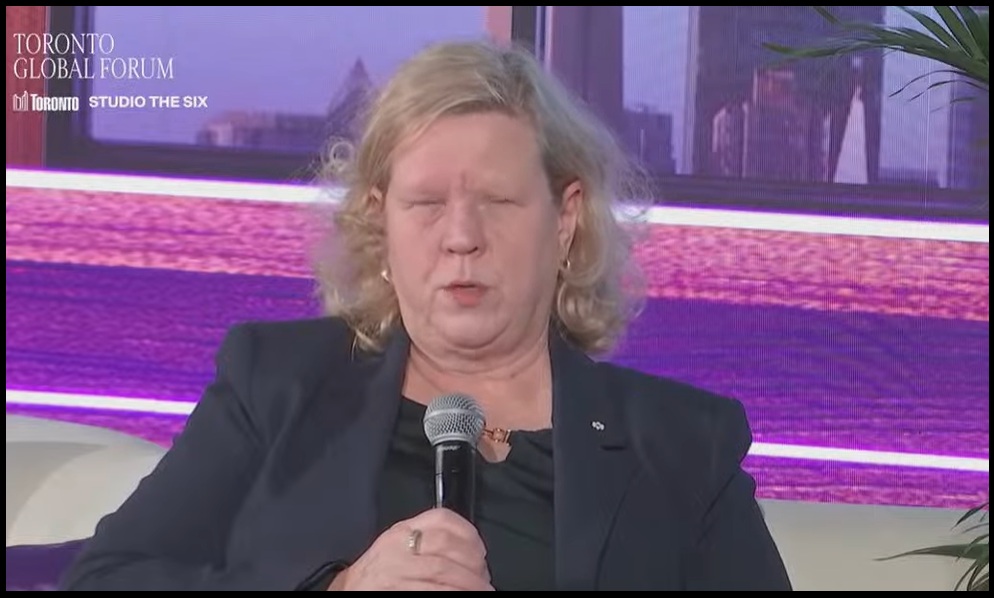
Janice Charette is participating in a discussion at the Toronto Global Forum, where she is questioned by Brian Tobin, vice chair of the BMO Financial Group about the trade relationship with the United States and the opinion that many Canadian officials have espoused that Canada just needs to outlast President Donald Trump.
Charette informs the audience that regardless of who is the U.S. President, tariffs will likely remain in place permanently because the amount of revenue being generated to the U.S. Treasury is too great for any President or congress to stop. PROMPTED – WATCH:
While almost all of her analysis is flawed, skewed and seriously underestimates the nature of the dynamic that Canada is facing, what Janice Charette outlines about how Donald Trump has shifted the national revenue model using global tariffs to offset national expenditures (her baseline) is accurate.
Beyond her statement it is worth pausing for a moment and using Charette’s frame of reference to reconsider the post WWII European revenue model. It was/is President Trump’s model in reverse.
The Marshal plan, was essentially one-way tariffs on American trade that provided one-way benefits (revenue) that permitted the EU to rebuild after the second world war. To Charlette’s framework, how willing was the EU mindset to change this beneficial economic outcome?
Answer: The EU fought it (and is still fighting it), perceiving the elimination of that benefit as an existential threat to their economic power. The EU became reliant on the Marshal Plan.
In many ways Canada made the same economic mistake.
Canada legislated and built their economy around dependencies they never thought would go away.
They disassembled their dirty “carbon emitting” jobs. They took apart their energy foundation. They deindustrialized in an effort to join/lead the world in their virtue signaling around clean energy. Canada intentionally chose to take a series of steps to make their economy less independent, less strong and much less resilient; while worshipping at the altar of the “climate change” religion.
Tariff free access to the USA market, while combining non-tariff protectionist barriers to USA imports formed the foundation of this progressive system. Without the benefit of tariff-free trade with the USA, Canada could never have deindustrialized and become an economy dependent on: (1) shipping out raw materials for dirty processing in other countries; then (2) reimporting the finished component goods for assembly in Canada.
Finally, a person steps forth to stop this one-way benefit. Along came Donald Trump.
When Canada was told those USA dependencies will no longer be permitted and reciprocity will frame the new trade agreement, suddenly all those decades-long deindustrialized vulnerabilities surfaced. This is their current status.
That’s why former Canadian Prime Minister Justin Trudeau told President-elect Trump the “reciprocity” demand was no longer feasible; which led to the 51st state response.
The current problem is that ‘elbow’s up’ Canada continues to maintain economic denial about their status.
Canada has raw materials, but Canada no longer has the willingness or capability to turn those raw materials into industrial scale products that later become component manufacturing goods. They are intentionally missing the industrial component because the processing itself emits dirty carbon outputs.
This is why we now see Canadian Prime Minister Mark Carney selling off the assets of Canada.
Both Canada and Europe changed their energy systems for exactly the same ‘climate change’ reason, and both Canada and Europe are stuck inside the economic confines of their own creation.
China has done a masterful job exploiting that self-created vulnerability in both Europe and now Canada. What this generation is now discovering is that no amount of assembled soft power will ever be able to compensate for the hard power of industrial capacity.
The United Kingdom, Canada, Europe, Australia and beyond will never be global powers again because they no longer have industrial capacity. They are no longer hard powers. This is the one point that all intellectually honest observers will notice.
The ‘soft powers’ are now in a situation where they are seeking alternative sources for their intentionally lost industrial capacity.
Thankfully, and I mean this in the sincerest way imaginable, the United States elected Donald Trump at just the right moment to remove us from this problem, or we would have been in the exact same position as Europe, Canada and Australia.
Simultaneous to this bullet dodged, it was only Donald Trump who drew significant enough attention to the problem so that other weaker persons in politics could realize the severity of the cliff we almost encountered.
Do not ever underestimate how fortunate we were. Without Donald J Trump the United States would have easily become just another larger version of a dependent soft power.
The term “service driven economy” ringing a bell?
Remember this when Trump, Xi and Putin get together next month.
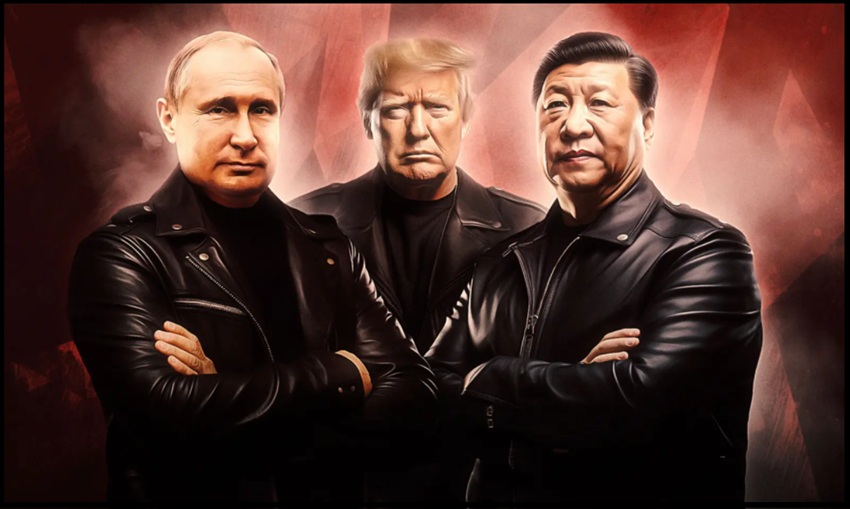
I need someone to tell me if that is a man in a dress or what?
Whatever it is, it’s butt ugly….
Either need Austin Powers or Mick Dundee to take one for the team.
Empirical evidence of all worldly matters informs us that at some point all things come to an end. Obviously, the Canadians never learned this lesson.
Yes, they don’t seem to have the ability to connect the dots….They are lost in space…Soon they will be doing post graduate work in FAFO.
Yep. We can’t all be plastic surgeons.
Ugh….Once again the journalist is slobbering all over Janice Charette, going soft and gentle….disgusting…then he tops it off with a big kiss at the end (best buddies). Will never forgive this woman who was Trudeau’s right hand person ( his privy counsel during covid tyranny). She continues to lie but now to our faces as opposed to behind Trudeau’s fancy socks! God is good…he made her look porcine for a reason.
US to remove 50% tariffs on some Canadian goods to help Republicans in midterms, WSJ reports
Oct 23 (Reuters) – The United States is expected to remove 50% tariffs on some Canadian agricultural and forestry products in a bid to help Maine Senator Susan Collins and other Republicans from northern US states in the upcoming midterm elections, the Wall Street Journal reported on Friday, citing people familiar.
https://share.google/WNaIbndzije6iqwoc
WSJ…? …Reuters….?
Charette is telling the peons that it’s going to be bad for thee, but not for me. The giant sucking sound is here to stay.
“Thankfully, and I mean this in the sincerest way imaginable, the United States elected Donald Trump at just the right moment…”
Yes.
Our Father/Creator has undoubtedly willed through His Grace the timely election of the right man to lead the nation and set an example for the world at this moment in history.
The interviewer and interviewee are both deluded. Her arrogant, entitled attitude is emblematic of Candian trade posture. Canada is now last on my list of “allies. Canada will need an education in reality which regretably will come with pain for Canadians.