♦ September 2015 – Billionaire Paul Singer contracts with Glenn Simpson and Fusion GPS for opposition research on candidate Donald Trump during 2016 GOP presidential primary. Simpson prior work during time at Wall Street journal serves as reference.
♦ November 2015 – Simpson hires Nellie Ohr to assist on Trump project. Ohr was CIA open-source analyst. Revelations by NSA compliance officer in April 2016 point to November 2015 as origin of multiple unauthorized searches of NSA database.
♦ December 2015 – Mrs. Ohr contacts Christopher Steele, submitting data for cross-reference with sources and seeking collaboration on Trump project. Ohr using ham radio license as independent operator.
♦ January – March 2016 – GOP Presidential primary ongoing. Candidate Donald Trump wins majority of primary delegates from all early state contests. Momentum for Donald Trump becomes significant. Cruz, Kasich, Rubio final group along with Trump. Late March, Paul Singer contacts Glenn Simpson to cancel opposition research. NSA compliance officer notifies NSA Director Mike Rogers about unauthorized use of database by “contractors.” Rogers asks for full review.
Bill Barr continued his Sunday Talk appearances this week, specifically organized by the apparatus in control of DC, to attack Donald Trump and position the executive branch of government as subservient to the interests of the United States Intelligence Community.
Don’t miss the forest when you are looking at the trees.
Barr is advocating for a system of government that has institutional interests above the constitution. According to Bill Barr, the DOJ, FBI and US Intelligence Community control the Office of the President. Look at what he is saying. The bureaucracy of the administrative state is above the chief executive office holder. The intelligence community supersedes the President.
I’m not putting words in his mouth. Barr believes the President is a functionary of, and in a lesser position than, the unelected people who control institutions that make up the executive branch of government. THIS is what he believes. Get past the parseltongue and obtuse linguistics; this is Barr’s advocacy position. WATCH:
.
Why? Why is he doing this? Does he really believe this? The answer is yes, and essentially what Bill Barr is doing is protecting the system that George W Bush, Dick Cheney and Barack Obama constructed and then used respectively. Barr is defending the surveillance state, the post-Patriot Act state of intelligence agency control over government.
Bill Barr is protecting the weaponized institutions of the Director of National Intelligence (Bush/Cheney), the Dept of Justice – National Security Division [DOJ-NSD (Obama/Holder)], the Foreign Intelligence Surveillance Act (FISA Court), and the Dept of Homeland Security (Bush/Cheney). These institutions, according to AG Bill Barr, are now in full control of the executive branch, full control of government, and now more powerful than the Office of the President of the United States.
This is the position of the DC system and everyone within it. This is why Bill Barr is positioning himself as the tip of the spear. This position is the entire reason why President Trump was told to hire Bill Barr, because Bill Barr had a job to do…. preserve the institutions, he helped build, at all costs. This is also why Bill Barr protected Robert Mueller, and never impeded the Andrew Weissmann effort.
Bill Barr knows what Jack Smith, Lisa Monaco, Andrew Weissmann, Barry Berke, Norm Eisen, Mary McCord, David Laufman and Lawfare are doing. Bill Barr supports that effort, because ultimately it preserves the institutions from the corrective action of Donald Trump.
I have been reviewing interviews, looking at discussion, and some of them I will share in the next few articles. However, for a solid representation of the state of our current dynamic, as it relates to the targeting of President Donald J. Trump, this interview below is a solid outlook from the detractors.
CBS News legal analyst Rikki Klieman and CBS News investigative correspondent Catherine Herridge join “Face the Nation” to discuss what’s in the indictment — and what it means for Trump. [Transcript Here]
Before getting to the video, it’s valuable to see Rikki Klieman representing the interpretation of the media outlook toward the indictment handed down by Special Counsel Jack Smith. It is also valuable to see CBS’s Catherine Herridge represent the defenders of the institutions, from the outside vulgarian personage of Trump.
Klieman buys the Lawfare narrative completely, including the framework of classified documents as opposed to documents containing classified markings. She sells the Lawfare outline as gospel and makes all assertions from that position. Herridge looks at how the bureaucracy responds to Trump, including how the institutions hold power of determination higher than a President of the United States.
As Bill Barr said emphatically earlier today, “The documents do not belong to Trump,” continuing with “The documents belong to the government who created them, not the man for whom they were created.” So sayeth the defender of the omnipotent Dept of Justice. This is where a sharp intellectual knife to cut through the chaff and countermeasures is needed, and notice no one brings up the visible and practical deconstruction point.
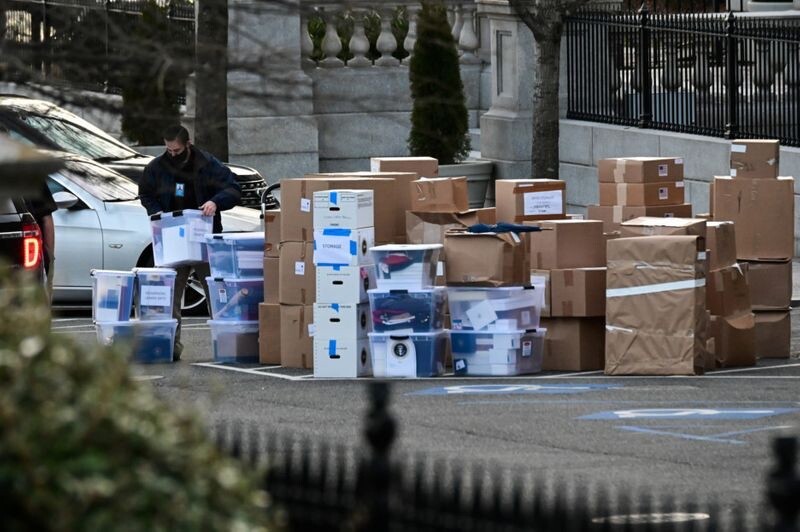
If the documents did not belong to President Donald J. Trump, then why did the government dump them in the parking lot of the White House and tell him to deal with them?
If the documents belonged to the government, and not to the man for whom they were created, then why did that same government give them to him and force him to take them to a location of his choosing? Can you see the obtuse argument fall apart when simple pragmatic questions are raised?
The institutions are presented, by the sellers of the Lawfare narrative, as higher than the authority of the President of the United States. This is how ridiculous our government has become.
On March 15, 2017, House Intelligence Committee Chairman Devin Nunes held a press conference announcing there was no specific evidence of “wire taps” at Trump Tower {HERE}. However, on March 22, 2017, Nunes held another press conference saying information was brought forth to the HPSCI showing the Trump campaign was under Title-1 surveillance by the FBI and former Obama administration {SEE HERE}. In between those critical six days, something happened that was important.
With the full backdrop of the Durham report as the baseline, we now know there was zero evidence of any Russian interference effort in the 2016 election.
The Trump-Russia narrative was created by the Clinton campaign, promoted by the FBI and Main justice and advanced in narrative construction by the Obama administration.
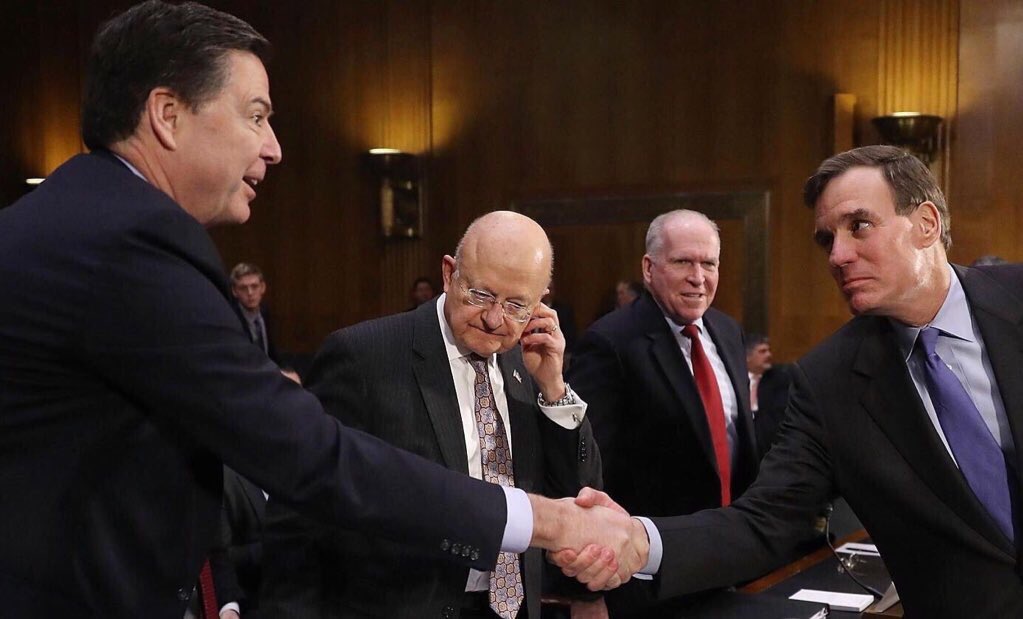
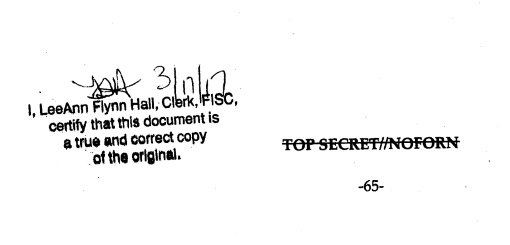
On March 17, 2017, Senate Intelligence Committee Vice-Chairman Mark Warner asked the FISA court for a copy of the FISA application used against Trump campaign official Carter Page.
This is not in doubt and was evidenced in DC USAO court records related to SSCI security director James Wolfe who was initially indicted for leaking that specific copy of the FISA application. The FISC stamp is also visible on the copy of the FISA that was eventually released.
QUESTION: Why did Mark Warner request a copy of the FISA application from the FISA COURT and not from DOJ Main Justice? The answer to that question falls into how insiders played the silo game against the Trump administration.
Warner didn’t request the FISA application from Main Justice because: (1) the DOJ insiders were going to fight the release of any toxic information that proved the Trump campaign was under active Title-1 surveillance; they were going to fight release to Devin Nunes. And (2) the legislative branch was part of the Trump-Russia attack construct and the SSCI membership were active participants with the DOJ and FBI (executive branch).
The FBI did not weaponize itself. The weaponization of the institution was done by people; the same people that John Durham did not indict for weaponizing it.
The same applies to the DHS, ODNI, DOJ, DOJ-NSD and SSCI. These institutions did not weaponize themselves; they were weaponized by the people within them.
This is the core reality behind the missing part of the John Durham report, no proposed change in policy or institutional systems. Why? Because the policies and systems are not the issue; it was the intent of the people within it – those who weaponized it. Here’s the kicker. Those people are still in place – that’s why the weaponization continues.
It doesn’t do us any good to rewrite the same articles repeatedly to emphasize the same point.
WE MUST GET THIS INFORMATION INTO THE BLOODSTREAM OF THE LARGER AMERICAN ELECTORATE.
Here’s the cited evidence.
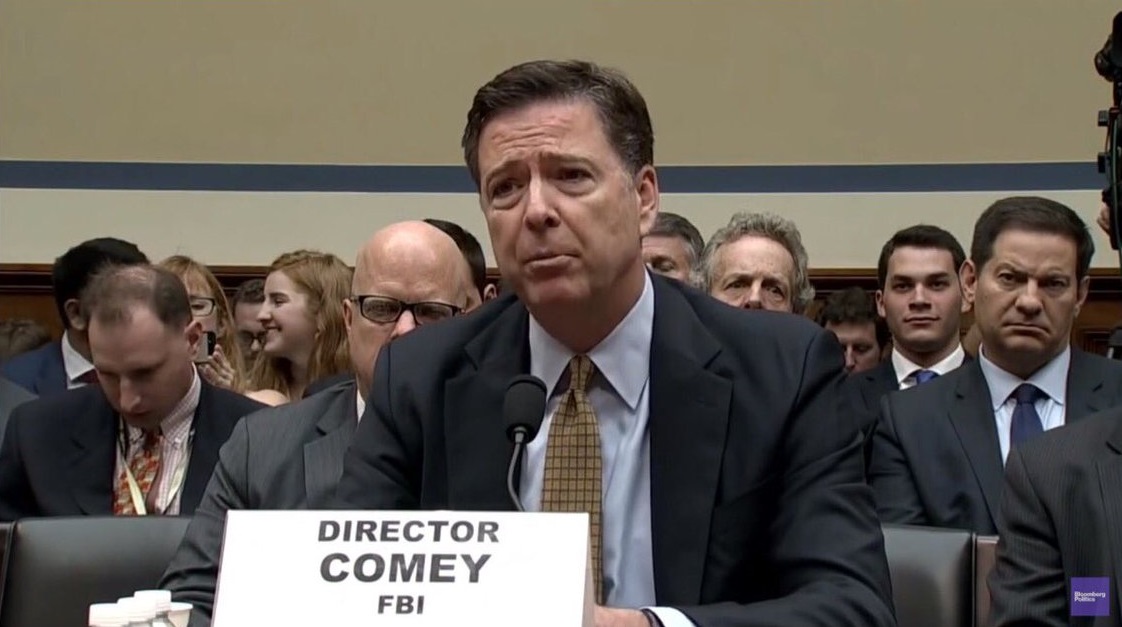
Former FBI Director James Comey openly admitted to Congress on March 20, 2017, how the FBI, FBI Counterintelligence Division, DOJ and DOJ-National Security Division, together with the Office of the Director of National Intelligence (ODNI) and the CIA, had been conducting independent rogue investigations of Donald Trump for over a year without informing Congress [the Gang of Eight]. When asked the question, Comey winced, then justified the lack of informing Go8 oversight by saying, “um, because of the sensitivity of the matter?”
Stupidly, Congress never pressed James Comey on that issue. The arrogance of Comey was astounding, and the acceptance by Congress was infuriating. However, that specific example highlighted just how politically corrupt the system had become. In essence, Team Obama usurped the entire design of congressional oversight…. and Congress just brushed it off.
Congressman George Santos was indicted on thirteen counts of wire fraud, money laundering, theft of public funds and lying on financial disclosure forms during his short period in Congress. He was taken into custody Wednesday in New York [DETAILS].
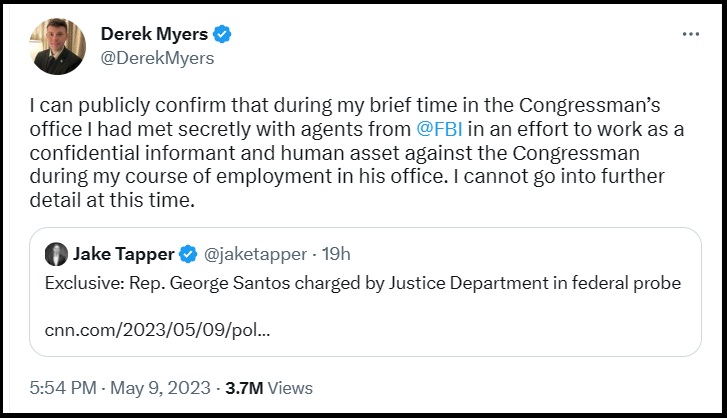
By most accounts and even his own words, Santos is a generally sketchy person, and I doubt there will be too many defenders of his character or the issues at stake. However, all of that said, this Tweet from a staffer in his office is wild:
The casual nature of this is quite alarming. It was not that long ago when the EXECUTIVE branch, using confidential human sources to investigate the LEGISLATIVE branch, would have been a matter of incredible controversy reserved for only the most serious of criminal possibilities.
An FBI informant penetrating the congressional office to relay information back to the FBI is quite remarkable. However, it appears we are in an era of justice administration where anything is just flippantly asserted inside the mechanisms of government.
In the big picture, beyond the selfish issues of George Santos, when we consider the Fourth Branch of Government operating to protect itself against sunlight and scrutiny, this example of the FBI operating in the shadows of congress should start to make everyone uncomfortable. How can there be “checks” and balances, when the enforcement mechanisms can be deployed against any entity who threatens the system itself?
Extend this approach to legislative committee oversight, and you start to see how the system protects itself. A reminder below of what they are ultimately protecting.
Read this as many times as needed to contemplate the nature of our problem.
Former FBI Director James Comey openly admitted to Congress on March 20, 2017, how the FBI, FBI Counterintelligence Division, DOJ and DOJ-National Security Division, together with the Office of the Director of National Intelligence (ODNI) and the CIA, had been conducting independent investigations of Donald Trump for over a year without informing Congress [the Gang of Eight]. When asked the question, Comey winced, then justified the lack of informing Go8 oversight by saying, “um, because of the sensitivity of the matter?”
Stupidly, Congress never pressed James Comey on that issue. The arrogance of Comey was astounding, and the acceptance by Congress was infuriating. However, that specific example highlighted just how politically corrupt the system had become. In essence, Team Obama usurped the entire design of congressional oversight…. and Congress just brushed it off.
This event, and everything in the background as outlined within the James Comey admission, factually happened. It is on the record, admitted and nothing about the reality of what took place is subject to conjecture or refute.
Yet somehow, we, specifically our Congress, just moved on as if what FBI Director James Comey outlined and admitted wasn’t a total usurpation of the U.S. Constitution and a collapse in the structure of our coequal branches of government.
We cannot fight our way through the issues until we first realize what lies at the root of the problem.
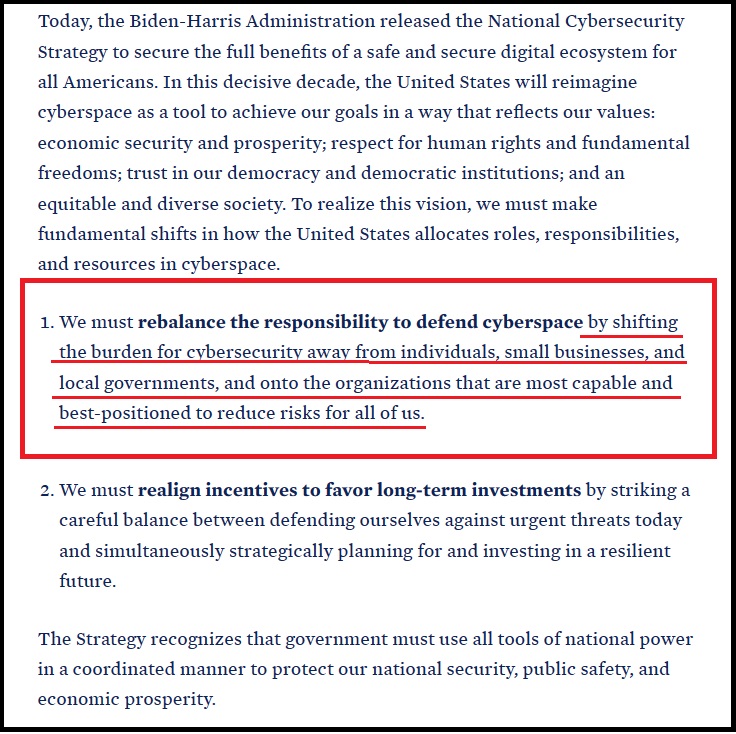
On March 2, 2023, the people in control of the Joe Biden administration officially announced that government control of internet content was now officially a part of the national security apparatus. [White House Link] If you have followed the history of how the Fourth Branch of Government has been created, you will immediately recognize the intent of this new framework.
The “National Cybersecurity Strategy” aligns with, supports, and works in concert with a total U.S. surveillance system, where definitions of information are then applied to “cybersecurity” and communication vectors. This policy is both a surveillance system and an information filtration prism where the government will decide what is information, disinformation, misinformation and malinformation, then act upon it.
In part, this appears to be a response to the revelations around government influence of social media, the Twitter Files. Now we see the formalization of the intent. The government will be the arbiter of truth and cyber security, not the communication platforms or private companies. This announcement puts the government in control.
All of the control systems previously assembled under the guise of the Dept of Homeland Security now become part of the online, digital national security apparatus. I simply cannot emphasis enough how dangerous this is, and the unspoken motive behind it; however, to the latter, you are part of a small select group who are capable of understanding what is in this announcement without me spelling it out.
The website Just Security, author former CIA operative Douglas Johnson, is very concerned about the House Subcommittee on Federal Government Weaponization. [SEE ARTICLE HERE} The concern is clouded under the auspices of fearing politicization by questioning the intelligence community about weaponized government.
The article is a mainstream bureaucratic outlook where the professional intelligence apparatus views themselves as beyond being accountable to the elected public officials, specifically the House members of the committee. The permanent unelected officials have a self-perception above the reach of the elected officials.
In essence, there is no public accountability model within their view of their operation. There can only be concealment, secret briefings, darkness and ‘trust us’ type reviews of their authorities. It’s quite a remarkable thing to read.
Just Security […] that’s oversight, a bipartisan endeavor conducted in the interest of all Americans, regardless of political affiliation. The oversight structure that came from the Church Committee investigations adopted legal and sensible rules of the road and protections for all stakeholders. Such supervision is conducted in controlled settings, shielded from public exposure, in a way that promotes candor and trust among both the auditors and the audited, facilitating transparency.
Note: How has that worked out for the American people?
During my trip to DC in the summer of 2020 there were a myriad of disconcerting datapoints assembled; revelations that made sense of the madness and disappointments found everywhere. However, one of the key notations for future reference was to watch the political evolution of Dept of Homeland Security (DHS) and spot the jump where the ideological outlook turns into specific government action.
The Office of the Director of National Intelligence (ODNI), specifically created as an outcome of the post-911 Patriot Act, is the pivot point on the surveillance radar sweep.
Prior to the DNI the general Intelligence Community (IC) surveillance faced offshore and swept foreign adversaries. If any threat was picked up that included the potential for domestic terrorism, the identified contact transferred from the CIA, NSA, DoD into the DOJ and FBI. The DOJ then used the FISA Court to request transfer of targeting from foreign to domestic.
However, after 911 it was determined the national security surveillance radar needed to sweep a full 360° to include domestic surveillance. The ODNI was the office created to manage the pivot point. As a specific outcome of the Patriot Act, American citizens were now under the same surveillance as foreign adversaries. The new definition of American citizens being threats to the national security state is ultimately what led to our taking off shoes at TSA checkpoints in airports. TSA is a subsidiary agency of DHS.