Quantcast

Wall Street Lobbying Groups Battle To Remove Transnational Shipping Restrictions To Protect Chinese Business Interests

The 40-year deindustrialization of America, and the subsequent destruction of jobs and the U.S. middle class, did not happen accidentally. It happened as an intentional outcome of selfish multinational business interests chasing profit, combined with the willingness of congress to accept bribes -via lobbying payments- in order to facilitative corporate greed.

The only disruption in the collective economic manipulation was the forced intermission by the American middle class when Donald J. Trump was elected.

President Trump’s tariffs, countervailing duties and protectionist policies against transnational dumping of steel and aluminum into the U.S. marketplace, was a major impediment to the corporate agenda, and it quickly resulted in the biggest economic resurgence in U.S. history.

As a result, people started demanding Congress take a new approach toward Chinese transnational shipping schemes as Beijing attempted to manipulate markets and avoid the Trump-era policies.   A few in Congress assembled legislation that would prevent companies from evading tariffs by rerouting their products through another country (i.e. transnational shipping).  That legislation has triggered the multinational business groups who are now lobbying congress to remove it.

The business groups opposed to the anti-dumping legislation are the same familiar voices who decry tariffs.  The U.S. Chamber of Commerce, the National Retail Federation and the usual list of lobbying interests are all lining up once again to demand the U.S. remains a ‘service driven economy’, so they can continue their business models and exploit the U.S. market while profiting from cheap imported goods.

(more…)

Tenuous Winter Wheat Crops Could Become Problematic

Wheat is an essential grain harvest in the overall food chain.  Winter wheat is planted in October and harvested the following June and July, however, the U.S. crop this year is in a tenuous position because of severe drought in the plains.  Kansas represents about a quarter of the U.S. harvest and is currently suffering through an extended dry season.

Last week, “Kansas Governor Laura Kelly declared a drought emergency, warnings and watches for every county in Kansas on Thursday due to dry conditions causing high fire danger.” (link)

We need to keep an eye on this, and it would be wise to make proactive preparations now for the possibility of a severe shortage.  This potential is what has driven the price of wheat futures, and when combined with the issues in Europe’s largest wheat producer, Russia, there’s a very real possibility of a global shortage of wheat.

The early March warnings are beginning to become more important.  “The world has grown hugely dependent on Ukraine and Russia for their wheat, a crop used in everything from bread to couscous and noodles. The nations account for a quarter of global trade. They are also cheap suppliers, which makes their exports favorites for importers in the Middle East and North Africa, including in Egypt, the world’s biggest wheat buyer.” (link)

(more…)

Bloomberg Has Inflation Advice for Proles Making Less Than $300k a Year – Shut Up, Eat Lentils, Ride the Bus and Kill Your Pets

You might wonder what the ruling class thinks of how inflation is hitting middle America.   For insight into their perspective, Bloomberg News just published some suggestions for all the unwashed masses – as defined as those who don’t earn $300,000 per year.

The advice includes, shut up about the price of food, and eat lentils instead of meat. Quit bitching about gasoline prices, and just ride the bus, and the coup de grâce, “If you’re one of the many Americans who became a new pet owner during the pandemic, you might want to rethink those costly pet medical needs.”

Yeah, they said that.  Us pesky proles and our pets are just mucking up the planet for the rest of them.

[ Tweet Source LinkArticle Link ]

The ‘inflation sucks, but that’s your issue, not ours’ article is authored by Teresa Ghilarducci.  According to her self-described bio, she “is the Schwartz Professor of Economics at the New School for Social Research. She’s the co-author of “Rescuing Retirement” and a member of the board of directors of the Economic Policy Institute.”

So, the think-tank economists who shape policy have a solution for all the complaining scrubs earning less than $300,000/yr who are now dealing with the inflation that leftist policy has created.  The elitist arrogance, in the “no one said this would be fun” approach, is quite remarkable.  However, it does show the snob-set no longer feel the need to filter their elitism.

The class gap has always existed, and whenever leftist policies are in place, that gap gets wider every second.

(more…)

Neil Oliver, Government Creating Another Brick for Us To Place in the Walls Around Us

Forty years ago, a rock band named Pink Floyd had a hit song, The Wall, describing the institutions of education as indoctrination machines generating thought controls.   In the era of the internet, the thought control mechanisms metastasized, but the intents of the gatekeepers remain the same.

In his weekly monologue, Neil Oliver frames new internet safety legislation in the U.K. around the issues of government-controlled speech, free thought and the recent examples of weaponized outcomes in the example of our COVID era.  [The transcript is HERE, and the internal citation he mentions from Alana Newhouse is HERE].  Oliver’s perspective is thoughtful.  WATCH:

[Transcript] – […] “Moving faster and faster, from the 1970s onwards, the online culture enabled the tiny, ideologically driven elite that created it to win and take all. The online safety bill now making its way through parliament feels a whole lot like yet another move from a playbook that is well worn by now – make us, the little folk, feel we’re in danger from something we cannot see, and promise to make us feel safe by assuming yet more control over our lives.

(more…)

BRICS Is Working, India Purchases 3 million Barrels Russian Crude This Week

A report in the AP shows the BRICS (Brazil, Russia, India, China and South Africa) trade alliance seems to remain strong despite western sanctions.  India admitted to purchasing 3 million barrels of Russian oil at a 20% discount rate this week.

There’s no mention of how the purchase will be transacted, what currency they would use; however, the top-line story of India refusing to follow western trade sanctions reflects the BRICS alliance is delivering economic results.

[Via AP] – […] NEW DELHI — The state-run Indian Oil Corp. bought 3 million barrels of crude oil from Russia earlier this week to secure its energy needs, resisting Western pressure to avoid such purchases, an Indian government official said Friday.

The official said India has not imposed sanctions against buying oil and will be looking to purchase more from Russia despite calls not to from the U.S. and other countries.

The United States, Britain and other western countries are urging India to avoid buying Russian oil and gas. Indian media reports said Russia was offering a discount on oil purchases of 20% below global benchmark prices.

(more…)

Planning To Use Oil Crisis, the Global Climate Change Agenda Is Triggered – Biden Declaring Climate Emergency, IEA Proposing Global Economic Changes, AOC and Bernie Sanders Join Drumbeat

We could all see this coming.  The Ukraine-Russia conflict creates the opportunity for the Build Back Better initiatives to get triggered.  None of this is happening organically.  All of this is opportunism based on a series of dominos purposefully triggered.  Three government solutions to rising oil prices surface simultaneously in an effort to exploit the crisis they created.

Keep in mind, this economic roadmap was strategically outlined in the World Economic Forum “Build Back Better” initiative, and that was built upon the economic ‘climate change‘ opportunity that COVID-19 created.  The U.S. version of BBB was called the Green New Deal.

First, Biden proposes to trigger a useful “Climate Change Emergency” (LINK).  Second, the International Energy Agency proposes a “Ten Point Plan” to change energy use in the modern society (LINK).  Third, comes AOC and Bernie Sanders with the “Executive Action Agenda” (LINK).

All of this is the fundamental change represented by western government in the agenda of ‘building back better’.

(IEA) In the face of the emerging global energy crisis triggered by Russia’s invasion of Ukraine, practical actions by governments and citizens in advanced economies and beyond can achieve significant reductions in oil demand in a matter of months, reducing the risk of a major supply crunch, according to new analysis released by the International Energy Agency today.

These efforts would reduce the price pain being felt by consumers around the world, lessen the economic damage, shrink Russia’s hydrocarbon revenues, and help move oil demand towards a more sustainable pathway.

(more…)

Biden Warns China Not to Interfere in U.S. Proxy War Against Russia

Keep in mind the cunning geopolitical perspectives of Beijing’s dragon that wears the panda mask.  Recently a person attempted to dismiss the strength of China by saying they had not won a war in a thousand years, to which I replied, “tell that to U.S. workers in the rust belt.”

There are two geopolitical battle spaces in the modern era to gain superiority without kinetic warfare, economics and information; China’s arsenal in the former is massive, the U.S. strategy has been reduced to using big tech in the latter.  This is why western propaganda and censorship control over the Ukraine narrative is so important.  This statement from the White House is weak:

WHITE HOUSE – President Joseph R. Biden, Jr. spoke today with President Xi Jinping of the People’s Republic of China (PRC). The conversation focused on Russia’s unprovoked invasion of Ukraine. President Biden outlined the views of the United States and our Allies and partners on this crisis. President Biden detailed our efforts to prevent and then respond to the invasion, including by imposing costs on Russia. He described the implications and consequences if China provides material support to Russia as it conducts brutal attacks against Ukrainian cities and civilians.

(more…)

Energy Secretary Admits White House Using Ukraine Crisis as “Urgent Moment” To Transition US to Clean Energy

Following the familiar pattern of never letting a crisis go to waste, the Biden administration has now admitted their intent, with the opportunity Ukraine represents, is to fundamentally change the U.S. energy program to Green New Deal objectives.

As they did with the COVID crisis, it is not the actual crisis that matters, but the government response to the crisis.  That response is what triggers the fundamental change.  As noted by Keeler, “there is no reason a contained conflict on the edges of Europe should be fundamentally altering the global financial system. The hysterical overreaction is doing that, as it was intended to.”

The same approach applies to oil and a totally new energy program. Jennifer Granholm claims that the crisis in Europe is an “urgent moment” to transition to “clean energy.”  Secretary Jennifer Granholm made the admission recently during remarks at a climate change discussion, while seated next to John Podesta {Direct Rumble Link}, WATCH:

(more…)

U.S. Retail Sales Collapse as Govt and Media Attempt Denial That Economy Is Contracting

Move along, move along folks… please do not pay attention to the fire raging downtown, the suburbs are so nice this time of year… move along folks, look shiny Ukraine thing over there…

When retail sales are calculated, they are calculated in dollars.  Any recorded increase in retail sales that does not exceed the price increases in those items is factually reflecting a drop in units sold.

Ex. – if you sell 300 items at $1.00 each, you have $300 in sales.  If you sell 250 items at $1.25 each, you have $312.50 in sales.  Technically, you have a 4.1% increase in sales.  However, you have sold 17% less items (50 units).

When you are selling less stuff, your business (economy) is contracting, not expanding.  We have been in this contracting cycle (an actual production recession) since May/June of last year; however, the contraction has not been recognized because massive inflation is hiding it.  That, my friends, is the painful truth and it spells big trouble ahead.

(AP) […] Retail sales increased 0.3% after registering a revised 4.9% jump from December to January, fueled by wage gains, solid hiring and more money in banking accounts, according to the Commerce Department. January’s increase was the biggest jump in spending since last March, when American households received a final federal stimulus check of $1,400.

Business at furniture and home furnishing stores fell 1% in February, while sales at consumer electronics and appliance stores slipped 0.6%. General merchandise stores saw business down 0.2%, while online sales fell 3.7%. Restaurant sales rose 2.5% as shoppers shift more of their spending to services as the threat of COVID-19 fades. (read more)

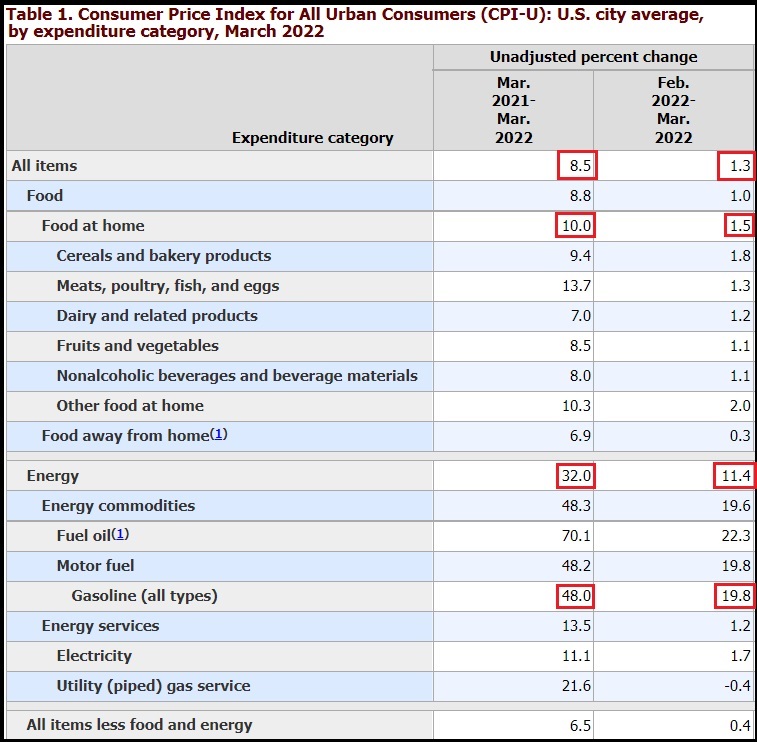
Take the figures above and compare them to the sector inflation in February (Table-2, BLS Report)  – Just sticking to what is above:

(more…)

Russia, India Exploring New Trade Payment Channels in Aftermath of Sanctions

The BRICS trade and economic partnership group is made up of Brazil, Russia, India, China and South Africa {GO DEEP}.  The alliance was originated in part to explore alternatives to the dollar as a global trade currency.  They discussed several options in their prior meetings long before Russia took action into Ukraine.

With western sanctions against Russia now in place, there are increasing reports that China and India have developed alternatives.  This is one such example:

(Via LiveMint) – Russia, many of whose banks have been cut off from the Swift financial network, is exploring opening alternative payment channels with India, including linking Unified Payments Interface (UPI) with the Faster Payments System (FPS) of the Bank of Russia, to continue cross-border trade.

According to Dmitry A. Solodov, a spokesperson for the Russian embassy in New Delhi, his government has also asked Indian lenders to connect to the financial messaging system of the Bank of Russia to facilitate interbank transactions. In addition, the two sides are discussing accepting RuPay and MIR Cards within national payment infrastructures, Solodov said in an emailed statement.

“All these options are on the table and are being discussed by the two governments, the Reserve Bank of India and the Bank of Russia,” said a senior Indian government official, requesting anonymity. (read more)

(more…)