I don’t want to focus too much on this, because there are multiple angles still at work. However, against the backdrop of the non-coincidental coincidences that followed the August 2025 Alaska Summit, the Lukoil story looks strategically interesting.
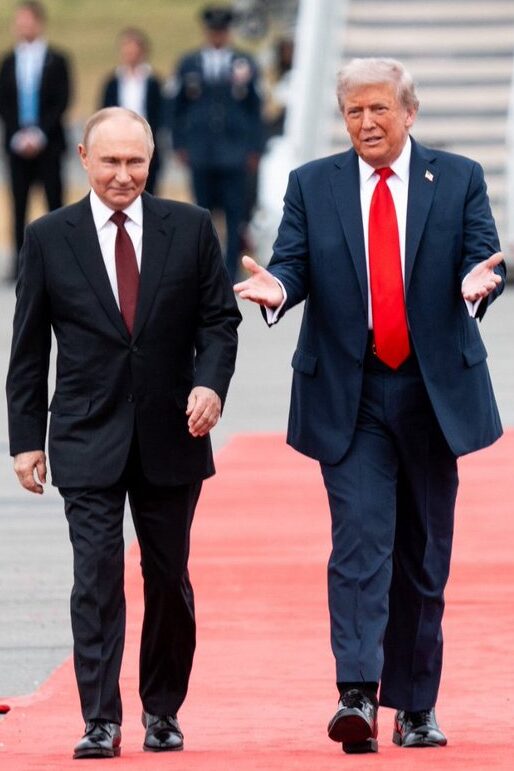 The New York Times is looking at Lukoil from the perspective of President Trump organizing financial gains for people close to his administration, specifically Witkoff and Kusher. {GO DEEP}
That aspect is nonsense, total nonsense; however, if you pull back and look at the background story without the Trump derangement overlay, there’s a potential here for something very good to come out of it.
As the story is told, Russian President Vladimir Putin has inquired about the potential for the U.S. to remove sanctions against Lukoil, a quasi-private energy company based out of Russia. Before, getting too weedy about it, remind yourself of the statements that surfaced during the Trump-Putin summit in Alaska, August, 2025.
You might remember that both the U.S and Russia spoke of strategic partnerships surrounding the energy sector. Obviously, this makes sense when we consider the “west” is actually fractured on the topic of energy. There are two competing interests that overlap in the financial side of the issue, the ‘trillions at stake’ aspect.
On one side you have the “climate change” team, those who are fully invested (literally) in the financial mechanisms of the climate change, green new deal, build back better talking points. The Green Energy team in the west. The Paris Climate Treaty and carbon-trading proponents et al.
On the other side you have the pragmatic energy team in the west. These are the Trump-minded and aligned western perspectives that look at oil, natural gas (LNG), clean coal and nuclear technology. These are the “all the above” aligned voices in the more pragmatic view of low-cost energy production and development.
In the middle, between both sides of the fracture, are the banking and finance systems. This is the BIG MONEY play, with the Climate Change team supported by banking ideology inside the city of London, while the Carbon Use team is constantly having to assemble finance and insurance from outside the banking control mechanisms.
The Climate Change team have support based on ideology within the finance system. However, the Carbon Use team have the advantage of low-price outputs, global dependency and actual profits as leverage. This is a fight essentially inside the larger energy sector, and we are all very familiar with it because it has been happening for decades.
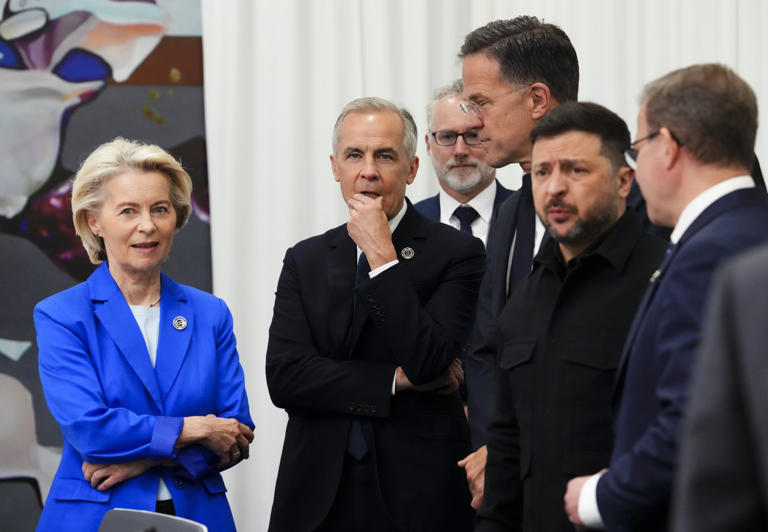
Canadian Prime Minister Mark Carney is currently the main tool deployed by the Climate Change team on behalf of the London finance system. Carney’s main opponent is U.S. President Donald Trump.
 Now we enter the Lukoil storyline.
Lukoil, a Russian enterprise, has some pretty amazing holdings in oil fields, gas fields, refineries in Europe as well as retail outlets for gasoline and LNG sale, their distribution. The estimated worth is north of $28 billion. Those holdings have been the subject of on/off sanctions as a result of the Russian ownership/operations.
Let me share some of the holdings {SOURCE} as you read this, think about the recent headlines involving each of these nation states: Lukoil’s biggest foreign asset is a 75% stake in Iraq’s West Qurna 2, one of the world’s largest oilfields. Lukoil also owns 60% of Iraq’s Block 10 development, which includes the Eridu field west of Basra. In Egypt, the company holds a 50% stake in the West Esh El Mallaha (WEEM) oilfield. In the UAE, Lukoil owns 10% of the Ghasha concession, one of Abu Dhabi’s largest gas developments.
Africa and Latin America – Lukoil has a 38% interest in the Deepwater Tano Cape Three Points block that includes the Pecan oilfield development off Ghana. It also has 25% in Eni-operated gas block Marine XII offshore Congo and 18% in Chevron-operated exploration block OML 140 off Nigeria. In Mexico, it partners with Eni in several offshore blocks and owns 50% of the Amatitlan block, operated by Petrolera de Amatitlan SAPI de CV.
REFINING ASSETS: In Bulgaria, Lukoil owns the 190,000 barrels per day Neftohim Burgas refinery, the largest in the Balkans. In Romania, Lukoil owns the 48,600 bpd Petrotel refinery, the country’s third-largest, and around 300 gas stations. Lukoil also owns exploration rights in the Romanian sector of the Black Sea, but drilling plans have been stymied by the sanctions. In the Netherlands, Lukoil holds 45% in the 180,000 bpd Zeeland refinery, operated by a joint venture with France’s TotalEnergies.
Lukoil also has retail gas stations in Finland, Romania, Moldova and the USA (northeast).
According to recent reports, Vladimir Putin has inquired about a strategic energy partnership with the U.S, and it would make sense that all of these assets could be part of a restructuring regime that would need U.S. Treasury Secretary Scott Bessent to approve given the current sanctions problem. That’s where the NYT report comes back in.
….”a different group emerged as the leading bidder: one led by Mr. Boehly, a billionaire supporter of Mr. Trump’s, alongside well-connected figures in the Middle East and the U.S. government itself. The members of the partnership were reported last week by The Financial Times.
Mr. Boehly is a co-owner of the Los Angeles Dodgers and donated $1 million to MAGA Inc., the Trump-aligned political committee, in December 2025. He gave another $1 million through his investment firm, Eldridge Industries, to Mr. Trump’s inauguration.
The U.S. government is taking a stake in the deal through the U.S. International Development Finance Corporation, an agency that invests in and lends to projects overseas. A D.F.C. official said in a statement that the potential Lukoil deal “would advance the Trump administration’s commitment to strengthen U.S. economic security, advance U.S. foreign policy and lower energy prices for everyday Americans.” (READ MORE)
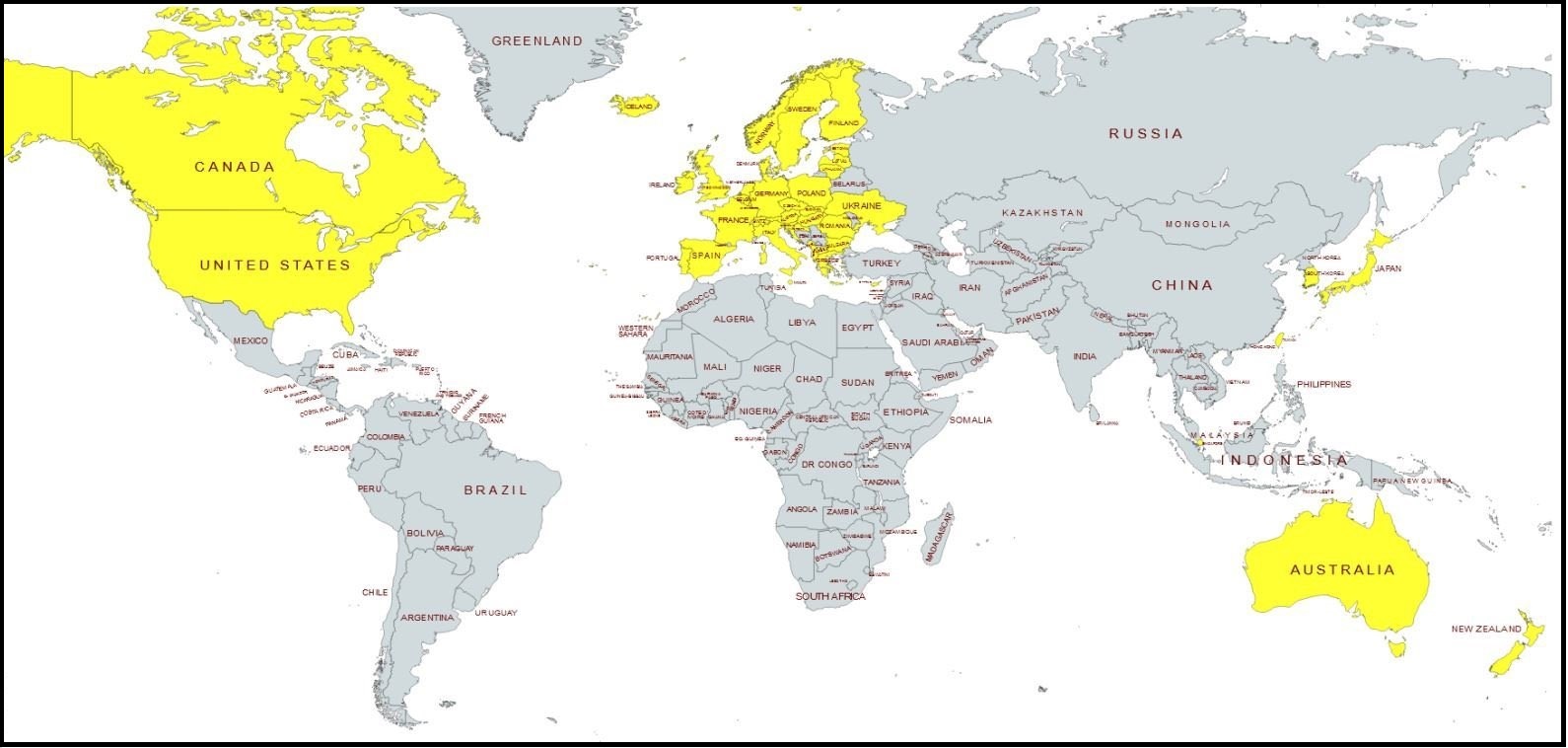
The British, European and Canadian climate change group (ideology, banking and finance), versus the USA, Mexico, South America, Russia, Central Asia and Middle East.
That’s an interesting geopolitical contest, no?
Is it accidental this global friction map makes an almost identical overlay to those interests opposed to President Donald Trump?
Perhaps looking at the Russian Sanctions map again might provide a visual reference:
Don’t forget what Putin said – GO DEEP
Speculation, exchange trading, market pricing, etc. these are the reasons why the EU presented an increase in central bank interest rates to try and lower energy prices. The central bank approach has nothing to do with the price of the energy (oil/gas) and everything to do with the financial markets speculating on the prices of oil and gas and profiting from the speculation/trading itself.
As noted by Russian President Putin, allowing hedge funds, financial interests and inorganic market forces to set the prices of an item (London Banking) disconnects that item from the economic principle of supply and demand. The prices that people suffer for oil and gas are being driven by the mechanisms set up by western financial interests. This is manipulative and creates pain on the consumer and the people who have to pay more.
…”A strategic partnership based on energy“?
An apoplectic London Banking system?
Imagine how frustrated the Europe Union, Ukraine, Germany and Canada leaders feel about getting out maneuvered?
It’s called FAFO!
The Greens told Europeans to give up their good jobs and warm homes to go live in trees and caves.
And then told them trees and caves were Protected Habitat.
OUCH!!! ROFLOL!!!
Out with the EU and IC, in with Russia. U.S. and Russia are natural allies. Russia as an enemy is a neo-con narrative fiction.
EU is a suicidal sinking ship. We can’t let the U.S. get dragged down with it.
Yes; it’s time we took out the (Euro)trash.
Spot on as usual Mrs. Sunshine.
For those with sharp minds, for those who seek success in their chosen vocation, for those who seek to do his/her best and desire to see just how far they can go in achievements…such people have a good memory for those who tried to screw them over during their efforts at success. They generally don’t forget.
President Trump is such a person, even at 80 years old he remains 95% sharp. He has been tested his whole life. Like most, he makes mistakes, but when someone goes out of his/her way to do damage to him or what he loves…he remembers.
Note how Geraldo Rivera discussed his Trump awareness on CNN a day or so ago…I note his care in not going too far attacking Trump and his inner circle, family. As a bleeding liberal, every once in a while he shows some smarts, not often but this time you could see his tip toeing.
Geraldo is a racist idiot. Racist because he favors illegal aliens as long as they are the same ethnicity as him. Idiot because he braodcast US troop movements live on air in real time during the Iraq war.
Lukoil has franchise gas stations in New Jersey, New York, and Pennsylvania. I imagine they are located around the NYC and Philadelphia area. I didn’t know that and probably most Americans don’t either. There must be a deal in the works and President Trump is working on it.
theyre around the eastern seaboard
As imperfect as it may be (I disagree with SD on the aggregate impact of speculators), I still prefer exchange traded pricing mechanisms to Govt mandated ones.
Frankly speculators and bankers would benefit the consumer if lead poisoned.
The Climate Agenda is a Big Lie anyway.
It’s not really about Climate or even air pollution. It is a Corporatist ‘Boil the Frog Slowly’ Control Mechanism for the Slow-Motion Genocide of Humanity, so craved by the World Economic Forum and the Wicked World Mafia.
But their day is done, Hallelujah!
Haggai 2
4 But now be strong, Zerubbabel,’ declares the Lord. ‘Be strong, Joshua son of Jozadak, the high priest. Be strong, all you people of the land,’ declares the Lord, ‘and work. For I am with you,’ declares the Lord Almighty. 5 ‘This is what I covenanted with you when you came out of Egypt. And my Spirit remains among you. Do not fear.’
6 “This is what the Lord Almighty says: ‘In a little while I will once more shake the heavens and the earth, the sea and the dry land. 7 I will shake all nations, and what is desired by all nations will come, and I will fill this house with glory,’ says the Lord Almighty. 8 ‘The silver is mine and the gold is mine,’ declares the Lord Almighty. 9 ‘The glory of this present house will be greater than the glory of the former house,’ says the Lord Almighty. ‘And in this place I will grant peace,’ declares the Lord Almighty.”
Shalom. Shalom!
It was the Globalists (Team WEF) preferred control vector. It’s now AI which, unfortunately for the true believes (Team Greta) requires abundant and cheap energy. The Grifters (Team Gore) make money on data centers these days.
“The central bank approach has nothing to do with the price of the energy (oil/gas) and everything to do with the financial markets speculating on the prices of oil and gas and profiting from the speculation/trading itself.
As noted by Russian President Putin, allowing hedge funds, financial interests and inorganic market forces to set the prices of an item (London Banking) disconnects that item from the economic principle of supply and demand. The prices that people suffer for oil and gas are being driven by the mechanisms set up by western financial interests. This is manipulative and creates pain on the consumer and the people who have to pay more.”
THIS NEEDS TO BE CLEARY ARTICULATED BY REPUBLICANS TO THE AMERICAN ELECTORATE!
Price Fixing, Price Gouging, Economic Pain for you any me.
“The New York Times is looking at Lukoil from the perspective of President Trump organizing financial gains for people close to his administration, specifically Witkoff and Kusher.
That aspect is nonsense, total nonsense; however, if you pull back and look at the background story without the Trump derangement overlay, there’s a potential here for something very good to come out of it.”
The first paragraph here might be so; however, not only is it providing “ammunition” for those afflicted with TDS – these lies are also sowing division among those that voted for PDJT.
no division here.😊
Kushner and Witcoff are proverbial dog whistles for the left –
one need only mention their names to trigger a severe exacerbation of TDS.😂
it’s a highly ignorable response after so many tries.
regarding the possibilities explored in the article,
i think this could be the deal that breaks everything open.
a U.S./RU joint venture in energy and it’s “Katy bar the door”
for the EU “Climateers” and all their fellow travelers.
not to mention the subsequent cascade of future deals possible between the two –
productive trading agreements, formal geopolitical cooperation,
alliances in world conflicts, and presto!
the world is suddenly a very different, better, place.
keep the left focused on personalities – in the meantime,
i think big stuff is happening behind the scenes.😁
My money is on Team Trump/Putin vs. the climate change criminal cabal. I would call the cabal nutjobs, but they know exactly what they are doing.
Is London finance system. Independent of USA finance or intertwined?
Control by different actors?!/
Count me a speculator I guess. I own shares in the oil ETF which tracks the price per barrel. When it spikes I will sell some and use the proceeds to offset what I’m paying at the pump. When it drops, I’m poorer but am paying less at the pump and will generally buy more of the etf.
I think of it as BNGs Strategic Oil Reserves.
An apoplectic London Banking system? That is, Dear Sundance, a HUGE understatement, I’m sure! This looks like it’s going to be fun!
The EU need to be worried about the communist rioters in countries like France instead of Trump. They have much bigger problems than Lukoil. In fact, they should’ve listened to him instead of laughing at him.