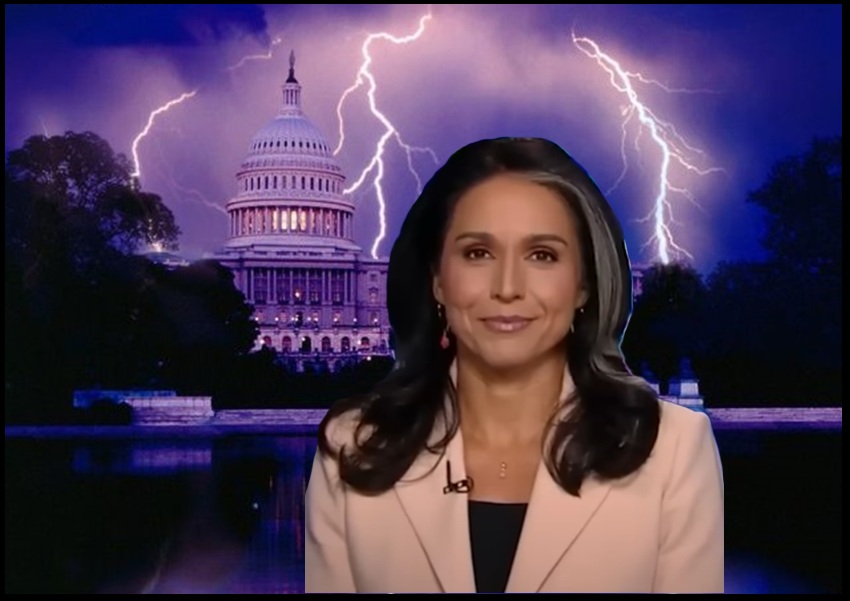
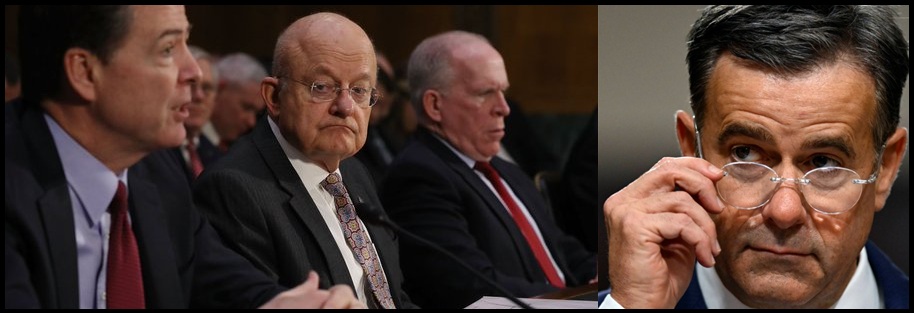
Today, Director of National Intelligence (DNI) Tulsi Gabbard declassified and released the 2020 House Permanent Select Committee on Intelligence report (HPSCI), that outlines their investigation into the Intelligence Community Joint Analysis Report (JAR) of 2016 and the Intelligence Community Assessment (ICA) that followed.
~ SEE DECLASSIFIED REPORT PDF HERE ~
I know that’s a lot of acronyms, however, the key element of Director Tulsi Gabbard’s release today is to underscore just how fraudulent the JAR/ICA created in 2016 and 2017 was. The JAR/ICA report was fabricated by the CIA and Intelligence Community to give the appearance of Russia interfering in the election. The declassified HPSCI report takes that fraudulent intelligence analysis apart, step by step.
The JAR/ICA was also used to justify President Obama expelling Russian diplomats, confiscating Russian property, targeting Russian officials for sanctions, and imposing a series of sanctions against various Russian entities, individuals, groups and organizations. All of the Obama’s Russian targeting effort was part of an enhanced IC op to give additional patina of credibility to the fraudulent premise.
In many ways, Russia was collateral damage created by a domestic USA political intelligence operation run by Obama allies in order to attempt to destabilize the incoming administration of President Donald Trump. ¹The framing of both Donald Trump and Russia is going to be a key facet to accept as time moves forward on this story.
Tulsi Gabbard gives a press conference. WATCH:
.
I will have more on the Tulsi release of the HPSCI report shortly. In the interim…
¹The timing does not appear to be accidental. President Trump gives Russia 50 days to come to the negotiation table and end the conflict in Ukraine. A few days later, DNI Tulsi Gabbard begins releasing information that shows both President Trump and President Putin being framed by the U.S. Intelligence Community.
It would appear that President Trump is setting a new baseline for a relationship with Russia. However, first the tables need to be cleared of the historic manipulation and targeting that structurally, and fraudulently, set the course of conflict and antagonism in U.S-Russia relations.