I have been requested to update and revisit my outline from summer 2024 when I discussed the potential for the Office of the Director of National Intelligence (ODNI), a position now occupied by DNI Tulsi Gabbard. As a new White House strategy begins to surface, perhaps revisiting what is possible will provide a perspective not often discussed.
Confronting a weaponized Intelligence Community is of great interest, because it is a component battle against the main tools of the Fourth Branch of Government. The IC influence is in every policy related to Trump’s domestic and foreign agenda. Taking control and neutering the capabilities of the IC and CIA specifically, is an important undertaking.
Again, as I originally noted in 2024, “This is going to be a little odd, because factually almost no one knows what the position of Director of National Intelligence (ODNI) is about.” Sometimes you have to wait until people reach a point of frustration, when they turn around and say, “Hey, about that thing”…
 The ODNI was created as an outcome of the 9-11 Commission recommendations. In the era shortly after 9/11, the DC national security apparatus was constructed to preserve continuity of government and simultaneously view all Americans as potential threats.
The Department of Homeland Security (DHS) and the Office of the Director of National Intelligence (ODNI) were created specifically for this purpose.
Washington DC created the modern national security apparatus immediately and hurriedly after 9/11/01. DHS came along in 2002, and within the Intelligence Reform and Terrorism Prevention Act of 2004 the ODNI was formed.
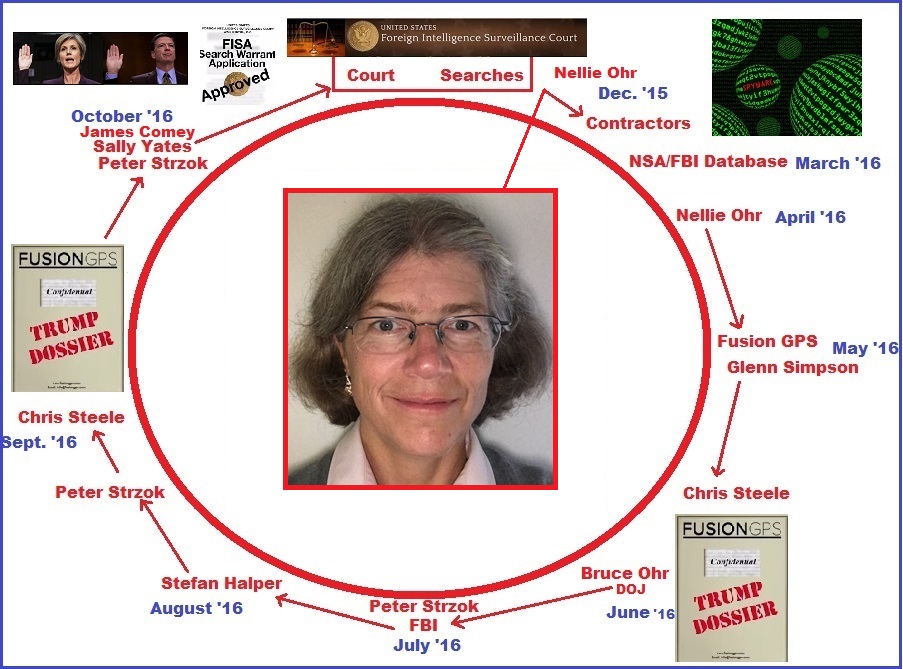
When Barack Obama and Eric Holder arrived a few years later, those newly formed institutions were viewed as opportunities to create a very specific national security apparatus that would focus almost exclusively against their political opposition.
Here is the weird part. The ODNI was formed in 2004, with the intent for the office to be the pivot point of a national security radar. The DNI was intended to provide information to domestic agencies about foreign terror networks that would prevent something like 9-11 from happening again. However, the Office of the Director of National Intelligence has never, not for one day, operated on this intent. This is why they are such a critical position from my perspective.
The office was new, not established yet as a functioning silo, when Barack Obama and Eric Holder arrived in 2009. They quickly dispatched an idiot, James Clapper, into the operation so they could weaponize around the office’s fulcrum point.
Prior to the DNI office existing, the CIA radar would sweep externally and then report to the Office of the President. The DNI was intended to take external radar sweep (CIA) and make it a full 360° circle, adding a sweep inside the USA that would be handled by the Dept of Homeland Security.
The DHS sweep and the CIA sweep would then be combined into a central collection hub called the ODNI. Everyone with responsibility for “national security” could access the ODNI material. Essentially, and presumably, post 9-11 nothing like jihadists practicing flying airplanes would be missed again – at least that was the intent.
(more…)