Quantcast

Neil Oliver, Think the Unthinkable and Accept That is the Better Reference Point

Neil Oliver returns from a vacation to deliver one of his best contemplative monologues to date.  Mr. Oliver rightly says that if you reset your historic reference points, and you begin to recognize that thinking the unthinkable is actually the best reference point for your current state, it is like a key that unlocks the answers.

We are the battered spouses in an abusive relationship with government. Nothing we can do is going to appease the abuser, it is the inherent state of their disposition. WATCH:

[Transcript] – It is hard to think the unthinkable – but there comes a time when there’s nothing else for it. People raised to trust the powers that be – who have assumed, like I once did, that the State, regardless of its political flavour at any given moment, is essentially benevolent and well-meaning – will naturally try and keep that assumption of benevolence in mind when trying to make sense of what is going on around them.

People like us, you and me, raised in the understanding that we are free, that we have inalienable rights, and that the institutions of this country have our best interests at heart, will tend to tie ourselves in knots rather than contemplate the idea those authorities might actually be working against us now. I took that thought of benevolent, well-meaning authority for granted for most of my life, God help me. Not to put too fine a point on it, I was as gullible as the next chump.

(more…)

Bidenflation Making Mexico Great Again, Retails Sales Up 30% in Mexico as U.S. Shoppers Cross Border to Save Money

The price differential is remarkable.  In this report from NewsNation, they follow Americans who travel to Mexico for their essential purchases.  Not only is gasoline over a $1/gal cheaper, but everyday essential items are significantly lower.

Retailers in the video highlight an increase in sales of 20 to 30% from cross border shoppers. Biden’s economic plan is Making Mexico Great Again.  WATCH:

(more…)

Inflation Moderates in July with Drop in Energy Prices, But Look Closely Food Prices are About to Skyrocket

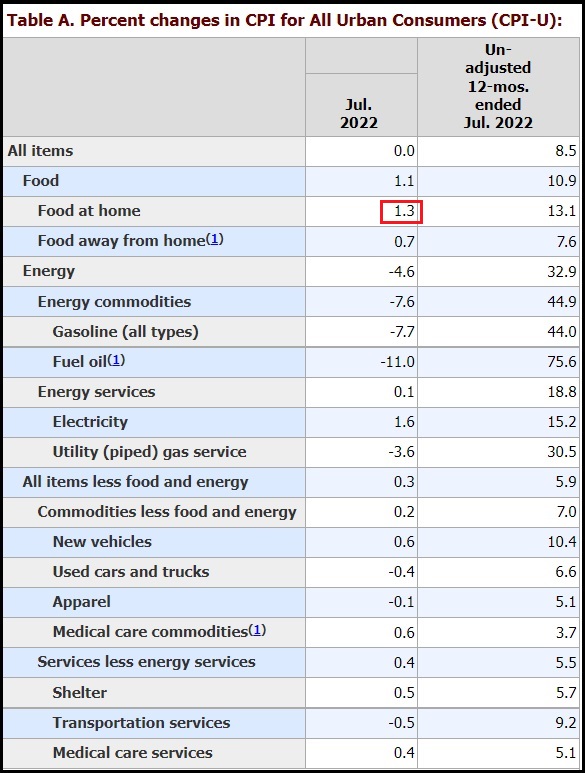
The Bureau of Labor Statistics (BLS) has released the July inflation figures known as the Consumer Price Index (CPI) [DATA HERE]. I’m not going to spend much time on the review because the big picture results are exactly what we expected, the appearance of a false inflation plateau, drop and/or moderation of inflation.

The July energy prices dropped significantly driven by a reduction in consumer demand for gasoline and fuel oil, which lowered prices.   We can expect a very similar outcome in August (report in Sept).
Most financial and economic media are reporting an “unexpected” drop in inflation, ex:

Prices that consumers pay for a variety of goods and services rose 8.5% in July from a year ago, a slowing pace from the previous month due largely to a drop in gasoline prices. On a monthly basis, prices were flat as energy prices broadly declined 4.6% and gasoline fell 7.7%. That offset a 1.1% monthly gain in food prices and a 0.5% increase in shelter costs. {link}

Most econ people will look at the price drop sectors and accept that consumer spending on durable goods and non-essentials has become a downward price point on key categories like vehicles etc.

This is the ‘stag’ part of the ‘stagflation’ (economy), or the new lingo; the ‘dis’ part of the ‘disinflation’ (consumer spending).

For the middle-class or working class, especially those families with young children, I would shake all those data points away, clear the table and look more closely at [BLS Table-2] to see where our eyeballs should be focused.

Look closely at all food group products that originate as “ROW CROPS” and/or “GRAIN”.   Just by looking at the current rate of price increase, you can easily see that all grain and row crop outcomes are going to explode in price in around 60 to 90 days.

(more…)

Second Quarter Productivity Drops Again, Companies Paying Workers More to Produce Less

The previous first quarter productivity drop of 7.4% was the largest quarterly drop in 74 years.  Today the Bureau of Labor Statistics (BLS) reports the second quarter productivity dropped another 4.6% [Data Here].

For July, companies are paying 5.7% higher wages and getting a 4.6% drop in output, resulting in a total unit labor cost increase of 10.8%.  That increase in final output cost will either result in higher prices or lower profits.
With weak consumer purchasing (low demand) already creating an inventory surplus, hence lower outputs, lower profit leads to cutbacks.  The largest company expenses are generally labor and energy costs. The more variable and controllable of those two expenses is labor.  You know what comes next.

(WSJ) – […] Rising productivity is the key to improving living standards; it allows companies to raise wages without raising prices and fueling inflation. Instead, businesses appear to be paying workers more to produce less. The higher unit labor costs suggest companies will either endure lower profits or pass on higher costs to consumers.

“The trend in productivity growth has worsened compared to prior to the pandemic, and the surge in unit labor costs makes the Fed’s challenge of getting inflation back down to its 2% target all the more challenging,” Wells Fargo economist Sarah House said in a research note.

(more…)

After Senate Passage, Democrats Drop Claim of Inflation Reduction Within Inflation Reduction Act

Prior to the 51-50 passage of the massive $700+ billion democrat spending bill, they called it the “inflation reduction act.”  However, after Senate passage they are now calling it the climate change bill.  Funny how that happens.

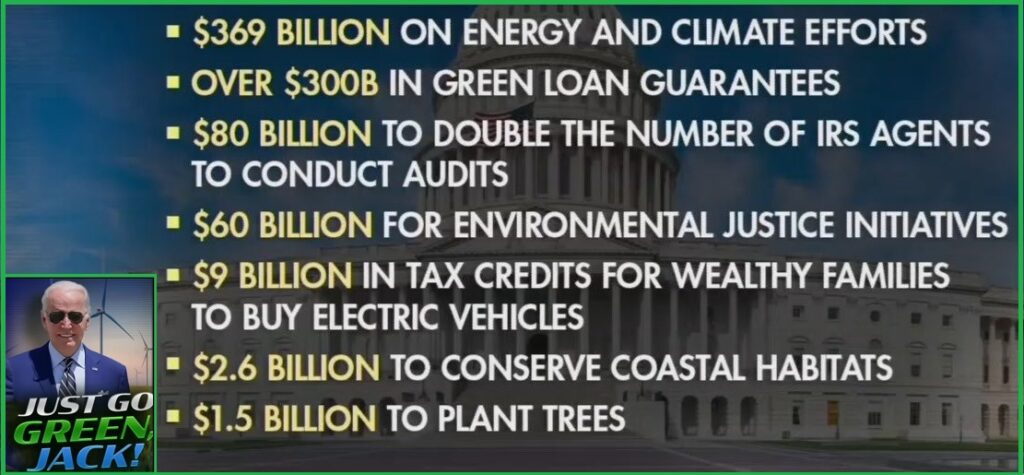
The bill itself contains absolutely nothing that will lower inflation; in fact, the bill itself will raise supply-side inflation in direct proportion to the energy production it reduces. To offset the contracted revenue caused by a much smaller economy, the Democrats have doubled the IRS tax army that will enforce personal income tax compliance.

The income tax compliance portion of the bill is very significant on two fronts.  First, it literally doubles the size of the IRS, giving them much more power to conduct audits and capture taxes from income earned.  As a review of tax audits has shown, the ordinary U.S. taxpayer is the target of this increase enforcement mechanism, not corporate tax review.

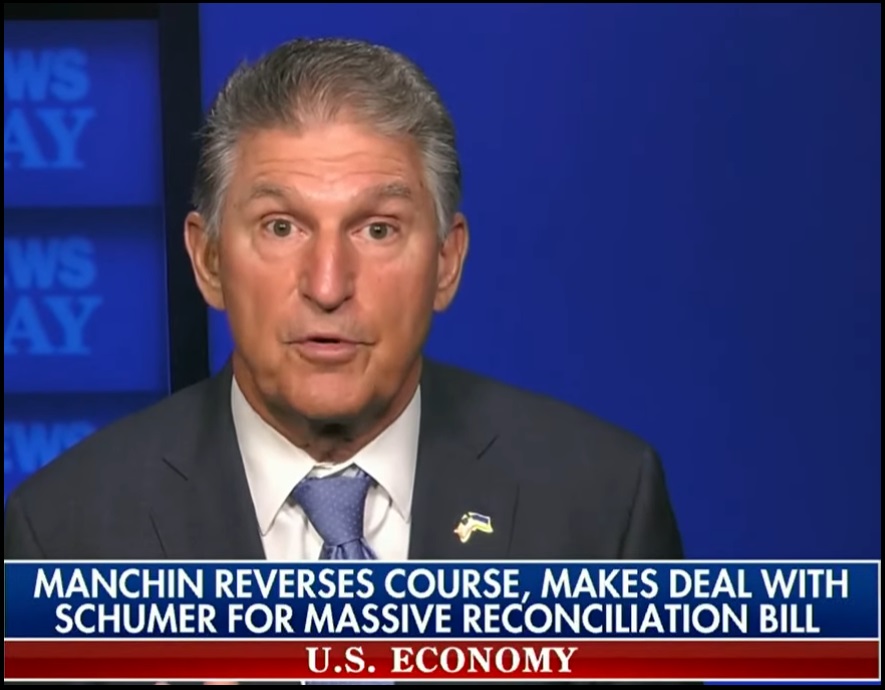
WASHINGTON – […] The bill, a product of 18 months of intense wrangling, passed by a margin of 51 to 50 on Sunday with Vice-President Kamala Harris casting the deciding vote. It was previously blocked by two Democrat senators who shared Republican concerns about its cost.

The Senate bill includes $369bn for climate action, the second largest investment on Green New Deal spending in US history.  The largest bill on climate change was the previous Obama-era American Recovery and Reinvestment Act (AARA), that paid billions of dollars to solar groups (ex. now bankrupt Solyndra) and climate energy companies connected to Democrat donors.

(more…)

New York Governor Kathy Hochul Enters Inauthenticity Contest Determined to Dethrone Elizabeth Warren

The glove has been thrown down, as New York Governor Kathy Hochul enters the national contest for political inauthenticity.

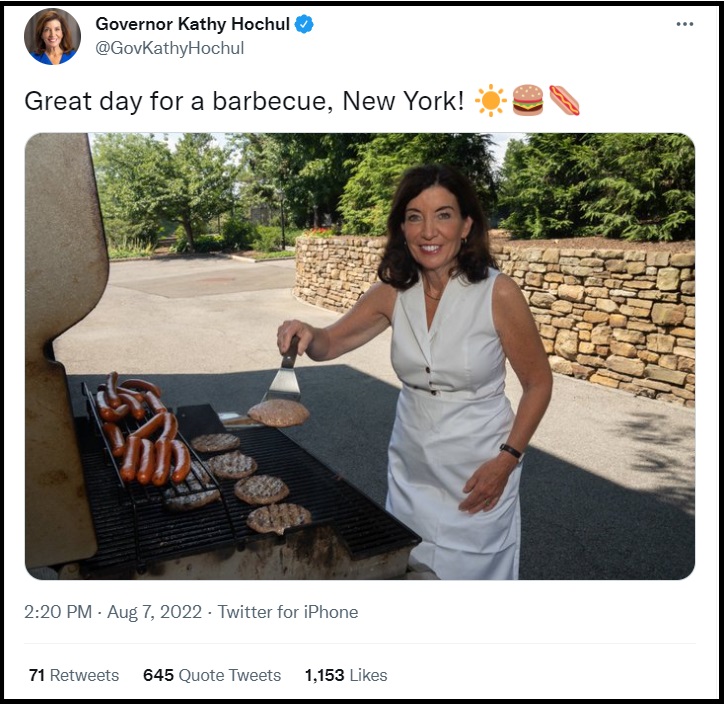
Prior to today, California Governor Gavin Newsom was the closest competitor within striking distance of Elizabeth Warren’s “I’m a git me a beer” moment.  However, the assembly of advisors that guide team Hochul have now entered the contest with Hochul’s visual tweet earlier today:

Unfortunately, there are several progressive demerits which may keep Hochul from achieving maximum pander points.  The biggest issue is beef, no longer an acceptable food product amid the left-wing judges.  A tray of sustainable algae cakes would have been better. However, to be fair, there are rumors team Hochul was using ‘cricket burgers‘, which could offset the carbon demerits as presented by grilling.

(more…)

Sunday Talks, SF Fed Chair Sees Half of Inflation Driven by Excess Demand of Some Unknown Something

The great pretending continues.  During a Sunday talk show appearance, San Francisco Fed Chair Mary Daley states, “what I see is supply and demand are just unbalanced. About 50% by my own staff’s estimates of the excess inflation we see is related to demand. The other 50% to supply.”  Note, she is not talking about energy.

Margaret Brennan, maintaining her position as the professional CBS narrative engineer, never thinks to ask: (a) where is this demand you speak of, and what exactly are they demanding? and/or (b) What is this 50% inflation on the supply side connected to?  Obviously, an actual probing of inflation wasn’t in the script. The great pretending continues.  [Transcript Here]

CTH has stated without reservation that August’s inflation report will show a significant –albeit temporary– drop in inflation as measured by the govt.  The drop in gasoline prices throughout July (created by a drop in demand) will allow the fiscal and monetary policy makers to falsely claim overall inflation peaked. However, after a brief respite the inflation now growing in the ground (massive increases in farm costs), will then launch into the food supply chain.  This delayed food inflation will overtake the energy inflation in the latter part of this year.  WATCH:

[Transcript] – MARGARET BRENNAN: We turn now to the state of the economy and the president of the San Francisco Federal Reserve Bank, Mary Daly. Good morning to you.

FEDERAL RESERVE BANK OF SAN FRANCISCO PRESIDENT MARY DALY: Good morning.

(more…)

McDonalds Dumps Trial of Plant Meat Because Customers Would Not Purchase – Next up, Bug Meat

McDonalds has announced they are dropping their program testing plant-based meats because people didn’t like it.

As noted by the Washington Times, “other trials at Panda Express and Yum! Brands (KFC, Taco Bell, and Pizza Hut) have also ended without a subsequent product launch. Beyond Meat products at Dunkin’, Hardee’s, and A&W have been discontinued after launching.”

Apparently, American consumers do not want to eat fake meat; at least not fake meat made from plants.

Next up….  Bug meat.

(more…)

Labor Report, 528,000 Jobs Gained in July, Large Gains in Restaurants and Services, Unemployment Rate 3.5%

A few days ago, we were discussing the disconnect within the economy as it relates to corporate valuations.  The Bureau of Labor Statistics report today [DATA HERE] highlights another economic disconnect, this time with labor.  According to the BLS survey 528,000 jobs were added to the economy in July, the unemployment rate drops to 3.5%.

The household data [Table A] shows the number of eligible workers unemployed dropped 242,000; however, the number of eligible workers no longer in the workforce increased by 239,000.  The total labor force is shrinking as unemployment drops.

Keep in mind the previous BLS survey of job openings (JOLTS report) showed available jobs dropped 605,000 in July.  “On the last business day of June, the number and rate of job openings decreased to 10.7 million (-605,000) and 6.6 percent, respectively. The largest decreases in job openings were in retail trade (-343,000), wholesale trade (-82,000), and in state and local government education (-62,000).” [JOLTS survey]

Going back to today’s release, 303,000 part-time jobs were added in July; these are workers working part-time for economic reasons.  The Household Data shows that within the leisure and hospitality sector [Table B-1] restaurants and bars added 74,000 jobs.

If we combine both BLS surveys two days apart is: 605,000 job openings cancelled, and 528,000 new jobs gained.

Of the 528,000 new jobs gained, 303,000 were part time jobs with the largest growth in the jobs in restaurants and bars.

Again, blending data from both reports and focusing on retail.  The retail sector cancelled 343,000 job openings in July, and the retail sector added 21,600 jobs in July.  Within the retail sector (table B-1), jobs at automotive dealers, furniture stores and clothing/apparel stores dropped by a combined 7,200 jobs.

(more…)

Senator Kyrsten Sinema Agrees to Senate Green New Deal Spending and Tax Proposal After Negotiating Minor Changes

Arizona Senator Kyrsten Sinema has announced her support for the senate climate change spending and tax proposal after some modifications to the new taxation.

To support the hedge fund donors, Senator Sinema insisted the carried interest loophole tax provision be removed and instead replaced with a corporate tax on stock buybacks.  Any time a corporation wants to buy back their own shares of stock, they will now pay the U.S. government a tax for doing so; at least that’s the ¹intent.

[¹Note: taxing shares of company stock will never work, because that’s exactly what shell companies were designed to avoid.  Set up a child shell company to purchase the stock and the parent company doesn’t pay taxes on the child’s purchase.  It’s a shell game]

Additionally, according to reports, there is some kind of agreement to modify the 15% corporate minimum tax.  Details unknown.  Bottom line, Senator Sinema now supports the $700 billion climate change spending and tax proposal.

“We have agreed to remove the carried interest tax provision, protect advanced manufacturing, and boost our clean energy economy in the Senate’s budget reconciliation legislation,” Sinema said, signaling that she plans to vote to begin debate on the bill.  “Subject to the parliamentarian’s review, I’ll move forward,” she said.  (link)

(more…)