There is an increased public discussion about the race to build datacenters in the USA that are part of the Artificial Intelligence (AI) race for superiority. There are multiple facets within the discussion and some things to consider that might not be at the forefront, yet.
Overall, there is a global race to build the best AI system that is not dissimilar to the nuclear arms race. Arguably the use of AI as a weapon is one possibility; while the second aspect surrounds strategic economic power.
The USA is poised very favorably in this AI race due to the advanced tech industry in America and recent national security moves made by President Trump in the tech sector surrounding strategic critical minerals and domestic chip production. However, no one is quite sure where China is in their AI development and last year’s explosive revelation around China’s “Deepseek” model shocked the U.S. tech industry due to its advanced intelligence prowess.
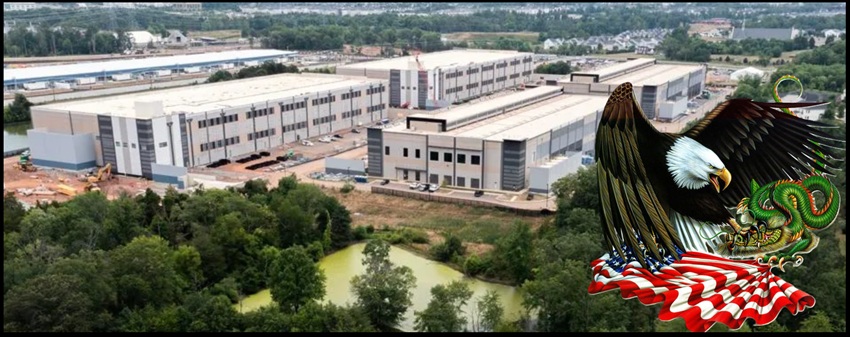
With China and the USA both in this AI race, and the need for massive investment in datacenters to do the processing needed for an artificial intelligence brain of such significant capacity, there is a sense of urgency in the tech industry that is surfacing around the country. Simultaneously, with datacenters becoming more controversial, suddenly the geopolitical intelligence operations enter the picture.
Currently, it is well accepted inside the tech industry that part of China’s strategy against the USA in this AI race is to slow down American system development. As a consequence, it is beginning to surface that Beijing may be funding voices inside the USA to rally against the building of datacenters. Essentially, China funding voices, real or artificially boosted influence operations, to amplify domestic opposition to the datacenters.
Anytime the intelligence operations become part of a domestic issue that has national security implications, things get opaque, cloudy and muddy pretty quick. Is datacenter opposition organic – actual citizens and communities pushing back against the development in their towns and/or cities or is the opposition to the datacenters a form of foreign influence operation?
These questions become challenging to answer, and discernment becomes very critical. The truth might even be a combination depending on the localized opposition and/or regional importance. One thing is very clear, building the world’s leading AI system is being rushed with an urgency similar to atomic bomb development.
Here’s a great example of that type of question.
Today Gallup released a poll showing 72 percent of Americans are opposed to building AI datacenters in their area. [POLLING HERE]
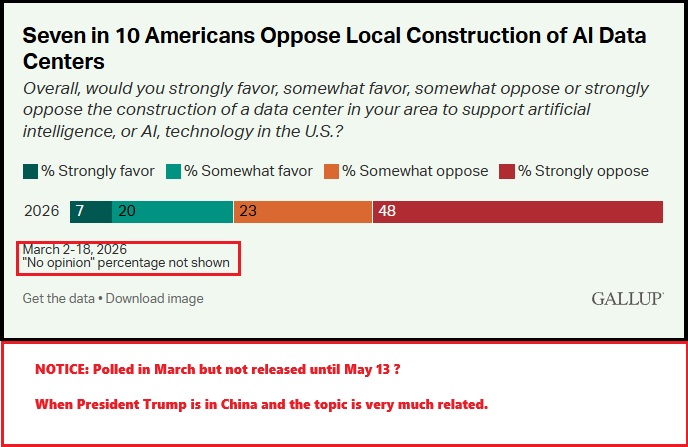
The topline sounds pretty straightforward right? 7 in 10 Americans oppose “the construction of a data center in their area to support artificial intelligence technology.” That’s the polled result. Indeed, this poll is being cited in numerous media articles now emphasizing opposition to the datacenters.
However, put on your discernment cap and look at it closely. Notice the date of the poll, “March 2-18, 2026.” Why did Gallup wait two months to release the results of a poll on May 13, 2026?
Did the date of release today have something to do with the timing of President Trump taking a list of key U.S. tech and finance leaders to Beijing to confront China on exactly this AI issue? …. Or was it coincidental?
This is where you have to make up your own mind as to whether this Gallup poll is an organic outcome, an organically timed release, on an issue that just happens to be at the heart of the geopolitical negotiations currently underway in Beijing between the USA and China. Or was there some kind of influence operation around it?
I really don’t know the answer, but I’m well aware of how the influence game is played once various intelligence operations identify something as critically important. Who funded this Gallup poll? Why did they wait to release it?
At the same time this battle to win the AI race is underway, there is a psychological battle to influence the outcome. China plays this game very well and they know how to draw on emotional influence operations; that’s why Beijing spends so much time, money and human capital on North America.
Again, opposition to datacenter development can be entirely organic, justified and righteous. Simultaneously, the information around opposition to datacenters can be amplified, enhanced or become part of an influence operation to win a battle. The truth can also be a mix of both, but discovering the truth first begins with an admission of the possibility and a decision to put emotion away and think logically about the controversy.
I’m no fan of Elon Musk, but he said something in/around this issue that is very thoughtful and well presented:
Musk: “After World War 2, the US could have basically taken over the world and any country. Like we got nukes, nobody else got nukes. We don’t even have to lose soldiers. Which country do you want?”
One nation on earth held a weapon nobody else had.
Total dominance. Zero competition. No risk of retaliation.
Every empire in history that held that kind of advantage used it.
Rome. The Mongols. The British. The Ottomans.
They conquered until they collapsed.
America had a bigger advantage than all of them combined.
And it rebuilt the countries it just defeated.
Musk: “The United States actually helped rebuild countries. So it helped rebuild Europe, it helped rebuild Japan. This is very unusual behavior, almost unprecedented.”
Almost unprecedented?
It had never happened before. Not once in 5,000 years of recorded history.
The Marshall Plan wasn’t foreign aid.
It was the most radical act of restraint any superpower ever committed.
America turned its enemies into allies. Turned rubble into economies. Turned surrender into partnership.
Germany went from ashes to the economic engine of Europe in a generation.
Japan went from unconditional surrender to the third largest economy on earth.
Three years after the war, America was flying food into Berlin.
A city in the heart of the nation that just tried to destroy it.
That’s not policy.
That’s a civilization deciding what it is at the exact moment it has the power to be anything.
You’re being told a story right now.
That America is the villain of history.
You hear it everywhere. Media. Universities. Social platforms.
Musk: “There’s always like, well America’s done bad things. Well of course America’s done bad things, but one needs to look at the whole track record.”
Every nation on earth has dark chapters. Every single one.
The difference is what a country does when nobody can stop it.
And when nobody could stop America, it fed its enemies and rebuilt their cities.
Musk: “The history of China suggests that China is not acquisitive. Meaning they’re not going to go out and invade a whole bunch of countries.”
Probably right.
China has historically built walls, not fleets.
But the real question isn’t about borders anymore.
We’re approaching a moment that mirrors 1945 in ways nobody has fully processed yet.
AI is going to give a handful of people a power advantage that makes nuclear monopoly look quaint.
If someone is going to hold that kind of power, who do you want it to be?
The country that conquered when it could? Or the one that rebuilt when it didn’t have to?
Every alliance. Every trade route. Every economy.
Billions lifted out of poverty.
All of it traces back to one act of restraint that had never been done before.
And carries no guarantee of being repeated.
The most powerful thing America ever did wasn’t building the bomb.
It was what it didn’t do after. {source}
Artificial Intelligence (AI) development, winning the AI race, has been identified as the #1 national security issue of the next few years. The winner in this digital war could turn off the lights, pollute the water, hack elections, empty your bank account, control communication systems and generally create nationwide chaos without ever firing a kinetic missile.
AI is both an offensive weapon and a defensive weapon guarding against AI attacks.
Within the race and setting aside that technocrats will reap billions from it regardless of outcome, the regional AI datacenters are likely to be a political issue. Think about 2028. AI and the development of these datacenters could be a very divisive topic.
How do you feel about it?

The impacts these data centers have on the local environment can be significant. So yes, people should get involved at the local level because each center can have particular benefits (cash inflow, jobs) and risks (impacts to electric, water, noise), don’t fall for the “they’re all the same” trope. Also, the government use of these centers should be treated separately from the commercial use, mixing this conversation doesn’t help anyone understand it better, and these tech companies that service both gov and private markets should operate as separate entities. We don’t need more “public-private partnerships”. And last but not least, this AI tech currently has shown more potential for harm than for good, that needs to change before the public should jump onboard with these proposals, even if couched as for our defense (or our safety). An atomic weapon at least still requires a firing sequence controlled by human beings. AI can do harm without asking permission from anyone.
AI is Frankenstein’s Monster built from parts found in Pandora’s Box. Currently, our largest concern seems to be how will we feed this monster? An AI model is not an objective mirror of human knowledge; it is a product shaped by financial constraints, developer demographics, and corporate governance. We are racing toward ASI machines running millions of times faster than human thought solving or creating millions of problems simultaneously 24/7/365. Developers decided to move the process along by more training AI using synthetic data. Human language is anchored in the messy, evolving physical world. Synthetic data is anchored only in mathematical patterns. When an AI model is trained iteratively on synthetic data generated by previous generations of AI its knowledge base becomes a distillation of affordable data curated by corporate culture and developer bias with a pinch of government interference. The only thing close to a conscience is provided people who for years have been laser focused on collecting our personal data for fun and profit. AI’s scope, at least while it remains controlled is only limited by ROI and continued interest of the shareholders. In terms of a single hour, we are maybe 5 minutes into the AI experiment and the best minds in the country do not fully understand how it works. The more I look into AI the more landmines I discover and each one has already been given a sanitized technical term. The end of the line begins with a “Fast Takeoff” and ends with an “Existential Event”
The function of data centers has evolved a lot in the last 30 years. It used to be that a data center housed the computers used by a tech firm or telecom company (or U.S. government) and was onsite or dedicated to that organization’s processing requirements.
In the early 2000s this changed to companies like AT&T (who I worked for in 2005) leasing data center space to corporations who did not want to house their computer operations in house. This saved those corporations from spending their budgets on building leases, manpower, and they could opt for various levels of service from the leasers such as full system administration support or just rack space and telecom lines, and even servers by using virtual computer machines.
Somehow I can’t believe it is the AI computing alone that accounts for the explosion in data center construction. I fear something nefarious is also driving it–more than likely it’s increased surveillance. When I drive by the dozens and dozens here in Northern Virginia all clustered within a 10 mile radius, I have to wonder why the millions of square feet of space is being used for, and I’m a retired IT professional.
I, too, am a retired IT Professional. I can remember when those huge warehouse-sized data centers housed disk drives, computer mainframes, tape and key punch equipment and libraries and all the equipment to keep everything powered.
I worked in a building that had a jet engine in the basement as backup power; and the enormous air conditioning systems that kept the temperature inside the computer room at a “comfy” 60 degrees to make sure it didn’t overheat. It was a 4 story building that took up most of a city block and housed programming staff along with all the operations folks.
I now have the an almost equivalent in computing power on my desktop computer; my laptop and my cell phone all have become mini-data centers. They don’t require the energy consumption (to keep them cool), they don’t require the water cooling systems, or the massive boxes to contain all the components to make them work.
So I echo your question – what is going on in all those “data centers”? The sheer size and space are no longer required for the computational power – are they storage centers? Usually, the larger a thing becomes, the less efficient it becomes. The more pathways the information must travel, the slower it becomes.
And isn’t quantum computing going to revolutionize the computer world?
“Somehow I can’t believe it is the AI computing alone that accounts for the explosion in data center construction. I fear something nefarious is also driving it–more than likely it’s increased surveillance. When I drive by the dozens and dozens here in Northern Virginia all clustered within a 10 mile radius, I have to wonder why the millions of square feet of space is being used for, and I’m a retired IT professional.”
You are exactly right!!! They want to store every scintilla of information on everyone for control. Which is exactly how the communist Chinese use the information. Full stop. Why exactly are we in competition with a COMMUNIST COUNTRY in a race to build these data centers? Hmmm?
U.S. AI Data Center Delays: 7 GW Capacity Crisis [2026] (tech-insider.org)
Nearly half of all U.S. data centers planned for 2026 have been canceled or delayed, according to Bloomberg reporting confirmed by multiple industry trackers. Out of 12 GW of AI data center capacity announced for this year, only about 5 GW is under active construction. The rest — billions of dollars in planned infrastructure — sits stalled by power grid bottlenecks, electrical component shortages, Chinese tariff impacts, and growing community opposition. This is the story of how the AI infrastructure boom hit a wall, and what it means for the $650 billion Big Tech spending cycle, the semiconductor supply chain, and the future of artificial intelligence deployment in the United States.
Personally I think you could drop the part of this polling question down to “do you oppose the construction of a data center in their area” and get the same results. It is the data center itself, not the kind that is the issue. That may be secondary, but not what stops it in its tracks
It doesn’t matter what it is for, residents are opposed to it, and for very good reasons. But residents are not getting any say in the matter. City leaders and city councils are taking away our choice. This just happened in my city. They are claiming it brings jobs. Yeah, very short term construction jobs, after that, not much. All to slap up another warehouse style concrete monstrosity. And for this they give them tax abatements.
We are not free being watched and having our information on file somewhere. US is smart, find a better way than following China or Israel in data collection on its citizens.
There is significant grassroots opposition to data centers for the following reasons – whether perceived or real. China may be adding to it, but there is general grassroots opposition without China.
Logically, I question why anyone would build a data center in the lower 48 due to cooling costs.
It seems most reasonable to build data centers in the coldest part of the country. For example, Alaska has huge swaths of undeveloped land and the coldest temperature.
Theoretically there would be the least amount of electricity used there for cooling–which is a perpetual expense even if the up front cost to build was greater–thought I am not sure that that would even be the case compared to some of the construction costs elsewhere in the country.
Also, when you look at the electric companies’ rate schedules, electric companies charge data centers less $$ per KWH for electricity than residential customers.
This also fuels a feeling of unfairness: Why would a company who can clearly afford to buy electricity at standard cost after buying thousands of acres and millions of computers be asked to pay less per unit of energy than a single mom living in a trailer?
It’s an engineering standards question. How these facilities are constructed; how they attenuate and manage sonic bandwidth and acoustic pollution; surface and geoacoustic, and how dedicated energy is produced. They don’t belong on the grid. They need their own dedicated energy source. They also present major land-use questions. We don’t want to lose farm and range land. We don’t want to put our aquifers are risk. We don’t want to endanger the watersheds. These facilities will be full of toxic heavy metals and at unprecedented scale. There will be some off gassing due to the thermodynamics of the process. The purpose of the facility is to create a massive machine of unprecedented scale. My only concern is the engineering that creates the components is not intended to create such massive unit count scale. This needs careful engineering study and optimization of the physics involved. The sonic/acoustic phenomenon alone are a genuine environmental and public health concern. I am all for large data centers. I don’t think they should be located within the equivalent of 1,000,000 square foot triple-wide mobile home on a concrete pad. These engineering problems are what national standards and subsidy are for; what licensing is for. What the public mostly likely underappreciates is what happens when you concentrate all this energy flow, vibrational force and compounded amplitudes, and resonant and acoustic energy, heat, radiation and electromagnetism in this manner and at this scale. This is not a matter of building another million McDonald’s drive thru facilities. This more than building another 100,000 miles of new roads and railways. This is bigger. The capitalization challenge is dwarfed by the greater engineering issues, some of which have yet to be fully understood and mitigated. People have to live and work in these environments, and function and prosper. Do you appreciate how few engineering, architectural and environmental health subject matter experts fully grasp doing data centers at this scale? The US Navy probably has the most employed in our deepwater and submarine technology clusters. Imagine the engineering task of building the equivalent of a modern nuclear submarine on land that covers a 100 acre footprint, where what is inside must be isolated from what it outside while providing all the electric power needed and also safe and efficient workspaces for humans to operate the processes and still stay healthy.
The WEF threatens humanity with water, claiming ‘the next war will be fought over water’.
Data Centers use staggering amounts of water.
Action – Re-Action…