There is an increased public discussion about the race to build datacenters in the USA that are part of the Artificial Intelligence (AI) race for superiority. There are multiple facets within the discussion and some things to consider that might not be at the forefront, yet.
Overall, there is a global race to build the best AI system that is not dissimilar to the nuclear arms race. Arguably the use of AI as a weapon is one possibility; while the second aspect surrounds strategic economic power.
The USA is poised very favorably in this AI race due to the advanced tech industry in America and recent national security moves made by President Trump in the tech sector surrounding strategic critical minerals and domestic chip production. However, no one is quite sure where China is in their AI development and last year’s explosive revelation around China’s “Deepseek” model shocked the U.S. tech industry due to its advanced intelligence prowess.
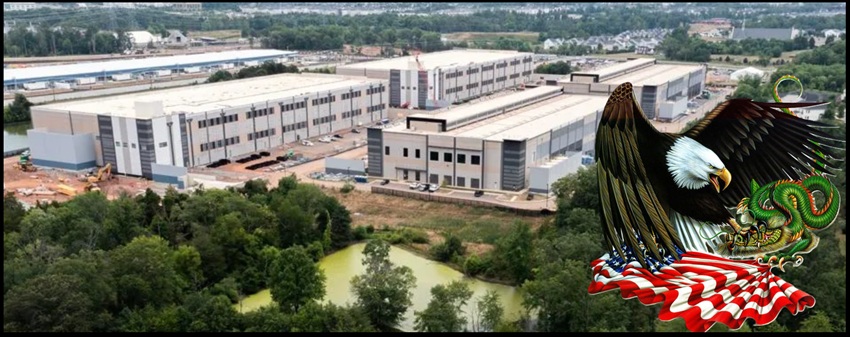
With China and the USA both in this AI race, and the need for massive investment in datacenters to do the processing needed for an artificial intelligence brain of such significant capacity, there is a sense of urgency in the tech industry that is surfacing around the country. Simultaneously, with datacenters becoming more controversial, suddenly the geopolitical intelligence operations enter the picture.
Currently, it is well accepted inside the tech industry that part of China’s strategy against the USA in this AI race is to slow down American system development. As a consequence, it is beginning to surface that Beijing may be funding voices inside the USA to rally against the building of datacenters. Essentially, China funding voices, real or artificially boosted influence operations, to amplify domestic opposition to the datacenters.
Anytime the intelligence operations become part of a domestic issue that has national security implications, things get opaque, cloudy and muddy pretty quick. Is datacenter opposition organic – actual citizens and communities pushing back against the development in their towns and/or cities or is the opposition to the datacenters a form of foreign influence operation?
These questions become challenging to answer, and discernment becomes very critical. The truth might even be a combination depending on the localized opposition and/or regional importance. One thing is very clear, building the world’s leading AI system is being rushed with an urgency similar to atomic bomb development.
Here’s a great example of that type of question.
Today Gallup released a poll showing 72 percent of Americans are opposed to building AI datacenters in their area. [POLLING HERE]
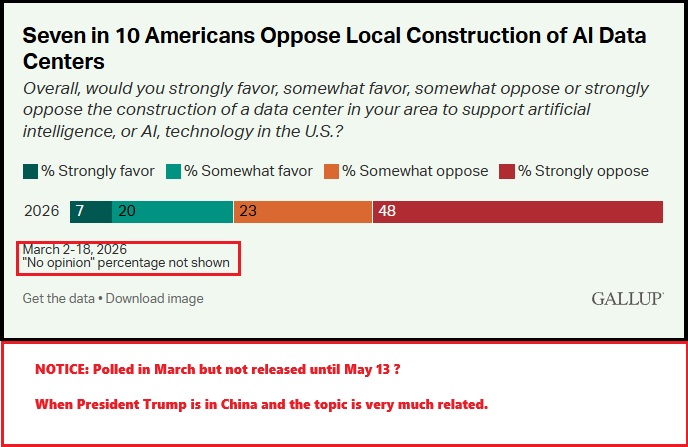
The topline sounds pretty straightforward right? 7 in 10 Americans oppose “the construction of a data center in their area to support artificial intelligence technology.” That’s the polled result. Indeed, this poll is being cited in numerous media articles now emphasizing opposition to the datacenters.
However, put on your discernment cap and look at it closely. Notice the date of the poll, “March 2-18, 2026.” Why did Gallup wait two months to release the results of a poll on May 13, 2026?
Did the date of release today have something to do with the timing of President Trump taking a list of key U.S. tech and finance leaders to Beijing to confront China on exactly this AI issue? …. Or was it coincidental?
This is where you have to make up your own mind as to whether this Gallup poll is an organic outcome, an organically timed release, on an issue that just happens to be at the heart of the geopolitical negotiations currently underway in Beijing between the USA and China. Or was there some kind of influence operation around it?
I really don’t know the answer, but I’m well aware of how the influence game is played once various intelligence operations identify something as critically important. Who funded this Gallup poll? Why did they wait to release it?
At the same time this battle to win the AI race is underway, there is a psychological battle to influence the outcome. China plays this game very well and they know how to draw on emotional influence operations; that’s why Beijing spends so much time, money and human capital on North America.
Again, opposition to datacenter development can be entirely organic, justified and righteous. Simultaneously, the information around opposition to datacenters can be amplified, enhanced or become part of an influence operation to win a battle. The truth can also be a mix of both, but discovering the truth first begins with an admission of the possibility and a decision to put emotion away and think logically about the controversy.
I’m no fan of Elon Musk, but he said something in/around this issue that is very thoughtful and well presented:
Musk: “After World War 2, the US could have basically taken over the world and any country. Like we got nukes, nobody else got nukes. We don’t even have to lose soldiers. Which country do you want?”
One nation on earth held a weapon nobody else had.
Total dominance. Zero competition. No risk of retaliation.
Every empire in history that held that kind of advantage used it.
Rome. The Mongols. The British. The Ottomans.
They conquered until they collapsed.
America had a bigger advantage than all of them combined.
And it rebuilt the countries it just defeated.
Musk: “The United States actually helped rebuild countries. So it helped rebuild Europe, it helped rebuild Japan. This is very unusual behavior, almost unprecedented.”
Almost unprecedented?
It had never happened before. Not once in 5,000 years of recorded history.
The Marshall Plan wasn’t foreign aid.
It was the most radical act of restraint any superpower ever committed.
America turned its enemies into allies. Turned rubble into economies. Turned surrender into partnership.
Germany went from ashes to the economic engine of Europe in a generation.
Japan went from unconditional surrender to the third largest economy on earth.
Three years after the war, America was flying food into Berlin.
A city in the heart of the nation that just tried to destroy it.
That’s not policy.
That’s a civilization deciding what it is at the exact moment it has the power to be anything.
You’re being told a story right now.
That America is the villain of history.
You hear it everywhere. Media. Universities. Social platforms.
Musk: “There’s always like, well America’s done bad things. Well of course America’s done bad things, but one needs to look at the whole track record.”
Every nation on earth has dark chapters. Every single one.
The difference is what a country does when nobody can stop it.
And when nobody could stop America, it fed its enemies and rebuilt their cities.
Musk: “The history of China suggests that China is not acquisitive. Meaning they’re not going to go out and invade a whole bunch of countries.”
Probably right.
China has historically built walls, not fleets.
But the real question isn’t about borders anymore.
We’re approaching a moment that mirrors 1945 in ways nobody has fully processed yet.
AI is going to give a handful of people a power advantage that makes nuclear monopoly look quaint.
If someone is going to hold that kind of power, who do you want it to be?
The country that conquered when it could? Or the one that rebuilt when it didn’t have to?
Every alliance. Every trade route. Every economy.
Billions lifted out of poverty.
All of it traces back to one act of restraint that had never been done before.
And carries no guarantee of being repeated.
The most powerful thing America ever did wasn’t building the bomb.
It was what it didn’t do after. {source}
Artificial Intelligence (AI) development, winning the AI race, has been identified as the #1 national security issue of the next few years. The winner in this digital war could turn off the lights, pollute the water, hack elections, empty your bank account, control communication systems and generally create nationwide chaos without ever firing a kinetic missile.
AI is both an offensive weapon and a defensive weapon guarding against AI attacks.
Within the race and setting aside that technocrats will reap billions from it regardless of outcome, the regional AI datacenters are likely to be a political issue. Think about 2028. AI and the development of these datacenters could be a very divisive topic.
How do you feel about it?

They Don’t Have the Power: Utilities Expert Debunks the AI Data Center Myth
Most of the data centers being built by Amazon, Google and Microsoft have their own electric power plants. They don’t need public utilities.
“……………have their own electric power plants.”
Are these plants nuclear, solar, wind, hydro, natural gas, or coal powered?
Or do they just use AI to pretend they have power?
I think the plan is for nuclear. SMNRs
You can pretend all you want but President Trump’s top priority is to give AI Data Centers everything they need to be built and operated unrestricted! 😎
I thought our power bills and energy costs. gasoline, were going to be cut in half by now.
Gas in my ‘hood is $5.35.9 and no relief in sight. But its to keep Iran from having nukes? And what about the Iranian citizens? Do we hear much about them?
After Covid, and 4 years of Biden, China’s lap dog, and now this?
I think the war mongers found a way to get us into an “operation” resembling a war. Data Centers are looking like another RINO globalist scam?
Allowing access to nuclear (google/Three Mile Island) by corporations is probably a bad idea. It open a new concerns of nat’l security, et al.
Nuclear is much more safe now and they don’t have to be huge.
I’ve followed this issue for decades beginning with my one and only protest march that I ever joined….a No Nukes one back in the 70’s. Now I favor it over solar and wind.
I don’t know how big the nuclear power units have to be for data centers and I’m not for just handing big tech Carte Blanche with them.
Except for water.. they also have massive tax easements..
If AI centers have its own source of power, and the water used is recycled again for cooling . If the infrastructure required by local government finances is only public road way, water and sewer that would improve the growth of the community a data center would be an asset. When quantum computing becomes affordable will the data centers survive?
I think data centers will be obsolete on a few years.
Till then let’s teach AI how to make electricity.
Perfect. Haha
Yes. And step one is getting everyone on the same page about the facts we do know–and confronting ignorant politicians who only see public fear as a convenient wave to surf into their next term in office.
Data centers are not a big user of water.
Chip manufacturing is, though, and they’re just as necessary in this Manhattan Project II as anything.
I get it but I do think there needs to be a fair and reasonable process to building them. They obviously take a lot of power and water which if they or th government pay for the infrastructure and do it in a respectful way of the local community and environment, then fair enough. But I don’t trust Google and other major players, or the government to not put it on the backs of ordinary people. In that case, of course it’s the government telling us they know what’s best for us.. as if that always works out. I also don’t trust the use of ai, we know they will surveil us and build huge database, which will most likely lead to the social credit scores. Again, I understand the need to build out the infrastructure, but I don’t have a good feeling of how it will be used and who will pay and who will benefit vs who will lose.
Fair points most of them. What everyone needs to look at is this;
DOES ANYONE BELIEVE CHINA WON’T DO EVERYTHING THEY CAN TO DESTROY US?
Responsible use of land, resources and electricity you say. China has built cities with very little people living in the actual city. China has flooded areas of the country cutting off entire communities from homes, businesses etc etc to build damns for electricity. China has modern day concentration camps of Uyghurs giving up organs for harvesting and slave labor to help the communist economic engine to continue thriving.
We the People need to figure things out and fast! Mid-terms coming up. Landslide victory by MAGA voters (too big to rig again) and such a victory in the senate and house that President Trump gets the support and energy of a super fired-up electorate that understands the Golden Age is here! When Trump says Gold HE MEANS Gold.
Nuff said.
China did not pay me to say this. Either your on board with President Trump or you ain’t. Yes things need to be done responsibly, but they need gettin!!
Agreed let’s go!!!
Actually, they are not building water cooled centers any longer. We have 5 already in our town with about 10 more to come. Only one is water cooled and it was converted to recycle the water.
Which methods do they use for cooling?
BETTER TELL – Politico –
30 MILLION GALLONS of FAYETTE GEORGIA COUNTY WATER
https://www.politico.com/news/2026/05/08/georgia-data-centers-water-00909988
Why aren’t the environmental wackos and tree huggers up in arms about these data centers?
I oppose, and china has not paid me to say that.
I’ve said what musk said for decades…
USA didn’t keep any “conquered land” after the first world war or the Second World War.
It is unprecedented.
The only land we acquired was that which was necessary to bury our fallen soldiers.
yes, but Musk wants to leverage that fact for his transhumanist project, a total rejection of the values of the men who rebuilt the world.
My objection to data centers is what they are being used for – collecting everyones data.
The computer servers need hardware infrastructure for large language model growth along with applications deployed in cloud server farms – tech stacks / internet pipes
You lost me after ‘infrastructure’.
Same. Furthermore, my view pretty much aligns with that of Anonymous Conservative, whose blog most browsers and antivirus suites won’t even allow you to look at, and who I’ve been reading for years, second only to Sundance and “you people” 😉.
These are a tool and, as SD said, it matters who wields it.
The unaccountable, above all laws deep state surveillance cult wields it.
Therefore I oppose it.
My concern as well. 🙏
Many of you today might not have been around to see it, but the last Software Industry SCAM was called: “Y2K.”
I was careful to run around bookstores at the time, buying copies of the “Y2K doom” books and magazines which were very-confidently telling the entire world that “data processing would completely melt down, precisely at midnight,” on 1/1/2000.
The rationale was basically: “two-digit years.”
Apparently, no one at the time ever looked at their mortgage statement, which continued to require monthly payments well into “the 21st (gasp!) century.” (Look at your mortgage coupon-book … what does it say?)
These were difficult times for me, as an honest data-processing consultant who refused to take advantage of my customers’ fears.
I even worked, for a time, with a “dot-bomb” company who staked its IPO on “COBOL” and proclaiming loudly that they had “solved the Year 2000 problem.” Believe it or not, their stock issue survived for almost nine months.
Most systems were immune if using some sort of ERP
The homegrown systems at business were at risk but yea there were exploits
The worry was payroll systems / hr systems
The local level democommies are the voices. Community organizers under plight of persecution of “our space”. Albeit it maybe a desolate non populated area under consideration. Start with removing all communists
This is timely.
There is a very contentious thing going on in our smallish suburb.
Without getting into it all, it appeared to be all about the 15 minute city thing.
And it is, on the surface. Underneath it is setting this community up for expanded data centers.
What is fricking scary is not the need for data centers or AI, although that is there, it is the subversive nature of local government and how they are going about it. A very contentious local election pitting neighbors against neighbors so the details are hidden (worse case) or just very difficult to find.
I love when the city government types ask why they’ve lost the trust of the residents. Maybe they should ask AI.
“it is the subversive nature of local government and how they are going about it. A very contentious local election pitting neighbors against neighbors so the details are hidden (worse case) or just very difficult to find.”
That is going on all across America.
Data centers are a major issue in our North TX community. Two main concerns are water usage and the additional strain on the electrical grid. There needs to be discussion about locating these centers in coastal areas of the U.S. The water for cooling could be piped to the site and returned to the source in a looped system. If they are developed using on-site electricity generation, both concerns would be addressed! Movement of information, of course, would be instantaneous. COMMENTS?
The data centers I know about in TX are having to pay to have natural gas brought in to run the generators to make their electricity. They also utilize closed loop cooling.
I’m not claiming they all necessarily do, just the ones I am familiar with
You are correct about the water cooling, however, nobody is building water cooled any longer. As for electric in TX, ERCOT allocates to data centers. There is a list and it is moving quite slowly.
There isn’t a Data Center/Power Plant that ERCOT doesn’t like. No matter the people they build on top of. Hood County, TX is getting overrun with projected data centers and the power centers they support. There are at least 6 in the works plus more. They aren’t small either, over 2000 acres. The city of Granbury is now getting blow back for annexing 2000 acres on the west side of the city. They claimed to know nothing about what the land was going to be used for. Granbury has been voted the best historical small town in the country many times. These developments will end that if they continue to disregard the communities objections.
Citizen push back is very real for good reason.
Question: How many of these data centers nationwide, existing and proposed, are owned or being developed by the Chinese (CCP)?
I think closed loop cooling AND a way to ensure that the returned water is clean – this is the way to go. Memphis, TN is dealing with this very issue currently.
Power sources for these systems are getting very creative and I think American ingenuity will solve the issue. (It’s the big advantage we have over China – free markets).
The issue is that these centers need to be built and managed with the input and backing of the locales in which they reside. Regulated too. They must be owned, managed and operated by legacy Americans, people that care about their posterity and the blessings of land, water, and energy. Not foreigners.
The tax abatements issued to Amazon are prime examples of your idea.. This has left a multi billon dollar company not paying minimal taxes, if any at all, for the next 30 years.. What do you think will happen when their tax avoidance ends in 30 years..
Stop on.. Yep those two items and…… tax abatements issued by all the municipalities with the promise of maybe jobs.. Amazon has reached its B$ zenith with a business model staked on not paying taxes on anything for the next 30 years.. They have gotten away with it too.. Do you think these DataCenters are not pushing the same model.?
I live in the heart of the Northern Virginia data center explosion. There are concerns of drawing too much water from the Potomac River, not to mention the rise in residential electric bills.
This article points out the boon to Loudoun County that has allowed it to lower residential real estate taxes.
https://www.city-journal.org/article/loudoun-county-virginia-data-centers-construction
As to AI technology–most all top AI experts believe it will kill us eventually–LITERALLY kill us!
Look at what AI agents are already doing with no oversight (see link).
https://x.com/lifeof_jer/status/2048103471019434248
Used to drive thru AOL campus in morning to work, would stop to watch the deer.
That former AOL complex is now Raytheon offices and data centers.
I know, company that my friend worked at removed all the cabling on the campus and replaced it with primary and redundant.
It was one of the jobs that put them over the top on revenue as such they didn’t qualify as a small businesses for the government contracts. They had to find a small company to partner with to continue with the government contract side.
Asimov’s Laws of roborics, 0-th through 3 would provides much needed restraint. Listening Elon?
Ties right in with all this push for technology and zero regard for our heath and human life.
https://open.substack.com/pub/jonfleetwood/p/6g-dominance-bill-introduced-despite?r=b7nwz&utm_medium=ios
One county over from me they had an overflow crowd fight the county government over building one. They want to build it in the middle of farming country where water is at a premium. There data centers require enormous amount of water to cool them. The farmers are fighting it tooth and nail
I lived in Ashburn, VA from 2006-2023. Ground Zero for data center construction. At first, I was all for it b/c this meant less available land for the builders to build high density homes, and create traffic nightmares. And guess what, it worked. They don’t employee many people, especially considering how large they are (footprint).
Now, I see the plague they present. Higher energy costs for those living near them, and of course, the larger IC surveillance issue.
They took out Dominion Brewery after A-B bought them out and closed shop.
Good Lord, I am so happy that I am an old man.
This old lady hears ya!
Yes Sir.
We live in a land that’s dying, but we’re going to a land of the living.
Amen! But I mourn for my son and granddaughters. May God protect them.
CHINA winning AI could steal all the money in the Federal reserve and unlock all blockchain
“Is datacenter opposition organic – actual citizens and communities pushing back against the development in their towns and/or cities or is the opposition to the datacenters a form of foreign influence operation?”
It’s organic and I find the implication that it was coerced by foreign entity absurd. In the same vein, has our government ever done anything that causes concern and suspicion? You betcha! The demons are on both sides of the political aisle in this country. Give me one example (just ONE) of something the government has controlled that hasn’t turned into an utter sh!t show at an outrageous cost to the American taxpayer.
I’m with Catherine Austin Fitts on this one. I think it’s an essential part of the control grid, and will be used to crush our freedom.
100%
It is said that the data centers use a lot of water. Many different company data centers or modest sized computer rooms I’ve seen use closed loop chiller technology. I would think just scale up the size of those cooling systems. The system room I work in now, use’s glycol in the closed loop. Maybe the “AI center’s use a lot of water” complaint is bunk. Just wondering
Yeah, the water stories don’t make sense to me. The filtering and maintenance would be more costly than a closed loop system.
Even if they just used river water in the final cooling exchange, intake water processing would be expensive, or there would be high maintenance cost on the heat exchanger. If it was evaporative system, cleaning the sediments would be a continuous overhead, and the temperature differential for 150C water is not very high.
Sounds like fake science to me.
Living in NC, Dook Energy frequently says it does not have enough power to supply the current customers when slightly out of the norm weather occurs. A hot or cold spell sends panic warnings about rolling black or brown outs because there is not enough power available.
I am for someone to say no more building permits until there is sufficient utility reserve to handle current power demands and any proposed expansion, residential or industrial. Industrial plants can supply their own power if needed, but with 35,000 people moving into Charlotte and Raleigh per year (it may be greater) and no new power plants on the books, data centers will eat too much demand available for current customers.
And should a high demand event occur, it will be the residential sector hardest hit, data centers will likely not miss a single HZ.
They’re trying to build a 3.6 million square-foot hyper data center 400 yards from the new elementary school which is located at the front of our brand new gated community here in Florida. Project Tango. They won’t even tell us who the end users are planning to be, although we can guess, because they say they’re all under NDA.
Do a little research on the level of noise, air, water and magnetic pollution these things generate and then ask me if you want your child to be in class 400 yards away. Don’t even think about if all of that lithium catches fire because it’s going to create an economic and environmental disaster of proportion people have never seen in this country before.
All done under the cloak of secrecy mind you.
The price of the average new home here in this development is $1 million. 2400 homes.
Meanwhile Larry Ellison bought the wild animal park, Lion Country Safari, 1.8 miles down the road to the other side of us.
So as you can see it’s not so much the residents are opposed to data centers in general, although there is that element, it’s where they’re putting them. So yes it is an organic uprising against many of these.
They use millions of gallons of water annually cool these things, the coolant they put in them is toxic to the environment yet they locate them right beside our wildlife refugees.
The ambient noise level is something in the range of 67 dB, not to mention the presence of a hundred diesel backup generators grinding and smoking periodically, all hours of the day and night.
So honestly I am a loyal follower of yours but don’t blame China as funding the objections, if they wanna do these huge projects they need to do them out in the middle of nowhere. But even that doesn’t work very well because there’s no way to get the power there easily. This is what of trapped them to our location, the biggest nat gas power plant in Florida is right down the road.
Your electricity cost will go up around any of these data centers, like way up … 50% or double and the grids across the country do not have the capacity, same thing for more electric cars added in.
Secondly, there are still big questions whether AI will provide profits and benefits or never show a return on the massive investments.
I will not vote for anyone that supports data centers. They are using fresh water at alarming rates, destroying farm land, and raising electric bills significantly for the average household.
Every time I read a local news site anywhere in VA there is talk of another huge data center being planned or built.
I want no part of technocrat designed feudal systems where the 90% are surveilled, and denied clean water and fresh food so that our technocrat lords can live in unfathomable levels of luxury.
We are already in a neo-feudal system.
There is no stopping AI / data centers.
See the book of Revelation, Chapter 13:
The first beast rising out of the sea appears to suggest humanity augmented by the first and second industrial revolutions. (The “sea” is said to be a metaphor for humanity.)
The second beast, starting in verse 11, appears to portray humanity augmented by the third and fourth industrial revolutions including digital tech and AI. (The “earth” apparently a reference to the source of silicon, the second most prevalent element in the earth’s crust.)
The “mark” is the unique digital record of each individual matched using biometrics plus other identifiers.
The much-misunderstood “666” is apparently a reference to man-created / flawed multiplicity, vs. divine-created which is associated with the number 7 in the historical context.
The four industrial revolutions explained, by none other than Klaus Schwab:
https://www.britannica.com/event/The-Fourth-Industrial-Revolution-2119734
—–
The data centers using AI to control the neo-feudal system will be built. Revelation chapter 13 predicts it.
Wildlife is a great concern. When the illegals came pouring in, there was a lot of land being taken to house them and, evidently, they eat anything. Doesn’t sound like these factories would be compatible with our nature way of life. That and the loss of farmland and ranches.
People protesting with vehemence against something they know nothing about but what the propagandists are putting out there is no different than what the environmentalists began doing when former USSR leader Gorbachav took over the International Green Cross (world-wide environmental movement).
It’s what communists (ahem, China) do; get the useful idiots to do the grounswelling work of creating the narrative.
“And when nobody could stop America, it fed its enemies and rebuilt their cities.”
Because…Jesus.
It occurs to me that the main forces calling America a villain are those upset that American power was not used to conquer and control others.
The USAAF negotiated a truce with Germany before WWII had ended. The sole purpose was for bomber aircraft to fly to Holland to airdrop food to the starving people.
There are anecdotes from German soldiers watching hundreds miles long streams of low flying aircraft approach and they nervously kept their hands from firing their weapons.
************
America had long held the position as the country with the most hospitals.
Service to your fellow man. To love your neighbor as yourself.
When it was asked why no islamic medical centers in Los Angeles, they quickly built a clinic. A clinic and only opened part time.
************
Missions established throughout the world, doctoring of the body and of the soul.
Official U.S. funded programs such as the Peace Corps gone out to the world.
These are some examples of obedience to our LORD Jesus.
All glory to God
My electric bill got jacked up a whopping 20% a few months ago. Personal computing is becoming increasingly unaffordable and literally unobtainable because of components parts shortages due to data centers. Local farmland and neighborhoods being ruined by these monstrosities. And what do I get in exchange for these sacrifices? AI slop art. Americans dumbing themselves down by outsourcing even basic thinking and creativity (I was disgusted when someone personally bragged to me about using AI to write a birthday card to a beloved relative). AI-induced mental illness (go read /r/MyBoyfriendisAI if you want examples).
At the start of all this AI stuff—pre-20% price hike to my electric bill—I was at least neutral on the topic of AI. I never trusted Elon and still don’t, but I was willing to give President Trump the benefit of the doubt on this particular topic. Now I am being forced to pay more because of forces beyond my control and receive zero benefits for it. My opinion on AI has gone from “neutral” to “enough already.” A rejected data center in my county just means a lower chance of another electric price hike, so I am not exactly upset or concerned when it happens. If there truly is a dire national security threat, then the Trump Administration and tech industry need to get out there and do a better job of explaining why these price hikes, the environmental destruction, and the PC parts shortages are worth it.
Actually, it wasn’t Donald Trump that killed the climate change hoax. It was AI Date Centers!
The unprecedented need for electric power for AI Data Centers owned by The Master’s of the Universe destroyed the climate change hoax with a little help from President Trump! 😎
“Climate change” was debunked long before Trump.
DEBUNKED For THOSE of U.S. That READ HISTORY and Follow Weather Cycles…
These centers are the scourge of all those unlucky enough to live near them. I wish the damn technology was never created. Looking at YOU Al Gore!
lol. yup.
“Outrage Over Kevin O’Leary’s 40,000 Acre Data Center in Utah – As Nation Says NIMBY”
I live near the proposed site in UT. And as far as the people I know, the protests are organic.
We’ve already had water use cut by 20% , impacting agriculture and other irrigation bc of the drier than normal winter, and there is a constant problem of the Great Salt Lake levels dropping with the number of people settling here. This area is NOT the place for something requiring a massive amount of water.
I’m skeptical we need so many giant data centers for AI specifically, its an arms race for sure but AI as it is right now is financially a huge Ponzi scheme. And if there have to be data centers built to win such an arms race, it has to be somewhere where there’s actually enough water to support the operation, plus the influx of people to build then support the place. Here is not it.
That’s OK, they can build it all in Texas and Dubai.
NOOO! No more in Texas!
As a commenter stated earlier, the horse is out of the barn. AI is here, and the implications are staggering. I hate this BS, as many/most here do, but the fact is, it is here. I am sadly not confident it will turn out well for us. But, I’d rather us be on the forefront of this “endeavor”.
Best wishes and prayers for the best outcome.
Apologies for too many commas.
I think one of the biggest sources of skepticism of these data centers is the fact that these same tech companies all ran and still do run massive censorship campaigns against conservatives, performed massive cover-ups at the behest of government such as the COVID scam. There is not much trust there for these companies, and the advent of AI promises even more power to these same entities. So any push against them from either domestic or foreign sources is going to find fertile ground.
China is the number one threat to Christendom. Period. How much of their AI infrastructure was stolen and/or gifted to them?
The oligarchs love Goddless China. They want to export our wealth and import 3rd world hordes. While depopulating Americans like us. They want China to rule the NWO.
If I had any doubt about this truth. I would hold my tongue. But everything I have seen points in that direction.
End
I am very careful regarding my info getting out. Regardless, I get “notices” of data breaches sent to me a couple times a year. I don’t want to be a part of the social credit program either. My main concern (and I am researching) is the amount of water use to keep everything cool.
It is somewhat disongenuous to frame the opposition to data centers as contrived. Sure, that may be the case. But opposition is largely real.
There are the real concerns over resources, mostly about water and electricity.
The construction of data centers has outpaced the increase of the availability of resources. Too, apparently the residential areas immediately adjacent to a new data center are complaining about the continuous sonic disruptions to their daily life.
There is also stories of building & planning limiting public comment. In some cases, construction began before the public comment period had ended.
Notwithstanding how much of this is true, or to what degree, the fact is that there has been little liason with the public.
People hear rumor of a forthcoming data center to their town and already has permitting been approved. People are feeling left out of the loop.
So far, little to none has been said to address these concerns.
You are absolutely correct on all these points. We started this fight with a bit coin facility built right next to the power plant. They operate behind the meter 24/7 bB 85. My friend as well as others live across the street. She just paid off her property and it’s worthless. They have stolen her life’s work as well as her health.
Data Centers are now trying to take over the county. They come in with NDA’s, how is that legal. Hood County, TX do an internet search, lots of real people hurting.
‘Currently, it is well accepted inside the tech industry that part of China’s strategy against the USA in this AI race is to slow down American system development. ‘
That aligns with the many signs that China has been working to degrade America for decades, colluding with the infamous opaque agency located on the west side of the Potomac that became all-powerful as a result of the apparent controlled demolition in Sept 2001* – which only that same agency had the means to covertly execute.
(* ae911truth.org)
All said initiatives serving the same goals of said agency: To increase its power and steer the inexorable decline of the US, dragging the West down with it, for the agency’s long-term power as veiled quasi-satrap in the planned end state:
Diminished West under de facto totalitarian control, as part of the coming “Multi-Polar Global Governance” headed by China.
Brilliant machination designs, including running down electric power grids with the climate canard, then driving urgent data center buildup on the pretext of “national security” which is going to cause disastrous consequences of epic proportions on several levels. Bravo!
Both of the men in the photo are puppets doing the bidding of said agency. They have no choice.
live fairly close to one of the wokest (on a scale of woke-woker-wokest 😆)
suburbs in illinois (and that’s saying something!)
as Naperville, Il goes, so goes TPTB woke agenda, which makes it very easy to evaluate issues.
if Naperville is for it, i’m usually against it.
so it was kind of a jolt when i found myself in general agreement with Naperville
when the city just recently rescinded approval for a large data center, as did it’s neighbor Aurora, il,
and several other surrounding suburbs, after “public” outcry.
this question raised in this article by our host is something i hadn’t considered at all –
and am now reconsidering.
Naperville is just the kind of place that would be extremely susceptible to “influencing”
by social media opinion, rumors, speculation, et al.
i have to wonder….
https://patch.com/illinois/naperville/data-center-proposal-voted-down-naperville
https://www.fox32chicago.com/news/data-centers-spark-debate-across-chicagoland
https://cleanview.co/
As a full-stack application engineer with over 20-years experience, I have much to say about leveraging AI in practice – most of it very positive with a few meaningful caveats.
However, I will stick to the rules and address the subject of the article and answer the question posed at the end.
In short: AI Will DOOM Large Data Centers!!
I also invite one to read the article Jay Valentine published in the American Thinker, later republished by Jim Hoft at the Gateway Pundit
A dedicated Pixel 9 will comfortably run 4 continuous human LLM user interaction sessions at 7W TDP.
The data centers and connectivity are only needed for the search grounding.
I expect most of the data centers to eventually go bust, like the dot com crash.
Impressive! Would such a set-up do well to serve as a “team” of trained data engineer AI agents building read-write pipelines to and from Delta and Data Lakes in Apache Iceberg, Hudi, or Databricks, or Snowlflake?
I know things are headed there if not already. Still someone with an actual organic brain filled with tangible first-hand experience will need to manage them.
I’ve am using Databricks Genie, Kiro, Amazon Q pro, Brave Leo, and chat GPT. Strangely, haven’t used Co-pilot yet. From my cursory research despite its massive support from MS/Azure/Git, Co-pilot doesn’t measure up as these others have.
Peace!
Sadly, Americans essentially threw away their 4th amendment rights when the majority of them volunteered to post every event in their daily lives to the internet, and to pay a monthly fee for the privilege of carrying a personal tracking device every moment of their waking lives. I chose differently, but I do not expect any minority protection for that. I avoid going into ANY city. The idea of being on camera every step I take just creeps me out. I choose to to live close to where they keep the food, and fresh drinking water. Whatever the datacenters have on me, they’ve got. I just hope that I never become interesting enough for anybody to send a drone or satellite over to check on us.
Will have to say that much of my high electric rate in the Northeast has little to do with datacenters though some might be gaslit into believing it.
A disclaimer I’m sure, in that there are already a lot of existing datacenters regionally throughout the Boston-NYC-D.C. metro corridor.
Much of those costs reflected in the electric rates up here have much to do with the cap and trade rules of CO2 from the Regional Greenhouse Gas Initiative, ruinable energy requirements in solar and wind, as well as a heaping measure of NIMBYism from multiple directions.
Maine has to import a lot of hydrocarbons in the form of heating oil and natural gas aside from motor fuels. Biggest difference that could be made here would be to get new pipelines built to carry more of all of it up this way from points father South, like Pennsylvania. Not going to happen so long as both New York and Massachusetts continue being run by a bunch of climate cultists.
Where are the pipelines from PA that President Trump promised?
I’m opposed for two reasons.. Water resources and power supply.. in Texas the business climate is very reasonable but… the resources are not.. Is there a reason they can’t they put these data centers on the coast build their on power sources and desalination plants..? that would be better for everyone
Truman did the rebuilding and restrained agression (mostly). Midwestern common sense, neighborliness, and peace when one can have it.
Met him twice, extremely intelligent, common as an old shoe.
“All of it traces back to one act of restraint that had never been done before.
And carries no guarantee of being repeated.”
Yes, and that includes no guarantee of being repeated by the same nation 80 years later. We are not the nation of character and statecraft we once were. Our leaders are greedy, vain, morally compromised. Our people are addicted, subjected, distracted. Our unified, Anglo-centric culture is shattered. Perverts and Scammers run Big Tech. Perverts and Commies run Big Ed. Perverts and Globalists own the farms, sterilize the seeds, steal the water, poison the air, devalue the money, subvert the law, perpetuate war. They grasp and grasp and grasp and destroy and destroy and destroy. There is nothing of Christ in them.
It’s great to tell a yarn about the good old days and how magnanimous our forefathers were. It’s worthwhile to call us to be that again. But it’s ludicrous to expect us to accept tyranny by the stolen merits of liberators. They are unworthy of our trust. They are traitors to the nation that rebuilt Europe and Japan.
I live within feet of one of the data centers that feeds the energy needed for Nividia’s Chips. In Santa Clara California, there are 9 Core Power Datacenters within a three mile area. Each one are massive and take up a one block area with fencing ten feet high and sharp daggers at the top to discourage hackers from climbing. The community was notified after construction was approved by the city council that the noise level would begin at 7am till 5pm daily. There was no opposition. The utilities for senior housing are subsidized by the city so it doesn’t impact them, but renters and homeowners pay increased energy and water bills for these datacenters. If I lived in a small community or rural area outside the city, I would be very concerned about the expense datacenters would pass on to the residents living in that area.
There are already thousands of data centers in the US. How many more do we need? I live close enough to one to hear the constant jet-engine roar of the cooling fans 24 hours a day. I have not seen a deer in the area since that Chinese-made noise maker went online. And no more peace & quiet while relaxing in the yard. Everybody I speak to about it is strongly against it, yet it was built secretly and without our permission by a Chinese speaking construction crew.
My question is : where do we draw the line? Why build more than can be powered or supplied with cooling water that is needed elsewhere?
Have you seen the movie “A River Runs Through It” ? Would you trade that pristine trout river for a data center?
https://cowboystatedaily.com/2026/04/07/where-a-river-runs-through-it-inside-the-hunt-for-data-center-sites/
It is my opinion that many, if not most, of these data centers being build will be used to spy on the population and store data that can later be used against them. Please prove me wrong.
Apparently to remain the #1 superpower you just have to give up your privacy and rights..oh but they will us it will never be used against us like we haven’t been through this song and dance before. They just keep refining the tools for power and control till we are all ground to dust
As someone who lives in Northern VA, which has become the capital of datacenters, my opposition to these things is fully organic. They are spreading like the plague, or lantern flies if you’ve been lucky enough to have those in your life as well. Any plot of land that is 20 to 25 acres in size, that’s big enough for two and the supporting substation that has to be constructed to power them. Electric companies are having to build lines of high voltage transmission towers as fast as the centers to keep up. Agricultural land is being gobbled up, there has been a lawsuit going for sometime in opposition to a massive data farm being built on the edge of a civil war battlefield and now planning is underway to build one on the edge of a national park in the area.
People in NoVA are being prepped for the same sort of brownouts and load sheds they have to deal with in California, simply because the electric demand is so rapidly outpacing the ability to build any sort of power generation, and the electric bills are starting to skyrocket for some of us as a result.
How do you feel about it?
Not to good. LOL
Some sure but don’t take up all the farm land my goodness thats suicide. Land of milk and honey for a reason.
Tom DeWeese’s American Policy Center, generally an articulate defender of citizen Property Rights, is publishing articles supporting the anti-data-center movement, e.g.
https://americanpolicy.org/2025/07/18/data-centers-growing-dangers/
As you say, this is both a national-security issue, and also a major component of President Trump’s America-First Re-industrialization project. But Property Rights are an essential part of the American Experiment, and some of these data centers may pose threats to living space and farmland, just as ‘green’ solar farms and windmill farms do.
This is clearly a public dilemma that the all-star Trump Cabinet must address in a fair and judicious way—and ASAP, before it becomes a political football that the Left can exploit.
I would not categorize data center construction and implementation as re-industrialization. These data centers are full of soon-to-be obsolete computers, which may be a boon to high-tech manufacturers but are not consumer products. When the construction workers who are building these data centers leave once they are built, the local economy will suffer since those workers won’t be spending money on hotels, restaurants, gas, etc.
I liken this to the shale oil fiasco.
What “shale oil fiasco”? Hydraulic fracturing of oil-bearing shale is a large part of the energy revolution here in the United States (who remembers ‘peak oil’?). It is a great boon to our nation and the world.
The one thing that happens to obsolete computers (in private industry, not government) is they get replaced. That keeps people busy. And these new data centers are going to build their own power plants, too. They are indeed part of the President’s re-industrialization movement.
Kevin O’Leary claims there are several “bot farms” flooding social media with opposition to the northern Utah data center he is promoting.
Oh. H3ll. N0. We did N0T vote for th1s!!
I always thought it amusing that they want to protect land from data centers. Then on the other hand they don’t see to care about large wind and solar farms which has a much larger footprint and ecological damage that they do. This is how I know that this is all about power and politics.
Exactly. We have a monster datacenter going up just north of Milwaukee near the City of Port Washington, WI.
There was initially much worry about Lake Michigan water usage but the cooling appears to be self contained. Even so, the cooling is still not free. The laws of thermodynamics don’t change when you have to transfer/pump heat.
It’s a huge energy need for both the CPUs AND the cooling. Their answer? Wind farms and solar panels to the rescue.
Quoting. “To meet its massive power demand, Vantage and We Energies are adding nearly 2 GW of new zero-emission energy to the grid (solar, wind, and battery storage)”
https://dcpulse.com/project/vantage-lighthouse-15b-wisconsin-stargate-ai-data-center
https://www.badgerinstitute.org/claims-of-data-center-water-use-are-laughably-wrong/
Video of the in-progress build.
2 GW on the nameplate is not going to be the actual output of that ruinables project. Not to mention quite misleading when the actual megawatt-hours are delivered.
One would need to do an integration of the data points with calculus for a more or less average day of output and then compare that to the theoretical max. Would likely be in the low double digits for capacity factor all told. Maybe 16-20%
Pretty much worthless if you need power all the time at a stable frequency and voltage and not just when the weather obliges. Rectifying both to the grid is not free.
Besides, they are building it for subsidy mining and curtailment payments that will offset other expenses in the data center more likely.
Agree on the nameplate output BS.