Remarkable video shows three people surviving after a 15o foot portion of the Santa Cruz Pier collapses. Two engineers and a project manager from a construction team fell into the ocean with the pier and were rescued as the portion that collapsed floated away.
Remarkable video captures the aftermath, and the lifeguards responding as even a skid loader was floating atop the debris.
CALIFORNIA – A portion of the Santa Cruz Wharf has collapsed and is floating away Monday, according to the National Weather Service.
Three people went into the water when the pier section collapsed, according to the Santa Cruz Police Department. Two of them were rescued by lifeguards, and a third person was able to get to safety on their own. All three were treated and released, according to Santa Cruz Fire Department officials.
Unfortunately, as the Northwest coastal area of Florida continues to recover from Hurricane Helene, the National Hurricane Center is now warning of a tropical storm in the western gulf, heading East, that is likely to become Hurricane Milton.
There are many variables present within the models for the track of TS Milton as it develops and strengthens into a hurricane. This storm will be a little unique in modern forecast as it is traveling from west to east. Storms that travel this way create a very different set of variables in the cone of uncertainty.
Due to this path, the area north of the impact eyewall will see winds offshore. The area directly south of the impact eyewall will see winds directly onshore. Preparations are always critical within the cone area; however, preparations for a west to east storm are even more critical. A few miles and a little wobble can make all the difference in the storm surge.
Currently the cone of possibility extends from Ten Thousand Islands (South of Naples, FL) all the way to the Big Bend in the Peninsula of Florida. The center is Tampa Bay. The entire west coast of Florida is in the cone of uncertainty.
(NHC) – At 400 PM CDT (2100 UTC), the center of Tropical Storm Milton was located near latitude 22.7 North, longitude 95.5 West. Milton is moving toward the north-northeast near 3 mph (6 km/h). A slow east-northeastward motion is expected to begin tonight. A slightly faster eastward to east-northeastward motion is forecast by Monday and Tuesday.
Today at 2:00pm ET, President Donald J. Trump, will visit Valdosta, Georgia to receive a briefing on the devastation of Hurricane Helene, facilitate the distribution of relief supplies, and deliver remarks to the press.
VIDEO ADDED: Franklin Graham Prayer at 13:30 of video.
I am certainly no expert on North Carolina politics, but what I can tell you after watching this interview is that North Carolina Governor Roy Cooper is completely incapable of dealing with the catastrophic crisis unfolding right now in WESTERN NORTH CAROLINA.
Far-east Tennessee and Western North Carolina are cut-off from the rest of the world. Not only have the main artery roads, interstates and bridges been wiped out, but also communication lines, fiber optic cables, transmission towers, cell towers, the works have been destroyed.
If you remember the communication blackout, and subsequent slow rolling information stream that took four days to surface in the aftermath of Hurricane Katrina (2005), you will have reference for why it is taking the nation so long to realize what is happening in Western NC.
The video below is exactly what you do not want to see in this situation.
Last night Governor Roy Cooper delivered a shocking “exclusive interview” with WLOS News 13. What makes the interview “shocking” is not just what Cooper says, but the manner in which he says it. This guy is in a bubble without any concept of what is happening on the ground. This interview represents everything you NEVER WANT TO SEE, in a state of emergency. WATCH:
First, Governor Roy Cooper is isolated and alone. There are no state emergency officials next to him. He is not in an emergency response posture; nor is he in a coordination center with the officials that matter. 15 minutes of time during a period of extreme crisis is a lot of time to waste. This should be a press conference with every state emergency official, from every responding agency, surrounding him to offer specifics on what they are doing.
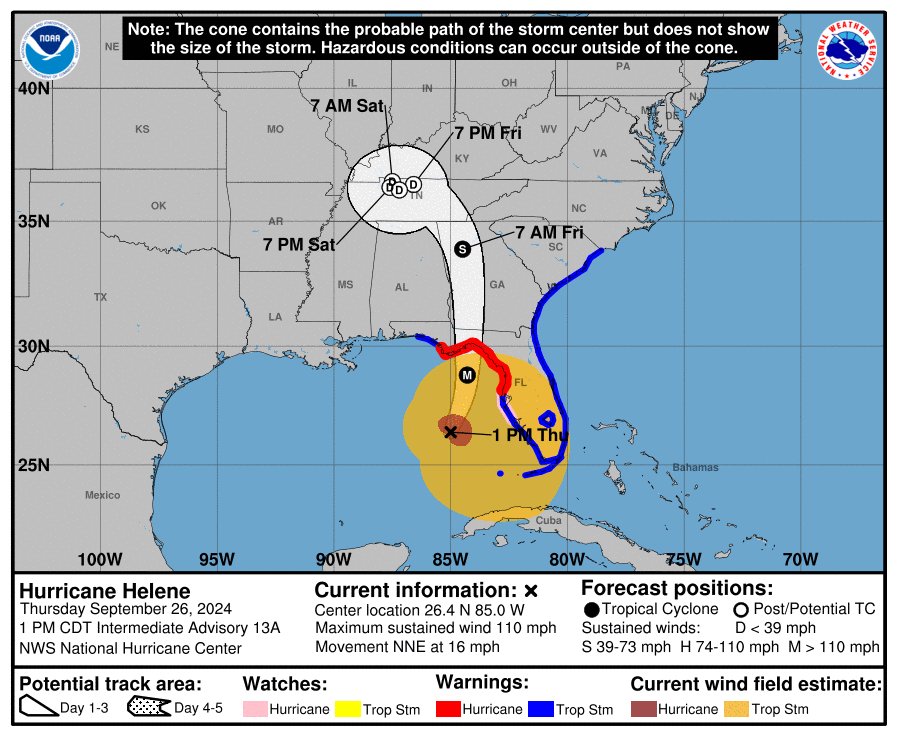
Hurricane Helene is following the forecast track. SW Florida is feeling the impact of the first storm surge. Tropical storm force winds are being felt throughout Florida. All interests in the Big Bend area should heed local officials’ warnings and instructions. Focus on the local emergency management advice.
For those who are in the path of the storm, there comes a time when all options are removed, and you enter the “Hunkering Down” phase. You’re just about there now. Hurricane force winds extend 60 miles from center.
At 100 PM CDT (1800 UTC), the center of Hurricane Helene was located near latitude 26.4 North, longitude 85.0 West. Helene is moving toward the north-northeast near 16 mph (26 km/h). A significant increase in forward speed is expected during the next 24 hours. On the forecast track, Helene will make landfall in the Florida Big Bend region this evening. After landfall, Helene is expected to turn northwestward and slow down over the Tennessee Valley on Friday and Saturday.
Maximum sustained winds have increased to near 110 mph (175 km/h) with higher gusts. Additional strengthening is forecast, and Helene is expected to be a major hurricane when it reaches the Florida Big Bend coast this evening. Weakening is expected after landfall, but Helene’s fast forward speed will allow strong, damaging winds, especially in gusts, to penetrate well inland across the southeastern United States, including over the higher terrain of the southern Appalachians.
Helene is a very large hurricane. Hurricane-force winds extend outward up to 60 miles (95 km) from the center and tropical-storm-force winds extend outward up to 345 miles (555 km). (link)
Those in the area of Sarasota, Clearwater/St Pete to the Florida Panhandle and Big Bend area need to pay particular attention to the path of this storm throughout the day today and tomorrow. An area of extreme weather is expected to become hurricane Helene very quickly.
There is a potential for strength to major hurricane status in the Gulf of Mexico prior to landfall. Those in the Mississippi and Alabama coastal area should also keep an eye for updates.
At 800 PM EDT (0000 UTC), the disturbance was centered near latitude 18.3 North, longitude 82.3 West. The system is moving toward the north-northwest near 7 mph (11 km/h). A northwestward motion is expected on Tuesday and Tuesday night, followed by a faster northward to north-northeastward motion on Wednesday and Thursday.
On the forecast track, the center of the system is forecast to move across the northwestern Caribbean Sea through Tuesday night, and then over the eastern Gulf of Mexico on Wednesday and Thursday. (link)
Hurricane Ian hit the Florida SW coast on Sept 29, 2022. September hurricanes are strong, the Gulf of Mexico is very warm.
For those in the cone of uncertainty, remember, planning and proactive measures taken now can significantly reduce stress in the days ahead. Plan when to make the best decision on any evacuation (if needed) consider Tuesday night the decision timeframe. As a general rule: take cover from wind – but evacuate away from water.
Tropical Storm Debby is anticipated to intensify quickly now and will likely impact the “big bend” of Florida area as a hurricane. The good news is that Debby is moving fast (13 mph) and getting faster. Less time for the buzzsaw is a good thing, regardless of intensity.
NATIONAL HURRICANE CENTER – At 200 PM EDT (1800 UTC), the center of Tropical Storm Debby was located near latitude 27.3 North, longitude 84.4 West. Debby is moving toward the north-northwest near 13 mph (20 km/h). A turn toward the north is expected later today, followed by a slower
motion toward the northeast on Monday and Tuesday. On the forecast track, the center will move across the northeastern Gulf of Mexico through tonight and reach the Florida Big Bend coast Monday morning. (LINK)
Remember, you are in control right now, not Debby. She takes control tomorrow. There is no need for panic or dark imaginings. Calm, prudent preparations should be taken if you are in the zone of uncertainty. A lot of change in impact zone can happen quickly with these northerly moving storms.
What follows below are less discussed things to consider if you are prepping for a hurricane impact and/or deciding whether to stay in your home or evacuate. Standard hurricane preparations should always be followed. Protect your family, secure your property and belongings, and prepare for the aftermath.
Hurricane Beryl has been churning her way through the Caribbean for the past few days. She is now a dangerous CAT-4/CAT-5 storm nearing the island of Jamaica. Beryl is a very dangerous storm with a well-defined eyewall.
The positive aspect is the eye is generally only about 45 miles wide. However, she is pushing a massive amount of water and extreme tidal surges and storm surges should be anticipated.
National Hurricane Center – At 800 AM EDT (1200 UTC), the eye of Hurricane Beryl was located near latitude 16.9 North, longitude 75.3 West. Beryl is moving toward the west-northwest near 20 mph (31 km/h), and this general motion should continue through today, followed by a turn more toward the west tonight or Thursday. On the forecast track, the center of Beryl will move rapidly across the central Caribbean Sea and is forecast to pass near or over Jamaica later today. The center is expected to pass near or over the Cayman Islands tonight or early Thursday and move over the Yucatan Peninsula of Mexico early Friday.
There was much said about the potential of “space weather” disruption prior to a series of solar flare outbursts or “Coronal Mass Ejection” (CME) events this weekend. However, despite some of the more alarming predictions, the geomagnetic issues appear to be minimal.
The aurora, essentially widespread ‘Northern Lights’ was visible last night over northern part of the Northern Hemisphere. Canadians, Americans and Europeans were able to see a rare event. Typically, the Northern Lights are centered closer to the geomagnetic poles; however, with the sun storm interacting with the atmosphere the light display is visible further south Friday and Saturday night.
[…] The US government’s advice to the public on how to prepare for a space weather event largely resembles the same steps you’d take in response to an extended power outage.
For example, the government recommends keeping extra batteries or a hand-powered charger available for small electronic devices. Officials say you may want to disconnect electric appliances to protect them from power surges and limit your electricity usage during a solar weather event. You may also want to keep your car’s gas tank at least half-full so that you do not need to visit a gas station (which needs electricity to operate the pumps). (read more)
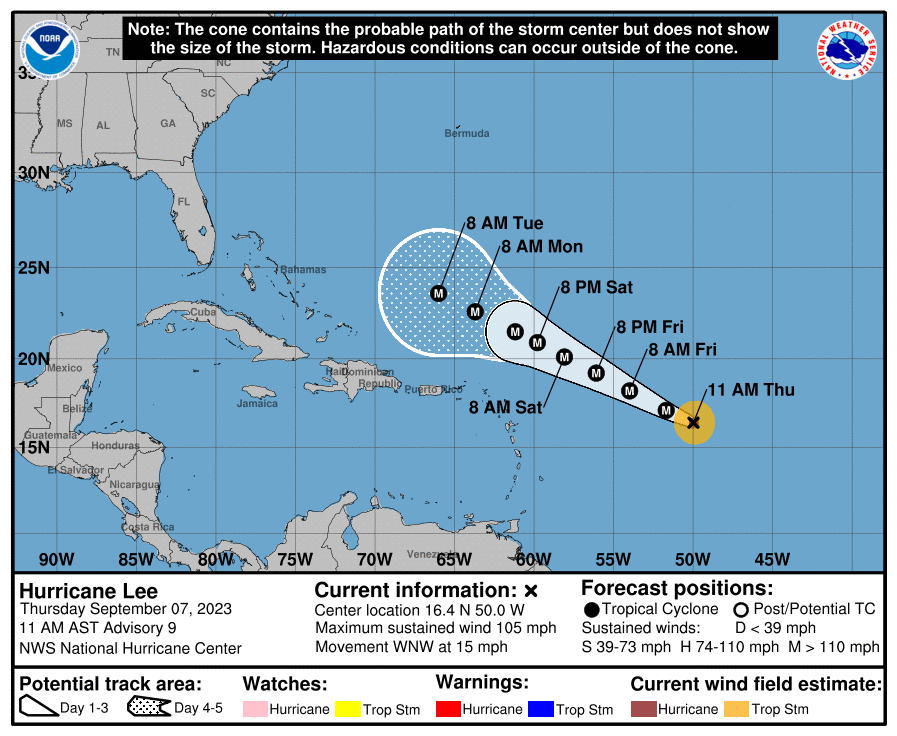
Hurricane Lee is moving slowly in the southern Atlantic approaching the Leeward Islands. [NHC DATA HERE] Residents on the Southeast coast of the USA should monitor. Lee is expected to become a major hurricane later tonight as it moves toward the west-northwest over the next few days.
Hurricane Lee is still a long distance from presenting any immediate risk, but prudent checks and evaluations of your situation should take place. Keep an eye on the National Hurricane Center for updates. The storm is not anticipated to be a major focus until mid-week next week.
At 1100 AM AST (1500 UTC), the center of Hurricane Lee was located near latitude 16.4 North, longitude 50.0 West. Lee is moving toward the west-northwest near 15 mph (24 km/h), and this motion is expected to continue through Friday. A slower motion toward the west-northwest is forecast over the weekend. On the forecast track,the core of Lee will move north of the northern Leeward islands during the next few days. (link)
Obviously, this is currently a long way from the eastern U.S. However, coastal residents should keep an eye on Lee and evaluate their pre-existing preparedness plans.