Quantcast

Reminder of Some Less Familiar Disaster and Hurricane Prep Tips

The next sixty days are peak hurricane and storm season for the Southeast coast.  While we all hope for a non-eventful next few months, several people have requested a repost of the lessons from Hurricane Ian.  I am duplicating that information for sharing and bookmarking in case you missed it last year.

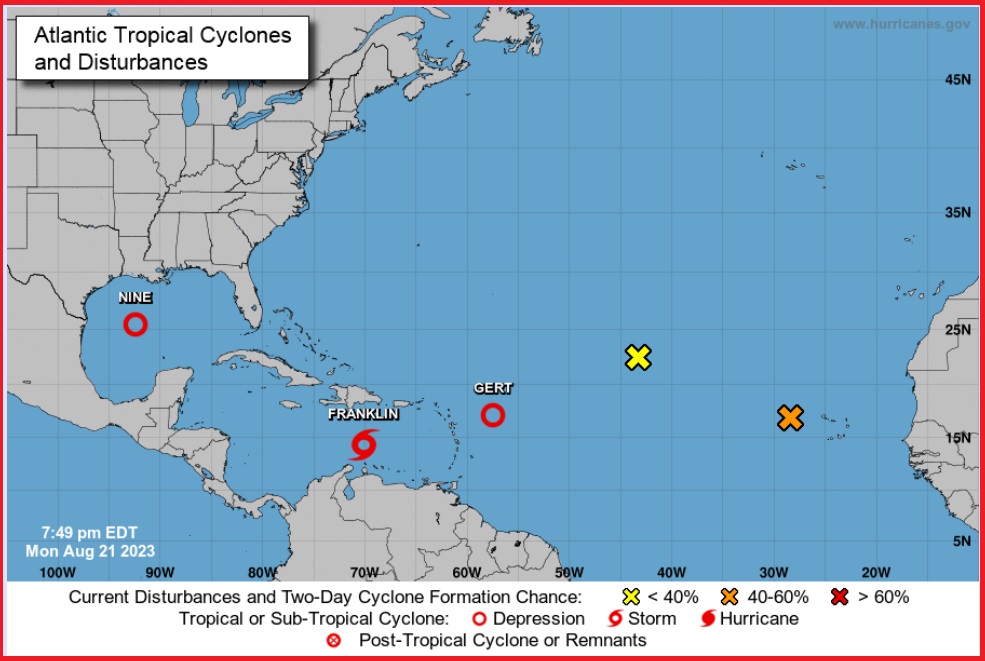
[Current Tropical Status per NHC]

The ‘context’ of Ian was shared previously {Go Deep}.  What follows below are things to consider if you are prepping for a hurricane impact and/or deciding whether to stay in your home or evacuate.  Standard hurricane preparations should always be followed.  Protect your family, secure your property and belongings, and prepare for the aftermath.

(more…)

Site Note

Dear friends, several people have made inquiry about my sporadic posting in the past week+ and asking if everything is okay.  While I generally do not discuss facets of challenges that are of a more personal level, here’s the essence.

The post hurricane recovery process is exceptionally challenging and difficult.  There’s so much to rebuilding an entire community, economy and social system in the aftermath of such damage; it’s almost too encompassing to explain.

Previously, as I worked in the aftermath of disaster, I always enjoyed the benefit of leaving after the first several phases of recovery were addressed.

This is not that.

Even the smallest life detail can be difficult when everything is in turmoil.  My roof was structurally repaired by professionals about two weeks ago; I no longer have a tarp.  However, now the work inside begins against the backdrop of shortages of materials and workers.  If you don’t have buckets of cash to burn to go live somewhere else while you hire a contractor to do the work, essentially you end up in the role of a contractor yourself.

Living while this is happening is a series of complex challenges, I’ll explain.

(more…)

Two More Bodies Recovered in Aftermath of Hurricane Ian

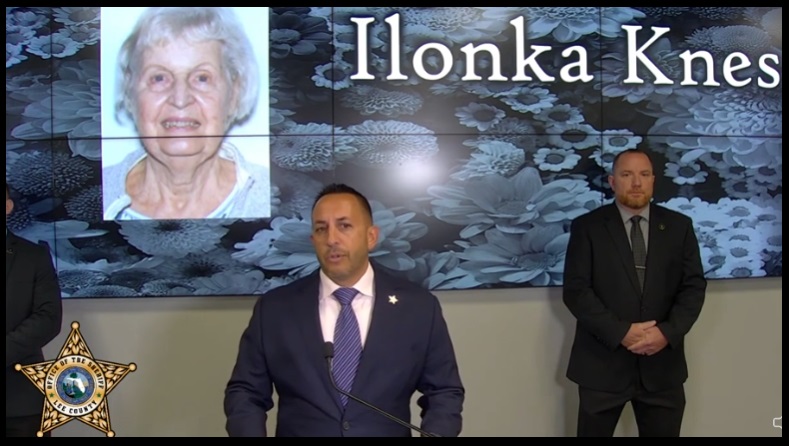
Their names will not make national headlines, and generally everyone has moved on, but to their families and friends Ilonka Knes and James Hurst mattered.  As CTH readers may remember, in the aftermath of Hurricane Ian we shared that many missing people would be found in the months after the storm, and unfortunately many more will likely never be found.

The body of Mrs Ilonka Knes (82) was found in the mangroves and back bay salt marsh near Fort Myers Beach and has been positively identified. The body of her husband Robert was found in the days immediately following Hurricane Ian.

Additionally, the sailboat “Good Girl” was found submerged with human remains believed to be the body of James ‘Denny’ Hurst (73).

Mrs. Knes and Mr Hurst bring the total number of Hurricane Ian victims in Lee County, Florida, to seventy-five.  Mr. Hurst was the final “official” missing person on the local list; however, there are many more yet unaccounted that were not from this immediate area.   The physical devastation is widespread, but the emotional toll on the families and friends of the missing has been beyond imagining.  Tonight, two more families have answers.

(more…)

TS Nicole Likely to Become a Hurricane as Storm Approaches Florida East Coast Wednesday Night

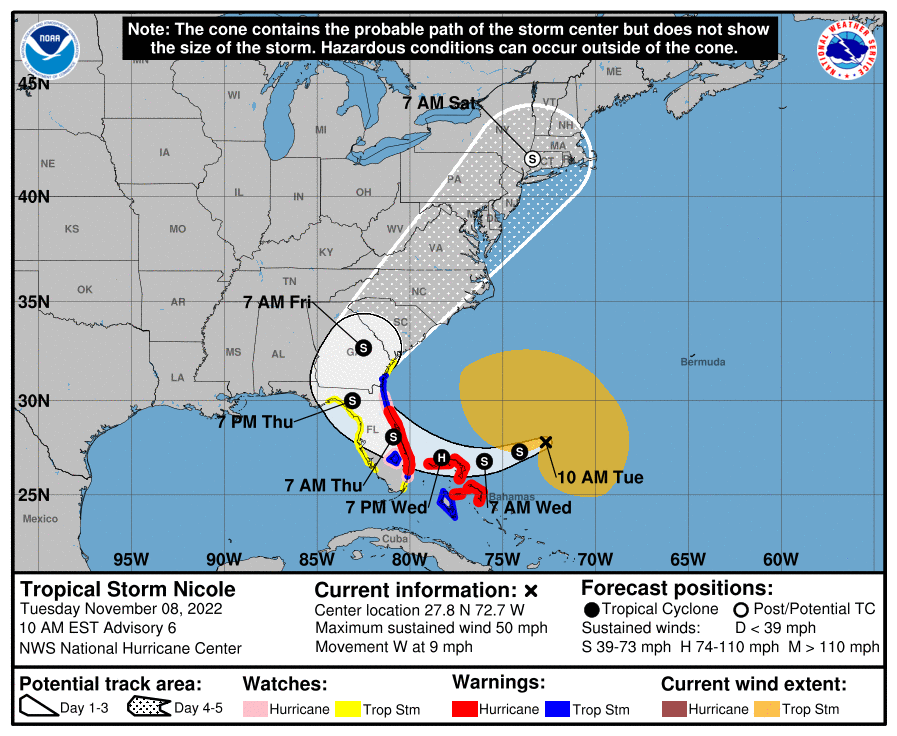
The National Hurricane Center is advising Florida east coast residents to prepare for hurricane conditions during the Wednesday overnight hours. [NHC Website]  Tropical Storm Nicole is moving quickly toward the Bahamas and will approach the Florida east coast late Wednesday.   Florida Governor Ron DeSantis has declared a state of emergency to release resources and trigger support mechanisms.

[NOTE: Florida West Coast – Nicole is a large system with tropical storm force winds extending for 380 miles from center.  For SWFL residents in the debris and recovery zone from Ian, the winds from Nicole will be coming from the North, starting soon. Keep this in mind when securing already destabilized structures, roof tarps, fences, debris etc. Anticipate tropical storm force winds arriving from the North tomorrow.]

(NHC) At 1000 AM EST (1500 UTC), the center of Tropical Storm Nicole was located near latitude 27.8 North, longitude 72.7 West. Nicole is moving toward the west near 9 mph (15 km/h). A west to west-southwest motion should continue through Wednesday. A west-northwest motion is forecast to begin on Wednesday night, followed by a turn toward the northwest and north-northwest on Thursday and Thursday night.

On the forecast track, the center of Nicole will approach the northwestern Bahamas today and tonight, move near or over those islands on Wednesday, and approach the east coast of Florida within the hurricane warning area Wednesday night. Nicole’s center is then expected to move across central and northern Florida into southern Georgia Thursday and Thursday night.

Maximum sustained winds are near 50 mph (85 km/h) with higher gusts. Strengthening is expected during the next 36 to 48 hours, and Nicole is forecast to be near or at hurricane strength by Wednesday and Wednesday night while it is moving near the northwestern Bahamas and approaching the east coast of Florida. (more)

The majority of my advice below is for the Florida EAST COAST:

(more…)

Head’s Up, STS Nicole Anticipated to Be Hurricane as it Approaches Florida Southeast Coastline – All Coastal Areas, Including GA, Be Advised

There are only two words that come to mind as I write this notice from the Ian impact zone, “mercy” and “uncle.”  Prayers.

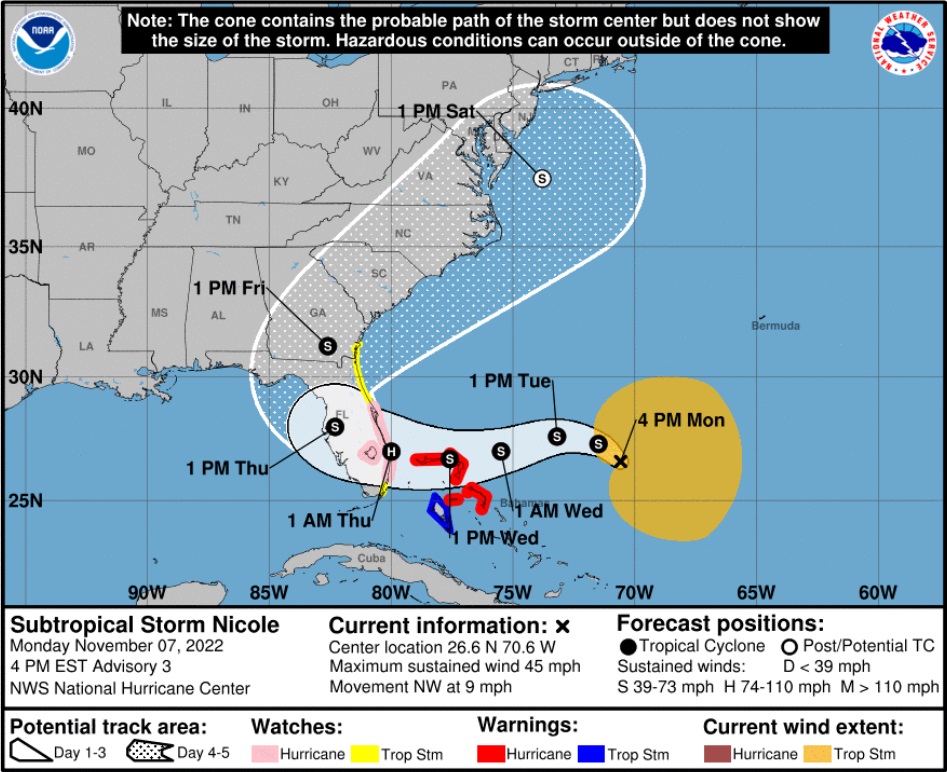
STS Nicole is anticipated to become a Cat-1 Hurricane as it approaches the southeast coast of Florida late Wednesday night. A Hurricane warning is in effect for the Northeast Bahamas, and a Hurricane Watch is in effect for the East Coast of Florida from the Volusia/Brevard County Line to Hallandale Beach. Residents along the Florida east coast should watch for updates [Hurricane Center Link].

If you are on the east coast of Florida, you should begin preparations today and tomorrow for the potential of high winds, power outages, coastal storm surge and inland flooding.  Georgia and South Carolina should also keep an eye on this.

Additionally, on the other side of the state, while Nicole is not anticipated to be a strong hurricane and will hopefully lose strength quickly as it moves over land, any tropical storm winds and rain along the southwest Florida areas (SWFL) previously impacted by Ian could be very troublesome.  Everything is tenuously held together in SWFL and there is massive debris and structural instability present as recovery efforts continue.  This is not good.

(NHC) – At 400 PM EST (2100 UTC), the center of Subtropical Storm Nicole was located near latitude 26.6 North, longitude 70.6 West. The storm is moving toward the northwest near 9 mph (15 km/h). A slower northwestward motion is expected tonight. A turn toward the west or west-southwest is forecast to begin by Tuesday night and that motion should continue through early Thursday. On the forecast track, the center of Nicole will approach the northwestern Bahamas on Tuesday and Tuesday night, move near or over those islands on Wednesday, and approach the east coast of Florida Wednesday night. (more)

(more…)

Hurricane Ian Recovery Update – “Debris”

In a previous update I noted the scale of debris cleanup ongoing as an outcome of Hurricane Ian.  Several people made inquiries wanting to better understand the overall magnitude.  So, I took some pictures today to share.

According to one of the debris contractor officials I incidentally bumped into, he shared how the debris cleanup was bid to the municipal regions using an actuarial formula from prior disaster recovery.  It’s a pretty interesting, albeit heartbreaking, formula and overall process to understand.

After a geographic region is identified, an interim helicopter flight by specifically trained experts in the industry of debris removal is conducted.  The general statistics applied to the contracts are for seven years’ worth of normal debris in the municipal region.

Meaning whatever tonnage is normally accumulated in municipal trash pickup over a year (garbage and recycling), that tonnage number is then multiplied by seven, and that’s the amount of debris anticipated during the initial hurricane debris removal.  Seven years’ worth of ‘trash’.

More pictures below to help understand.

(more…)

Part II, Lessons from Hurricane Ian

The ‘context’ of Ian was shared previously {Go Deep}.  Here we outline things to consider if you are prepping for a hurricane impact and/or deciding whether to stay in your home or evacuate.  Standard hurricane preparations should always be followed.  Protect your family, secure your property and belongings, and prepare for the aftermath.

What you do before the hurricane hits is going to determine where you are in the recovery phase.
Additionally, and this should be emphasized and discussed within your family, if you cannot be self-sufficient in the aftermath – for any reason, then you should evacuate.

Self-sufficiency in this context requires being able to cope for up to several weeks:

(1) potentially without power; (2) potentially without potable running water (3) potentially without internet service; (4) potentially without communication outside the region; and (5) with limited municipal and private sector assistance.   If you decide you cannot deal with these outcomes, you should evacuate.

Additionally, as a family or individual, you should also honestly evaluate:

(1) your physical abilities; (2) your emotional and psychological ability to withstand extreme pressures; and (3) your comfort in losing daily routines, familiar schedules and often overlooked things you might take for granted.  Post hurricane recovery is fraught with stress, frustration and unforeseeable challenges.

I saw a video presented by a structural engineer who was sharing his experience with Hurricane Ian.  I am going to use his video for a few references because even with professional credentials, some of the common mistakes people make are highlighted in his experience.  Keep in mind his video is taken about 30 miles inland from where the majority impact area (coastal region) is located.

(more…)

Part I, Lessons from Hurricane Ian – The Context

Many CTH readers know I have been involved in hurricane prep and recovery as a longtime member of a civilian emergency response team.  I have physically been through four direct hurricane impacts and responded to recovery efforts in more than fifteen locations, often staying for days or weeks after the initial event.

Through the years I have advised readers on best practices for events before, during and after the storm. In this outline my goal is to take the experience from Hurricane Ian and overlay what worked and what doesn’t work from a perspective of the worst-case scenario.

Hurricane Ian was a worst-case scenario.

Let me be clear from the outset, I am not advising anyone to put greater weight on my opinion or ignore local emergency officials or professionals in/around the disaster areas. What I am going to provide below is my own experience after decades of this stuff, against the backdrop of Ian, and just provide information that you may wish to consider if you are ever faced with a similar situation.

Hurricane preparation can be overlaid against other types of disaster preparation, there are some commonalities.  However, for the sake of those who live on/around the U.S. coastal areas where hurricanes have traditionally made impact, the specifics of preparation for this type of storm are more pertinent.  I’m going to skip over the basic hurricane preparation and get into more obscure and granular details, actual stuff that matters, that many may not be familiar with.

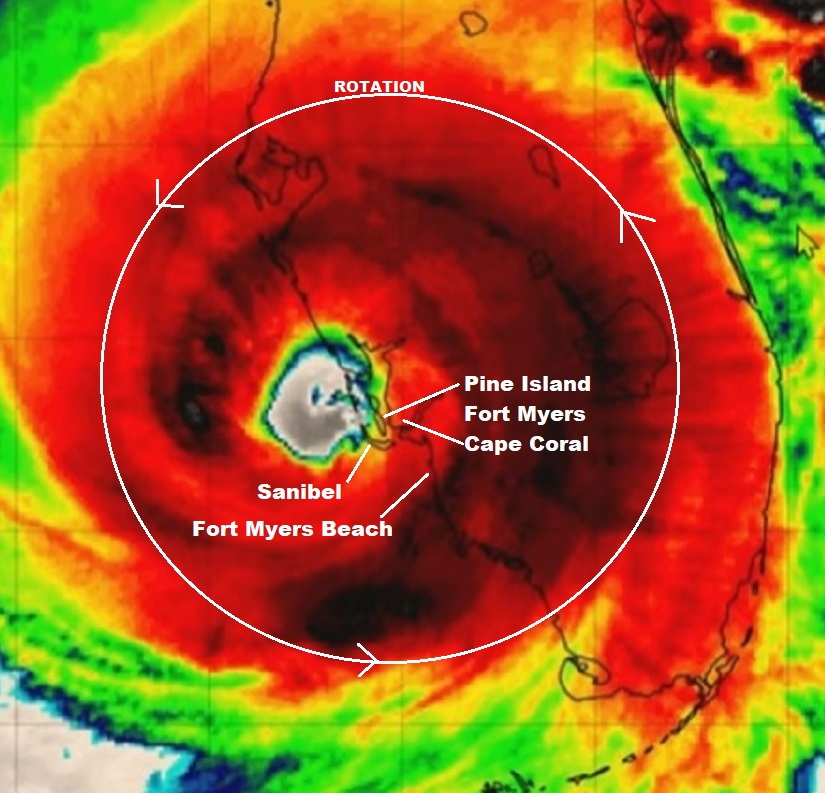
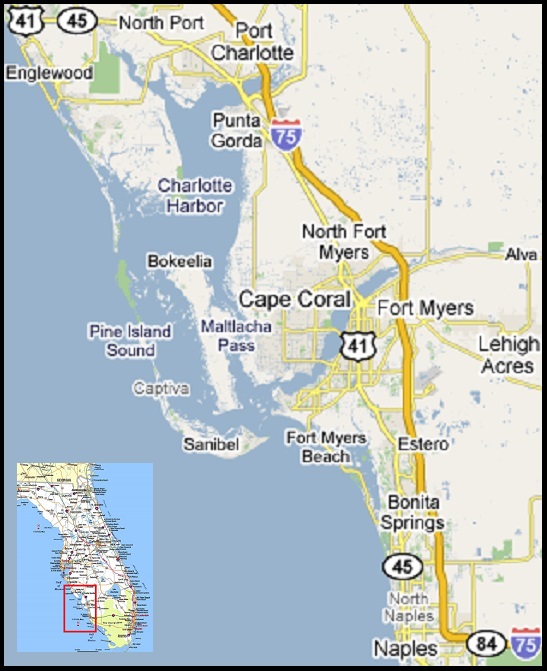
Let me start by sharing a graphic that you may overlay with the information you may have already seen from national media coverage.  The graphic below shows Hurricane Ian in relation to Southwest Florida and points to locations that you may have seen on the news.  The context of understanding Ian is going to be critical when contemplating preparation, so it must be emphasized.

This satellite image was likely taken around 4 to 7 pm on the evening of September 28, 2022, approximately three hours after Hurricane Ian officially made landfall at Bokeelia, a small community on the Northern end of Pine Island. All of my discussion below is from the ‘major impact zone’.

(more…)

Hurricane Ian Recovery Update

I’ve been sharing some of the challenges with site admins; at their suggestion here’s the latest from the impact zone.

First things first.  To establish the context, what made Ian completely different from all other hurricane recovery responses I have been involved in comes down to two issues: strength of the storm (155+ mph winds), and more importantly the duration of the event (8+ hours of peak destruction).

In normal hurricane impacts the worst affected areas generally experience 3 to 4 hours of chaos.  Hurricane Ian was unique in that it was only moving 8 to 10 mph and that made the storm damage completely different.  Structures that survived the first half, completely failed during the second half of the storm.

Almost nothing survived unscathed after 8 to 9 hours of that strength of storm sitting, almost stationary, in one place; nor was anything ever designed to withstand that duration of storm with winds from the South, then East, then West as Ian meandered inland from the gulf toward the north northeast.

After this storm, and having been through four previous direct impacts, including Homestead AFB, I would say this….  If there is even a remote chance you would ever encounter this type of a hurricane event, EVACUATE.  Do not try and hunker down if there is a looming possibility of having to rely on a structure to withstand 150+ mph wind for a full day.  Just leave.  With all of my preparations in place, and all of the knowledge I possess in storm survival, I would never attempt that again.

That said, I will put a better word image together at a later date to share, along with specific recommendations learned as an outcome of this event.  In the interim, just accept my most strenuous advice. If this specific type of storm was ever predicted to come near you, GET OUT.

(more…)

A Tribute to Git R Done

Sometimes the knights in shining armor appear as crews’ wearing jeans, overalls and steel toed boots.

It doesn’t take an emergency beacon to activate them, just a need… and they come.  Purposefully, without condition, ready to move, activate and respond.  They throw the gear bags, kiss the ladies & babies, and head out. The rest is figured out upon arrival.

Superior Construction, came from Jacksonville, Ajax Paving from Fort Myers, Honc from the Cape and trucks with subs from just about everywhere. There’s both a unity and similarity that flows when callouses are clasped and the melding of purpose comes together.  Few words are needed, because it’s a task centered outlook, let’s git r’ done – no quit.

I asked Richard to put this together. {Direct Ruble Link} The drone video is from FAI photography. The song is by Lucy Thomas.  The message, well, given all of the critics who say America’s best days are behind, perhaps they need to pause a little bit and remind themselves what we are capable of.  Enjoy:

.

What has been accomplished in two weeks of 24/7 reconstruction is nothing short of remarkable.  Then again, this is the Christian America we know well.  The truckers, pullers, spreaders, drivers, welders, machinists, heavy equipment operators, tugboat operators, barge haulers, diggers, pumpers, tradesmen, all of them, just people.

Damn good people at that.

People who represent what makes our nation unique.  The invisible, salty, mostly scruffy and beautifully comfortable about it, yet critical network of blue-collar crews that keeps it all operating.  God, how I cherish them so.

At the core of our American purpose is a decency and unity.  Critics don’t like to talk about it, but American workers are fundamentally good. When something seems impossible, for blue-collar Americans ‘impossible‘ is just another starting point, if you get out of the way. Don’t lose sight of that.

(more…)