In an effort to keep the Daily Open Thread a little more open topic we are going to start a new daily thread for “Presidential Politics”. Please use this thread to post anything relating to the Donald Trump Administration and Presidency.
This thread will refresh daily and appear above the Open Discussion Thread.
Our Father, who art in heaven, hallowed be thy Name. Thy kingdom come. THY WILL BE DONE, on earth as it is in heaven. Give us this day our daily bread. And forgive us our trespasses, as we forgive those who trespass against us. And lead us not into temptation, but DELIVER US FROM EVIL.
For Thine is the kingdom and the power and the glory, forever and ever. Amen †
Keep in mind the Washington Post receives all of their exclusives from the CIA leak network.
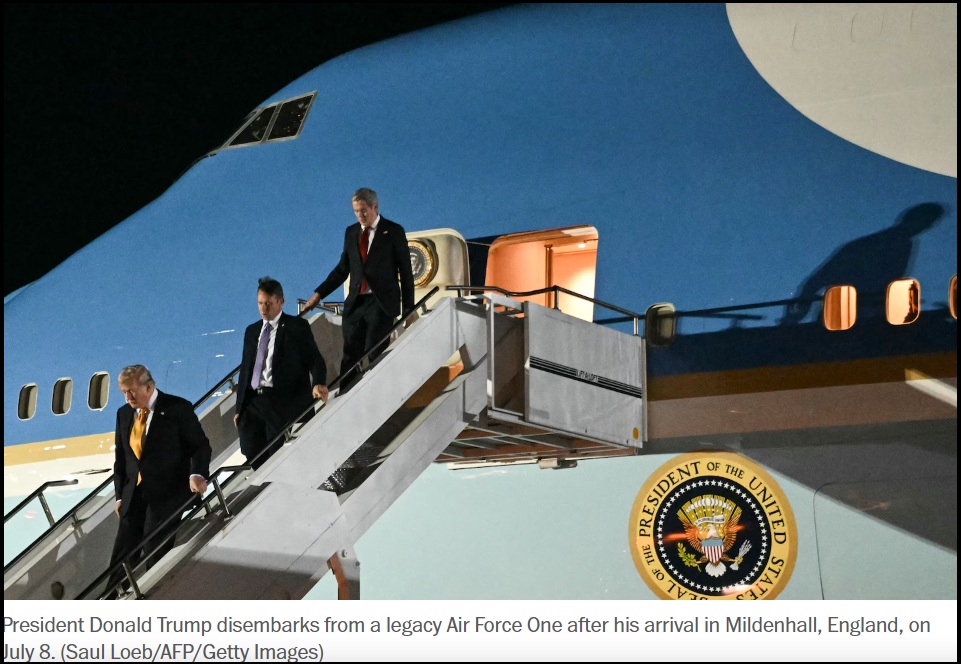
For some insufferable reason, the Washington Post (CIA) is publishing a story about President Trump’s security protocols following the NATO summit in Ankara, Turkey last month.
As the story is told, President Trump went into the legacy Airforce One, however, he quietly exited the plane via a catering truck set up on the opposite side of the plane and then he boarded an Air Force C-32 support plane for the flight out of Turkey destined to Britain’s Mildenhall air base.
At the time of the travel there was a credible threat from Iran toward the President. Apparently, extra precautions were taken, and the Washington Post (CIA) needs to tell people about them.
[…] In Ankara, Trump boarded the old Air Force One jumbo jet in view of television cameras. He was secretly shuttled minutes later to a smaller plane — an Air Force C-32A — via an airport catering truck typically used to load meals and other supplies preflight, according to the U.S. official and corroborating material reviewed by The Post. That made Air Force One a “decoy” with media and some White House staff aboard, the official said.
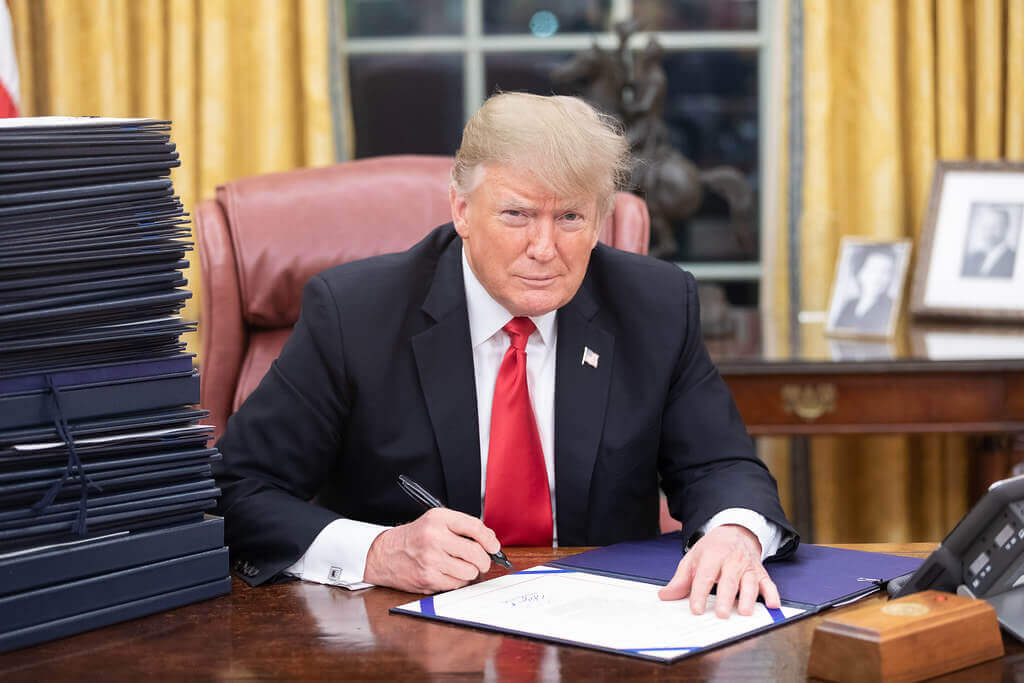
Earlier today President Trump held an executive order signing ceremony in the oval office on the subject of the childhood vaccination schedule. [White House Fact Sheet Here] President Trump also took questions from the media.
WHITE HOUSE – DELIVERING GOLD STANDARD CHILDHOOD VACCINE RECOMMENDATIONS: Today, President Donald J. Trump signed an Executive Order to recognize Gold Standard Childhood Vaccine Recommendations that maximize parental choices over vaccinations for their children and align three categories of childhood immunizations with scientific evidence and best practices from peer, developed countries.
The Order provides recommendations that give parents more information and options when making immunization decisions for their children.
The Order recommends all children get immunizations to provide protection for 11 diseases – a decrease from the 18 diseases recommended by the Centers for Disease Control and Prevention in 2024. Immunizations no longer recommended for all children are now recommended for shared clinical decision-making, ensuring that parents have all options available to them.
The Order recommends separating out the combined MMR vaccine into three single-disease shots and recommends administering all vaccines during separate medical visits to give parents more options regarding the timing and frequency of this vaccine administration.
States that enact school vaccine requirements are advised to consider the Gold Standard Childhood Vaccine Recommendations and consider updating their laws to reflect the recommendations.
All Federal agencies are advised to advance the Gold Standard Childhood Vaccine Recommendations based on their relevant authorities to ensure Americans have the best scientific information.
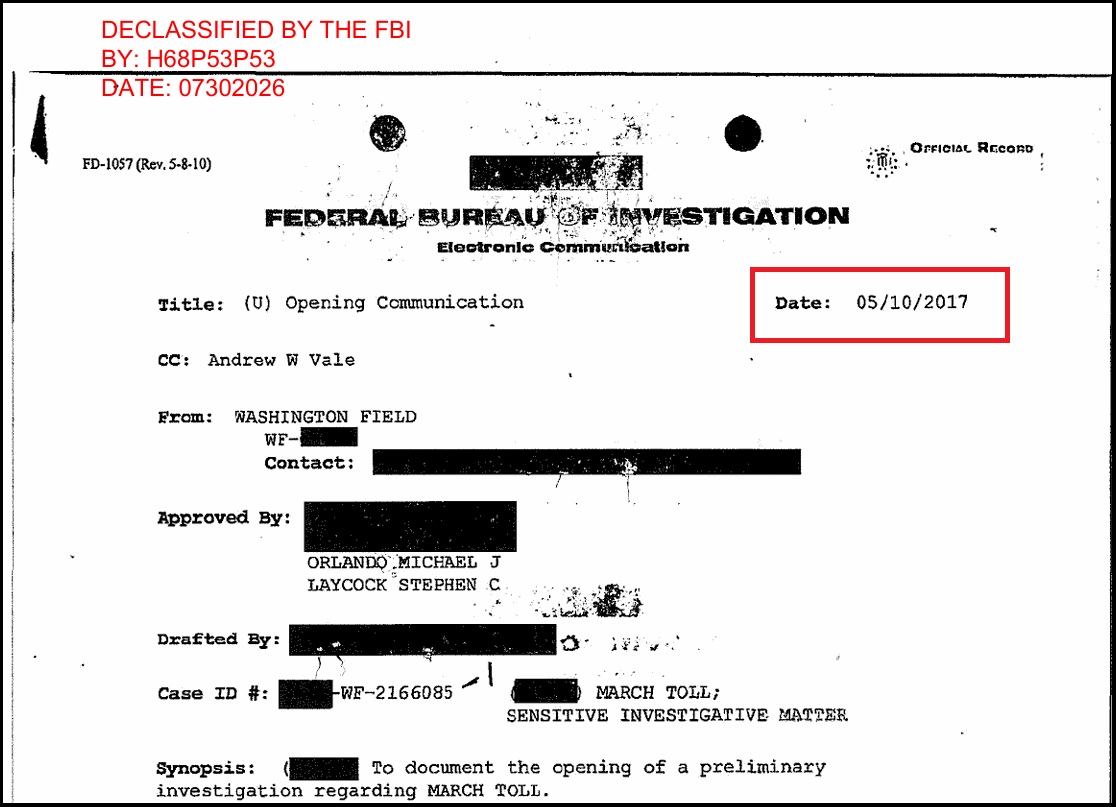
The White House government transparency office, John Solomon, has declassified and released FBI internal documents surrounding their opening of an investigation of Jeff Sessions on May 10, 2017. The investigation of Sessions surrounded his contact with the Russian ambassador Sergey Lavrov and was opened the day after James Comey was fired on May 9, 2017.
Several people have questioned the naming of the FBI investigation as “March Toll,” however, the essential aspects to the nonsense investigation stemmed from corrupt DOJ and FBI insiders (the ‘small group’) who were strategizing on a way to force Jeff Sessions to recuse himself. That planning took place in March, hence the term ‘March Toll.’
Jeff Sessions was confirmed as Attorney General on February 9, 2017. Almost immediately the group in charge of the Crossfire Hurricane (Trump-Russia) investigation began planning on a way to force Sessions to recuse himself. Ultimately they were worried that Sessions would tell the FBI to end their ridiculous Trump-Russia investigation, so they needed the Attorney General isolated.
CTH previously wrote about the campaign to recuse Jeff Sessions {GO DEEP}. The original planning meetings took place on March 2, 2017, and were attended by Jody Hunt, Dana Boente, Tashina Guahar, Jim Crowell and Scott Schools. All of those names are directly connected to the manipulation of the Trump-Russia investigation therein and thereafter.
The day after James Comey was fired, on May 10th, Deputy AG Rod Rosenstein was immediately on the phone with Robert Mueller to organize the Mueller special counsel investigation. As you can see from the opening EC, this was also the same day the FBI triggered the ‘March Toll’ investigation of Jeff Sessions.
In an effort to keep the Daily Open Thread a little more open topic we are going to start a new daily thread for “Presidential Politics”. Please use this thread to post anything relating to the Donald Trump Administration and Presidency.
This thread will refresh daily and appear above the Open Discussion Thread.
Our Father, who art in heaven, hallowed be thy Name. Thy kingdom come. THY WILL BE DONE, on earth as it is in heaven. Give us this day our daily bread. And forgive us our trespasses, as we forgive those who trespass against us. And lead us not into temptation, but DELIVER US FROM EVIL.
For Thine is the kingdom and the power and the glory, forever and ever. Amen †
Extreme leftists and white, female, overeducated, urban communists have one primary prism: how Obama-ish is their candidate?
Both El-Sayed and Barack Obama are supported by the Muslim Brotherhood directly. Both El-Sayed and Barack Obama campaigned for Senate in the mid-term election (BO ’06, ES ’26), and both Barack Obama and El-Sayed planned to run for higher office in 2nd year of their freshman term as senator.
The media now begin their fawning endeavor as the Muslim Brotherhood backed Abdulrahman Mohamed El-Sayed tries to moderate himself in the image of Barack Hussein Obama. I find it a little revealing that El-Sayed’s wife is a doctor who refuses to treat Medicare and Medicaid patients (cash only), as El-Sayed campaigns on Medicare for all. Of course, don’t look for the media to point this out during questioning.
Notice also the Middle East nations that El-Sayed criticizes (Egypt, Saudi Arabia, Jordan and Pakistan) are the Mid-East nations who have pushed back or banned the Muslim Brotherhood. This is very revealing for those who walk the political deep weeds. By the way, he’s a paper doctor; a Phd, not an MD. WATCH:
[Transcript] – KRISTEN WELKER: And joining me now is Michigan’s Democratic Senate nominee, Abdul El-Sayed. Dr. El-Sayed, welcome to Meet the Press.
DR. ABDUL EL-SAYED: Thanks for having me.
KRISTEN WELKER: Thank you so much for being here and congratulations. Let’s talk about your victory this week. You narrowly defeated Congresswoman Haley Stevens. And when you actually add up all of the votes, the vote totals that went to Stevens and Mallory McMorrow, a majority of voters actually ended up voting for candidates who are more moderate than you. So how do you win over those voters who voted for someone else?
Slowly she builds her performance outrage, methodically working through the talking points afore her. Full dramatic acting on display. Lips pursed, bladed eyebrows angled, contempt tone triggered and the intent obvious.
NIH Director Dr. Jay Bhattacharya appears on CBS Face the Nation to discuss Mexican poop lettuce, Mexico poop peppers, Illegal Alien measles spread and the weaponized information from health ‘administrators’ around the COVID-19 vaccine. Obviously, with Media Patron Saint Anthony Fauci facing scrutiny, Margaret Brennan defends Fauci as she would if the Lightbringer, Chicago Jesus was disrespected. Combative video and Transcript below:
[Transcript] – MARGARET BRENNAN: We’re joined now by the Director of the National Institutes of Health, Dr. Jay Bhattacharya. Good morning to you, doctor.
NIH DIRECTOR DR. JAY BHATTACHARYA: Good morning.
MARGARET BRENNAN: And we should mention you are also helping to run the CDC until the new director is sworn in as well.
DR. BHATTACHARYA: Until next Wednesday, yes.
MARGARET BRENNAN: Until next Wednesday. So let me ask you about a number of things that I think people at home are worried about, particularly around the food supply. The cyclospora outbreak linked to iceberg lettuce from Mexico is now in 15 states. There were two deaths this week due to it. Yesterday, USDA issued an alert for a range of products that may have salmonella, including meat and poultry. 27 states are affected by salmonella, possibly linked to jalapeños, but cilantro, red onion, avocado, also listed in the CDC notice. Albertsons, a grocery store, just recalled some items. There’s risk of salmonella in eggs in Texas, according to the CDC, and then you have the screwworm outbreak affecting beef. This is overwhelming for someone going into a grocery store right now. Why do they seem out of control?
In an effort to keep the Daily Open Thread a little more open topic we are going to start a new daily thread for “Presidential Politics”. Please use this thread to post anything relating to the Donald Trump Administration and Presidency.
This thread will refresh daily and appear above the Open Discussion Thread.