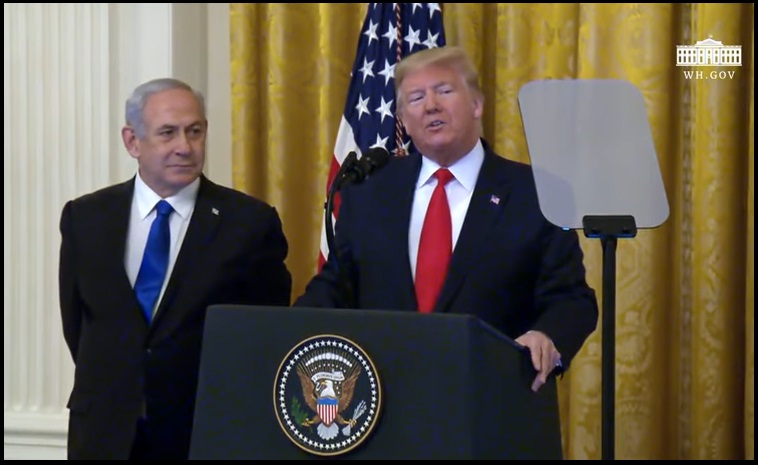
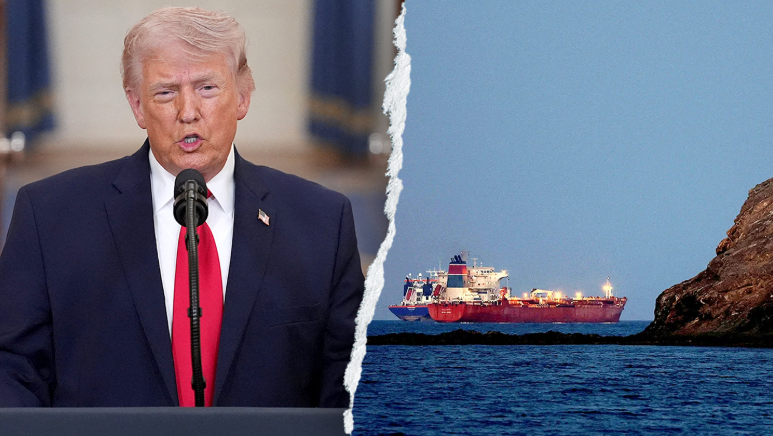
Fox News correspondent Trey Yingst shares details from a conversation he had with President Donald Trump surrounding negotiations to end armed conflict.
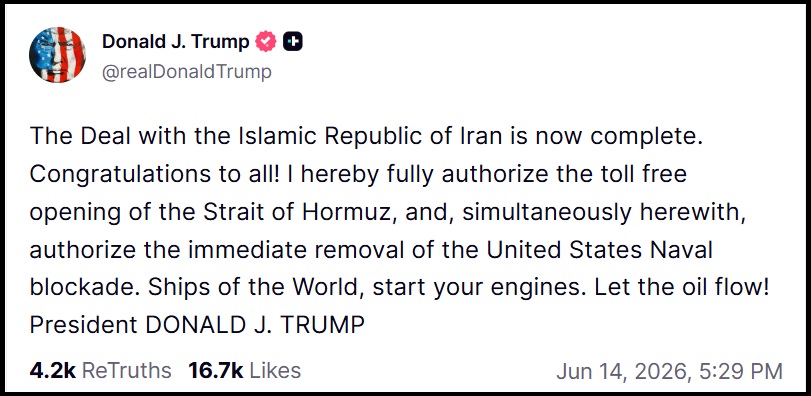
According to Yingst, President Trump is optimistic for a diplomatic settlement and a negotiated deal as early as tomorrow. However, if the deal is not made, the infrastructure within Iran will be systematically destroyed – as noted in a recent Truth Social Post:
Senator Lindsey Graham (U-DC) has never met a military combat operation he didn’t like. In his career Graham, like his friend John McCain (RIH), has always supported war against every country.
However, beyond the unquenchable bloodlust there is one thing Senator Graham fears, an exit from NATO. With the Iran conflict providing buckets of citations for why the United States should pull back from the NATO alliance, citations that Graham cannot easily refute, the war monger is worried the old war ethos of NATO could be lost.
Al Jazeera is essentially the state run media outlet of Qatar. Secretary of State Rubio sat down for a lengthy interview with Al Jazeera that will be shared throughout the Arab world.
“In an exclusive Al Jazeera interview, US Secretary of State Marco Rubio stated that President Trump always prefers diplomacy, with messages and indirect talks ongoing between the US and figures inside Iran. Rubio demanded that Iran abandon all nuclear weapons ambitions, end its missile and drone programmes, and stop sponsoring terrorism across the region. He rejected Iran’s conditions for ending the war — including sovereignty over the Strait of Hormuz and financial compensation — calling the strait demand illegal and a dangerous global precedent. Rubio declared that the strait “will be open one way or another” after US military objectives are achieved, whether through Iranian compliance or an international coalition.”
“He outlined those objectives as the destruction of Iran’s air force (achieved), navy (largely achieved), missile launchers, and weapons factories — all to be completed in weeks, not months. Rubio expressed disappointment with NATO allies like Spain for denying basing rights and airspace, warning that the US would re-examine its NATO commitment. He confirmed the US would welcome regime change in Iran but insisted it was not the official objective of the current military operation. The interview also covered post-Maduro stabilisation in Venezuela and called for serious economic and political reforms in Cuba.”
As Secretary of State Marco Rubio appears for an interview on Good Morning America, President Trump released the following statement:
“The United States of America is in serious discussions with A NEW, AND MORE REASONABLE, REGIME to end our Military Operations in Iran. Great progress has been made but, if for any reason a deal is not shortly reached, which it probably will be, and if the Hormuz Strait is not immediately “Open for Business,” we will conclude our lovely “stay” in Iran by blowing up and completely obliterating all of their Electric Generating Plants, Oil Wells and Kharg Island (and possibly all desalinization plants!), which we have purposefully not yet “touched.” This will be in retribution for our many soldiers, and others, that Iran has butchered and killed over the old Regime’s 47 year “Reign of Terror.” Thank you for your attention to this matter.” ~ President DONALD J. TRUMP
Secretary Rubio responded in real time to questions about the objectives. Rubio impressively underlined the objectives in Iran, reemphasizing the core intent of the military operation to remove the capacity of Iran to pose a threat to the stable alliances that have formed in the region. WATCH:
For the first time in centuries, the Catholic mass at the Church of the Holy Sepulchre in Jerusalem commemorating Palm Sunday, was stopped as a result of security concerns. Palm Sunday commemorates Jesus’ triumphant entry into Jerusalem and launches the Holy Week commemorations for Christians which culminates in Easter.
Pope Leo XIV, at the end of Palm Sunday Mass in St. Peter’s Square, prayed for all Christians in the Middle East who he said were living through an “atrocious” conflict. He said that “in many cases, they cannot live fully the rites of these holy days.” (source)
Luke 19: 28-40 The Entry into Jerusalem.
Jesus proceeded on his journey up to Jerusalem.
As he drew near to Bethphage and Bethany at the place called the Mount of Olives, he sent two of his disciples.
He said, “Go into the village opposite you, and as you enter it you will find a colt tethered on which no one has ever sat. Untie it and bring it here. And if anyone should ask you, ‘Why are you untying it?’ you will answer, ‘The Master has need of it.'”
As the ongoing Operation Epic Fury military engagement continues, CENTCOM announces the arrival of 3.500 Marines from the 31st Marine Expeditionary Unit into forward position.
As negotiations with Iranian leadership are reported to be ongoing, it would appear that options are now present for President Trump to make a decision on the potential seizure of Kharg Island, a crucial oil export hub off Iran’s coast.
(Via Wall Street Journal) – The Pentagon is looking at sending up to 10,000 additional ground troops to the Middle East to give President Trump more military options even as he weighs peace talks with Tehran, Department of Defense officials with knowledge of the planning said.
The force, which would likely include infantry and armored vehicles, would be added to the roughly 5,000 Marines and the thousands of paratroopers from the 82nd Airborne Division who have already been ordered to the region.
The rebranded Lyndon LaRouche PAC has another good outline on the new strategic alliances assembled by President Trump as the ongoing conflict with Iran continues.
Susan Kokinda reviews how the United Kingdom and Europe have been sidelined as President Trump directly negotiates with key stakeholders in the middle east and Asia. Kokinda correctly notes the messaging from Russia indicates a strategic awareness that old systems are fracturing and the potential for new strategic alliances is rising.
“Susan Kokinda argues President Trump has opened a new diplomatic space to de-escalate the Iran conflict by working through a regional roster—Saudi Arabia, Egypt, Turkey, Pakistan, Gulf States, and back channels into Iran—while the U.K., EU, and NATO are absent and increasingly irrelevant. Citing reporting that ministers met in Riyadh and that Egypt, Turkey, and Oman carried messages, she says this “Board of Peace” architecture is isolating Iran and weakening its proxies, pointing to Lebanon’s move against Hezbollah, the Palestinian Authority’s condemnation of Iran, and Hamas considering disarmament. Kokinda links Europe’s exclusion to self-inflicted energy weakness from Green and anti-Russia policies, noting rushed LNG moves and a delayed Russian oil ban vote. She concludes Ukraine’s outlook darkens as Europe and Britain lack leverage, highlighting Zelenskyy’s scramble for support in London and Washington.” WATCH:
Obviously, one of the challenges faced by President Trump following the elimination of all senior Iran political leadership, is to know who is left in power that has the ability to negotiate terms between Iran and the U.S.
During the Q&A media segment of Mark Wayne Mullin’s swearing in ceremony, President Trump was asked how he can trust the Iranian leadership he is currently communicating with. President Trump responded that he doesn’t trust anyone; however, the voices in Iran currently negotiating with the U.S. team sent something of great value to the White House to verify their Bonafide’s. It is an interesting segment. WATCH (prompted):
Barbara Boyd gives her perspective on the latest developments and President Trump policy intersects with the Iran conflict and the Mideast oil disruption.
According to the latest information from the region, some ships have begun navigating the Strait of Hormuz despite the conflict. It is reported that Iran is charging a $2 million fee for safe passage, however those reports are not officially confirmed.
Mrs Boyd notes the Arab nations have historically -and recently- remained under the control of the British, and President Trump has fractured this financial control system. While there is an obvious historic reference to that relationship, I’m not as convinced the connective tissue is as deep as ¹claimed in the modern era (last 20 years). WATCH:
In the modern era, thanks to technological advancement and strategic policy (even before Trump), oil and gas development and use has increasingly become regional. Oil dependencies and the trade partnerships are now associated more with refinement capacity than simply global commodities. Not all oil is created equal.
In the “producers and users” chart below, you can see the origin of regional production and import relationships. The oil supplies from the middle east flow mainly to China and Asia. The oil from Russia is the current wildcard.
President Trump delivers remarks and takes questions from reporters in Palm Beach, Florida, before boarding Air Force One en route to Memphis, Tennessee. President Trump emphatically stated that continued negotiations with ‘leadership’ within Iran continues and reaffirms the conditions for a cessation of hostilities.
The military leadership within the Islamic Revolutionary Guard Corps. (IRGC), do not recognize any political representation over their military control of Iran. This fracture within the political structure of Iran is what seems to create the conflict with U.S. negotiations with political entities the IRGC refuses to recognize.
President Trump is confident the presentation of terms now being discussed with Iranian political leadership will be agreeable to both Israel and U.S. interests. Additionally, President Trump discusses the issue and circumstances around former NTSC Director Joe Kent and his view on the controversy that have flowed since Kent’s resignation. WATCH: