The United States is hosting the G20 Summit this year. As part of the G20 Process various ministers and ambassadors from all of the G20 ministerial sessions, attend summits in the lead-in to the political leader summit in Miami this December.
During the opening session of the G20 trade plenary session, Greer outlined four strategic priorities that President Trump is bringing to the center of the G20 trade group this year. “There are four workstreams the U.S. Presidency has focused on over the course of the year: (1) the weaponization of food, (2) structural excess capacity and production, (3) the Most-Favored-Nation principle, and (4) forced labor in global supply chains.” [READ MORE] These were the directed topics at the beginning of the summit.
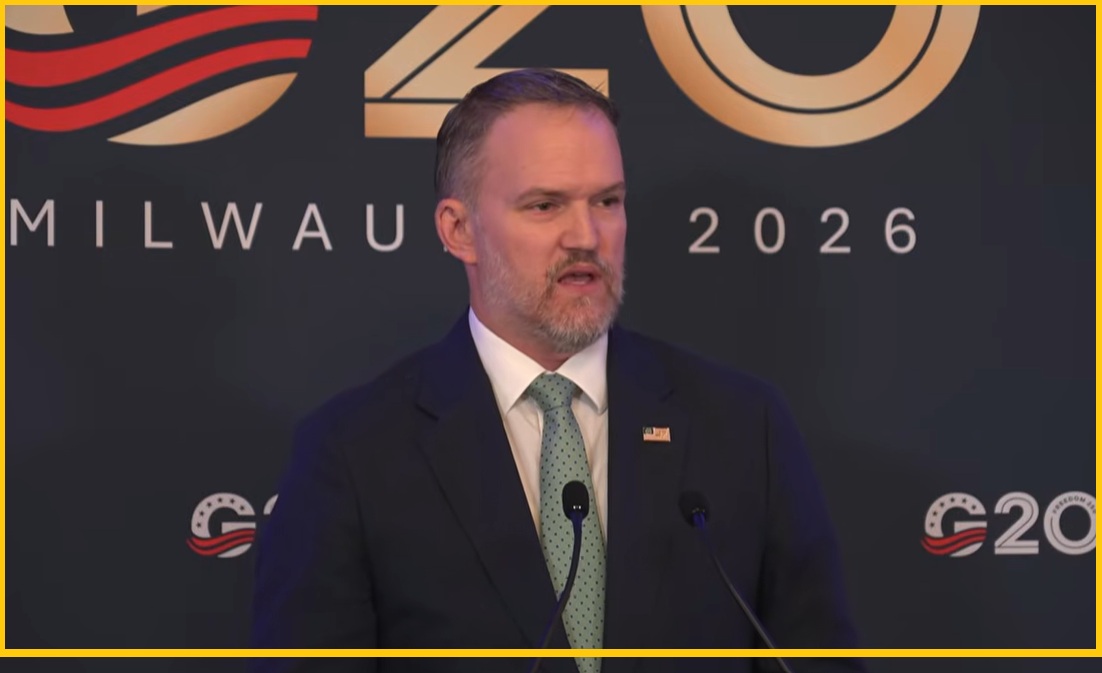
Speaking from Milwaukee, Wisconsin, at the G20 Trade Ministerial Session, U.S. Trade Representative Jamieson Greer gives important remarks and answers questions from the media at the conclusion of the two-day event. WATCH:
Within one question from an EU/Canada media stenographer, there’s a rather brutally obvious statement from USTR Greer. Absolutely epic. Both Canada and Europe are missing a very key something from their economic model, CONSUMERS!
Instead of focusing on growth within their domestic economies, both Canada and Europe rely on the USA to provide the CONSUMERS for their goods. Negotiating from that position is not too difficult.
ESSENTIALLY, currently Canada sends their overproduction to the USA (hence their trade surplus). Currently the EU send their overproduction to the USA (hence their trade surplus). Block those inbound surpluses and what exactly is Canada and the EU going to do with their newly acquired excess?
The two lowest growth economic systems, that are both missing the critical component of ‘consumers’, are going to send their excess products to each other? Think about it.
Another wolverine.
Ugh. Milwaukee. They ought to have held it almost anywhere else.
Dearborn, Michigan
Inflation at 3.1% and unemployment at 4.1%…the best stats in my lifetime.
That is kind of funny!
Bunch of knuckleheads.
G20 trade ministers did not reach a consensus text on forced labor at the Milwaukee meeting that ended today, and the holdouts have not been named publicly.
The only G20 member that had publicly signaled opposition beforehand was Brazil. Reporting in Valor and Brasil 247 said Brasília intended to reject the U.S. proposal for a G20 information-sharing mechanism to keep forced-labor goods out of trade, on the grounds that it could be used to restrict market access rather than just improve transparency. That stance followed the July 2026 USTR Section 301 action, which put an extra 12.5% duty on most Brazilian goods for lacking an effective forced-labor import ban.
China is the other obvious candidate, but it has not been named as a holdout on this specific text. It was the sole dissenter at the September G20 finance meeting on language about “non-market policies,” and USTR’s June 2026 report found China has no legal ban on imports made with forced labor.
Russia attended the Milwaukee talks (Economic Development Minister Maxim Reshetnikov) and is also on that USTR list; it has not been identified as a signer or a refuser either.
“forced labor in global supply chains.”
International companies and governments still use slave labor.
….and take their organs when they get them to work any more….trading partners…heh
They were schooled by the same fools that schooled Janet Yellen and Jerome Powel. Economic plans guaranteed to fail.
Think about it is right. Many people are not critically thinking about all of it, no connecting the dots.
Everything President Trump is doing is exactly what MAGA voters have wanted to happen for decades.
Close the border cut government waste, and all the rest of what he is doing.
.. and the primary resistance to President Trump’s efforts are from INSIDE the US .. resistance, lawfare, playing financial games on the markets, representing our foreign enemies as well as adversaries as lobbyists or advocates, REPUBLICANS failing to provide legislative support …. plus the leaking vital military, legal and commercial INTEL to hinder efforts of the President’s Team.
Google on their devices is their critical thinking skills. Just like China we are.
Canada’s Minister of International Trade has met with the U.S. Trade Representative, the first meeting of its kind since trade talks between the two countries fell apart in August.
Maninder Sidhu spoke with his American counterpart, Jamieson Greer, Wednesday evening on the sidelines of a G20 trade ministers meeting in Milwaukee. But neither side gave any indication of progress toward an agreement.
Sindu says he also spoke with American auto workers in a coffee shop…
https://www.theglobeandmail.com/world/article-canada-us-trade-war-international-trade-minister-meets-greer-autos/
Extolling the virtues of HB1 visas?
“Hey Canada, we have extra prune wine,
you need to take it.”
Canada -” no, you need to take ours.”…..lol
Oh my 😳
It’s been some time since Sun Dance has used the pictures of wolverines growling to represent the different US trade Reps. I reckon the reason why is because they aren’t just growling anymore because all of them have their mouths full tearing into Canadian and EU globalist flesh.
Right about now it is the Canadians that are having pounds of flesh torn from them and they are now totally defenseless.
Canada has no defense because of decades of its government failing to allow the development of its vast resources. Didn’t matter what party was in charge the barriers to investment and development placed by the provinces and national governments and tribes just kept getting worse.
It seems to me that Canada’s problem is not one that can be solved by putting a different party in power. Canada’s problems are much more fundamental than that. Provinces get played against each other and Canadians buy into it. As much as they chant their elbows up and Canada strong crap, the reality is Canada is not united in the most fundamental way because each of it’s provinces are in competition with each other and use trade barriers to try and protect their own turf instead of having free economic systems that would naturally work for each to develop it’s own strengths, whatever those may be for each province.
the national government politicians use those conflicts to get and gain political power from their constituencies. None of then really want true unity. None of them want free trade.
It also seems to me that developed nations with Parliamentary governments seem far more likely to slip into socialism over time than republican forms of government.
Yep..spot on. I watched Carney and Alberta premier press conference today. Carney now says, “Trust me, Bro,” on building that oil pipeline to the west. Mind you, the indigenous people and British Columbia’s have not been talked to yet about it. The Alberta’s will swallow this BS, right before their separation referendum, and as soon as they vote to stay “Elbows Up,” Canada/Carney will cancel the deal. Trust me, Bro!
Carney only promotes or enables projects that he can force into using his Pathways Project “Great Green Grift” Carbon capture boondoggle, with Brookfield managing the carbon credits, CBAM etc. Risk carried by taxpayers and large pension funds, most of the profits to Brookfield.
That’s his pathway to becoming a billionaire which is all he cares about.
But if it fails and America wins, he’ll still do fine as 92% of his personal stock portfolio is American.
He’s not as dumb as he looks. For a scrawny little WEF puppet psycho-lizard green (fake) zealot CCP-lackey Fabian-disciple child-mutilation-enabling Satanist, at least. 🤮 😡
Reality. Here is an excellent video from what I believe to be the best independent Canadian podcaster out there. The video concerns the new LNG pipeline deal and how Carney to globalist is using it and how their Net Zero crap plays into leaving resources in the ground until the globalists can benefit by tapping them.
Thank you for posting.
EXCELLENT
A MUST WATCH
Exactly what the EU wants to do with resource rich Russia.
Overthrow Putin, install an EU puppet and then carve up the country like a roast for it’s natural resources.
The Canadian puppet is already installed and the carving has begun.
You certainly picked a beauty here. Mr. Thomas will give you about as honestly an objective opinion of Mark Carney that Hakim Jeffries would of Donald Trump
Sooo happy Mr. Greer is our trade rep..he takes no prisoners! 😊
If Kamala had won the USA would be swimming in cheap Chinese EVs coming in tariff free via Mexico and Canada that would be putting Ford and GM out of business. Lets hope the auto workers appreciate how Trump’s tariffs have likely saved their jobs. That should help Rogers in his Senate bid in Michigan except that GOPe Rogers is against the tariffs. And he wants to know why he loses elections in Michigan.
“Forced labor in the supply chain”
Such a polite term for slavery.
Thank you, Sundance.
MAGA
Forced labor — and we would have been their forced consumers. The goal was to turn us into a resource colony and a pool of debt slaves working low/minimum wage service jobs that bought their manufactured goods on credit. Debt slaves to their company store.
Europe and Canada deserve on another.
Perhaps Canada & the EU can import more foreign consumers (aka migrants) to absorb goods & services no longer exported to the US.
Provoking migrants to destroy buildings, vehicles … might supercharge demand;-{