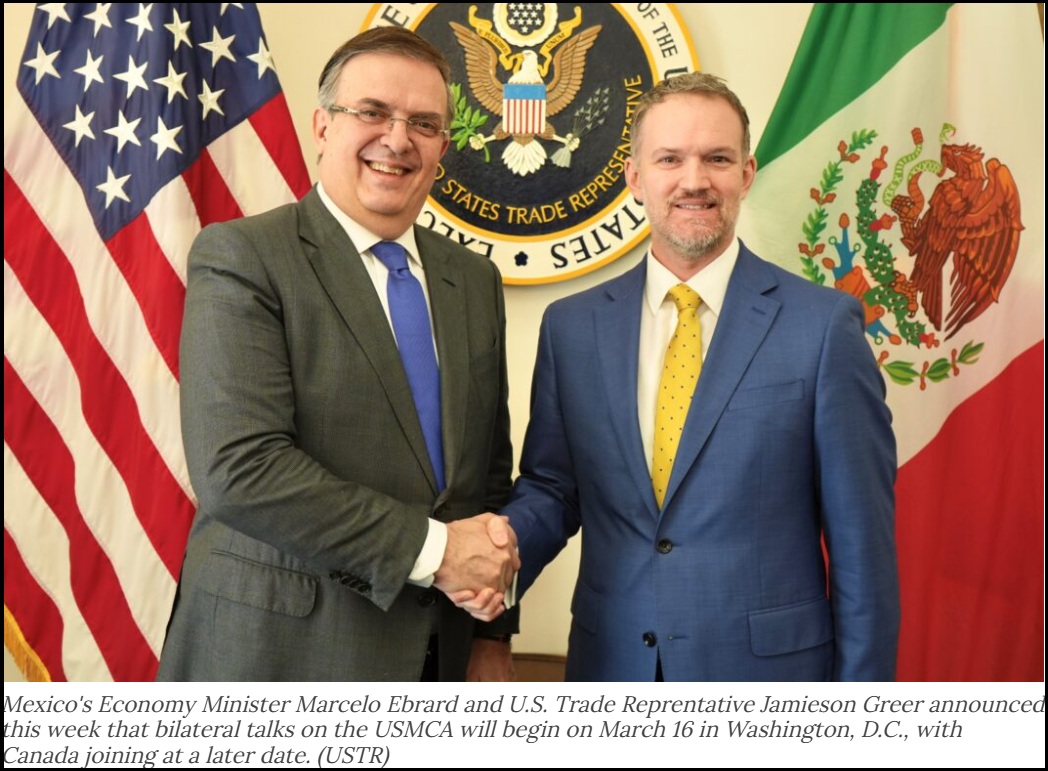
The state visit by Chinese Chairman Xi Jinping in combination with USTR Jamieson Greer’s responsibilities within the U.S-China trade program, meant that Greer had to defer a visit to Mexico to work on the USMCA replacement. However, bilateral trade agreement discussions at a technical level remained on track and progressing during Xi’s visit.
 The U.S. and Mexico delegations have now expanded the bilateral topics from 54 sections to 90 sections. This indicates significant agreement on the major components of the framework and now the smaller overlapping topics that enmesh with the bigger topics are brought in.
Greer shifted focus toward the Chinese trade aspects due to the timing of the Xi-Trump summit. USTR Jamieson Greer is expected to be returning to the Mexico trade talks in about a week.
For the interests of the Mexican side, the main focus is seeking favorable reductions in the section 232 tariffs on steel, aluminum and automobiles. However, the digital platform section and intellectual property is also a priority being negotiated by team USA.
MEXICO CITY, Sept 23 (Reuters) – The fourth round of trade talks between Mexico and the United States will not take place next week and could instead be held in October, a senior Mexican official said on Wednesday, as the two countries juggle a shifting diplomatic calendar.
Luis Rosendo Gutierrez, Mexico’s deputy economy minister for foreign trade, said the delay was due to scheduling conflicts, including Chinese President Xi Jinping’s visit to the United States and the upcoming G20 summit. Despite the pause in formal rounds, Gutierrez said technical coordination with the US Trade Representative’s Office (USTR) remains a “daily” occurrence.
The negotiations are seeking an interim bilateral bargain under which Mexico could win relief from some US tariffs while addressing US demands on areas including automotive content and Chinese investment.
“Our priority is reducing Section 232 tariffs on steel, aluminum and automobiles,” Gutierrez told reporters following the bi-national convention of business group the American Society of Mexico in Mexico City.
The negotiation agenda has expanded from 54 issues to nearly 90, which Gutierrez described as the natural evolution of complex topics such as digital platform regulation. (read more)
As USTR Greer noted in interviews Thursday and Friday, the U.S. is very comfortable with our current position toward Canada, even without any further trade discussion. We have expanded reciprocity tariffs against Canadian sectors, and we maintain baseline tariffs against core component manufactured goods, steel, aluminum and autos.
In January 2027 those baselines will be enjoined with 50% reciprocity tariffs on Canadian autos, thereby expanding the overall tariff policy. [U.S. will impose a 50% tariff on all Canadian automotive and steel imports, effective Jan. 1, 2027, after trade talks between the two nations collapsed. (source)]
There is no urgency to change anything toward Canada, and Greer is now focused on finishing a direct bilateral trade agreement with Mexico. Once that agreement with Mexico is confirmed, then the termination of the trilateral USMCA can be executed with virtually no disruption between the U.S and Mexico. All the friction points, pain and economic conflict will be unilateral on the Canadian side.