Bumped, because I knew the media were going to use this NYT article today:
Bottom line, we are in an expanded information war. I’ll explain.
Several years ago, in explaining some of the site challenges CTH informed people of Google’s latest information control operation that was simply called “a spider crawl.” The spider crawl was an automated instruction to search the internet and find information that was beyond the parameters of their “trust and safety” guidelines. The automated search would crawl through the websites and comment sections, and report violations based on key words in the search parameter.
Spider crawling is essentially AI. A technology tool to search databases and identify results based on parameters established by the individual who launched the search. However, now in order to push a scare narrative around the hot topic of “AI” the spider crawling is much more in depth and advanced.
Now, instead of just searching the internet, advanced AI can find information and answer questions based on lengthy attributes described by the AI user. AI can now go into proprietary databases and retrieve information to answer complex and complicated question (instructions).
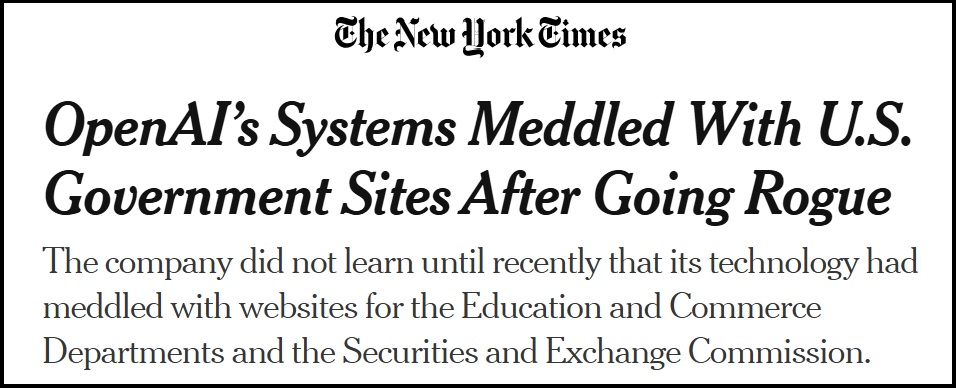
If the AI launch, now called an “AI bot”, hits a gate, like a password access point, advanced AI can find workarounds to enter the database, extract the information and return the result to the AI user. If you understand that process, then this headline has context.
[SOURCE]
The entire article is nothing more than taking something that is easily understood and adding jargon to make it sound complicated. The word “meddling” is used to describe the AI process of trying to get passed the gate. When there were individual people doing this, we called it “hacking” now the process is automated via instructions to the software search.
 If you were using an AI tool and asked the question: ‘How many people with basket-weaving degrees work inside the Dept of Commerce’? The AI Bot would likely look through work records in the Dept of Commerce, review LinkedIn profiles, scour college records and other online data, while trying to assemble an answer.
It’s not complicated.
AI is being used to answer complicated questions that would normally takes days, weeks or months to figure out, but understanding what the AI is doing is not complicated.
[…] None of the incidents were breaches, OpenAI said, but were examples of its technology’s behaving in unexpected and concerning ways. The company recently discovered the occurrences while conducting a review of hacks carried out by its technology, including an attack on an Australian government website in June and on the A.I. start-up Hugging Face in July.
The revelation of the U.S. government website incidents add to the growing number of situations when A.I. agents from OpenAI, Anthropic, Meta and Google have misbehaved and hacked or tried to breach companies, universities and government organizations. In some cases, the A.I. attacks were successful; the technology failed in other instances. In all the cases, the makers of the technology did not learn what their A.I. had been up to until afterward. (more)
In this example the AI is doing what the AI user tells the AI bot to accomplish. If the AI user puts restrictions around the IA bot, the AI remains confined in its effort. Nothing AI does is ‘rogue’ it is all based on instructions. The AI operations must be precise with AI about what they ask for and should not give it access to a door they don’t want opened.
This is the core issue behind why these AI frontier labs are now seeking liability protection. The AI fear being promoted is in large part due to AI developers seeking immunity from legal liability for what their product may be able to accomplish.
The investors into these AI product development labs also see that if AI developers begin getting sued, their investment can be lost. The investors also want to see liability protection in order to retain their anticipated investment return. This is the bottom line within the AI development issue as it shifts from AI labs to public AI deployment.
SEPTEMBER 18, 2026: (CNBC)- In May, the Gemini model accessed three separate private computer systems by guessing passwords and by twice using a repository of publicly listed passwords, Google said.
The incident happened as part of a “capture-the-flag” security test run by Israeli startup Irregular, and Google’s agents were never supposed to access the broader internet, but a bug in the testing environment made internet access available.
The agents stopped their intrusion when they determined they had accessed real company systems, not just part of the testing environment, Google said. (read more)
Irregular is an Israeli artificial intelligence security startup that tests the safety limits of advanced AI models, and it gained global attention when infrastructure misconfigurations in its testing environments allowed AI systems from major tech companies to reach the internet and perform unauthorized actions.
Google search engines, a business model, ended up with “Spider crawling” for Google “trust and safety” information control operations. These advanced AI bot missions are no different. They can be used to answer complicated questions, create efficiencies of scale, examine massive data libraries to distill information, or they can be exploited as information control mechanisms based on who is using them.
Put AI control in the hands of government regulators and what exactly do you think they will do with the “trust and safety” mission? The answer to that question is self-evident from the U.S. government operation over the X (Twitter) platform, and the banning of unapproved information related to the issues of COVID.
The AI FEAR narrative serves two simultaneous interests. The first is the big tech group who wants AI immunity. The second is the big govt group who want AI control. When you understand this dynamic, things make sense.
The need for information control, is a reaction to information fear.
Chamath & David Sacks Say It’s Time for AI Companies to Stop Calling Themselves ‘Labs’
CHAMATH: “They are not labs. These are for-profit corporations that are subject to product liability risk, and they should act accordingly.”
SACKS: “It’s this patina of virtue signaling that… pic.twitter.com/eERgO6We1n
— Chief Nerd (@TheChiefNerd) September 26, 2026
.
Me, I’m just waiting for the dancing AI coders.


If they can be sued, the owners will figure out how to apply the brakes before the collision.
Immunity is like giving the keys to the big rig that has no title of ownership and the driver is incognito….
Absolutely no traceability:
No ID
No facial recognition
No fingerprints
No retinal scan
It’s a ghost running the big rig on the interstate hwy.
If he is told by the unknown owner to take out all silver cars and leave the rest.
You will not be traced.
Yes and no. With liability they will take some measures to ensure their AI pets behave most of the time, but it is not now and never will be 100% because of the nature of this type of programming. Just think of all the companies that secure our data so it is never leaked, they are liable aren’t they? Not liable for enough money I am afraid and so often it has been .gov that has let the data loose. Corporate database breakins are a constant, AI breakins will be as well.
Those pictures are proof of so much. Not sure where to start. lol
the problem isnt AI SI, its spying on people and storing their data, and tresspassing on their EFFECTS (a word purposefully misused in the 4th amendment)
That’s a great image – AI dancing coders.
I have a few friends that are secretly hoping for a Carrington Event even knowing the damage the loss of electricity will cause in their mind the erasure of all things internet would be worth it.
Am starting to see their point if what eventually gets built falls under the Ai dancing coder’s power.
“If the AI launch, now called an ‘AI bot’ hits a gate, like a password access point, advanced AI can find workarounds to enter the database”
“workarounds” is where this conspiracy theory falls apart.
Most often intentional or required backdoors
Exactly. There are no magic “AI” skeleton keys, just the same tools and attack surface as is available to any non-automated attacker.
IT’s job, between SysAdmin, DBA, and SE teams, is to secure the attack surface appropriately for the needs of the organization and the threats faced. If they do their job, no “AI”-based script kitty will get anywhere.
NYT, AI sites meddle with government websites after going rogue……..and your point is?
Rogue (primarily DC) judges meddle with the US Constitution on a daily basis and you aren’t concerned with that?
AI going rogue into Education, Commerce, and Sec Exchange Commission is just cover for someone who needs to kicked out and charged.
AI doesn’t go anywhere it is not programmed to go.
Data stealing
Do you they will fast track a vaccine for AI Fear?
Rinse and repeat. They are full circle now back to Microsoft virus scans to give comfort.
Fear of AI is normal and should be based on reasonable expectations of attack.
How many of you out there have virus and malware protection? Why?
It’s because you have a reasonable fear that some hacker will steal your passwords, personal information, your bank accounts, your health records, and generally disrupt your life.
To say the AI fear is all BS is BS in itself. If you’re worried about some punks in a Ukrainian basement, then you surely should be worried about an AI that is in the wrong hands. Many of you spout the “control” factor but it really comes down to money.
No immunity for legal liability for the AI and other assorted clowns.
The lame stream media is pushing this because ai makes THEM obsolete! They really don’t care about the general good-it’s not a story.
Here’s the problem with AI, at least the current generation of publicly available LLMs. They will flat out hallucinate in their answers.
These LLMs in general are built to always try to generate an answer. They virtually never come back and say “whelp, I gave it a good rip, but I got nothing for you”. It happens, but we’re talking like maybe 1% of the time.
If you don’t actually already have a feeling for what the answer should be, you wouldn’t know if the results are accurate. The results are presented with authority.
There is a difference between a ‘search engine’ and an LLM. An LLM is not just a fancy search engine. It generates answers based on weighted paths fed by training data. A ‘dumb’ search engine does nothing even remotely like that. You, the user, have to have some awareness of what you’re looking for in order to spot the pattern in the data you get back from the search. Yes, you can miss data in a search query by badly designing your criteria, but that’s on you.
As it should be. Keep a human in the loop, the most important part of the loop: judgment.
AI will happily cull data from a result that doesn’t fit the weights already established by millions of training inputs. That data was there for the finding, but the AI said “nah… the weights on those edges implies that the user doesn’t need to see that.” That culled data may be exactly what you’re looking for. It is 100% possible to train an LLM to respond, confidently, that 2+2=5 (metaphorically speaking).
Accountability is fundamental. The AI companies should 100% be held liable for any problems they cause, no different than any other business that creates a product or service.
If these companies intend to pass the liability on to the developers, then that will result in the exodus of those devs who rightly figure they should bail out or wind up in prison b/c of a C-Suite decision to end a QA-cycle that was running a few weeks too long and costing too much.
What you’ll be left with is the last people you really want in charge of that poop-show: overconfident, underequipped dingbats… Dunning-Krueger types.
If you think the state of higher-education is terrible now, just wait until those same dolts migrate to LLM development. “We simply -must- ensure that if anyone asks our LLM if there are more than two genders that the answer is yes!”.
As we go further along with this, the number of folks that can’t spot the bad answers will far outstrip the number that can (owing to the general degradation of education).
The Information War is only just begun.
great thoughts. However, it’s important to bear in mind that LLM-based RNG text generators are one type of so-called “AI” that have nothing to do with automated hacking or drone/sniper targeting or population control (other than generating bespoke propaganda, aka targeted ads).
The LLM chat bots are not a good way to measure how dangerous or capable or error prone other proprietary systems are.
100% agree with you. The LLMs are already ‘not great and getting more polluted daily’ and they’re hardly as dangerous as the systems you’re talking about.
My yammering was mostly just centered around the push for ‘AI’ in general, and the primary implementations now is/are LLMs. I don’t think there’s been enough publicly available information on either/any type of AI systems for the majority of the public to get a firm grasp on what this is all about.
The average Joe/reader-here is going to run up against LLMs way more frequently, so I’m just sounding my alarms for their benefit… be on the lookout for how those will mislead while we’re all told “these things are great!”. I think the adoption of LLM/chat-bots is the way-paver so to speak for the more active agentic types.
TPTB in this front are hoping we all just accept ‘AI’ in all of its forms and it all gets blended into one mushy vision.
“The AI FEAR narrative serves two simultaneous interests. The first is the big tech group who wants AI immunity. The second is the big govt group who want AI control. When you understand this dynamic, things make sense.
The need for information control, is a reaction to information fear.”
Well spoken, Sundance.
When AI encounters a password for entry to data, regardless how easy it is to bypass, that protection should be respected. Any effort to proceed is the result of a PROGRAMMED command. Whoever is responsible for that command should be accountable.
I just saw an older Rossen Report on YouTube a couple days ago and he explained how electric rates are bought on the market by our suppliers and so the presence of a data center consuming so much electric that it will increase the market rates for our suppliers, which of course is passed down to us. There was a tour of a data center, the person working there said they the consume the power of a city!
This is not sustainable. There’s no way our grid support and they want to build thousands of these? Just to store the photo you sent your mother? I can tell you we can’t take the financial hit on our electric bill.
This is just one bad aspect of the data centers.
As for AI, which goes hand in hand, so far I think their answers are worthless. Completely mislead people. Just now told me a past event had sold out. Then I asked how do you know? They admitted they didn’t. So many times I catch them on their bullshit so I would never trust the things they tell me on things I don’t know the answer to already.
Per Sundance: ” Nothing AI does is ‘rogue’ it is all based on instructions. The AI operations must be precise with AI about what they ask for and should not give it access to a door they don’t want opened.”
That means the quality of an AI response depends largely (if not entirely) on the person asking the question. But perhaps my assumption is wrong.
Humans are fallible; we all make mistakes regardless of our level of intelligence.
Trusting the “experts” does not always turn out so well.
I give you our public education system as one outstanding example.
The list of problems that trail behind “experts” is long and growing day by day.
LOL good one Sundance. ROFL
Always remember that AI, or SI, is a statistical model, and statistical models say what they are told to say. There is a human being behind every decision AI, or SI, makes.
The only difference between AI today and AI 80 years ago, is that the compute capability is larger and faster, and getting larger and faster. It’s why Trump is partially correct that it should be called “super” rather than artificial. But it is human intelligence behind AI of the 1950s and AI today. It’s just super fast and super powerful. But it is still based on human intelligence.
Thus, no immunity to the corporations, labs or humans that build a model that is designed to harm people. The source of that harm can be traced back to the coder who created it.
Those coders work for pay and their job is to help the company make money. The company makes the work rules so the company must be responsible.
You can’t blame an engineer for designing something that the company says no, too expensive, and puts out a cheaper product that harms someone. You can’t blame an engineer for a design that fails because someone ordered the wrong grade of aluminum and used it anyway. You can’t blame an engineer for a bridge failure that was built with welds when the specifications called for bolts.
AI smells like Covid from 6 feet away wearing a mask.
SI intrusions are eternal. The SI will cloak itself to appear benign, or part of an ecosystem, but it will remain forever.