Take heart, we only need to wait approximately 60-days until we see a major price decline in diesel and gasoline prices in the USA. Once the midterm election is over, prices will begin their retreat with the finished collapse mid-January.
The non-pretending reality exists within a generally non-western perspective that current “market prices” are not driven by oil supplies, refining capacity or the other various justifications used by the speculators, traders and various regional spot-market control systems. The prices are being controlled in order to influence political outcomes.
Once those political influence operations are concluded, the stakeholders in the market price approach will moderate their justifications accordingly, and prices will plummet. Sound nuts? Well, let me explain who agrees.
On my side of the argument is Russian Federation President Vladimir Putin, who does happen to operate the world’s largest gasoline station – at least, according to the professional republicans. Others on my side include Chinese Chairman Xi Jinping, Saudi Crown Prince Mohammed Bin Salmon, Qatari Sheikh Tamim bin Hamad Al Thani, Turkish President Recep Erdogan and Venezuelan interim President Delcy Eloína Rodríguez Gómez.
Others who accept the reality of this position, albeit with various political limits to their ability to speak openly about such matters, include President Donald J Trump, Treasury Secretary Scott Bessent and Secretary of State Marco Rubio. Unfortunately for this aligned group they are stuck inside the largest western political system who controls global finance and world economic outcomes.
What all of these aforementioned names understand is that “market prices” are entirely detached from the archaic terminology behind supply and demand; a quaint concept that stopped applying years ago – but pretenses must be maintained or else the masses may find their pitchforks, see: DSA pitchfork suppliers.
A second subset of allies who unintentionally support this perspective, includes those who use the terms “sold at a discount” where “sold at a discount” in reality means sold outside the western market pricing approach.
 How many times have you seen the term “sold at a discount” repeated when you are reading about former Venezuela oil being sold to China, or current Russian oil being sold to India?
It’s such a common term it is accepted without anyone ever asking, ‘what is this discount you speak of, and how is it applied’? No-one seems to ask that part.
We accept this terminology created by “western market pricing” advocates just as we accepted the term “service driven economy” in the era before Donald Trump.
The reality is that ‘western market prices’ are not an outcome of supply, demand or even availability or production capacity. Western market prices are determined by speculators, traders and regional benchmarks created by “independent agencies.”
Remember those pesky housing loan bond rating agencies, Standard and Poor’s and/or Moody’s during the lead-in to the 2008 financial crisis. That type of rating ‘independence’ is akin to the benchmarks of these regional independent agencies within the energy markets; which is to say, they are not independent at all – they are part of the manipulated western financial system that determines ‘market pricing’.
Behind that curtain are the traders, speculators, ideological banks and financial systems who create the finance system for the energy market. Want to stop oil exploitation, change the lending requirements to favor windmills and solar panels etc. Not coincidentally changing these lending rules and regulations was Mark Carney’s former job. Does that sound like an open market approach?
Thus, when you really understand how this pricing is structured you begin to realize the price of diesel has nothing to do with the supply of it and the price is more controlled by those who wish to generate financial -or political- outcomes from it.
You don’t have to take my word for it, review the words of the world’s largest oil/gas producer about this rigged game. {SEE HERE} Wouldn’t Vladimir Putin be the subject matter expert?
“How, in fact, is the price of gas formed on the European exchanges? It is not determined by producers, but by exchange traders.”
In essence, right now “the west”, specifically Americans, are paying fuel costs based on market commodity prices. The most recent examples are oil, LNG and now the headline leading, diesel fuel. However, the actual supply of diesel fuel is not driving the price. The price is being driven by speculation and trading, which is based on arbitrary price formulas created by western multinational corporations and financial markets.
Right now, Russia is overproducing diesel fuel, and shipping it out of the country to allies. Yet diesel prices in the west are determined by commodity traders, and the pricing mechanism is disconnected from the supply. {SEE HERE}
This is why Secretary Bessent essentially said yesterday, he was “evaluating” calls for a U.S. export ban on diesel. Bessent knows it makes no sense to halt U.S. exports of diesel fuel, because (a) the US has no ability to store it, and (b) if we produce more than we can store, that doesn’t lower the USA price.
Our US diesel supply doesn’t lower the US diesel price because the price is set by market traders, by the western financial markets, not by production or supply. There is a disconnect. It’s the same reason why Oranges grown in Florida cost the same as Oranges shipped into Minnesota. Local supply does not determine local price; the rigged commodity market does.
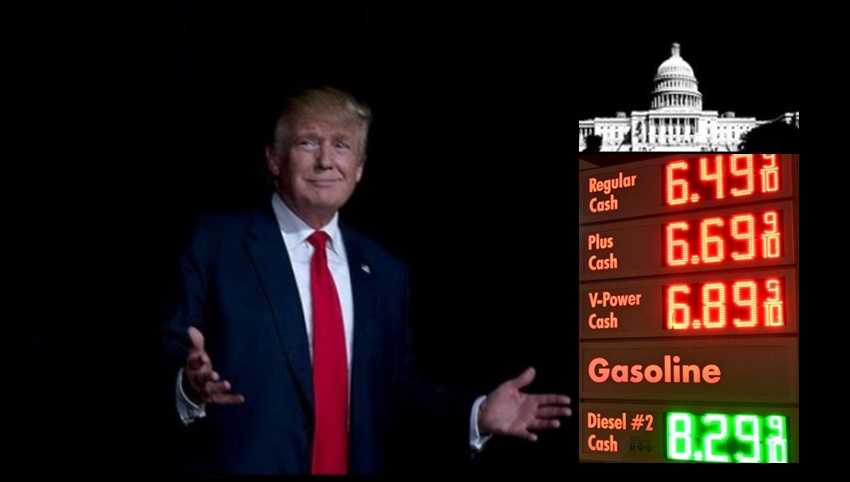
The USA could be swimming in diesel fuel and yet the price at the pump remains $6/gal.
Ironically, or not, Sylvain Charlebois, a Canadian describing the potash issue, exposed the western price manipulation in this article {SEE HERE} when ultimately, he asks, ‘how can Belarus sell potash so cheap’, and ‘Belarus could put pressure on Canadian potash prices’.
If Potash pricing is determined by western market commodity prices, then how can America get a cheaper fertilizer product for their farmers by buying from Belarus? The answer is in the part of the conversation they don’t want us to have.
Belarus can ship the product far cheaper to the USA because Belarus doesn’t need to participate in the “western commodity” pricing structure. Belarus can increase production and sell at a price they determine, exactly like Russia.
Apply this level of potash thinking to oil, gas or diesel fuel, and you realize what BRICS have been arguing about western price manipulation. Suddenly the price is not attached to supply, demand or production capacity, but is really connected to an elite rigged game of market price controls.
The price of USA gasoline and diesel will drop as soon as the event behind the price control is concluded.
That event is the USA midterm election.
So it’s not a free market. It’s highly manipulated and we are at their mercy. So hip hip hurrah prices will come down at their will in 60 days. So we can expect our grocery and other goods prices to follow. Thank you so much!
I’m not normally one to go against SD’s views on things, but as a significant % of my portfolio is oil and gas, all streams, I see things differently. Worldwide demand for oil and specifically diesel has been artificially manipulated by China’s recent oil purchases restarting, and Brazil’s export tax on diesel, respectively. I will also concede the fake news about Russian production destruction is a perfect example of a price control SD is referring to.
We get Canadian sour crude(WCS) at a discount to WTI market prices due to higher transportation costs, sulpher content, and a more expensive refining process. The recent VZ deal, gives us that oil “at cost”, which you could also call a discount.
$100 oil is not driving today’s pump prices. Avg $65 crack spreads are. A crack of 3-2-1 means 3 barrels get refined into 2 of gasoline and 1 of fuels like diesel and jet fuel. The long term average for USA crack spreads in $25. And remember those are averages – it was $19-20 in December. Some refine with a crack of 2-1-1, like CVR energy. Their crack spreads should be significantly higher.
The EU and USA get oil at or below market rates (plus transportation costs). But not everyone does. Was is SD who wrote the article about SRI Lanka paying nearly $300/barrel? I digress.
The diesel prices you speak of are futures prices. Small companies hedge nearly all their supply in the futures markets to avoid large and fast price drops. They need those traders and exchanges or they’d never last more than one cycle.
My prediction is that on the Russia angle, SD is correct. Prices are inflated because of lies. But they’re also inflated due to shrinking refinery capacity in California and the ME (war); increased demand (China); and export controls (Brazil); and Russian sanctions.
Before the election, Q3 results will have been announced. EU/UK/Canada will be in full recession = demand destruction. Export controls may disappear. Iran and Ukraine wars may end. There are too many other variables to claim that the boogy man manipulating markets is the main cause of USA diesel price appreciation.
Except in California.