President Trump discusses the last two weeks with Fox News Maria Bartiromo. The interview is broken down into a few segments below. WATCH:
.
In the second segment below, President Trump discusses the Big Beautiful Bill.
President Trump discusses the last two weeks with Fox News Maria Bartiromo. The interview is broken down into a few segments below. WATCH:
.
In the second segment below, President Trump discusses the Big Beautiful Bill.
Russian President Vladimir Putin answered questions from the media earlier. One of the questions was about President Trump against the backdrop of peace efforts, the middle-east conflict and Ukraine.
President Putin’s response is very interesting. I am placing here as a datapoint for my own analysis without reading too much into it at the moment. All of the points are converging in one direction. WATCH:
BREAKING: Putin says he deeply respects Trump, whom he describes as a courageous person who’s trying to do the right thing by bringing about world peace.
“I believe he truly wants peace in Ukraine and the Middle East, though it may be harder than he expected.” pic.twitter.com/utXlbaiPNf
— Ian Miles Cheong (@stillgray) June 27, 2025
.
Congratulations Treepers. If you have followed the discussions [SEE HERE] you can see how we are on the cusp of a big geopolitical change. GET THE BBB PASSED and things begin to unfold. All of the datapoints go in one direction.
U.S. Ambassador to Russia, Lynne Tracy, who was appointed by Joe Biden, has departed her position in Moscow as U.S. Ambassador to Russia. There has been no announced name for replacement. [¹Get the friggin’ BBB passed!]
Remember, in the last 20+ years, no American official has spent more face-to-face time with Vladimir Putin than U.S. Special Envoy, Steve Witkoff. On behalf of President Trump Witkoff has held multiple meetings and discussions with Russian President Vladimir Putin lasting more than 4 and 5 hours at a time. U.S. Ambassador Lynne Tracy was not present.
Do not forget, nor overlook this baseline fact.
MOSCOW, June 27 (Reuters) – Lynne Tracy, the U.S. ambassador to Russia, is leaving Moscow, her embassy said on Friday, noting she had served through one of the most strained periods in relations between Moscow and Washington.
The departure of a career diplomat appointed under the administration of former president Joe Biden comes as Russia and the United States discuss a potential reset in their ties which sharply deteriorated after Moscow launched its full-scale war in Ukraine in 2022.
Presidential envoy Steve Witkoff deserves a great deal of credit for what followed in the aftermath of President Trump’s final elimination of the Iranian nuclear threat. Throughout the 12-day war, Witkoff maintained a diplomatic connection to the Iranian delegation in order to position a ceasefire upon conclusion.
The Trump administration is now taking a more firm stance toward who in Iran they will accept negotiations with. As noted by Secretary Rubio, the use of intermediaries has exhausted its usefulness. While Qatar may play a role as an interlocutor to bridge the two sides, the time has come for direct face-to-face discussions with Iranian officials.
With the potential of a peace agreement and increased stability throughout the region, there is an opportunity for an expanded investment and economic zone throughout the middle east, not just in Iran. As CTH noted regarding the threat to close the Strait of Hormuz, technically it is not the Iranian government who closes the strait, but rather the maritime insurance companies who refuse to underwrite an enlarged risk. The same concept applies when the absence of conflict becomes the norm. Steve Witkoff draws attention to this background context within his remarks.
An ancillary benefit in the Russia-Ukraine conflict comes from a very public display of FAFO outcomes. None of the principle characters within NATO, the EU, the U.K nor Ukraine or Russia want to face the Godzilla FAFO strategy that President Trump is willing to deploy.
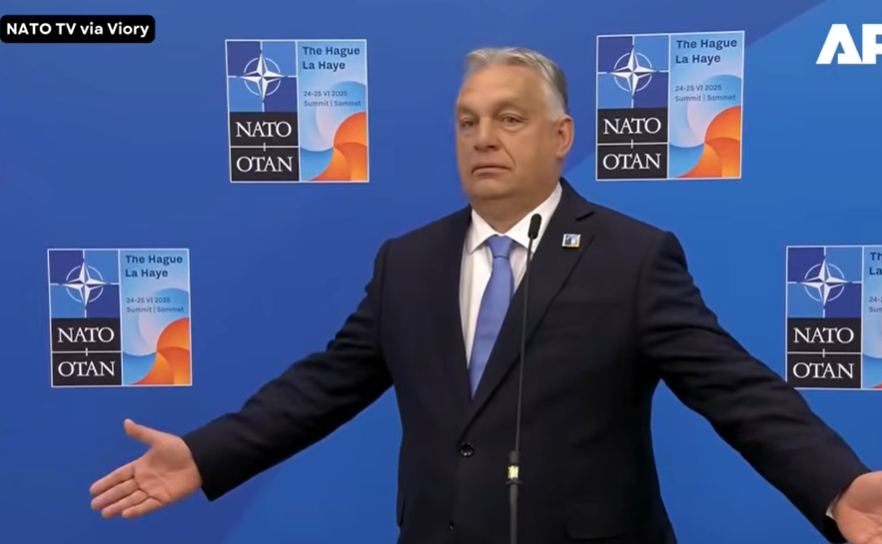
The reason why the NATO partners responded with great deference to President Trump in the Netherlands is no global observer wants to face Godzilla in FAFO mode, militarily or economically. Even before the dust settled from 70 tons of massive ordnance detonation deep underground in Iran the leaders of the world knew things would be different now.
How different? We saw the outcome at the Hague.
Canadian Prime Minister Mark Carney welcomes President Donald Trump at the beginning of the working sessions for the G7 assembly in Canada.
During the press availability President Trump notes the G7 used to be the G8, however following the Crimea referendum and President Putin’s response to accept the outcome of the vote, the NATO alliance led by President Barack Obama took Russia out of the group. President Trump says he “agreed” with Putin’s reaction to the decision.
The G7 speak about Russia consistently at almost every meeting, without a willingness to listen to the voice or opinion of Russia in context to their protestations. Quite simply it is easier for Italy, Canada, the U.K, France, Germany, Japan and the USA to exist inside an echo-chamber without having their multilateral arguments challenged. President Trump does not fear the debate of ideas with Russia present in the room, another point of distinction between Trump and the assembly.
Wrong is wrong even if everybody does it; and right is right even if nobody does it. It takes strong confidence to assert a position counter to popular opinion, this is what makes President Donald Trump a transformative political influence.
In the background, President Vladimir Putin is undoubtedly paying attention.
Also, read carefully what President of the European Council António Costa said today:
According to most information flowing from the region, a second wave attack from Israel us underway (or just completed). The first wave targeting was the Iranian military leadership and nuclear scientists, the second wave hitting the nuclear installations.
We could tell from the initial targeting, the IDF were not targeting hardened installations, they were targeting people who run them where they live in the middle of the night. This appears to be confirmed by ground reporting of residences being the target with highly strategic Mossad agents on the ground doing major intelligence activity to identify the targets. It appears Israel was very successful (but still really early).
That approach also establishes the baseline for internal Iranian political opposition to push for regime change.
The second wave of Israeli targeting then goes directly at the nuclear installations. This approach also makes sense. First round takes out the brain power, second round takes out their hardened facilities (much more difficult to eliminate).
As the operation proceeds, we now turn focus to the U.S. interests, and this is where we use hindsight to last Sunday’s Camp David meeting.
Secretary of State / National Security Advisor Marco Rubio emphasizes Israel is acting “unilaterally,” without USA support. President Trump proactively and strategically emphasizes his preferred approach of “diplomacy.”
Some will doubt, but I would draw your attention to Trump’s relay of the call with Vladimir Putin last week. Obviously, President Trump understood Israel was on the cusp of taking some ‘unilateral’ action, albeit with a likelihood of a heads-up to USA of approximate timing (Sunday Camp David as a proactive ‘get us prepped’ agenda).
Jeffrey David Sachs is an American economist and public policy analyst who is a professor at Columbia University. Mr Sachs has been against the Ukraine-Russia conflict from the outset and provides a voice to those who are tired of the constant global conflict.
0:00 Introduction
0:47 Why Is Ukraine So Central to the Deep State’s Plan?
4:51 The West’s Obsession With Weakening Russia
9:11 The Origins of the West’s Hatred of Russia
23:49 How the Deep State Used Bill Clinton to Usher in NATO Expansion
31:37 What’s Stopping Trump From Making Peace Between Ukraine and Russia?
At sporadic times of inconsequential normalcy, on the streets of Russia you will see two distinct types of people asked for identification, Asians and middle eastern males. When asked why, the average, ordinary grey-person in Russia going about their business, ambivalently has no idea.
To the southeast they are bordered by China, Mongolia and Asia, they even have a small border with North Korea. To the southwest they have the “stans,” most notably Kazakhstan; this region is the source of most domestic terrorists who attack inside Russia. To the West they have Ukraine and the EU nations.
From the standpoint of Russia, they have Asians on their East, Arabs on their South and EU supported Nazis on their Western flank. Keep in mind, despite the breakup of the Soviet Union the muscle memory from World War II is still very much a part of their social compact.
Consider Arlington Cemetary for scale. If you were to build a cemetery just from the battle of Leningrad (now St Petersburg) it would be bigger than Washington DC. If you were to build an Arlington type cemetery for all the Russians killed in World War II, the 27 million gravesites would envelop a landmass bigger than Washington DC and the state of Virginia combined. These realities underpin Russian perspectives.
CTH shared previously that Russia is drawn into an alignment with China not by desire, but rather by necessity. Most ordinary Russians do not like China, and they would prefer not to purchase Chinese industrial or manufactured goods. Russian President Vladimir Putin is well aware of this, and I believe U.S. President Donald Trump is aware also.
The implication of the remark, as President Trump says, “a better security” venue, is that something of much greater significance than traditional White House operations is in need of attention. To such a degree, that prior strategic discussion arrangements are not considered “secure enough.”
President Trump does not like Camp David.
Before taking office, President Trump once told a German journalist in an interview, “Camp David is very rustic, it’s nice, you’d like it. You know how long you’d like it? For about 30 minutes.”
So, the big picture questions become:
I suspect this is about Iran.
This is super interesting on multiple levels. Several key issues are rapidly approaching an inflection point at the same time. Urgency scale 1-10: Trade deals (5), BBB (9), Russia-Ukraine conflict (9) and now domestic ICE operations which will require intervention against California (9).
In addition, thanks to work by National Security Advisor Marco Rubio and Director of National Intelligence Tulsi Gabbard, the corrupt Intelligence Community network has taken several hits below the waterline.
From a White House official to traveling press: “On Sunday, the President will depart Bedminster and spend the night at Camp David before returning to the White House on Monday. The White House has organized what will become a regular off campus retreat of principals attended by the President and Vice President. They will meet on a number of issues and topics.” (source)
It’s a smart move.
Remember, it’s Team MAGA facing down DC.
Quiet time, in a casual format, for tight, secure team-building focus on specific high priority issues as they increase in urgency.