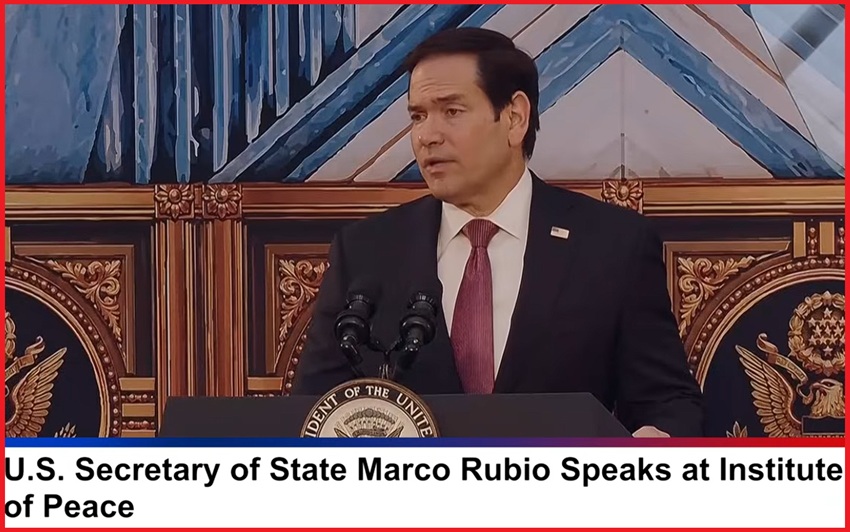
As the inaugural meeting of the Global Board of Peace gets underway, Vice President JD Vance, Secretary of State Marco Rubio and Special Envoy Steve Witkoff delivered speeches at the beginning of the Board of Peace session in Washington DC. WATCH:
.
As the inaugural meeting of the Global Board of Peace gets underway, Vice President JD Vance, Secretary of State Marco Rubio and Special Envoy Steve Witkoff delivered speeches at the beginning of the Board of Peace session in Washington DC. WATCH:
.
President Trump invited global leaders to Washington DC to participate in the inaugural meeting of the Board of Peace. U.S President Donald Trump, U.S. Vice President JD Vance, U.S. Secretary of State Marco Rubio, Special Envoy Steve Witkoff and Jared Kushner all delivered remarks during the event.
Participating countries include Albania, Argentina, Armenia, Azerbaijan, Belarus, Bulgaria, Cambodia, El Salvador, Hungary, Indonesia, Kazakhstan, Kosovo, Mongolia, Pakistan, Paraguay, Uzbekistan, Vietnam, Israel, Saudi Arabia, Egypt, Qatar, Bahrain, Jordan, Kuwait, Morocco, Turkey and the United Arab Emirates.
The Vatican and Pope Leo rejected an invitation to participate, concerned the Global Board of Peace may overshadow the United Nations, and that would not be acceptable to the Catholic Church or the European Union. Full video of the event below:
.
An interesting thing happened last weekend, President Trump went golfing with Florida Governor Ron DeSantis. {SOURCE} Simultaneously, President Trump released the following statement from his Truth Social account.
(Via Truth Social) – “The Board of Peace has unlimited potential. Last October, I released a Plan for the permanent end to the Conflict in Gaza, and our Vision was unanimously adopted by the United Nations Security Council. Shortly thereafter, we facilitated Humanitarian Aid at record speed and secured the release of every living and deceased Hostage.
Just last month, two dozen distinguished Founding Members joined me in Davos, Switzerland, to celebrate its official formation, and present a bold Vision for the Civilians in Gaza, and then, ultimately, far beyond Gaza — WORLD PEACE!
On February 19th, 2026, I will again be joined by Board of Peace Members at the Donald J. Trump Institute of Peace in Washington, D.C., where we will announce that Member States have pledged more than $5 BILLION DOLLARS toward the Gaza Humanitarian and Reconstruction efforts and have committed thousands of personnel to the International Stabilization Force and Local Police to maintain Security and Peace for Gazans.
Very importantly, Hamas must uphold its commitment to Full and Immediate Demilitarization. The Board of Peace will prove to be the most consequential International Body in History, and it is my honor to serve as its Chairman.” PRESIDENT DONALD J. TRUMP
I said a few weeks ago that I would not be surprised to see President Trump announce the appointment of Ron DeSantis to be the Chief Executive Officer of the Board of Peace. DeSantis’ executive experience in combination with his relationship with Israel functionally makes him a good fit. Just a guess.
Secretary Marco Rubio went out of his way in this joint presser to emphasize the personal relationship between Hungarian Prime Minister Viktor Orban and U.S. President Donald Trump. Orban is facing a serious election challenge this April and all of the EU/NATO systems are actively trying to create pressure points to remove him.
Secretary Marco Rubio is in Budapest today for meetings with Prime Minister Viktor Orbán and his government to include the signing of a civilian-nuclear cooperation agreement heralded by the Trump administration. Hungary is one of the few voices within the European Union who is pushing back against Brussels efforts to go to war against Russia.
Prime Minister Orban has been very critical of Ukraine, openly stating his opposition to EU membership for the embattled country. In response President Zelenskyy has weaponized Ukraine’s geographical stewardship of oil and gas pipelines to shut down Hungarian energy and drive-up prices. VIDEO:
[Transcript] – MODERATOR: (Via interpreter) Good morning, ladies and gentlemen. May I extend my most cordial welcome to all of you, and may I extend my most special welcome to His Excellency Mr. Marco Rubio, Secretary of State of the United States of America, at the press conference and signing ceremony organized on the occasion of his visit to Hungary. Let me also extend my warm welcome to Mr. Viktor Orban, Prime Minister of Hungary, members of the U.S. and Hungarian delegations, and all our esteemed guests.
At today’s event, the agreement between the Government of the United States of America and the Government of Hungary to facilitate cooperation on the civilian nuclear program in Hungary will be signed. The signatories to the agreement on behalf of the United States of America, Secretary of State Marco Rubio, and on behalf of Hungary, Minister for Foreign Affairs and Trade Mr. Peter Szijjarto.
Secretary of State Marco Rubio took a different path on his European visit than Brussels wanted to see. After his time at the Munich Security Conference, Rubio headed to Slovakia and Hungary for conversations with the two nations who are not at all in alignment with Brussels leadership on the issue of Ukraine.
UPDATE: Better video and Transcript Added
Rubio speaks very bluntly on the topics that are of key concern to Prime Minister Robert Fico, including the topic of energy which is a major problem for both Slovakia and Hungary right now. Toward the end of the presser, the very last response by Fico [44:20 of video] is very interesting.
Prime Minister Fico directly claims that Ukraine is purposefully withholding oil and gas from pipelines that travel from Russia through Ukraine, into Slovakia. Fico notes he is not going to blame either Ukraine or Russia for previously detonations at the oil refinery and transport hub, but he is very sure Ukraine is purposefully withholding energy products from Hungary as blackmail until Hungary changes their position on Ukraine achieving status in the European Union.
You can tell from the way Fico presents the subject and from the prior points of Rubio this hot button issue is why Fico flew to Mar-a-Lago a few weeks ago for a talk with President Trump. WATCH:
MODERATOR: (Via interpreter) Hello, ladies and gentlemen. Please, welcome to our press conference after mutual meeting of the Prime Minister of Slovakia Robert Fico and Secretary of State of the U.S. Marco Rubio. So, Prime Minister, please, you have the word.
PRIME MINISTER FICO: Thank you. (Via interpreter) Dear Secretary of State, dear Marco Rubio, please allow me to welcome you once again – you and your whole delegation – to Bratislava and our office of the Government of the Slovak Republic. Dear ladies, dear gentlemen, we had a shared, short tete-a-tete meeting with the Secretary of State, and then we had delegations’ discussion when we went into details, where we discussed topics that are the point of our today’s meeting. I’ll try to briefly sum up the conclusions of our discussions, be it in Four Eyes or, let’s say, in our meeting of delegations.
First of all, I deeply appreciate the fact that this visit comes quickly after our meeting in Florida, where I had a chance to speak with the President of the United States Donald Trump with Mr. Rubio being present. So, it’s a great follow-up and great country, nation. And after a short while when we met in Florida, we could discuss how much we achieved during those few weeks about topics we discussed.
Marco Rubio appears for an interview with John Micklethwait of Bloomberg News. The interview was pre-scheduled as a follow up to the rather historic speech in Munich at the security conference. Within the interview {video and transcript below} Rubio expands on the baseline of the speech, the ‘why‘ is the U.S-EU alliance important.
Beginning with the end in mind, Rubio reminds the interviewer that an alliance must first accept the purpose of the assembly. There are common values and common social components to the relationship that sit at the core of the decision to be allies.
We have a shared civilization based on shared values, and within that central component the Trump administration is staring at the Europeans and saying they have lost focus on these values. Europe is diminishing itself; it is fracturing its culture and has lost its sovereign identity. The United States wants to stay partnered with Europe, but we are not going to be a partner anchored to a collective mindset that has lost its identity.
This culturally Marxist status, a gathering of nations infected with political correctness, pontificating wokeness and apologetic self-flagellation, is the core problem the Europeans are not willing to face. President Trump and Marco Rubio are essentially telling the EU to shake it off, quit being woke, get proud of your heritage, institute political systems that give benefit to the population and regain pride in themselves and their identity.
The process begins with national security, but that is not just about military spending. Their energy industry needs to support economic independence; they cannot outsource component manufacturing; they need to reestablish economic baselines that are not dependent on Russia, China, India or any other risk vector that could be used to manipulate.
QUESTION: Marco Rubio, Secretary of State, thank you for talking to Bloomberg. You’ve just made this rather remarkable speech where you talked about the destiny of Europe and America always being intertwined. You talked about the alliance which has stretched all the way, culturally, from Michelangelo to the Rolling Stones – a first, I suspect, for a secretary of state – but a culture that has bled and died together. But the very common theme of your speech was the need to share the burden, the need for Europe and America to do things together, which was slightly different from the Vice President last year. Were you kind of offering a carrot where perhaps he was offering a stick?
SECRETARY RUBIO: I think it’s the same message. I think what the Vice President said last year very clearly was that Europe had made a series of decisions internally that were threatening to the alliance and ultimately to themselves, not because we hate Europe or we don’t like Europeans but because – what is it that we fight for, what is it that binds us together? And ultimately, it’s the fact that we are both heirs to the same civilization. And it’s a great civilization and it’s one we should be proud of. It’s one that’s contributed extraordinarily to the world and it’s one, frankly, upon which America is built, from our language to our system of government to our laws to the food we eat to the name of our cities and towns – all of it deeply linked to this Western civilization and culture that we should be proud of, and it’s worth defending.
And ultimately, that’s the point. The point is that people – people don’t fight and die for abstract ideas. They are willing to fight and defend who they are and what matters and is important to them. And that was the foundation he laid last year in his speech – and we add on into this year – to explain to people that when we come off as urgent or even critical about decisions that Europe has failed to make or made, it is because we care. It is because we understand that ultimately, our own fate will be intertwined with what happens with Europe. We want Europe to survive, we want Europe to prosper, because we’re interconnected in so many different ways and because our alliance is so critical. But it has to be an alliance of allies that are capable and willing to fight for who they are and what’s important.
This is a critically worded speech that is very important to listen to with great deliberation. Within his remarks Rubio is telling Europe that we want to remain allied in our interests, but we are no longer going to allow the system of “globalism” to destroy our uniquely American life.
The United States is separating from the madness; this is not up for debate. The only question is whether Europe is too far gone, or whether they will join us.
The euphoria that followed the collapse of the Berlin Wall, “led us to a dangerous delusion. That we had entered quote the end of history. That every nation would now be a liberal democracy; that the ties formed by trade and by commerce alone would now replace nationhood. That the rules-based global order, an overused term, would now replace the national interest, and that we would now live in a world without borders where everyone became a citizen of the world. This was a foolish idea that ignored both human nature and it ignored the lessons of over 5,000 years of recorded human history, and it has cost us dearly.”
[Transcript] SECRETARY RUBIO: “Thank you very much. We gather here today as members of a historic alliance, an alliance that saved and changed the world. When this conference began in 1963, it was in a nation – actually, it was on a continent – that was divided against itself. The line between communism and freedom ran through the heart of Germany. The first barbed fences of the Berlin Wall had gone up just two years prior.
And just months before that first conference, before our predecessors first met here, here in Munich, the Cuban Missile Crisis had brought the world to the brink of nuclear destruction. Even as World War II still burned fresh in the memory of Americans and Europeans alike, we found ourselves staring down the barrel of a new global catastrophe – one with the potential for a new kind of destruction, more apocalyptic and final than anything before in the history of mankind.
At the time of that first gathering, Soviet communism was on the march. Thousands of years of Western civilization hung in the balance. At that time, victory was far from certain. But we were driven by a common purpose. We were unified not just by what we were fighting against; we were unified by what we were fighting for. And together, Europe and America prevailed and a continent was rebuilt. Our people prospered. In time, the East and West blocs were reunited. A civilization was once again made whole. ”
U.S. Secretary of State and National Security Advisor, Marco Rubio, departs from Joint Base Andrews en route to Germany, where he will attend the Munich Security Conference.
Giving brief remarks to the traveling press pool, Secretary Rubio notes, “this conference is at a defining moment.” Further stating, “the world is changing very fast in front of us. The old world is gone, frankly; the world I grew up in, and we live in a new era in geopolitics. And it’s going to require all of us to reexamine what that looks like and what our role is going to be.” WATCH:
Within the notes about the current geopolitical stakes of the world, Rubio alludes to his own reset and way of thinking or approaching U.S. national security issues and policies.
As new alliances form, new national viewpoints and sovereign discussions take shape, multinational globalism has ended, and a new world of strategic national alliances has risen. The era of Bush and John McCain has ended, and with-it Marco Rubio accepts the sovereign state framework of President Trump.
Each day more and more people are starting to realize/notice there are elements of the United States intelligence apparatus that are targeting Director of National Intelligence, Tulsi Gabbard. The need for control is a reaction to fear, and Tulsi Gabbard has the DC Intelligence Community very worried.
What you will read below is something that was written back in 2024 about the potential for the Office of the Director of National Intelligence (ODNI), if President Trump were to win the election. Subsequently, he did win; and while we are not saying this is the exact ODNI script that is being followed, we are certainly not disputing that either.
Read the roadmap below –Written in 2024– compare it to current events and decide for yourself if this is something that rings a bell and may explain the IC apoplexy.
The ODNI was created as an outcome of the 9-11 Commission recommendations. In the era shortly after 9/11, the DC national security apparatus was constructed to preserve continuity of government and simultaneously view all Americans as potential threats.
The Department of Homeland Security (DHS) and the Office of the Director of National Intelligence (ODNI) were created specifically for this purpose.
Washington DC created the modern national security apparatus immediately and hurriedly after 9/11/01. DHS came along in 2002, and within the Intelligence Reform and Terrorism Prevention Act of 2004 the ODNI was formed.
When Barack Obama and Eric Holder arrived a few years later, those newly formed institutions were viewed as opportunities to create a very specific national security apparatus that would focus almost exclusively against their political opposition.
Here is the weird part. The ODNI was formed in 2004, with the intent for the office to be the pivot point of a national security radar. The DNI was intended to provide information to domestic agencies about foreign terror networks that would prevent something like 9-11 from happening again. However, the Office of the Director of National Intelligence has never, not for one day, operated on this intent. This is why they are such a critical position from my perspective.
The office was new, not established yet as a functioning silo, when Barack Obama and Eric Holder arrived in 2009. They quickly dispatched an idiot, James Clapper, into the operation so they could weaponize around the offices’ fulcrum point.
Prior to the DNI office existing, the CIA radar would sweep externally and then report to the Office of the President. The DNI was intended to take external radar sweep (CIA) and make it a full 360° circle, adding a sweep inside the USA that would be handled by the Dept of Homeland Security.
The DHS sweep and the CIA sweep would then be combined into a central collection hub called the ODNI. Everyone with responsibility for “national security” could access the ODNI material. Essentially and presumably, post 9-11 nothing like jihadists practicing to fly airplanes would be missed again; at least that was the intent.
In the past few years people have heard the term “rare earth minerals” or “critical minerals” as they relate to the manufacture of component goods that are vitally important in the lives of everyone. However, the term “rare” is somewhat of a misnomer. The minerals themselves are not rare; indeed, they have been around for hundreds of millions of years in abundant supply. It is the processing of those minerals into stable second stage commodities that has become rare.
As a result of western environmental rules and regulations, U.S, EU and developed nations have outsourced critical mineral processing (the dirty stuff) to China and Asia. We then import the finished commodity after processing. This becomes a problem when you realize the processor can weaponize western dependency, as we have recently seen with China controlling the export of processed minerals needed for manufacturing.
President Trump has made a strategic decision to bring back the manufacturing of critical minerals to the United States and has made a policy decision to create a critical mineral reserve. Just last Monday President Trump announced a $12 billion strategic mineral reserve to combat China’s domination of critical mineral supply chains, a major step toward tackling China’s advantage in a crucial sector of the U.S. economy. The initiative is called “Project Vault.”
“For years, American businesses have risked running out of critical minerals during market disruptions,” President Trump said. “Just as we have long had a strategic petroleum reserve and a stockpile of critical minerals for national defense, we are now creating this reserve for American industry,” Trump said during the Oval Office announcement.
Today in Washington DC, Vice-President JD Vance and Secretary of State Marco Rubio led a critical minerals discussion at the State Dept., where they are organizing an effort to get all nations to invest and create their own critical minerals strategic reserves. WATCH:
.