On one hand you have Canadian Prime Minister seeking to attain “associate member” status in the European Union {SOURCE}. On the other hand, you have U.S. President Trump speaking about a “united Ireland.” {SOURCE} At first blush the stories seem disconnected, until you think about them.
 Canada is a commonwealth country of the United Kingdom (UK) and seeking to achieve ‘associate membership’ status within the European Union is Carney’s way to counter the geopolitical reset currently underway by President Trump. A reset that diminishes the influence of Great Britian’s, ie. London’s. historic economic influences. One way to hit back against the scheme would be to leverage populist sentiment to take down London and Ottawa simultaneously. That approach would support the breakup of the U.K commonwealth governing structure. There’s the connection.
As we review the media reports, keep the U.S-Russia “strategic relationship” approach in mind.
CANADA – Canadian officials are negotiating with the European Union for closer ties with the economic bloc in response to the breakdown of trade negotiations with the United States earlier this summer, the Wall Street Journal reported on Saturday—including potentially becoming an “associate member” of the union.
Although the EU is historically not known for allowing flexible membership arrangements with individual countries, European officials are reportedly open to Canada joining as an “associate member,” anonymous officials from both Canada and the EU told the Journal.
This could mark the largest reorientation of the Canadian economy in decades—the U.S. has long been Canada’s largest trading partner, with about going across the southern border in 2025.
The details of a potential deal are still being discussed, according to the Journal’s reporting, but it could lead to increased trade between the two, including potentially shipping fertilizer through the Arctic and building new natural gas pipelines, which could help Europe end its reliance on Russian natural gas.
A deal could also see the EU and Canada collaborate to lay new underwater cables, launch satellites and build data centers as people on both sides of the Atlantic grow cautious of U.S. tech companies. (read more)
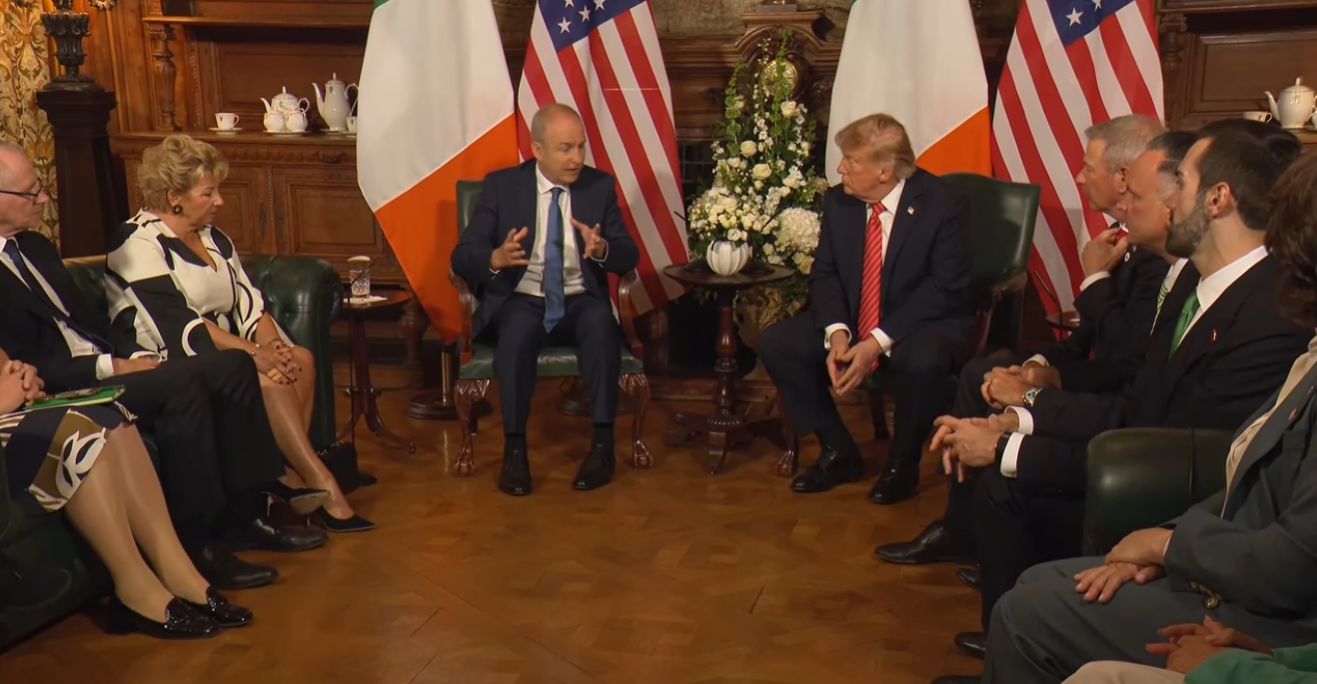 Sitting next to Irish prime minister Micheál Martin on Saturday hours after arriving in Dublin, President Trump was asked about the prospect of the Republic of Ireland joining with Northern Ireland, which is part of the United Kingdom. “I don’t want to cause any problems, but I will tell you, I’d love to see it unified,” he replied. “I think it would be a great feather in everybody’s hat if that happened,” he said.
President Trump’s remarks about a united Ireland don’t come in a vacuum.
There is a meeting happening next week where leaders within Ireland, Scotland and Wales are assembling to discuss a united strategy to exit the United Kingdom, thereby forever removing the entire political construct of the British Commonwealth. Sinn Fein president Mary Lou McDonald is also expected to attend the summit, reported the Telegraph.
FIRST POST – The leaders of Northern Ireland, Scotland, and Wales will meet on Monday to discuss plans for the breakup of the United Kingdom, according to The Telegraph.
First Ministers John Swinney of Scotland, Rhun ap Iowerth of Wales, and Michelle O’Neill of Northern Ireland are expected to sign a joint declaration demanding the right to hold referendums on breaking away from the UK. For the first time, the three constituent nations of the UK are held by pro-separation parties.
The Telegraph reported sources as saying that the summit’s purpose is to pile more pressure on Prime Minister Andy Burnham after he said in the parliament on Wednesday that he would back another Scottish independence referendum if public opinion backed one.
A source close to Swinney told the newspaper that Burnham “fucked up” by making the comment and unionists should be very worried.
In the UK, unionists are those who support the union of Northern Ireland, Scotland, and Wales with England in UK, whereas parties like Sinn Féin (Northern Ireland), Scottish National Party (SNP), and Plaid Cymru (Wales) support the breakup of the UK.
The source further said: “Burnham has not read his brief and doesn’t seem to know the basics of the UK Government’s position on the Union. If I was a Unionist, I would be very worried.” (read more)
There are trillions at stake.
With a U.S-Russia strategic economic alliance, something factually stated at the end of every message from Moscow, the dynamics of global structures is entirely different. However, all the oppositional interests are well aware of the consequence and their actions reflect it.
The United States and Russia ended World War II. A U.S-Russia alliance would change everything.
Who would benefit from such a strategic partnership? The USA, Russia, India, China, Saudi Arabia, the Gulf States (GCC), ASEAN countries and even Japan and the Caribbean, including Cuba.
Who would oppose such a seismic shift? The U.K, specifically the financial constructs within the City of London, Canada, the EU-NATO states, all the Commonwealth countries and the Five-Eyes group (Australia, New Zealand, Canada, the U.K and the U.S. Intelligence Community).
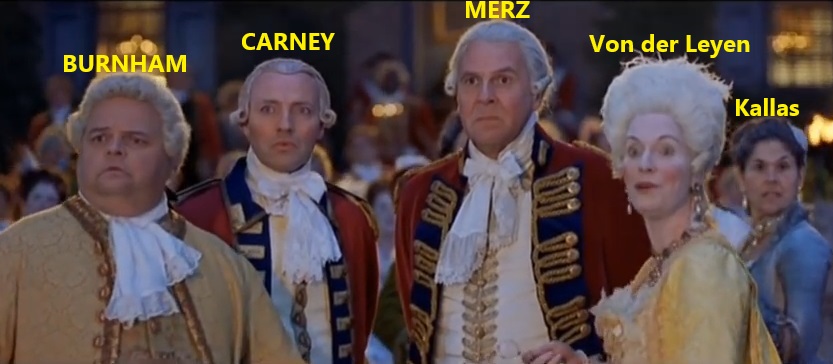

The last thing the EU wants is a strong U.S. / Russia alliance.
All their elite money making extortion and forever war scams would end.
…and we don’t want a strong Russia – Germany alliance. Unlimited Russian natural resources married to German industry and engineering. It’s why Biden destroyed the Nordstream Pipelines.
There is no German industry, as it was historically, due to their total buy-in of the climate change net zero energy policy. Their industry is collapsing in real time.
Before the Nordstream Pipelines were destroyed German industry and engineering were still formidable.
President Trump is fiercely fighting for life, liberty, prosperity and the pursuit of happiness for people all over the world. Individual liberty, popular sovereignty and patriotic nationalism are the goals.
Carney lusts for power and wealth for himself and his fellow cartel members. Authoritarian power and massive wealth are the goals.
May God continue to bless and protect President Trump.
How does she do that??? 😂😂😂😂😂
President Trump is fully engaged in the biblical Good works sum up in Jesus 2 GreatCommandments and Paul in Gal 5:14.
I’d rather he focus on the life, liberty, prosperity and the pursuit of happiness of Americans because if the Democrats win in 2028 and we have a Newsom-AOC White House our lives will be miserable.
May God bless the people of Scotland, Wales and Northern Ireland.
You now have the complete attention of the EU Globalist Monsters, and you will need God to go before you in this fight.
May God bless them for understanding it’s best to get off a sinking ship.
Everything wrong with their countries was brought on entirely by themselves.
God does his good work through his faithful followers. Catholicism has been taking it on the nose in Ireland for far too long. Time to step up. A catholic revival would blend nicely with the initiative to separate from The EU Mobsters, along with the Bank & Church of England into the bargain.
If separation can be achieved, a new constitution including the right of citizens to keep and bear arms would be nice.
Excellent!
Really!
As our President is there… did he share his courage with them?🙏
When, in the course of human events …..
Alberta, Saskatchewan, and Manitoba to sign declaration of independence from Canada Wednesday. No hard proof. I just feel it in my bones.
Good luck with that!!
Wab Kinew is a liberal
Lackey.
Alberta – and perhaps Saskatchewan and Manitoba – should immediately apply for Associate Statehood.
Now, if only the AFD can get a tighter grip on Germany …
The New World Order is fracturing everywhere.
Glory to God for tearing down this iteration of the Tower of Babel!
Wait until the riots start happening. I have a feeling they are coming big time in many EU Countries.
The ladies at Promethean Action must be jumping up and down with joy!
Love those beauties!
EU break up is next.
Well now the globalist found someone they can try to go to war over. Trump should recognize the independent countries immediately. Want to play games with Canada? Let’s play games.
Leaving the collective. President Trump would say good I can make deal with those people. Really big hugh deals!
Tell me this will help stop the flooding of third world invaders into their countries.
Coming right after Great Britain (and 12 other countries) announce sanctions against Israel for settler -colonizing of their own land, the remains of the British Empire starts to fall apart. This has been the pattern throughout millenia: all the countries attempting to wipe out the Jews and take their land eventually are brought down.
As is written”bless those who bless Israel and curse those who curse Israel”
i think Carnnibal (i.e.: he who is cannibalizing Canada)
is gonna find out his next WEF assignment will be a lot
less prestigious after the fallout from this one.
“associate” status?
like “customer service”? 🤣
Alt: https://xcancel.com/F0XYOU/status/2098836556798923217
They even teach English. 🤣
<Carney Seeks ‘Associate Member’ EU Status>
Ass. Member for short 🙂
Provide them hats with the new logo.
🙂
And WHO is “behind” it? 😉
Give Ireland back to the Irish!!!
Give Ireland Back To The Irish
…so the Irish can gleefully give Ireland to the Africans!
Paul McCartney said that a long time ago in 1972 written after Bloody Sunday……….
Carney lives in the U S A; the prime minister’s home in Canada sits empty. He wears many caps but Brookfield is where he hangs his heart. $23 billion of their investments are in China as well as 90% of the CPP’s. Canada cannot find $11 billion controlled by him and the go0verning Liberals. He failed in his attempt to destroy the U S buck while heading the Bank of England. Murkey indeed.
So, Carney is openly fighting for the benefit of China in it’s trade with the United States at the expense of Canada because he has a $23 billion investment in Chinese green energy companies.
Why doesn’t President Trump point that out every time he is asked about Canada trade?
Why Britain’s Political Class IGNORES Immigration | William Clouston
Do you have a bullet point summary of the 14 minute video?
thx
Let’s look at the Ireland, Northern Ireland, Wales and Scotland situation from another angle. The UK is no longer part of the EU. However, individually, these countries support the EU. Ireland, of course, is in the EU, and even Sinn Fein (which won the last election but did not get a majority) is a globalist entity. While the rest of these countries may wish to extricate themselves from the British crown….maybe…..they are still very much supportive of the EU.
One step at a time.
0.o
That is what I understand as well. So, how are those three leaving the UK considered a good thing if they want the EU as their overseer?
That’d be ironic if King Charlie ruled over the dissolution of the United Kingdom – leaving the remnant to his heir.
Cannot wait to see him pay taxes on what remains of Balmoral after Crown lands are divvied up or seized outright.
How will the Muslims be treating he and his royal family once they have more power?
Some people in our country might want to consider that before they think about sitting out the midterms.
These meetings next week between Scotland, Plaid Cymru in Wales, Sinn Féin in NI are amongst Nationalist parties…and feelings about separation and self rule have always run high within them.
They may be meeting collectively for the first time (to my knowledge), yet my gut feeling is that this memorandum will come to nothing in the end.
But then again, the peoples of Britain (no longer “Great”) have been jettisoned by both Labour and Tory. Fury and frustration are running at extreme levels as their lives are upended and despotic authoritarianism supplants ordered constitutional rule.
A round about way to say, whoever knows what may happen. Ten years ago, none would believe the insufferable nightmarish state of both the UK and Ireland. A map would have a big red arrow on both stating ” You Are Here”.
And so they are.
Watching.
Thank you for the no longer “great” reference. It needs to be permanent across the board.
As my home as an expat for a couple of decades, Dexter, it grieves me to say it.
And it would also negate the UNITED Kingdom title?? Maybe I will achieve my wish to no longer be a SUBJECT?
People are reminded daily of what these asshats did during the “plandemic “ No Quarter
The Crown’s global empire that it spent centuries dividing is being taken apart piece by piece and rearranged in such a way that it will never again attain the capacity to control as it once did.
Didn’t the Founding Fathers say something about meddling in foreign affairs ?
Does the US intelligence community have a side hustle? Otherwise why would salaried employees care what happens outside their window.
Do they want to EUExit?
If they stay in the EU wouldn’t they have to continue the EUSuicide?
If not, wouldn’t they have to recreate currencies, and trade etc?
What consequences would this have on Farage? Weaken or strengthen his base?
Sounds like false-flag time.
I like this X account. He did a thread on 12 countries’ national anthems. #11 was a hoot. Worth clicking on ‘Show more’ link to read what all he said about Canada.
Saggezza Eterna@FinalTelegraph
Twelve National Anthems That Outlived Empires
The songs nations kept after the kings, wars, and excuses were gone.
Number 11 will BLOW YOUR MIND!
Most anthems sound official. Their backstories are not. One was scribbled by a 20-year-old who would be dead at 21. One has no words because every lyric attempt started a fight. One was a drinking-club tune fitted to a flag that survived a night of rockets. One is 158 stanzas long and two countries share the first two. One was written in Italy by soldiers from a country that no longer existed.
This is a listening tour of 12 national anthems. The history is shorter than the ceremony, and much better.
Enjoy!
Wouldn’t it be truly wonderful if President Trump not only liberated the American population from their puppet masters, but also the peoples of Ireland, Scotland and Wales?
I wish he could liberate us from the Mooslime and communist invasions that we are experiencing right now.
Exactly. Don’t really give a crap about the British.
There is no “Commonwealth” that King Charles “governs”. It is a voluntary association, for sport and trade. Prometheus is wrong. Charles does not ‘govern’ Australia.
Are there London financisl markets trying to control the world markets? Absolutely. Just as there are US markets trying to control world markets. The biggest investor in Australia since 1950’s is USA.
Ca Asians won’t be happy when they see their immigrant quotas.
Canadians.
Trump has limited time to get the Russia alliance going. Ending Ukraine conflict did not happen. Opinion will be strongly against a move like this while hostilities remain in Ukraine. I expect to see make trouble every he can to keep folks on their heels.
This is done only for the EU to be able to make Ukraine an associate member of the EU.
My goodness are those EUnuch’s thinking about encroaching on our Northern border, with NATO, after we leave them all hung out to dry, when they start up WW3 in Russia???
Lying and scheming with the shadow spooks and Global Blob???
Good grief. Carney is a bought and paid for ass hat.
Thank you, Sundance go deeper.
Does Carney know that the United Kingdom doesn’t belong to the EU? 🙄
For our Canadian Treepers……………..
Here’s how to abolish the monarchy in Canada (and say goodbye to King Charles)
https://policyoptions.irpp.org/2023/05/abolish-monarchy-goodbye-charles/
A nation once again.
My first true laugh of the day: MbS and Putin, a beautiful photo that speaks a thousand words.
They have been after the resources within Russia since the 1850’s
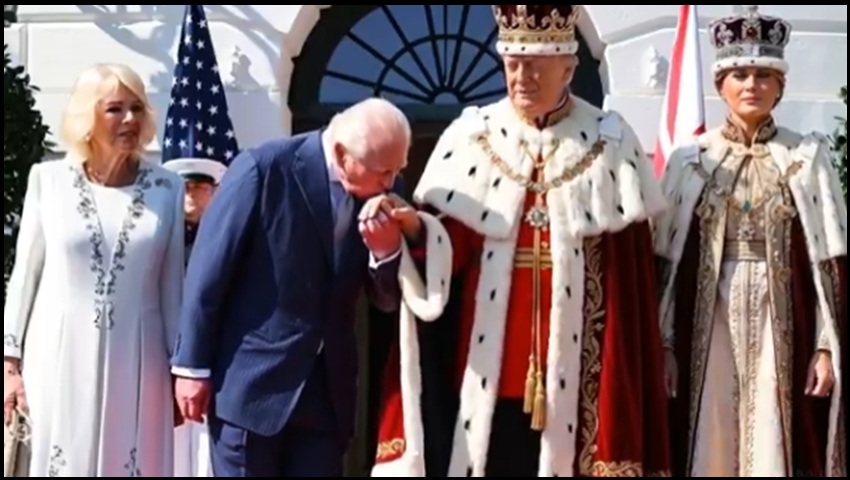
Love the photo of “King Charles” kissing king Trump’s hand! After what President Trump has done for the world he should get that kind of recognition! JMO
Embargo Canada. Blockade their access to the sea. Then they can “negotiate”.
CARNEY’S EU ISSUE – Well, most Canadians don’t want to join the EU.
So now, we have this :
A senior government source tells CTV News Canada is not seeking European Union membership in any capacity, pushing back against reporting by The Wall Street Journal that Prime Minister Mark Carney is exploring whether Canada could become an “associate member” of the bloc.
The source, who is not authorized to speak publicly, insists what is being reported “overstates” what is actually happening.
The WSJ report cited sources from multiple unnamed European officials.
More : https://www.ctvnews.ca/canada/article/pm-carney-says-canada-not-looking-to-become-member-of-the-eu/
Canada does not want to get further onto Donald Trump’s fecal roster.
My gut tells me this “Separation from the Sovereign” is going to happen and liberty will begin to flourish on these nations once again.
Didn’t Britian’s citizens vote to leave the EU, think they called it Brexit?
The situation we are seeing now, with Canadians finally (hopefully) understanding their ‘nation’ is still part of the United Kingdom and the King (where are all those no-king protestors?) has the final say on the important parts of being a nation (finances, defense, borders, etc) and
now seeing President Trump on the golf trip to Ireland with family and meeting with the leaders of Ireland et.al. and the sudden news that Scotland, Ireland, Wales are all meeting to remove themselves from the crown rule,
can’t wait to see what Carney does tomorrow. Can he one-up himself on the no memes request?
Monday is going to be interesting.
iirc, the SNP actually wants to grab control of the North Sea oilfields.
Kick the English out of the petro-money.
To give big hand-outs to just themselves.
And likely skim “10% for the big guy” type corruption.
A kind of guaranteed-income scheme, nanny-state style. Commie, basically.
No oil money to the other parts of the almost-former UK.
But the “green” element of their politics won’t manage the oilfields properly, so it will fritter away, dwindle to poverty.
Probably like Maduro’s Venezuela.
It takes hard work to keep oilfields working, especially offshore.
Leftists just can’t keep anything complex functioning.
90% of the UKs oil wells are off the coast of Scotland.
President Trump showed these people a plan and they liked it, you can see it on their faces. President Trump knows how to wield power and the amazing fact its for the betterment of the USA but also the world. One of a kind!
Prois.