CTH continues to get considerable questioning about how the U.S-Canada fracture will take place, what it means for the Canadian dollar (CAD) and when the issues can be expected to apex. It appears that part of the reasoned disconnect people are struggling with is directly related to the messaging from the Canadian government in combination with the financial media.
In short, despite the increased trade friction, a decoupling of the U.S. economy from the Canadian economy just seems unfathomable to most observers. The main question we receive is ‘when will things happen‘? Meaning when will financial markets react? The most obvious answer to that question is, when the USA announces the termination of the USMCA (CUSMA) trilateral.
If you hold the opinion that all of these trade friction points will be resolved within the margins of the USMCA, then it is correct to predict that no significant material impact will be felt north of the border. If, however, you hold the opinion that the USMCA will be terminated because the core of the issues between the two countries are irreconcilable, then the material impact will come as soon as that announcement is made.
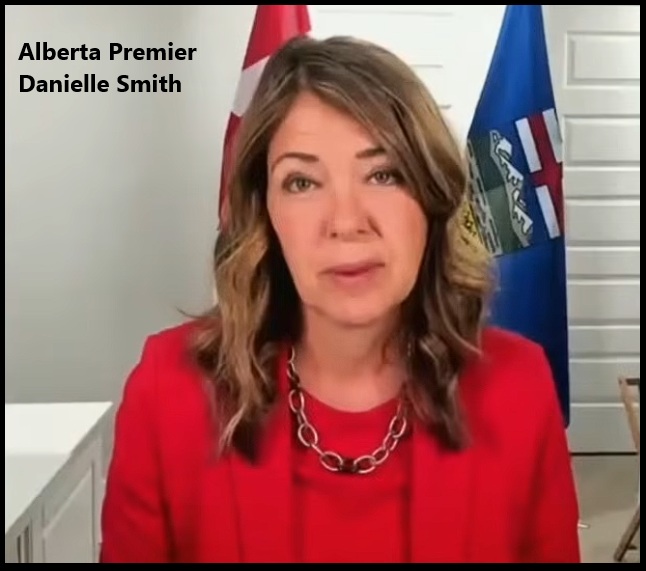
Alberta Premier Danielle Smith, the only Canadian government official to attend President Trump’s inauguration, appears on Fox Business. Like all other Canadian officials, she cannot contemplate the elimination of CUSMA/NAFTA. Such an outcome is simply beyond her comprehension. WATCH:
In previous interviews and broadcasts, Mrs Smith claimed if Canada was to introduce an export tax the USA would respond accordingly. This is not accurate. The U.S. has no mechanism to place a tax on exports.
Additionally, inside Canada the structure is provincial. That means each province taxes each other province for goods and services. In the USA we have state sales taxes, but those taxes are applied across all goods sold to/inside an individual state. Ex. Florida does not tax Texas. Florida has one sales tax for all goods regardless of their origin.
Does anybody actually listen to her when she talks about the pre-existing "Canadian Tariffs" on U.S. industrial goods?
Those pre-existing Canadian tariffs against America are part of the original issue. But she skims right over that origin. https://t.co/mTSyynk0iT
— TheLastRefuge (@TheLastRefuge2) August 28, 2026
If I recall correctly some states do ask you to self report untaxed out of state sales for taxation. I wonder how many people actually report it …
Pretty much every state now. That’s what’s called “use tax.”
“Sales tax” refers to a merchant’s requirement to collect the tax on sales because they have a nexus (some presence) in that state. But if you buy from a company/merchant with no nexus in your state, you are still liable for use tax. I’m not 100% sure that’s in every state — obviously not in those few states that have no sales tax.
In my state you have the option of tracking your use tax or just paying some calculation they come with when you pay your state income tax. We track it and it’s always been lower than the calculation (of course).
This was bigger during early internet where out-of-state retailers did not collect in-state taxes, but is generally obsolete with most retailers.
About that time, States changed from a “sales tax” to a “use tax”, or implemented both at the same time. The difference is, sales tax is allegedly only applicable if purchasing from a business within the state where it is charged. Use tax is applicable across state lines.
Buying goods from a tax free state brought or shipped to your state – your state wants you to claim the amount and be taxed on it. NC tobacco to NJ — must pay them shekels. Been that way a while now.
I kinda miss the good ol’ days of mail order and online shopping when it was essentially tax free.
It is if you move to or shop in a no sales tax state. For instance, Portland is across the river from Vancouver, WA. The WA folks go to Portland to shop.
Right: but then your home state thinks it is entitled to “use tax” on all that stuff you bought in a tax-free state.
I suspect everyone is paying various and many taxes for what we have absolutely no clue….I’m amazed anyone has any money left.
#taxationistheft
Short and accurate.
And infuriating.
Armed robbery, actually.
Government is the biggest thief of all.
Yes they do. Sometimes it’s called a use tax.
Not a lot of people are going to self report something unless the government has the information to cross check. However, they could be be in trouble if he IRS was auditing them.
This issue is becoming a moot point as automation increases and states require collection of sales tax by the merchants for items bought by out of state purchasers but shipped into the state of the purchaser.
“This issue is becoming a moot point as automation increases and states require collection of sales tax by the merchants for items bought by out of state purchasers but shipped into the state of the purchaser.”
I believe that is unconstitutional, as it is an impediment to free trade between the states. States are free to collect tax on sales occurring within their physical borders, if they choose to do so.
You are correct about sales tax. However most states have enacted Use Tax which is applicable across state lines. Thus, if a resident of Michigan buys a car in Indiana, Michigan will want proof you paid tax in IN before they will register the car in MI. If you didn’t pay IN tax, MI will demand to collect it.
I’m confused. Sales tax is at the state and lower levels of government. Why would the IRS be involved at all?
Your state and local typically use your fed filing to determine your taxable income based on their rules.
And not a single taxpayer has agreed to “share” their IRS filing with any state. It is odd to me that states are allowed to see individual IRS filings. I had to go through long ridiculous process after California tried to tax all of my income despite only working in CA for less than 30 days. I ended up owing a whole $42. CA spent that amount in postage trying to collect.
Normally, if I buy an item online, my state’s sales tax is added on checkout.
Not originally. Then sales tax states started having a cow.
Along the way, any online retailer was forced to collect sales taxes for any state they have facilities in. And for Bezos, that is just about every state.
I lost track after that.
I can’t even buy my favorite dog poop bags in California from Amazon. CA just banned them. They also banned high-flow shower heads years ago. Now we can’t buy new tires unless the state approves them.
Answer: U-haul.
Sad. It’s got to be tough living in a failing state.
Actually here in the eastern part of the communist state of Washington, most people that can drive to North Idaho for gas and most other items. Idaho has a resident income tax where Washington has a pretty high “sales” tax. Been avoiding both state’s taxes for years
Worse than tarification! Tariffs benefit the Nation and are creating re-industrialization. These inter-state taxes, at least in California, feed the political machine only. WE ARE STILL WAITING TO SEE SOME HIGHSPEED RAIL TRACK ! but as usual even fraudsters are protected “by law” in CA now.
So she is the premiere of Alberta? The one province we joke about making a state possibly?
Anyone on board with that, even prior to this needs to have their head checked.
You MUST remember, center right in socialist countries, is firm left of center in THE USA.
Let Canada have their debt compound and fire sale of assets. We need to be done with them until the ruins of their once decent society cause them to awaken.
Aren’t you concerned with U.S. government debt? It is roughly double that of Canada per person on a federal level.
No. Americans and Canadians are both blessed to reside in countries overflowing with abundant resources and filled with native citizens boasting a frontier work ethic. Our governments have worked tirelessly to reduce our standards of living through mass immigration, corruption, green idiocy and a plandemic—amongst other dumb and evil things—ballooning debt without the consent of the governed and turning it into a political football.
Canada is NOT a USA state!
You’re right – it’s a Chinese slave labor camp…
Thank God!
We don’t want Canada to be a state.
Canada is a parasite we want off our backs.
Since all online retailers collect sales tax and tariffs, I would expect that’s basically zero.
I’m guessing Trump triggers USMCA withdrawal after the US midterms. I don’t see him doing it before that point, given how disruptive it’s likely to be. That said, thank God for the commerce clause (that’s something I never thought I’d say). Without that, we’d have states taxing states just like Canada. The USA founders were really quite brilliant and full of foresight.
Yes, thank God the Republic was set up so that interstate commerce was tax free. Hope we can keep it.
Thank God the Republic was set up by some intelligent people. Not like the low intelligence and low moral people we tend to have in Government now.
thats because we were SUPPOSED to be independent nation states. the commerce clause has been warped to the point that it largely renders that meaningless.
That is mostly because of the Federal Income tax. Congress thinks of our coerced tax payments as an endlessly replenished Pot o’ Gold, theirs to waste as they please.
Hasn’t Canada already been notified the US is not renewing USMCA / CUSMA? That started a 6 month withdrawal clock.
“Such an outcome is simply beyond her comprehension.”
At least 70% of Canadians are going to have a very rude awakening, thanks in large to the steady diet of government propaganda they have been ingesting for years.
Yet in the end, this could be the very thing that saves Canada….because the people will be angry….across the board.
Perhaps they will look deep enough. My guess is that they will point to the Bad Orange Man south of the border and blame it on him to distract them from their misery.
The pain has to be very great to get some people to change,
maybe this will be it.
Well we have already seen what happens when they demonstrated against COVID lockdowns… the government shut down their bank accounts. Canada…. is ….. circling the drain. They have “one man one vote” and power is centered in the cities and they run the table EVERY TIME!
The US imports 150,000 barrels of oil per day from Venezuela. On the other hand…
Key Context & Breakdown-
Total Canadian Crude to the U.S.: Overall, the U.S. imports around 3.9 to 4.1 million barrels per day of crude oil from Canada.
Alberta’s Share: Alberta produces the vast majority of Canadian crude exports. It accounts for ~87% of all Canadian crude exported to the United States.
U.S. Reliance: Oil from Alberta makes up more than half of all total U.S. crude oil imports from foreign suppliers worldwide. Most of this heavy crude is delivered via pipelines directly to refineries in the U.S. Midwest (PADD 2) and the Gulf Coast (PADD 3), which are specifically configured to process it. “
How much of that imported oil is refined and sent back to Canada?
Canadian crude imports directly account for approximately 25% of total daily U.S. gasoline and diesel production.
Since crude oil from all sources (domestic and imported) is blended together during refining, it’s not possible to trace a refined fuel to a specific country’s crude. However, the mathematical contribution is derived from the following breakdown:
The Numbers Behind the Calculation
U.S. Refining Input: U.S. refineries process roughly 16 to 16.5 million barrels per day (bpd) of crude oil to generate refined products like motor gasoline, ultra-low sulfur diesel, and jet fuel.
Canadian Crude Volume: Canada exports around 4.0 million bpd of crude oil to the U.S. every day.
Refinery Share: Canadian crude represents roughly 24% to 25% of all crude oil entering U.S. refineries daily. Because petroleum yields for gasoline and diesel remain relatively consistent across refined crude streams, Canadian imports directly support about a quarter of daily U.S. fuel output.
We export almost that many barrels per day.
Just stop exporting oil.
Short-term pain.
It would be a wash.
Out of 4 million barrels a day from Canada only 22,000 barrels of gasoline and diesel are returned to Canada.
Okay, so according to this:
https://neb-one.gc.ca/en/data-analysis/energy-markets/market-snapshots/2026/market-snapshot-canadian-crude-oil-imports-dipped-slightly-in-2025-with-most-still-coming-from-the-us.html
“Since 2014, the U.S. has been Canada’s largest source of imported crude oil.”
I’m pretty sure that attempts to cut off or reduce the flows to the US will backfire
“Overall, the U.S. imports around 3.9 to 4.1 million barrels per day of crude oil from Canada.”
Mainly because no one else will buy it. Consider it a charitable act.
If you read the post you will see that 25% of our gasoline and diesel production comes from heavy crude directly from Canada. It’s not charitable when we actually rely on it every day. We can’t make gasoline and diesel from our light sweet crude oil.
Light-sweet crude is the primary source for gasoline and diesel fuel in the US. Heavy crude is used to make diesel fuel, jet-A, and kerosene, but not gasoline.
We can always buy heavy crude from somebody else. Who else can or would buy Canadian heavy crude? Maybe the chicoms would want some once the western pipeline is built, if it is ever built. Until then, the US is their only viable customer. We have options. They don’t.
That’s not what the facts are. We need heavy crude to make gasoline. We’re not buying heavy crude from anyone else at a 30% discount, are we? Don’t forget about the shipping costs on oil tankers vs a direct pipeline from Alberta to the United States.
Just another libtard. Alberta watch out she is a snake.
That lady is a real piece of work!
I lost count of the number of lies she told in that 3 minute clip-and all of it with a straight face and calm demeanor.
She’s a sociopath.
May God bless the Canadian people, and may He save them from the sociopaths who are destroying their country.
madamn premier is stuck in ’80s / early 90s “mba speak” … A milk carton caricature of why “mooslems will dominate”; because women need to go back to being “strong seconds” at best.
Ms Smith I trust as much as Varney.
Not one bit
Here is an interview between 2 Albertan/Canadians discussing Danielle Smith and what she might be up to –
–
Rob Anders used to be in the Stephen Harper Conservative government and Bolton is the host of the site.
The truth is everyone has their agenda!!??
She’s insisting on holding the vote on October 19th, it was already a very big deal and now this situation has made it that much bigger of a deal and far more divisive.
The separators are that much more fueled by all this and then the stay people are that much more scared and want to stay.
So this situation seems to have driven people deeper into the corner they were already in.
And interesting point the Separators have that I’ve seen nothing about in our media is that they want to separate and then bypass Ottawa and hammer out their own deal between Alberta and the US.. I would think that Team Trump that loves deal making would be open to that idea if they wanted to do that.
https://calgaryherald.com/news/separatists-say-trade-war-bolsters-calls-for-independence
She’d better wake up and quickly…
If Carney follows through with his dream of glory plan to join the EU (I’m still scratching my head over that one) all of Canada will be paying heftier taxes…on everything.
I know Canadians despise President Trump…but as is said, better the “devil” you know.
Sometimes reality has to hit “good and hard” before the truth can no longer be avoided.
And here it comes.
So Canada Tries to join the EU and then Russia overtakes the EU? How does that work out?
Not well.
Who would want the fast disintegrating EU?
Russia certainly doesn’t and has said so.
(Pretty sure Carney sees himself as the future King of the World.)
Carney is a low-IQ Bond villain.
Bruce these types are very dangerous though.
Look at the damage Barry did and the man couldn’t throw a ball.
Odd-Duck
Most of the Canucks are Liberals, so they love paying more taxes. Somebody has to support all those unemployable immigrants.
The God damn EU is
COLLAPSING .
(period)
She sounds like an intelligent and lucid person and yet she is so confused. Why is it so hard to understand that the trans-shipment of Chinese products is a hard no for the US and that Carney values his relationship with the CCP, more than he values his relationship with the USA? Frankly, Carny also values his relationships with both the City of London and the EU more than the USA, or he wouldn’t be trying to meddle in the USA’s mid-term elections.
She seemed to be trying to control a sing-song voice pattern (a sign the speaker lacks confidence) but it came through often. I suspect she doesn’t believe her talking points, but is dutifully reciting them anyways.
Also saw a Canadian streamer report that Smarmey’s retaliatory tariffs on Sept. 9th will target swing states, right before the midterms. Tariff on lobsters, for instance, tailored to hit Mainers where it hurts. Curious if there’s more substantial info on this.
If the law of supply and demand holds true, lobster should get significantly cheaper in Maine, on Sept 10. I don’t know fishing boat economics, so I cannot speak to how that will affect the industry.
Headed to Maine soon. Don’t worry on the lobstah thing. Will be eating a fair share. There won’t be sufficient quantities left to ship to canadistan… 😎
The Canadian tariffs on lobster I’m thinking will probably be a wash for Canada.
Last I knew, Canadian regulations allowed the taking of smaller lobster that US regulations would require to be released.
Other than that, Canada processes lobster meat for other retail and restaurant supply chains, much of which ends up frozen.
Maine lobstermen need not sell their catch to particular outfits and there is good money in selling the live lobster anyhow. The lobstermen will be fine so long as their catch covers more than their operating expenses in the Gulf of Maine.
You know we’ll eat every lobsta the Mainers bring in.. we have no issues doing this.
No need to worry about that one.. (it’s a brutal job but we’ll get it done).
Follow the price and volume chart on the ETF symbol EWC.
Everything will be reduced to that chart. If it’s breaking down, it’s the beginning. If it’s holding up nothing else matters. Opinions don’t matter. Price and volume does.
The issue of structure reminds me of a joke a Canadian once told me.
A Frenchman, Italian, German and Canadian student were all set a project where they were to write about elephants.After a week all had handed in their assignments.
The Frenchman had written about the culinary opportunities the elephant presented, the Italian had written about the sex life of the elephant, whilst the German had written a precise description of the elephant’s life cycle, and the Canadian? They handed in an essay titled, ‘The elephant, a federal or provincial issue?’
Peg you were drinking right? Eeekk! Sounds like a Canuck joke though. 🙃
Snow Mexican here. Yes, I heard that one as a child. Along with the line that Canada was supposed to get French cuisine, British culture and American government … but what happened is British cuisine, French government and American culture.
Loonie is going to test the lower limits against the dollar and I’ll be very surprised if the indebted UK or EU will provide much support apart from performative hot air. The UK Treasury won’t even provide our military with the funds to meet NATO obligations.
I suspect that once again Trump is “playing” them. He’s not immediately doing what they expect him to do. Therefore, they don’t know what to do.
But, very importantly, they are revealing their hand.
Sometimes silence does the talking. 😊
“Silence” is sometimes the most important thing a negotiator CAN say. Trump knows that.
If Canadians love this great relationship they have with the US…why do they keep booing our national anthem?
Just sayin’…..
Canadian politicians think they’re better than US citizens, and they project that onto a lot of their citizens.
we used to call that being a snob.
I think it is jealousy on their part.
No matter how friendly we are to them, no matter how much we have embraced them as our next door neighbor, no matter how much money we’ve allowed them to take through an abusive relationship, many seem to give off an air of superiority, which I believe stems from their feelings of inferiority.
Watch from about the 9:00 min mark on.
They talk about a Bank of Canada report on “The Price Impact of Canadian Retaliatory Tariffs”. Basically, based on past retaliatory actions….Canada absorbs most of their own retaliatory tariffs…not America. It hurts Canadian businesses. He also predicts Carney reverses and makes a deal right after the Canadian elections (and before tariffs actually go into effect).
+++
The Real Reason Mark Carney Broke Off Trade Talks With Donald Trump – Our Prediction
(23:39 full video)
Report link:
https://www.bankofcanada.ca/2026/06/staff-working-paper-2026-22/
Carney like Iran is in daily contact with Obama’s top people and is being coached to reject any potential solution offered by President Trump. Democrats sense that President Trump is vulnerable with war, inflation, interest rates and oil prices. They are simply taking advantage of those vulnerabilities. Don’t expect anything to change!
If Carney wants the deal he just shut down, how does he figure it`s still on the table?
My feeling is Trump should inflict as much pain as possible on Canada and the EU to the point they cannot recover. Let the globalist shithole countries burn!
We should be getting excess oil from Russia, Instead Biden pushed Russia and China together…. One of the stupidest things anyone has ever done…. but Biden is known for doing Dumb shit that affects other people negatively….. alas Bidenflation.
I think President Trump has demonstrated that he doesn’t like to ‘destroy’ anything – he’s a builder (and a rebuilder). He always seems to see things as salvageable even when no one else does. Most of the time I think he’s correct – in the long-term.
My worry is always, “how long do we really have to fix things? Will we get to that long-term point if we don’t fix things sooner?”
Canada is being made the example.
Who will learn from it first?
If that’s true, and I wouldn’t be surprised, they should be identified and charged with Logan Act violations and/or treason.
Agreed. But who will do the charging? We have a pathetic, passive DOJ when we need ravenous wolves.
I thought Varney went easy on her. She is the best of the Provincial Premiers and pounded some reality in to the idiot Fords head concerning how it would be crazy for Canada to try and use oil as a weapon. But Varney avoided the issues of China’s penetration in the the deepest depths of Canadian society and government and the illegal transhipments, etc.
Varney and Fox News is globalist, forever wars and America last.
Uniparty slop propaganda designed to appeal to people right of center. They pretend to be on our side.
Concur. Brett Baier is just as bad.
Bring it, Mrs.Sunshine. Everything you typed is absolute truth.
The question is when do the scales tip….when enough Americans realize we’ve been lied to by the MSM and our government for so many years?
I came here in 2016. Hard to believe its been 10 years but what I’ve learned mostly from Sundance with some brilliant import from others (Regitiger comes to mind) has put me in the minority in the area I live in. (SE Pa near a college town). I educate as many as I can (I am not a professor) but many folks are just happy with the status quo. They really have no idea what the hell is going on in our country let alone the world when it comes to the Trump Doctrine.
I’m reading “Revolution” by Eric Metaxas (which makes my Brave browser goes “Aw Snap” cuz it can’t handle the truth either) and that book brings out the true meaning of Liberty and what the Colonists put up with until they decided ENOUGH IS ENOUGH!
When will all of US realize that our time is now?
SE PA near a college town… Villanova? Collegeville? Swarthmore? Doylestown?
by the laws of the USMCA, does anyone know whether it can be reinstated once the 6-month dissolution clock runs out?
Why would we want to reinstate it?
Additionally, inside Canada the structure is provincial. That means each province taxes each other province for goods and services.
_________________________________________________________
And, let’s not forget the “Equalization Payments” employed between Provinces. Essentially, and in general terms, the Western part of Canada supports the Eastern portion of Canada. Each province receives “equalization payments” to accomodate the discrepency in production and revenue.
Quebec: $13,907 million ($13.9 billion)
Manitoba: $5,044 million ($5.04 billion)
Nova Scotia: $3,538 million ($3.54 billion)
New Brunswick: $3,360 million ($3.36 billion)
Prince Edward Island: $723 million
Ontario: $406 million
Newfoundland and Labrador: $182 million
Alberta: $0
British Columbia: $0
Saskatchewan: $0
Who’s bright idea was that? And when?
You must be wrong, ‘cause that sounds like socialism, and I was definitely told that Canada was a democracy /sarc. 😂
Well is t that interesting. No wonder people in Alberta feel like they have been used.
I don’t know.
Trump just tried to give Canada a favorable deal that keeps their beloved Cusma going.
Canada is the one that refused, and Trump has not retaliated by ending Cusma. We would be totally justified, but no.
Keeping the powder dry until the midterms are done?
Trying to maneuver Carney into killing Cusma?
Or maybe killing Cusma was the extreme rhetoric that was going to force the changes to make Cusma acceptable.
I don’t know. Sundance has been right about so much of this stuff, that it is hard to disagree.
Just that there is this nagging disconnect.
IMO the deal with the Mexicans has to be finalized first, and possibly Trump would prefer to wait until after the midterms.
Carney doesn’t care about the USMCA or Canadians. His only goal is to get the Democrats in control of Congress in November and, like Iran, that means rejecting any deal offered by President Trump no matter how much it benefits their country.
Carney and the Democrats work for the same Bosses…. the EU Royal Cabal….. their goal is to take over the USA…. and HRC was a willing participant, along with Obama, Biden and Company, etc…. Biden was busy exporting our military’s hardware to EU while he was in office, leaving us short here…. that wasn’t a coincidence.
These Canadian Premiers remind me of episodes of Criminal Minds… They wake up in the morning, go to the closet and decide which mask they’re going to put on for the day, depending on who it is they’re planning on killing. Do they really think that people won’t or don’t have the ability to pull up an article or video from the day before and see what it is that person said? Perhaps they think Americans are as stupid as Canadians?
You really can’t beat Scott Bessent.
“They’re going to take their two submarines from the Edmonton Mall and sic them on us?” Bwahahaha
Mic drop.
The really sad thing is at one time the W Edmonton Mall had four submarines. There were more subs in a landlocked consumer shopping mall than the .Canadian military. All of them were scrapped years ago, chopped up into pieces and hauled off.
Edmonton was also where HCMS Nonsuch was “docked.” This was actually just a building that the Canadian navy pretended was a ship.
https://www.cbc.ca/player/play/video/1.4291637
Pretending not to know things is very dangerous and I feel that Canada is about to get a real lesson in reality.
Prsident Trump only named the portion of the lake that in part of the U. S., Lake America.
https://truthsocial.com/@CitizenFreePress/posts/117190808898437490
I purchase supplements from a holistic veterinarian in Canada which I cannot find elsewhere in the USA. The business has been in existence for at least 12 years. I wonder if there will be a tariff placed on his business as many Americans purchase from him as well.
Maybe he should relocate south.
Maybe extend your search southward. There are many holistic vets in this country who can help you out. Our dog “Brandy” was diagnosed with “Pelvic Limb Weakness” and we did not go the normal route. We saw a registered vet who believed in holistic practice as we do. She did not gouge us money wise either. Brandy was given acupuncture, various supplements and most importantly taken off of DOG FOOD and ate what we ate. Beef, chicken and fish and veggies. She had a wonderful remaining 1 1/2 years with no regrets.
You can do it.
Maybe you should move to Canada Worry wart.
I don’t think it makes sense to look at this from an economic or trade perspective. Canada blew up the negotiations for purely political reasons, to help the Dems in November.
Once the elections are over Canada will settle for the exact same deal they are rejecting today.
The same deal may not be offered
The same deal CANNOT be offered.
Our country is going to be VERY different come November. One way or the other.
I really don’t think all the true Americans who showed on J6 to show solidarity and then got F’ed by the government in charge are going to make that mistake again.
Sounds like foreign influence.
And they brag about it
Canada has benefitted too long from USA funding their system like welfare. NO MORE!
Saw her last night and wasn’t paying too much attention, but thought she was a congressional dem from Wisconsin or Michigan, so I tuned out completely.
It seems as if the leaders of Canada do not have a grasp of international trade and economics.
They are people who took college economics classes but really were clueless in class and did not buy or read the textbooks.
Every leader in Canada received “D” or “F” grades in college Economics classes.
THE CANADIAN ECONOMICS MODEL: “If Canadian Company A earns $1 million, government takes it away and gives it to freeloaders.” (This is called “democracy” and “fairness” ).
“If Canadian Company B earns $2 million, government gives it to China and gives the middle finger to Canadian citizens.”
“If any Canadian company earns more than $3 million, the government gives the middle finger to Donald Trump and splits the money between China and Canadian politicians.
Throughout the process, regular Canadian citizens get fed bullshit by government-owned and controlled media and get arrested, and have their personal checking accounts frozen if they stage protests.”
This unique economic model is called: CANFORNICATION.
“The main question we receive is ‘when will things happen‘? Meaning when will financial markets react? The most obvious answer to that question is, when the USA announces the termination of the USMCA (CUSMA) trilateral.”
As I have commented several times before, the political and legal reality in the U.S. prevents it from being up to President Trump whether and when he pulls the plug. As a consequence, the withdrawal was and is never an option because such a move would almost certainly face several legal challenges with at least one preliminary injunction that deems the withdrawal unlawful:
Congress [1] approved USMCA [Implementation Act (H.R. 5430; Public Law 116-113)], which President Trump signed on 1/29/20 [2] and which has been in effect since 7/1/20.
According to a report from Senates Committee on Finance [3, p 18], President Trump needs Congressional approval to withdraw :
“The United States cannot withdraw from a congressionally approved trade agreement without the consent of Congress.”
[1] USMCA: Implementation and Considerations for Congress
[2] President Donald J. Trump’s United States-Mexico-Canada Agreement Delivers a Historic Win for American Workers – The White House
[3] S. Rept. 116-283 – UNITED STATES-MEXICO-CANADA AGREEMENT IMPLEMENTATION ACT | Congress.gov | Library of Congress
“each province taxes each other province for goods and services.”
Wacko.
Trade makes up 66% of Canada’s GDP, the US 13% ! Canada laundering money for the Cartel and CCP and setting up LLC to illegally bypass US imposed Chinese tariffs the tune of $100 Billion USD’s a year, can no longer be allowed to continue!
There are many different layers to just how Canada has been sticking it to the US!
So, do any Canadians have any PRIDE left?
“Make CANADA Great Again!!” Any takers? 🤷
“…integrated defense…”?
“…integrated markets…”?
I’m guessing the word “integrated” don’t mean the same thing in Chinada as it does in the real world.
Inconceivable.
She said “stronger together.”
Gag. Gawk. Spit.
Oh the beast is “strong” in this one.
“Like all other Canadian officials, she cannot contemplate the elimination of CUSMA/NAFTA. Such an outcome is simply beyond her comprehension.”
But, But, we’ve never done it that way before!
Thanks Sundance for these reports on Canada and also Russia. I find your descriptions of the cultures to be interesting and enlightening.
Does anyone realize that Carney probably already has a deal in place with the Democrats, and blessed by Thune and the Uni-party Republicans, to restore the USMCA as soon as the Democrat president takes office in January 2029?
Isn’t the Canadian “leadership” concerned about the climate change brought about by all that gaslighting?
🤣 Not to worry. They already used taxpayer’s dollars to buy Carbon Credits from Brookfield to offset that. 😉
Supposedly 70% of the Canadian population supports Carney’s decision to walk away from U.S. trade talks.
https://toronto.citynews.ca/2026/08/28/canada-abacus-poll-us-trade-talks-mark-carney-donald-trump-tariffs/
That’s up about the same level as the Palestinians’ ongoing support for Hamas.
Canadians are just as gas-lit as Palestinians and just as willing to commit personal and national suicide.
I seriously doubt any polls coming out about this. Keep in the mind the purpose of polling in Canada is the same as it is here – not to measure public opinion, but to influence it. Polls are just more propaganda.
Canadians don’t have HAMAS exterminating “traitors” as motivation.
On a side note, isn’t that about the same level of buy in as the jab? Silly me. Canada is 85% at least one dose. 82% fully vaccinated. And 50% at least one booster. So the mass formation is slipping at 70%, but still strong.
So amatuer question….. what would that mean from an investing standpoint? Say I was 100% in the S&P 500. Would I benefit, or get crushed?
WHY DIDN’T STU PUSH BACK ESPECIALLY ABOUT THE CANADIAN PRESS WON’T CALL 911 A TERRORIST ATTACK? MY FAMILY AND I HAVE STOPPED BUYING ANY AND ALL PRODUCTS FROM CANADA. WE NO LONGER HAVE ANY RESPECT FOR THEM WHATSOEVER. BEEF,LUMBER, SYRUP, WHATEVER THEY HAVE TO OFF THEY CAN KEEP IT, THEY ARE JUST A BUNCH OF LIBERAL PUNKS!!!
I think that Carney reneged on the trade deal which had been negotiated so that it could be used as another issue to attack Trump over in the mid-terms. And if Trump gives the USMCA termination notice before the midterms that will also be used politically. Trump should hold off on the termination notice until after the midterm.
To the point, the President has clearly articulated the situation and has done so for more than 10 years. Make no mistake it’s going to happen because it has to happen. Whether the people of Canada come to attention and turn away from their globalist socialism the facts remain the same.
For the United States of America the conditions are intolerable the only reason they can operate with their particular godlessness is because of how they manipulate trade they have nothing else.
They can talk tough all they want but because of their corrupted ideology they have no character, when they speak there’s nothing there there, no personality no character Nothing genuine, an empty suit animated by who knows what. They’re given over. No character no courage.
May God bless and inspire the president and all those who serve him.
As for Tariffs, they must remain until our manufacturing infrastructure is able to allow our homeless their dignity (once again) and become productive participants.
what makes you think the US is going to terminate CUSMA,the US needs canadian energy and power,,Trump would have announced such by now,he is not one who waits.He needs the trade deal to happen so he has a win to take into the mid terms.imo
Trump needs to cozy up to her. Get Alberta to become the 51st state of the union. They hold 98% of Canada’s proven oil reserves.