It has been said that all wars are “bankers wars,” however, against the modern era of inverted fascism where corporations tell the govt what policies take priority, the more accurate truism ‘is all wars being controlled by money’, not necessarily banks.
The European Commission has constructed a very special kind of proactive financing for Ukraine that doesn’t require them to give their own €uros to the historically corrupt country. Partly because the EU doesn’t have their own money, and partly because everything the EU does in the sphere of finance is always a false construct, what the EU put together was a financial system based on sanctioned, confiscated (ie stolen) Russian sovereign wealth funds {citation}.
As part of the sanction regime, the EU and western NATO alliance seized roughly €250 billion, $300 billion USD, in Russian sovereign wealth assets. As long as the USA was financing the Ukraine government and war effort, those funds sat on the sidelines undiscussed. However, once the USA stopped writing checks to Ukraine an alternate finance system was needed.

What the EU (Ursula von der Leyen) put together was a finance package using the confiscated $300 billion in the Russian sovereign wealth fund as collateral for loans to Ukraine. The EU would send the money to Ukraine as a loan that did not have a payback mechanism. Instead, the thinking goes that when the negotiations for a ceasefire take place, Russia would be forced to give up the confiscated $300 billion as part of a reparations package to Ukraine.
Ukraine doesn’t have to pay back the loans because Russia will be forced to give up their sovereign wealth fund, and those funds will repay the loans. That’s the way the EU financing of Ukraine is set up. {SOURCE} The EU isn’t giving Ukraine EU money; the EU is giving Ukraine the Russian wealth fund money.
Now, immediately you can see a few problems.
♦ PROBLEM 1 – What happens if Russia demands the return of their $300 billion as one of their baseline terms for a peace deal? If the confiscated money is given back to Russia, the EU and Ukraine are on the hook for the $300 billion they would have spent.
♦ PROBLEM 2 – With #1 in mind, there is now an incentive to never reach a peace agreement or ceasefire; at least never reach a solution that would consider the return of the $300 billion. Russian Federation President Vladimir Putin has previously said the stolen money belongs to the Russian people and must be returned; he will never accept the theft.
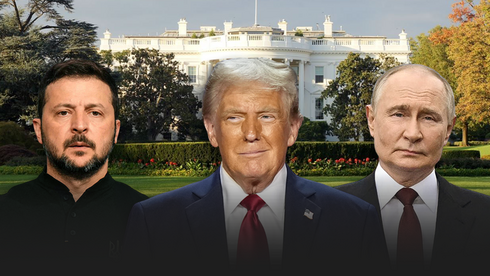 Zero Sum Loggerheads – If Vladimir Putin refuses to accept the theft, and the EU won’t return the stolen assets, it seems the only option left is to escalate the Ukraine conflict, with the EU aiming to defeat Russia. It doesn’t seem like a coincidence that this appears to be their current approach.
Yesterday in a stunning interview with Sky News, President Zelenskyy said a few remarkable things. One, he has plenty of money and two, Zelenskyy wants to build big, big factories in Great Britain in order to build missiles and drones away from the threat of Russian countermeasures.
The sick irony is that Zelenskyy would be building missiles and drones in the U.K to attack Russia using money confiscated by the EU/U.K and given to Ukraine. However, in this bizarre world that’s the reality of the thing.
When you overlay the pragmatic, transactional nature of President Trump into this dynamic, we can see how things look even more muddied over this confiscated Russian sovereign wealth. President Trump has often advocated for “taking the oil” or assets of a country to pay for the military expenditures incurred by the USA. Both in Afghanistan (theoretical) and in Venezuela (reality) this Trumpian approach is visible. To the victors go the spoils.
Russia is militarily holding approximately 20% of the land mass of Ukraine, the Donbas region, with no intention of ever returning it. Putin wants his sovereign wealth fund restored, and, if his doctrine is to be consistent, President Trump has no room to say Putin shouldn’t get it back.
The Europeans likely understand that President Trump is ideologically on the side of President Putin on this national economic aspect. The EU is against the return of sovereign Russian wealth. This part is a very interesting dynamic to watch.
Meanwhile, there are ancillary interests that exist within the economics of the conflict with direct stakes into the billions of euros. One of those interests is held by Ukraine’s richest person, a very corrupt billionaire Rinat Akhmetov, the owner of mining and steel firm Metinvest and the Ukraine power company DTEK.
Pay close attention. Billionaire Rinat Akhmetov (DTEK) has a lot on the line in the Russia -vs- Ukraine conflict.
[…] Akhmetov lost more than half of his assets as a result of the full-scale invasion, with many of his industrial holdings, such as the Azovstal steel plant in Mariupol, destroyed or damaged during the fighting. According to the Bloomberg Billionaires Index, as of Oct. 31, Akhmetov’s net worth fell by 52% to $5.39 billion compared to the pre-war numbers.
Billionaire oligarch Rinat Akhmetov operated in that very lucrative space between Ukraine and Russia. Akhmetov’s assets are directly tied to both nations now in conflict. Akhmetov even has operational loans from Russian banks that have not been repaid due to the sanction’s regime, and if there ever was a resolution to the fighting, he would also be on the hook for repayment as well as the loss of his industrial assets in the Donbas.
[NOTE: Keep in mind, one of the primary issues that brought Putin to power was his opposition to the Russian oligarchs who surfaced as wealthy control agents following the collapse of the Soviet Union. The billionaire oligarchs controlled Russian politics until strong man Putin diminished them, smacked them in the nose and took back control.]
There is a lot of motivation for Rinat Akhmetov (DTEK Energy Co.) to support funding pro-Ukraine influence operations against Russia considering the billions at stake from direct energy company asset losses and reconstruction funds that he could also benefit from…
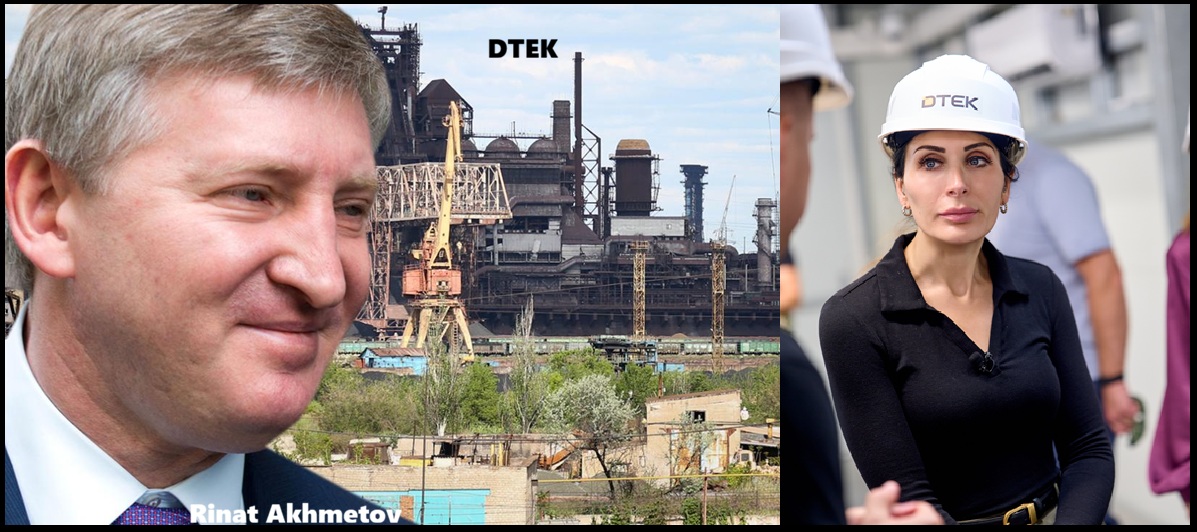
YAHOO NEWS – Ukraine’s richest man Rinat Akhmetov allegedly borrowed $400 million from Russia’s largest bank, Sberbank, the International Consortium of Investigate Journalists (ICIJ) said on Nov. 14, citing information obtained from leaked documents dubbed “Cyprus Confidential.”
The documents are part of a massive leak of millions of files obtained from Cypriot financial service providers.
The files also shed light on Akhmetov’s involvement in Russia’s coal industry after the annexation of Crimea in 2014. In 2016, Akhmetov’s energy company DTEK transferred ownership of a number of coal mines to a subsidiary of Fabcell Ltd., based in Cyprus. She bought these mines four years earlier in the southwest of Russia in the Rostov region. DTEK also transferred to the subsidiary a significant loan obligation in the amount of about USD 400 million from Sberbank (Russia’s largest state-owned bank).
In January 2017, Fabcell reclassified its shares into 7,999 common shares and one gold share. The gold share was assigned to Sberbank, which would allow the bank to gain control over Akhmetov’s company in case of non-fulfillment of its obligations.
[…] In response to the investigation, Akhmetov issued a statement to ICIJ saying that the loans provided by Sberbank and others before Russia’s illegal annexation of Crimea in 2014 were “standard practice for Ukrainian borrowers.”
Transferring the ownership of the Russian coal mines to the Cypriot subsidiary was a way of “limiting [DTEK’s] exposure to the claims of Sberbank as creditor and paved the way to exiting DTEK’s investment in the Rostov Coal Mines.”
In June 2022, Akhmetov filed a lawsuit at the European Court of Human Rights against Russia for gross violations of his property rights. Akhmetov asked for “billions of dollars” to compensate for the blockade, looting, destruction, and theft of his grain and metal from Ukraine to Russia. (read more)
With all of that said, we now have a solid baseline for how some financial interests in Ukraine are positioned.
All of the above information should help us to understand the dynamics and stakeholders.
World War Reddit continues.
Now on Fox News they just showed a file photo of Zman and Lindsey embracing and all smiles
And voice coverage moved on to “tonight?” congressional activity to do with US assistance to Ukraine in fighting off Russian efforts
yada yada
I imagine they spent quite a few nights playing late night duets on the piano
I would have taken them to be lovers of the flute.
F NATO F EU ! Oh by the way Ukraine is not a member.
Fox News
“Trump — Will take out Pickaxe Mountain if no deal”
and showing cartoons of the bunker-buster bombs and how they work
I envision mini-mini nukes in Pickaxe future.
were there any cartoons of desalination and power plants being taken out, or the mass evacuation of millions who would no longer be capable of living in the desert?
i bet those would be cute.
All that will happen within the hour if anything remotely resembling a nuke hits this Pickaxe Mountain
There is no way to win this war .. wo causing extreme damage to the world economy
There is this:
Or this…
Russian FAB 15, 33,600 lbs, any comments?
Well that certainly feels familiar in the USA, doesn’t it…
We need a big dog…one that likes to bite!
Maybe a Malinois?
For those interested in the breakdown of Russian Assets HELD Captive by Nation (in Billions of Euros):
Belgium 180B
France 19B
Luxembourg 10B
Japan 28.1B
UK 26.6B
Canada 15.1B
Switzerland 6.2B
USA 4.3B
Note: The fidelity, security and trustworthiness of the banks in these the nations listed, except for the US and Japan, makes up a major part of the economies of those nations. So, if the EU starts tampering with this money … the real question is what will be the impact on the ability of the Banking Industry in these nations to generate FUTURE BUSINESS as well as on the deals cut for any FUTURE BUSINESS.
This is the reason Belgium has given pause to agreeing to use the sequestered Russian Funds. Belgian Banks rank with Swiss banks in terms of how they operate internationally.
Notice how the coalition of the willing: Germany, France, UK and Canada have no problems risking Belgium’s financial future … while they have relatively little financial risk in the game.
Neutral Switzerland?
They are not a member of the EU.
Non-NATO and Non-EU nations should release all Russian assets.
The cost of war.
I asked Googe AI:
How much World War 1 debt has the UK not paid back?
I received this answer in the first line:
The UK has paid off all of its official World War I debt,
with no remaining principal balance left unpaid. (my emphasis)
I repeated the question expanding it:
How can the Guardian claim World War 1 UK debt has been paid back
while Peter Hitchens said it has not been paid back but payments stopped in 1934?
I received a rather different answer:
The Guardian and Peter Hitchens are talking about two different things:
The Guardian refers to domestic war bonds owed to British citizens,
while Hitchens refers to international government-to-government debt owed to the United States.
Both statements are technically correct in their own contexts.
Google AI is misleading at best.
Peter Hitchens says that there was no need for the UK to get involved in World War 1.
There was a huge economic and social cost for the citizens of the UK.
(Listen to his recent interview on Triggernometry, “We Live in the Age of Delusions” on Youtube)
Similarly I believe the US, UK and EU should not have got involved in the Russia-Ukraine war while trying to deceive their citizens by not declaring war and sending their soldiers to fight on the front lines. Had they given no financial support, weapons and logistical help, I believe the war would have ended quickly and many lives spared.
Loss of lives, soldiers incapacitated for life, massive destruction of property and the outflux of millions of Ukrainains to various countries. The cost of reconstruction will be enormous and I do not believe citizens of the Western countries should contribute even a single dollar. Perhaps the arms industry and those with shares in the military industrial complex have a moral obligation because they have exploited the war.
The AI answer omitted that the Nations of Western Europe (especially the UK, France, Belgium and the Netherlands) used the “War Reparations” owed by Germany to pay off their “war debt”. This was a major influence on the rise of the Nazis Party 1920 to 1933.
The same is true for WWII war debts.
The US forgave war debts owed by Europe from WWI and WWII.
This is akin to the EU Members using the sequestered Russian Assets to pay off “war debts”. It will leave a highly volatile situation in place, if the EU ever decides to back away from fomenting a war.
One may also recall that following the French and Indian War the UK also decided that its war costs should be borne by colonists, a decision that fairly promptly led to dramatic consequences.
The whole situation is like a mid-stage game of Diplomacy; the initial moves are done and now the remaining Powers are jockeying into position to find the ‘stab’ (or sudden reversal) that results in victory before others can react. Diplomacy is set in turn of the 20th century and does not include nukes.
Uh….You seem to be unaware that the U.S. began preparing rump state Ukraine for subversive activities against the Soviet union beginning almost immediately upon cessation of WW2 kinetic warfare?
That effort NEVER ended, not even after the Soviet Union imploded. The current kinetic war that is taking place mainly in rump state Ukraine was INITIATED by forces under the command of both traitor Obama and his prop/puppet Biden.
Russia did NOT initiate the conflict.
And Russia sure as hell isn’t going to lose it, even after the satanic elite seeking the destruction of Europe start sacrificing their dazed, confused and lost populations into the furnace of war.
And if the demonrats had their way, a generation+ of Americans would join them.
I believe that American politicians and certain US business people were seeking to exploit the situation in Ukraine long before 2022. I also noticed, years ago, that certain (many?) US politicians are not viewing the situation in Russia in the same way they have viewed Eastern European countries that were under control of the USSR. If nothing has changed in Russia why do they encourage the reading of books like The Gulag Archipelago by A Solzhentsyn?
While I have no idea of the rationale behind the actions of Putin, Western mainstream media are most unhelpful at best in clarifying this, it angers me when the corruption in Ukraine is ignored as well as the greed and selfish ambitions of Zelensky. He appears to be determined to fight to the last man while I doubt Putin would sacrifice so many of his young men had roles been reversed. I am even more angered by Western nations squandering so much money in the conflict while they have very serious matters desperately needing attention and funding back home.
I agree. It seems no one is speaking for the entire generation of young men who have been taken from this earth so some people can make tremendous profits at war. I cannot find justification for this war, except that it is a massive money laundering opportunity for members of the US Congress and those who produce weapons of war. Yet an entire generation of young men are being wiped out. Think about that. Think of all the women that will never marry, never have children. Think of the mothers who will never have their husbands back, and children who will never have their fathers back. Think of the men on both sides gone. Completely gone. Or maimed within an inch of their lives. It is grotesque. The EU is a totalitarian government that should be disbanded as an abomination. All totalitarian governments commit heinous acts of destruction and human beings are simply fed to the fires of their destructiveness. May God have mercy on their souls.
In all of this nonsense, I place great faith and trust in: Vladimir Putin. He has been elected and re-elected many times in fair elections. He was there when the Soviet Union collapsed and the member nations, particularly including Russia, were suddenly scrambling for identity and autonomy. He was right there, adroitly doing that. And his people keep bringing him back.
Both his parents and his grandparents suffered greatly in war. When the “Ghost Regiment” marches, his family has many memories and photographs to share.
This is a man who loves his enormous “Motherland” passionately. And he is extremely devoted to leading it. He is well-educated, historically informed, articulate, patient, and level-headed. He looks at what Europe and Ukraine are doing, and he understands it clearly. Yet, when they try their best to provoke him, he is not easily provoked.
Russia has enormous military power – nuclear and otherwise – and very advanced weapons. Yet, he is keeping those capabilities sheathed. He could wipe Kiev off the map. He hasn’t. He is trying to spare civilian lives in this region, which has ancient familial ties to Russia. The “limited special” operation … still is.
He will always do what is best for Russia. But he doesn’t want World War, because he keenly understands what that actually is. Europe clearly does not.
So: Of the actors now on stage, I trust Putin and Trump greatly, and the European fools(!) not at all.
If all countries would just honor their national heritage build on best strengths and quit the blunder bus and hate that is self destructive and wholly unnecessary in this 21st century of the modern era. Seems the sheeIt from 19th and 20th century not lessons learned. So if your gonna FA, you ll FO! As for Mr L. Graham, he was no statesman, just a good ol politician, a bit fickle at that.
LOL
Bravo Mike. You nailed it.
I read that Miss Lindsey had expected the Iran Conflict to last 3 to 4 weeks.
I wonder how bad they’re underestimating the timeline of WWOneHundredEleven?
I’d guess Bibi told him personally.
Pillow talk….
Questions? Yeah, who was the genius who decided it would be a good idea to place Russian money under EU control?
I don’t know, but that’s likely his epitaph.
Putin ???
I could find the answer. So could you.
My guess is the globalist freak running the Rothschild aligned, BIS affilated Russian Central Bank.
Russia is not a Dictatorship. Putin is forced to make certain compromises just like President Trump (King Trump?)….🤣🤣🤣
So the Russians are paying for weapons that the Ukraine has used to kill hundreds of thousands of Russian troops.
Not the best planning ahead by the Russians.
Europe stole the money.
And Putin wasn’t smart enough to think they would ???
Of course he and his nation’s bankers knew the risks. Nations place their sovereign funds in other nations’ banks for a variety of reasons. They are supposed to be sacrosanct . . .
Haven’t the globalist cabal been using our own money to screw us?
I don’t think these people ever really fund the things they do.. it always comes from the taxpayers.
Always, to wit the inflation of the past century and half, hurts whom?
The use of sequestered Russian Funds is not yet a done deal.
For good reason, Belgium has not yet agreed to using these funds to secure Ukrainian Loans.
Belgian Banks hold 180B of 210B Euros, in Captive Russian assets held by the EU, Canada and UK. Those Belgian Banks rely very heavily on International Business Deals for their revenue … which in turn figures quite heavily into the GPD of Belgium. The nation of Belgium stands to loose heavily if this entire effort goes side ways or Businesses as well as Nations see the use of Russian assets in this manner as NEW MAJOR RISK to doing business with a Belgian Bank.
Belgian Banking laws are comparable to those of Switzerland … Being an EU member makes this a highly lucrative attraction for customers looking for banks to use when doing business in the EU. If this use of Russian Funds becomes a major risk … then the banks of NON-EU Members (especially Switzerland) gain big time while Belgium looses.
Notice that France, Germany and UK and Canada have no problems risking Belgian Future Financial Security for their own purposes .. when they have very little skin in the game.
But you know the fix is in. The decision makers are compromised. Zero chance they would not be.
The theft shall be approved. That’s a given.
The EU members have been haggling over the “theft” for over 6-months. The fix is far from in as any potential future customers of a Belgian Bank will have to consider the very high risk of having their funds “stolen” if they upset the Masters of the EU.
The “Socialist” Minded Masters of the EU have not acquitted themselves as being very trustworthy. Belgium is still holding out.
“Belgium is still holding out.”
So…….they’re waffling??
Wealth confiscation by non-participants in a war is an action that ought to put those confiscating that wealth in the cross hairs. If those very countries confiscated US wealth because of our actions in Venezuela or Iran would that be bad on our part?
“Ohhh … trust me on this one …” Wealth confiscation is nothing new in history.
And, yeah: “lots of blood has been shed alreaady.”
“hundreds of thousands of Russian troops”
Somehow I highly doubt that number.
Where are the graves? With satellites it’s possible to see new graves or cemeteries getting larger than normal. Such info has been shown for Ukrainian graves, but not Russia.
Russia does not choose to publicly catalog its (inevitable) losses. War Is Hell.™
Of course, it does refer to enemy losses, and to the exchange and refused-exchange of bodies. “Welcome to Propaganda.™ Get used to it . . .”
Believe me: crack open your History books. “Russia” knows more about “enemy losses” than any other nation in that region, or ours(!), p-o-s-s-i-b-l-y could. 💀
Best estimates derived from multiple legit in my opinion sources suggest potentially as many as 300,000 KIA for Russian forces and possibly another 700,000 sufficiently disabled as to no longer be eligible for military service.
The Ukrainian Slavs slaughtered to date likely exceed 1.5 million and disabled perhaps 2 million.
Ukraine is unlikely to exist as a sovereign entity beyond the early 2030’s even in a best case scenario.
How much of the Russian money originated as payment for Russian energy- gas and oil- into the EU? The conditions offered to Russia would be interesting to know.
Given the ancient duplicitous and hostile European attitudes to Russia, the thinking was probably “things will go pear shaped sooner or later, at least if we have anything to say about it, and – hey!
We’ve got their money! “
Lol….
Go home kid.
This place is for adults🤣
That number is BS. Receipts please.
Each year, the European Natural Gas reserves become more precarious – especially since NordStream2 was blowed up.
Perhaps this is the year spring doesn’t come soon enough…..
I continue to wonder when someone is going to go there, pull the sections back up, and repair the thing. Yes, it would be a big and tricky engineering project. But I’m sure that it could still be done.
Europe needs enormous amounts of gas energy and, like it or not, they basically have only one place to get it.
One silly point…..
If you think the U.K. can build drones, then check what utter pieces of crap British cars are (and always have been).
See also Lucas electrical systems.
Oh… and the genius Spitfire – took several iterations to get Fuel Injected, as some dunce-ass engineer proved that fuel injection wasn’t nearly as good as a carburetor.
Lucas, Prince of Darkness! Owned three Triumph bikes, in the sixties, a Jag XKE and a few BSA Gold Star flat trackers…. yup, Lucas sucks.
I have a question but its not about money. Keep going back to the recent firing of his men and now situating in UK. Could it be that Z is now expecting UK, etc., to be his generals? Never thought much of Z and now even less.
Acts of war would also include Ursula and her international crime syndicate all being legitimate targets.
I would like to know the fine details – as to who is getting a piece of that 300 billion.
And how much interest that money has accrued in 4 years.
At just 3% that would equal $9 Billion per year x 4 = $36 Billion
It can be deduced using elementary logic and easily accessible FACTS that the biden/obama maladministration dumped Afganistan in disastrous fashion specifically so as that all the military ISR and particularly space based assets would be free. Also specific personnel including various military/intelligence asset teams and specific CIA paramilitary units were reassigned….
The cabal CHOSE to sacrifice Ukraine in an effort to destabilize Russia in hopes of completing the project these vultures unleashed upon the fall of the Soviet Union.
To steal the vast natural wealth of Russia and to destroy Russian civilization by infecting it with the cancer of demonic leftist ideology.
Demonic leftist ideology destroyed Russia 1918 to 1980. Russia, now about half hostile Muslim will never recover from 62 years of demonic leftist ideology. And the 1920 to 1955 of genocide of intelligent productive people whose DNA was bred out because of mass slaughter by Jew communist leftist mass murder.
The Swedish Viking descended Rus are fast being out bred by mongol types. Given the genetic destruction from 1918 to 1980 and since 1980 Russia will take hundreds of years to recover. If it ever does. DNA is DNA. Slaughter not just the best and brightest but average functional and a society is gone.
Virtually every country in Europe, the United Kingdom, and the US has entered various states of violent civilizational fracture, that are existential in nature. Civil wars are in Europes future. And if America doesn’t do a course correction soon, so too in the US.
How is directly training UKR soldiers and manufacturing their munitions not acts of war against RU? Would RU not be justified in striking those facilities in UK and elsewhere in EU? WW3 seems inevitable. Guess COVID1984 and pisslamic invasion wasn’t suicidal enough for the Globullshits.
I hope Russia doesn’t find out about the UK based drone factories.
Don’t worry.
Treepers won’t say a word.
That’s a pretty obvious, and frankly pathetic, “provocation.” Which Putin doesn’t have to give the time of day. So you are building drones, many hundreds of miles away. Goody for you.
YOU want: “bad old Russia.” You want to provoke(!) them to be “that.” Perhaps to satisfy your military industrialists. To make “NATO” feel relevant again?
Well, why should they bother? Seriously.
Frankly, it looks like you’re shooting off a cap pistol, surrounded by buckets of gasoline. Why should your “enemy” take you seriously? 🤷
Why give you what you think you want? “War” isn’t a business, and it isn’t a game. Maybe you just don’t understand that. Fortunately, they still do.
Your late Queen remembered: she was there. Let us hope there are old men and women among you who remember, too …
What I find so disapointing is that so much truth is buried beneath shallow and easily disproved lies. Oliver Stone released his film Ukraine On Fire in June 2016, a full decade ago.
Yet Western media, including cable TV providers as well as YouTube, Netflix, and Amazon Prime Video failed to promote and worse yet, buried it. The film tells the whole story of how OBama’s State Department allowed Deputy SOS Veronica Newland to stage the Maydan color revolution to overthrow a fairly elected president, and then install a puppet (eventually the poison green dwarf – Z-man).
Likewise, Crossfire Hurricane, impeachment hoaxes 1&2, Covid, the 2020 stolen election. The list goes on and on.
It just goes to show that Fabian Socialist-corrupted 4th Estate (free press), education system and states’ legal profession regulators (state BARs), followed by eight years of OBozo staffing at the DOJ and IC have allowed the cancer to metastasise such that Truth is unrecognizable.
We have much fixing ahead of us. Thank goodness we’re on the side of Truth and God.
“Will no one rid me of this turbulent priest?”
It seems tat the Zelenskyys, Netanyahus, Rothschilds, Loomers and Levines don’t want to invest their own money, rather use that of the Christians.
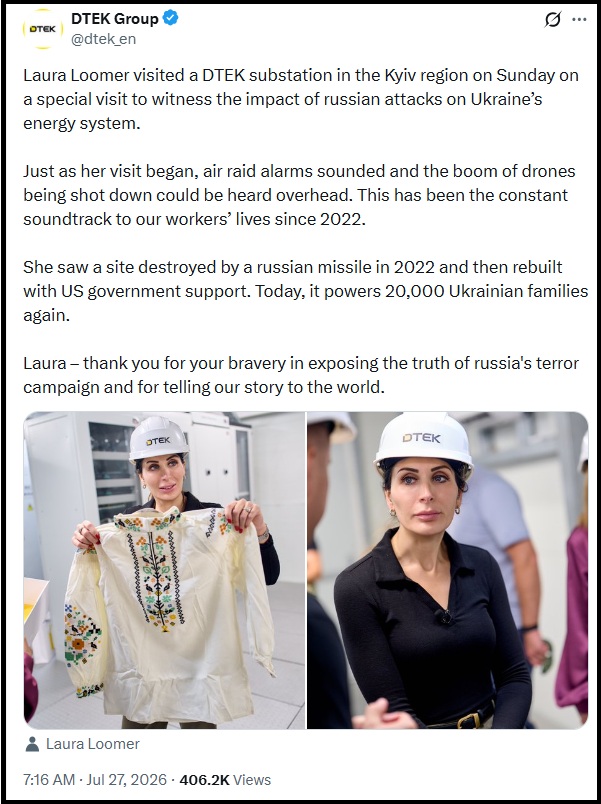
Who paid Laura Loomer?
There were rumors which started swirling around this past week to the effect that this Akmatov tycoon is the one who paid Loomer to go over to the Ukraine to work her witchcraft.
She denied that suspect #1 Ellensky paid her something to the tune of $2-3 million Euros.
Has anyone figured it out?
0.o
Why is this low life cretin Loomer even part of the discussion…..Israel comes to mind. Is she one of the paid influencers? Would love to see Sundance do a deep dive into our situation and what is going on with Trump….Why no domestic solutions to what is destroying this country? How much is Israel involved?
Sundance, Thank you.
This makes my head spin and my gut feel queasy…
The EU grab of Russian assets is unconscionable.