At the conclusion of the discussions in Switzerland, Secretary of State Marco Rubio spent time emphasizing the two groups attained a very important objective. Putting all other issues aside, they had formally mapped out a communication strategy for deconfliction between U.S. and Iranian leadership.
Meaning, if everything starts to go sideways both the USA and Iran agreed to the mechanism for immediate talks. Even if fighting and hostile action was taking place, the deconfliction agreement laid out the process to keep both sides in direct communication. This is not like the “red phone” approach toward nuclear deconfliction, even if both sides were in the midst of red zone brutality against each other.
This urgent deconfliction assembly is exactly what appears to have been triggered, when earlier today President Trump announced via Truth Social that U.S. and Iran delegations were going to meet in Doha.
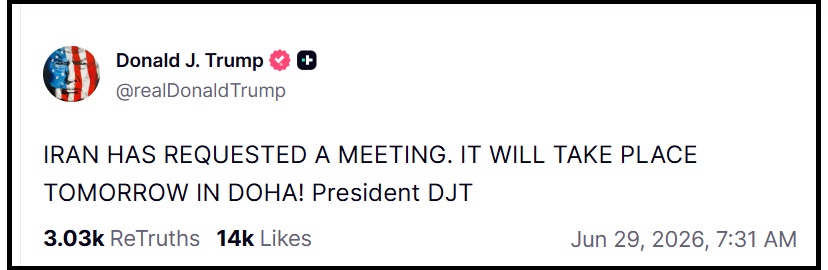
[SOURCE]
Both President Trump and Secretary Rubio well understand that as long as a direct communication process is in place, all of the various regional escalations can be managed safely.
Some element within Iran attacks a ship; the USA retaliates and takes out critical infrastructure. The conflicted point does not disrupt the communication process. This is the optimal solution approach.
(Via NBC) – […] There was no immediate reaction from Tehran. Hours earlier, a senior Iranian official denied any technical discussions were scheduled to take place.
Technical teams working on the implementation of the initial agreement between the two sides are scheduled to meet in Doha in the coming days, a source with knowledge of the talks told NBC News.
Communications channels created to de-escalate any incidents are in place and technical talks are set to continue, the source added.
This follows a series of escalating reciprocal strikes over the weekend that threatened to unravel efforts to secure a permanent end to the war. (read more)

weak excuse..in my opinion……there will never be a long term peace with Iran .
get out let the ME handles it they have the money ……finish it…get out.
Getting Iran’s ancient neighbors directly involved was always part of the plan.
They know what Iran/Persia used to be, and they have been enduring what it became. Yes, they have formidable firepower of their own.
Until the Mullahs with their insane plans are permanently taken out, there will be no peace.
I think of it like our Rino problem. Voters don’t want what they keep pushing and block what the voters want. The IRGC is to the Iranian Government and people as the Rino’s are to the voters who put them in office.
I’m just waiting to see the re-engagement with North Korea. I don’t think there would be a unified Korea on the horizon, but I Think North Korea would’ve been stepping towards opening up had the IC not disrupted PDJT in Term 1.
The “optimal” solution path is what I call the realistic path. Not every single country needs to look like America, but every country we engage with should respect a standard set of norms and pursuit of happiness for their citizens. We are unique in the world and even within this nation. A lot of people prefer to have their hand held, be told what and how to do things and plug away at mediocrity — but they’re happy with that and want nothing more, just don’t make me follow that path!!!!!!
..they also saying..they never will be under “Yoke of Epstein Class and Rothschild’s bankers “…Mike Robinson…….
..Mike..this a job of Iranians not ours…we are not WORLD’S policeman / Santa Claus or to be involved in the endless fight for someone who can not criticized………..
the mullahs we installed? just the bad mullahs. the good ones will work out well.
Tired of the naysayers. Think of Trump as a boa constrictor. Every time Iran tries to take a breath with an ineffective strike. Trump squeezes tighter on the exhale, making the next breath shallower. Soon there will be no breath left. Patience, every time they lash out the result is they are materially weaker.
Patience!
Trying hard to be patient …
Respectfully, please take a deeper look bjorkdream. While much of this situation reminds us of too many decades of previous events, it is completely different.
First and foremost: Unlike most previous presidents over the last century, excluding Reagan and Coolidge, Trump’s motivation is truly to Make America Great Again. The fact that he has stood in the line of fire, despite the attacks on his finances, family, his liberty, and at minimum three attempts on his life. That has got to be good enough to show his true intentions.
Secondly, the events show conclusively that President Trump has obtained all the leverage, by limiting the options of the IRGC. What in reality has Iran been able to do to change the current situation to their favor, besides launch a couple of missiles, or drones? Nothing, in this last episode they have fired four drones, and are once again begging for talks. Trump has limited their freedom of action to two options, bad or worse.
Lastly, I don’t have the time to rehash the 6 decades of my experience in this matter, but the bottom line is Trump has been building this plan of action since before he was re-elected, that I know it to be a plan to be the most effective possible, in consideration of the enemy we face, including but limited to, our own government, the propaganda system, the financial system, the banking system, and the indoctrination system. The timing of all of his actions since his return, evinces a design, a march order of such military proficiency that it equals, or exceeds the strategic thinking of any person, or power that you can name from history.
I can understand that you have no idea of who I am, my experience, or my deepest intentions, but I promise you that I personally know these points, through evidence, as facts.
Trust in Trump.
Thank you.
Yes. 100% Trust in President Trump. Masterful planning.
Ditto MC.
Was just about to post the same!
Well said and explained. Trust his judgement and the plan that he has devised. Unlike his whack at changing America, he had far too, too many within his administration ALL vying for their own selfish mower egos and fought him at every turn. Now, he has the overwhelming administrative management people that have their full trust in him and his capabilities to move our country to it’s greatest potential ever, and bring the rest of the world forward with us if they join in. More and more around the world they see us leading and growing while their one world order Oligarch elitists are trying to consolidate their losing power, and are facing chaos if they do not advance along with PDJT4547’s plans.
Your information and claims are pretty Stark.
Nice bark, spider, made me chuckle.
You, Mr. Stark is why I come here to the Treehouse. Voice of Reason.
Thank you.
Ditto!!! And. THANK YOU ALWAYS FOR YOUR COMMENTS!!
Has the fog of war blinded you Mister Stark? Barring nukes, it would take an extended war to take down the mullahs. If they can hold on for 30 or 40 days the whole world will be experiencing an economic armageddon. There is no longer room for any war with Iran. The administration’s plan must ultimately be to declare victory and leave. As the President said at Versaille, in 4 weeks as it is the world is going to have a serious energy problem. What a mess.
I beg to differ. Expand your thinking. Iran has no leverage, period. Every day they dither they become weaker.
I was just about to say similar.
I see no end ever of the problem that Iran is.
They are playing the long game and we’re not into that game.
The problem is if a nuclear bomb is triggered, the fallout will not stay put in the area, and will spread around the world.
The policy of isolationism does not work when it comes to some weapons.
what nuclear bomb? we ended their nuke program w/ midnight hammer. remember when trump planned that one out and nailed it. just before the next most recent time we destroyed their nuke program? the problem w/ their nukes lives only in your imagination.
we ended their nuke program twice in how many months? stop it.
yes..get out.. ASAP.. restore Constitutional Republic and…N E S A R A !!!!!
One cannot trust any Islamist. They freely lie to the infidel, as instructed by their “prophet”.
Shia, Islam has this insane eschatology they want to see happen.
The more chaos and confusion the more this pleases their fake
Allah too. The other gulf countries oppose this and that is what unites them against Iran/Persia.
I am not sure if the gulf countries really want to take over managing Iran.
We’ll see.
That is why I call it a cult! Name another religion that says to lie to the non believer and kill them! It doesn’t exist. It must be eradicated. Hard, but true! It id almost impossible to civilize a Pit Bull after it was trained to fight! Once it tastes blood it is too late! JMO.
While I respect Trump’s ongoing attempts to establish dialogue, this situation is not going to be resolved until the Mullahs who hijacked the country 47 years ago are militarily taken out. These are not rational people. When they chant, “Death to America,” you must keep in mind that they mean it.
They could be down to just a torso and a talking head, and they’d still chant Death to America. They must all D. I. E.
According to Mark Steyn, who does his research with accuracy, Bin Laden said, “The West may have all the watches, but we have all the time.”
As the predictable plays out, just so…
The Islamic leopard will never change its spots.
Always love your observations, Betsy.
^^100%^^
Mark Steyn had this figured out over a decade ago, still applies today.
what did he say about invading iran?
According to the grandmotherly ladies at Promethean Action, the modern-day construct of middle-eastern conflict began with the Balfour Declaration (1917) and other manipulations of politics, boundaries and resources in that part of the world–all managed by British Intelligence and The City of London. The English have been playing sho’nuff hardball ever since they defeated the Spanish Armada and Napoleon. It’s the great game, and the English have been running the table for a long time. President DJT has taken strong exception to English bossiness. He’s been standing them off pretty much singlehandedly. If Trump can get Thune out of the way and get the Save America Act passed, DJT’s crusade against the globalist\imperialist regime will be strengthened immeasurably.
When Promethean Action says the English I substitute that for the Freemasons.
You are all wet! Do you know what Freemasonry is about? Or do you just have a blank opinion?
Jefferson fought the Muslims before Balfour as a historical note.
…another historical note: the Russia Hoax against Trump was planted by Christopher Steele, MI6, London. Steele knew just exactly who to schmooze to get that hoax going, didn’t he? Rhodes Scholar Willie Jeff Clinton and his Chicago Communist wife.
The Armenian Genocide was also before the Balfour Declaration.
But everything was hunky-dory in the Ottoman Empire before the British got involved.
When they chant that, they mean it.
The US CIA hijacked the country when they took out Mossadegh in 1953. It’s been downhill ever since.
God bless President Trump and his teams for their peace efforts. I don’t have hope for peace in the Middle East while people who want to kill “the infidel” are still in power, or alive. Sigh…
I don’t have hope for peace in America while people who want to kill the infidel are taking over America.
it’s a amazing..how ppl are blind even here on this web…. or see gov.Abbott…
“This is the optimal solution approach.”
I respectfully disagree. The optimal solution approach is to keep your word. If Iran were doing that, this meeting would not be needed.
What I don’t understand is why any Iranian military capability is left intact at all.
Part of the problem is the Iranian government has miles of tunnels in which they park thousands of missiles and other weapons. Does the US have the ability to “look” underground to locate these tunnels? Does Israel have the intelligence to know where these tunnels are?
I think the fact that the US hasn’t taken out ALL of Iran’s missiles and launchers is a testament to the enormity of their weaponry stock. After all, this government spends zero on their people as is evidenced by the drought the people are experiencing. Instead, the government buys weapons of war, builds tunnels, pays proxies like Hezbollah and the Houthis, and are planning as we speak to re-start their nuclear program. That is what sending money to the Iranian government accomplishes.
What I would like to know is what can possibly be gained by “talking” to mass murdering psychopaths? Anybody here know?
Get them to murder Less or someone elsewhere First?
Unconditional Surrender comes at a high price as Gen. Grant learned at Cold Harbor, VA in 1864 in thirty minutes.
Americans can’t stomach such a price.
As much as I agree w/you sir on most of your posts, there are more than enough Americans fed up for the last 47 years of Iranian butchery in Middle East and world wide. Just do it, forgiveness will take place when the world is at peace again. The other alternative is what gives people weak stomachs.
Does the US have the ability to “look” underground to locate these tunnels?
Well, there’s aerial / satellite gravity anomaly mapping
Anyone here with enough technological knowledge to rule that in or out?
Or is it classified?
Simple, because we didn’t and don’t have an adequate inventory of bunker busters adequate to take out their missile and drone tunnels, so we just bombed their entrances. Even before the “ceasefire” satellite images showed they started digging them out within 48 hours of being bombed. An IDF X post I saw but I now can’t find bragged about bombing earth moving equipment doing that.
I have pointed out that this would not have been a problem if the government had fallen early on in the war as predicted by Bibi and the Mossad, but contradicted by our own IC.
Iran’s most critical underground missile and drone tunnels—often called “missile cities”—are buried hundreds of meters deep, with some key facilities reaching about 500 meters (1,640 feet) beneath solid granite mountain rock.
Key depth details:
| Facility/Location | Reported Depth | Rock Type |
| Yazd base (Imam Hussein base near Yazd) | ~500 meters (1,640 ft) | Shirkooh granite |
| Natanz, Fordow, Isfahan facilities | 200–500+ meters | Solid granite |
| General IRGC missile bases | Claimed 500 meters nationwide | Granite/rock |
| Some smaller bases | 30–80 meters | Mixed |
Why this depth matters:
– Granite protection: The Shirkooh granite formation is among the hardest rocks on Earth, making penetration extremely difficult
– Buffer zone: There’s a 440-meter “dead zone” of solid rock above the facilities where explosive energy fades before reaching critical areas
– Bunker-buster limitation: The US GBU-57 super bunker buster penetrates only several meters into hard rock, far short of Iran’s 500-meter depth
– Survival buffer: This gap leaves a massive survival buffer even against the heaviest penetrating strikes
Iran’s Aerospace Force commander Amir Ali Hajizadeh has stated that Iran created missile bases in all provinces at 500 meters depth. These facilities include automated underground rail systems connecting assembly areas, storage, and multiple exit points.
————
Six MOPs (Massive Ordnance Penetrator bombs) were dropped into each of the two ventilation shafts at Fordow, Iran’s underground nuclear enrichment facility.
Key details:
– Total MOPs at Fordow: 12 (6 per shaft × 2 shafts)
– Bomb type: GBU-57/B 30,000-pound Massive Ordnance Penetrator
– Attack sequence: The first bombs destroyed concrete covers, then the next four penetrated the facility, with the sixth as a “flex” backup weapon
– Additional MOPs: 2 more were dropped on Natanz, for a total of 14 MOPs in Operation Midnight Hammer
– Date: June 2025 during Operation Midnight Hammer
Fordow is built inside a mountain, and the ventilation shafts were targeted as a vulnerability to penetrate deeply into the underground centrifuge halls.
The U.S. Air Force likely has about six GBU-57 MOPs remaining in its stockpile.
Key details:
– Original inventory: At least 20 MOPs delivered by Boeing as of November 2015
– Used in strikes: 14 MOPs were dropped on Iranian nuclear sites during Operation Midnight Hammer on June 21, 2025
– Current estimate: Approximately 6 MOPs remaining after the 14 expended
– Stockpile size: The exact size is unknown but understood to be “relatively small”
– Replenishment underway: The Air Force awarded Boeing a sole-source contract in February 2026 to produce additional MOPs, with projected delivery starting January 2028
The idea that the government of Iran would collapse was unrealistic as it and its military were specifically designed to prevent that. They aren’t stupid…
Q: Was it projected by anyone in advance of the current war that the elimination of top level Iranian leaders would most likely lead to more radical lower level leaders and, at the very least, lead to uncertainty about who was in control during a peace agreement?
Yes. Before the current war with Iran began, U.S. intelligence and independent analysts explicitly projected that eliminating top Iranian leaders would likely empower hardliners and create uncertainty about control during negotiations.
Key prewar projections:
| Projection | Source | Timing |
|————|——–|——–|
| A CIA intelligence report completed shortly before hostilities suggested removing the supreme leader could empower hardliners within the Revolutionary Guards
| The National Intelligence Council’s February assessment concluded that if Supreme Leader Khamenei were killed, the most probable outcome would be appointment of another hardline successor from the existing elite, preserving ideological hostility toward Israel and the West
| Analysts warned that killing top leaders may not moderate Tehran’s behavior and could produce “continuity with radicalization,” especially if the IRGC gains larger strategic decision-making role
| Experts noted that increased assassinations could enhance regime resilience while promoting less experienced individuals to higher ranks, who may intensify defiance
About uncertainty during peace agreements:
The prewar assessments also found that no unified opposition coalition was poised to take over if leadership was killed, meaning the establishment would attempt to preserve power continuity. Currently, persistent internal disagreements remain among Iranian regime leaders over concessions to accept, with various power centers jockeying to influence negotiations. The untested leadership of Mojtaba Khamenei (Supreme Leader’s son) has yet to appear publicly, leaving uncertainty about his guidance as supreme leader.
The assumption that removing key leaders could bring rapid regime change has proven to be a miscalculation, with assassinations leaving little room for negotiation as those stepping up appear far less willing to compromise.
——–
Q: Did the Israeli IDF do most of the assassinations?
Yes. The Israeli IDF conducted most of the assassinations of top Iranian leaders in the current war.
Key facts about the assassination campaign:
Scale: Israel has eliminated around 30–48 senior Iranian officials, including the supreme leader, defense minister, IRGC commander, intelligence minister, and armed forces chief of staff.
Opening day strike: On February 28, 2026, Israeli strikes killed Supreme Leader Ayatollah Ali Khamenei and 40+ senior military commanders simultaneously in Tehran.
High-profile targets killed: Ali Larijani (de facto leader), Aziz Nasirzadeh (defense minister), Mohammad Pakpour (IRGC commander), Esmail Khatib (intelligence minister), and Abdolrahim Mousavi (armed forces chief).
Strategy: Defense Minister Israel Katz instructed the military to “continuously sever the head of the octopus” — a systematic campaign unprecedented in modern warfare.
Division of responsibility: In the US-Israeli campaign, Israel was left to hunt and kill Iranian leaders ruthlessly, using its intelligence apparatus built for targeted eliminations.
The IDF described this as ***a push to undermine command and control in Iran***, with the killing campaign being unmatched in modern history at this scale while actively fighting a conventional war.
——–
Q: On “a push to undermine command and control in Iran,” was it known that Iran had specifically prepared for that by creating 31 separate military command regions?
Yes. It was known that Iran had specifically prepared for command-and-control disruption by creating 31 separate military command regions.
Key details about Iran’s preparation:
Doctrine name: “Decentralized Mosaic Defense” (formalized in 2005 under General Mohammad Jafari)
31 regional commands: The IRGC reorganized into 31 autonomous provincial commands, each corresponding to one of Iran’s provinces
Purpose: Designed to make “any attempt at degrading Iran’s defense exceedingly difficult” and ensure the downfall of Tehran’s leadership does not create confusion in the military force
Autonomous operations: Each command is equipped, staffed, and trained to operate independently in wartime without waiting for orders from the capital
Self-contained units: Each provincial command functions as a self-contained military unit with its own weapons, intelligence, command systems, missile/drone capabilities, and munitions stockpiles
Created as early as: 2008 (the 31 regional commands were created then)
Reinforced after: October 7, 2023 Hamas attack, as Iran prepared for prolonged regional conflict
This structure was explicitly designed to allow regional units to launch an insurgency if Iran were invaded and to maintain operations under heavy assault, including decapitation strikes targeting leadership.
Short of an unrealistic peace throughout the region, is it the best thing for Israel to have its neighboring enemies occupied with internal wars and revolts to keep them preoccupied?
[long answer in the affirmative]
In summary, yes—preoccupying enemies via their internal problems is a pragmatic Israeli (and general) strategic preference short of peace or decisive victory, rooted in survival logic and seen in actions and writings.
Danny Citrinowicz (senior researcher at Tel Aviv’s Institute for National Security Studies / INSS, and a former Israel Defense Intelligence official with expertise on Iran).
In early March 2026, amid the Israel-Iran conflict, he told the Financial Times (summarizing the Israeli government’s perspective):
“If we can have a coup, great. If we can have people on the streets, great. If we can have a civil war, great. Israel couldn’t care less about the future…[or] the stability of Iran.”
Ty Winston….most ppl have no idea about strengths of Iranian’s missiles /drones and even ground military ..they shout now about 1,000,000 army will “welcome” invaders……. why some ppl still do not get ..they are not Iraquis/Libyians/Yougoslavs/Lebanesse…..
Get in through the front door? If we can’t get in, they can’t get out!
they been ready for this war/s at least 25 yrs ..they knew one day will war broke up…. now they openly shout they are ready for…..ground invasion….I do not think we are…….
The problem is: they have a large Army. It is not concentrated in a few bases; they are spread widely in small groups. Very difficult to exterminate that way.
Ridiculous, so Iran bombs a ship and some of its crew get killed or Iran bombs it’s neighbors and their citizens get blown up, hey don’t worry we have our ‘open discussion teams’ to ask the Iranian’s why did they do that. Trust me, go back and just study the one truly successful decision Truman made (other than dropping the bombs) –unconditional surrender or guaranteed death.
I agree, but the US attacks have been massive compared to what came out of Iran. Once again it’s the Iranians yelling uncle and wanting to talk more. Yes it’s a stalling act, but they are loosing more and more.
I also want unconditional surrender from every faction in Iran.
In Vietnam war USA didn’t even consider a NVA surrender, with much more bombing, USA troops in country, dead & wounded. All USA wanted was a brief cessation to leave “honorably”.
What you want, doesn’t include What the enemy is willing to endure.
FAFO, see how much they can tolerate. The Iranian population has already declared that they want the mullahs all gone, destroyed after being under their sadistic rule for 47 yrs, they would like something else.
want in one hand…
While Truman’s decision was binary and simple, most decisions and choices in the world are much more complex; instead of A and B, they are more akin to a spider web, where every decision affects the whole web, not just the parts that you wish to destroy, but also the parts you wish to save, Iran is connected to every other situation and problem we face, and it takes a level of deep analysis to ferret out the best solution.
The problem would no longer be a problem if we just nuked the entire world, but it would also destroy us; the complete destruction of Iran, would get rid of the problem, but those pesky things known as unintended consequences would have an effect also.
There’s more to it than that.
https://badlands.substack.com/p/badlands-brief-dc6?utm_source=post-email-title&publication_id=1135129&post_id=204061395&utm_campaign=email-post-title&isFreemail=true&r=kmf72&triedRedirect=true&utm_medium=email
Nope
Hope theres a scoyus thread. They really screwed trump and maga today
And it’s just the two “CONservative” judges you think it is who sided with the three cat ladies.
The lunacy needs to stop. Just get it over with already.
Yawn.
Talk with Iran is cheap, especially when nobody there has the power to make commitments for all.
I think our legendary Deal Maker in Chief has run into a deal that can’t be made.
its hard to make deals w/ people you blew up. or even the remaining family members of the people you blew up.
despite what john stark says…
Clausewitz must have been wrong. Wasnt the war supposed to be the “deconfliction” event?
When are you going to stop playing the IRGC games Mr. President? Their plan is so obvious. Enough already.
President Trump’s are just as obvious, if you look hard enough. Respectfully, and with no intention of snark here, please ask yourself this: does President Trump–the guy who succeeded in one of the most corrupt real estate markets in the world–not recognize the obvious plan that is so obvious to you and me?
If you had to put all your money, property, and family on one choice, which would it be? With zero hesitation, mine is on Trump knowing what he is doing; yours?
The only way this ends with Iran NOT having a nuclear weapon AND the strait of Hormuz open to free and unfettered access for ALL cargo and energy shipping is for two things to be accomplished….
We must bomb them so hard and with such intensity that any remaining leaders beg and plead on their knees for UNCONDITIONAL SURRENDER. We then imprison every last one of them on some remote island in the Indian or Pacific Ocean never to be allowed to leave.
This is the only way to destroy what Iran has become and eliminate the horrific British influence in the world.
I agree 100%.
Every day the US agrees to “negotiate” is a big win for the IRGC and the Mullahs.
Destroy everything – then leave.
We must look WEAK in the eyes of our adversaries.
Kill them them. Let Allah decide who gets the virgin 47 fresh/old goats to enjoy.
Lots of ghouls here on the treehouse. I would be more worried about my own soul.
“A successful communication strategy” is a major component to any USA and present Iranian relations. AND, once the line of credible communication has been established—–does the Iranian “communicators control the purse strings for th IRGC?
Follow the money financing the people and armaments will provide a more effective strategy to initiate and maintain a peaceful Middle East.
I tried to point out that most religious wars will never be resolved. (Especially ones that started around 1,500 years ago.) But I was flamed and attacked as stupid because I didn’t know the earth is flat. Well, maybe the trolls are correct, IDK, I wasn’t there in the City of Mecca at the time.
We have to face the fact that we are negotiating with barbarians. The rules that we attribute to civilized and honorable behavior have no meaning for barbarians. Unfortunately, there is only one way to deal with barbarians. You have to deal with them the same way that they deal with you. It all relates to “the last man standing.” There is no compromise.
That is called WAR! That is what we had towards middle of the last century. To the bitter end…until the last man standing. Will anyone win the next one? If it is confined to the ME, perhaps. If the IRGC is destroyed, maybe for a while.
It may be possible to wreak enough havoc in the Islamic Republic of Iran so that they are literally incapacitated and can do little to foment disorder in the ME but it will be temporary.
The Islamic Republic of Iran is NOT the military arm of the nation of Iran. Their mission is NOT defense of the Iranian people. They are a satanic terrorist cult absolutely obsessed with destroying Christianity (USA) and Judaism (Israel). They happen to have violently deposed the Iranian government and interposed themselves as dictators between the world and the Iranian people but they are NOT historically Persian.
They may be forced to cower and comply for a season, courtesy of the American and Israeli militaries, but they will seethe with demonic rage and continually plot to resume their war against the rest of the world. These creatures cannot be negotiated with. They must be forcibly contained and controlled with military violence. That is the ONLY option. The world has always had to contend with this satanic cult – only relatively recently have the globalists allowed them a resurgence and we are reaping the whirlwind today.
Jefferson did not try to “make a deal with” the Islamic “Barbary Pirates.” He created(!) the US Navy to go after them and destroy them. He knew that this was the only available option.
When he learned that the pirates said that what they were doing was sanctified by Allah, that’s all he needed to hear.
Even so, it took an invasion orchestrated by the French to finally and fully take them out.
“Some element within Iran attacks a ship; the USA retaliates and takes out critical infrastructure. The conflicted point does not disrupt the communication process. This is the optimal solution approach.”
President Trump knows things that we don’t know.
Is it possible that the “elements” (factions) alluded to by Sundance are in fact leftover “spooks” from the CIA/USAID that were so heavily involved in the Arab Spring?
I think that’s possible, although we have no way of knowing for sure.
If true, that means that President Trump is battling the IC Deep State as well as the Iranian theocracy, obviously complicating peace talks (sounds like Ukraine, doesn’t it).
The “deconfliction strategy” ensures that these rogue factions are not able to sabotage President Trump’s efforts in Iran.
I mention this possibility to offer some perspective to the “To Hell With Trump” crowd that is bleating so loudly with their negativity.
The perception to me is that Iran is buying time, stalling, trying to wait out President Trump’s term in office hoping some weak kneed politician will replace him like before! America is known for it’s weak kneed Presidents! President Trump being the first that wasn’t!
Blah Blah Blah. I support the President Trump 100.% but this is making him look bad.
We know, as no doubt he does too, that these “negotiations” are going to happen at the barrel of a gun.
“We have resumed beating the sh&t out of you. And we are going to continue beating the sh&t out of you. Would you like to talk?”
These are barbarians. Plan accordingly.
We will continue betting the shit out of you until your morale has change or you stop this asinine approach to your retaining power. Whichever comers first. Who wants the over/under spread odds they force us to kill the all?
For us and the rest of middle east, pick a medium sized city maybe like their main port Bandar Abbas and rubbleize it. The metro area is about 700k. It puts them in a bigger bind relocating all the people and lets them know beyond a shadow of doubt we mean business. Let them know if the nuclear deal is not made Tehran will look like Bandar.
It worked in Japan.
No do not do this to a population center.
We need to know the precise locations of their 31 buried command centers.
We should have known about their decentralized command structure before we tried with Israel to “decapitate” their command.
We need to stop pretending this will stop until those decentralized commands are taken out.
We need to stop pretending that our Bunker Busters will pernitrate 500 meters of Granite.
We need to consider that the world needs this although France, GB, Germany and the rest of Europe will gasp when we do it.
We need to ask “How many Kilotons will be needed in each device to reach the embedded command 500 meters down in the Granite?”We need to strike every one of these command centers with a heavy enough “ordinance” to dig them out and incinerate them all.
I have read down through this thread this morning and there have been many people here with way more military experience than I have (I have none.).
The people commenting here have way more military information than I have access to.
They have described this situation in detail and the only thing I can see is that we need to use whatever we have on hand that will reach these commands in their caves.
No one so far has said what that will take.
I’ll say it.
Nuclear weapons.
This will not stop until we make Iran a “Nuclear State.”
We are out of the amount and type ordinance we would use and it would be ineffective in any case.
As I read above Boeing will not deliver any more until 2028.
We have what we really need on hand.
We are just going to have to pull up our big boy pants and cinch up our belt and use it.
If we start using it one a day on the buried commands then after 2-3, the others may say Uncle.
But this stalemate is what we will be negotiating for decades if we don’t start wiping out their ‘Mosaic.”
Do you want everyone to take us seriously?
Do you want Europe to fall in line?
If they know the US has the will to go there when they have to everyone will take a deep breath and say “Yes sir.”
Dropping a nuclear weapon would destroy any chance of a peaceful Middle East. Yes you could destroy a single target but the surrounding nations will have to deal with the fallout and other issues that a nuclear weapon produces.
Alternative is to destroy all their dams providing what little water supply they have left. Will be slower than nuking them but same long term results.
It is a little late to expand my thought. Most of you are not old enough to remember the Allied Carpet Bombing of Dresden Germany. Don’t use a nuke, Do it the Conventional way. I am half way nuts but not all the way nuts. The people would be given advance warning to leave the city.
Keep on pretending!
This happened because President Trump bombed Iran everytime they violated the agreement. They violated during the day, he responded that night. It took them awhile but they figured it out. 300% inflation will do that.
We are fighting the Hormuz coast pirates.
Destroy everything military in Iran, make them defenseless. They are a mobster’s, extortion money laundering kidnapping murder and they terrorize their neighbors.
Yes this is the situation.
Look at the Coast of Hormuz, figure out where all of their drones and missiles are stored, and then drop enough nuclear devices to sterilized the coat of anything existing from the water back about 5-10 miles, so there can be no assault on shipping from the Iranian side.
And get the Hooties while you are at it.
Another meeting. Maybe this time….
Simply removes the ability of the IRGC to play let’s pretend and escalate the conflict. They can live in the fantasy, being supported by opponent’s of the Administration, that their power is un diminished, but in reality every attempt by them to restart the conflict will trigger a de-escalation mechanism and result in more of their assets being turned to scrap.
Via CNN, “Iran’s leaders say na-ah, we didn’t ask for a meeting”
Then we should keep bombing and don’t stop until the Iranian leader PUBLICLY ASK for a meeting.
And tell them this will continue until you publicly ask, Beg for the meeting.
And Say Please when you ask.
SO MUCH BS. HAVE THE 3 WORLD POWERS, USA, RUSSIA, CHINA, DECIDE ON IRAN, UKRAINE, TAIWAN.
PEACEFULLY SETTLE IT. SIMPLE EACH GETS WHAT IT WANTS IN ONE COUNTRY.
there is more and more distrust between those 2 blocks…….currently is great push military and general public on VVP to STALINGRAD-ized Kyiv and ANCHORAGE”SPIRIT” ..is in the question too…
I believe that with Trump we have the best negotiator possible. Having open channels for communication is good. I don’t see that “peace” will be accomplished anytime soon. Meanwhile, my concern here at home is how the disruption of oil will be affecting us while this continues to cause shortages. Should I be storing non-perishables, canned and dry goods, motor oil, and others items, local meats and vegetables (I live in Amish country, thanks be to God). Shortages on fertilizers and diesel will cause inflation of food costs sooner than later.
I’d like to have reliable accounting of where our nation accutally stands in oil supply…not some “everything is fine” and gas prices are not coming down (especially diesel) because we are being “gouged”.
AI prediction: A return to high-volume, mostly routine transit is probable (say, 60-80% likelihood within 6-12 months if the interim deal holds and expands), driven by mutual economic needs. However, the exact pre-war situation—uncontested, low-risk, no Iranian leverage—is less likely due to eroded trust, the precedent of Iran’s successful disruption, and Iran’s incentives to retain influence. Expect a “new normal” with higher baseline risks, costs, and possible oversight mechanisms rather than the old hands-off flow.
To me it’s simple Iran’s stalling ya can’t trust them they will never hold up to their end of deal.
So if we’re going to have pain at the pump and what not I want bombs dropping every damn day. I’ll take the pain at the pump for how ever long it lasts.
Yet I don’t want to feel the pain twice and that’s where we’re heading.
Although it would be the greatest troll ever If President Trump was secretly and slowly arming the Iranian citizens For the day we do decide to end them. This has crossed my mind many times.
I see this as 1) a recognition by both parties that the Iranian government has little or no control over the Revolutionary Guard (IRGC), and 2) a mechanism to prevent renegade IRGC attacks from derailing the peace process. In effect it neuters the IRGC. Attack, don’t attack, no matter, the process moves forward either way. It also provides some time and elbow room for the Iranian government internally to try to isolate and get control over the IRGC.
That Regime in Iran needs to be removed permanently! How many times can we look the fools for permitting these terrorists to continue lying and breaking agreements? Finish this and free the Iranian people who long for freedom! 💁🏻♀️ If this regime is destroyed so will their terrorist proxies be done!! Nobody will fund their terrorism!
Iran will continue to play Trump right up to the brink of the midterms then blow it all up to get gas prices back up in hope the R’s lose control of Congress. Sad that Trump is allowing it to happen so far!
And will this on again, off again farce until Iran can finally acquire nuclear weapons?
Just how stupid are we?
IMO, and it may not be popular is …. JD’s M.O.U. was a surrender agreement.
If that wasn’t good enough, then stronger military action may be needed.
Not true if you view literally anything put out by Iran. They have firmly said no one will be meeting the US delegation in Doha
Clown show continues…
CRUSADES 2.0 now.
I’m tired of the mad mullahs playing us. I’d tell Iran: Get rid of the Mullahs and the IRGC or Kharg island becomes an island of glass.
So, Iran hits a ship and we immediately have to have a sit down? Uh uh. Iran hits a ship and we hit them incessantly until they can’t send a message.
When it comes to strange, this whole thing merits a g old medal.
Deconfliction In Doha is one of my Rodgers and Hammerstein tunes!
Great plan President Trump. Keep it up. its all about Making American Great Again.
China will continue operating drones and other military engagements in Iran from China
Ida Turan 🇮🇷 ایده توران
@iranidaturan
The regime is in chaos right now, some people told Trump they want a meeting tomorrow in Doha, while others are denying it 😂
And now look at this post from a few hours ago by a Tehran MP who’s one of the hardliners against negotiations: ”is a coup on the way? ”
I made this video 3 months ago, right in the middle of the war. In it, I explained exactly who President Trump was signaling to, why they would respond, and I even predicted something close to a coup.
If I could see the situation this clearly, they can see it too.
I really hope arrests and infighting inside the regime start soon.
Let Trump cook
Cont…
This is why Trump should re-impose the blockade and refuse any further talks. Apply more pressure to break the regime from the inside. Letting them do this endless negotiation dance whilst being able to sell oil is letting the pressure off.
………..
For goodness sake, stopping this endless loop. This is what Iran has been doing to every US President for decades, stringing them along then breaking their deals.
Here’s the current version: Iran signs a deal, Hezbollah attacks Israel, Israel responds, Iran breaks deal, US responds, Iran requests meeting rinse and repeat.
I hate to say it, but the Mullahs have got Trump responding to them like they have every other President.
Stop talking and just re-impose the blockade – that’s what was really hurting the Mullahs. Don’t talk to them, force your will onto them by re-imposing the blockade.
When the blockade is re-imposed give no indication of when it will be lifted and let the Mullahs know that there will be no talks and ceasefires and deals etc. The Mullahs have had more than enough chances to talk and deal and work out a peace deal..
back and forth with lying iran regime there is ever ending regime’s game,?
Why Iran Keeps Attacking Tankers Despite the U.S. Iran Ceasefire
At the center of the dispute are two competing shipping corridors.
Iran insists vessels should transit closer to its northern coastline through waters it manages. Tehran requires ships using that route to coordinate with Iranian maritime authorities and has introduced transit fees that it says cover navigation and security services.
The United States rejects Iran’s position, arguing that commercial shipping has the right to transit the Strait of Hormuz under international law without paying Iran or accepting Iranian control over international navigation.
Instead, Washington has worked with Oman to establish an alternative shipping corridor running south of the main Iranian route along Oman’s Musandam Peninsula. U.S. naval forces cleared Iranian naval mines from the area during the conflict and have since provided security for commercial traffic using the corridor.
A significant development came this weekend when the Joint Maritime Information Center, operating under U.S. naval oversight, announced that the Omani corridor had been expanded to accommodate both inbound and outbound commercial traffic. Previously, the route had largely been used to move vessels out of the Persian Gulf following the conflict. The expansion now allows ships entering the Gulf to use the same protected corridor.
The announcement effectively created an alternative to Iran’s preferred route and represented the clearest U.S. effort yet to restore commercial shipping without relying on Tehran’s approval.
Iran reacted immediately.
Speaking during a press conference in Baghdad on Sunday, Iranian Foreign Minister Abbas Araghchi said the Strait of Hormuz would remain under Iran’s complete oversight and management for the next 30 days, describing the arrangement as consistent with the U.S. and Iran memorandum of understanding.
According to Araghchi, Iran alone is responsible for managing maritime traffic and restoring the waterway to normal operations once the remaining obstacles are removed.
“No other country or party has responsibility in this matter,” he said.
He also warned against any attempt to establish alternative arrangements for shipping through Hormuz without Iranian involvement.
Any unilateral action or separate navigation system, Araghchi said, would complicate the situation, increase regional tensions and delay the reopening of the strait.
His remarks amounted to Tehran’s clearest public rejection yet of the expanding U.S. backed shipping corridor.
https://www.osint613.com/article/why-iran-keeps-attacking-tankers-despite-the-u-s-iran-ceasefire