U.S. Trade Representative Jamieson Greer gives a broad overview of the current status of U.S. trade relations with China on the heels of the Beijing Summit. Greer notes that China has agreed to fulfill all previous purchase agreements and the future of trade between the U.S. and China looks very stable.
Additionally, China has made major purchases for 200 Boeing aircraft and up to 500 jet engines that are worth multi-billions in benefit within the manufacturing sector for the United States. Following the conflict points between the U.S. and Europe, specifically as it relates to outcomes from the military engagement in Iran and the weakening of selfishly motivated NATO alliance members, China does appear to be more open in their trade relations with the USA. Perhaps this is driven by the new paradigm of energy dependency that Beijing is not familiar with.
The most interesting aspect to the Beijing trip was not and is not the trade success stories that surfaced during the trip {USTR Greer}. While President Trump brought titans of industry, tech and finance with him to Beijing, the emphasis was on relationships.
Perhaps President Trump was teaching those influential peers something akin to needing a perspective change. Perhaps the nature of trade relations is so structurally under change, all those business interests within it need to look at things differently.
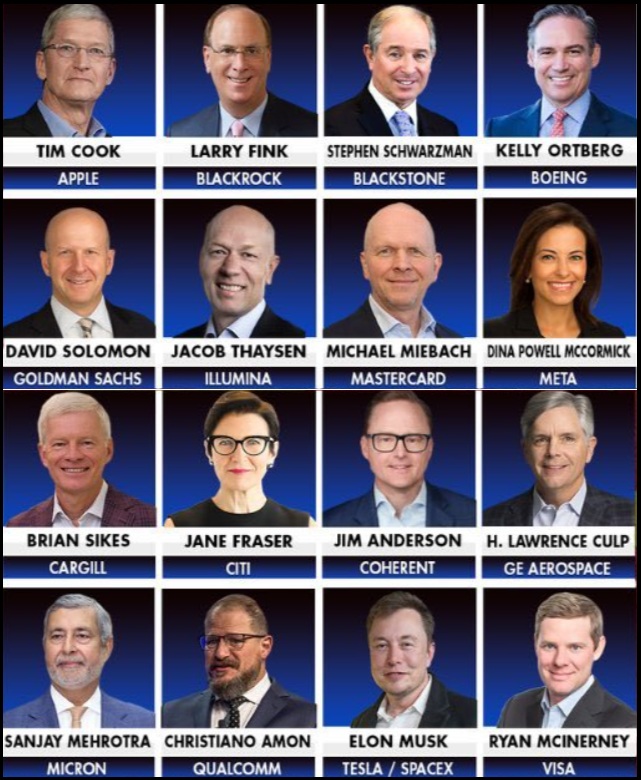 Stay elevated. Note the emphasis by Secretary Rubio was on geopolitical relations against the background of current events.
Beyond the customary chatter and headlines, note how much energy is spent on the ‘relationship’ aspect to President Trump and Chairman Xi, from both leaders and also on direct questions to all pertinent current events.
When questioned about issues, Trump, Rubio and Xi spoke of relations – not details of policy or current events.
The venues within China were specific to something more akin to understanding motives behind policy, personal motives, historic motives from a personal perspective. It wasn’t a trip of transactions; the vibe, the frequency of it all, was seemingly dominated by something more important to the moment than dollars and yuan.
The video of President Xi taking President Trump to his personal residence is exceptionally interesting. [HERE] There are facets to watch that tell a story.
Borrowing from some insight provided by MaineCoon.
First, the body language. Chairman Xi is very relaxed, shows interest in PDJT’s personal safety (not hitting his head on the door frame), and then the remarkable exchange of when President Trump asks via interpreters if Xi invites other presidents to his residence. Watch Xi’s body, reflexive response first (head, smile shaking “no”) heartfelt, to which he verbally says no also. Truly an amazing exchange. Shows true friendship, no pretenses despite the formality.
Second, watch how XI touches Trump’s arm sometimes. This show openness, trust, friendship on a deep level between them. There is a respect beyond the politics, we got to see a glimpse of it.
Later, in the room, Chairman Xi references President Trump previously inviting him to his personal home Mar-A-Lago. Yes, a foundation based on politics; however, the Chinese culture/perspective is long term, not short.
President Trump is a long-term planner too. Willing to accept criticism for the momentary events because he views the longer process more substantive. These men have more in common than most realize.
The relationship between Xi & Trump is personal in addition to the business of our countries. President Trump brought his closest “business friends” not only to make deals, but to respect a changed relationship with Xi’s country. Something that needs personal engagement beyond just business.
It seemed critical for both leaders to convey mutual alignment, ensuring and emphasizing the importance of no conflict between two superpowers, even if policy differences are present. During media hits, both Rubio and Trump emphasized this overall tone in their comments on policy.
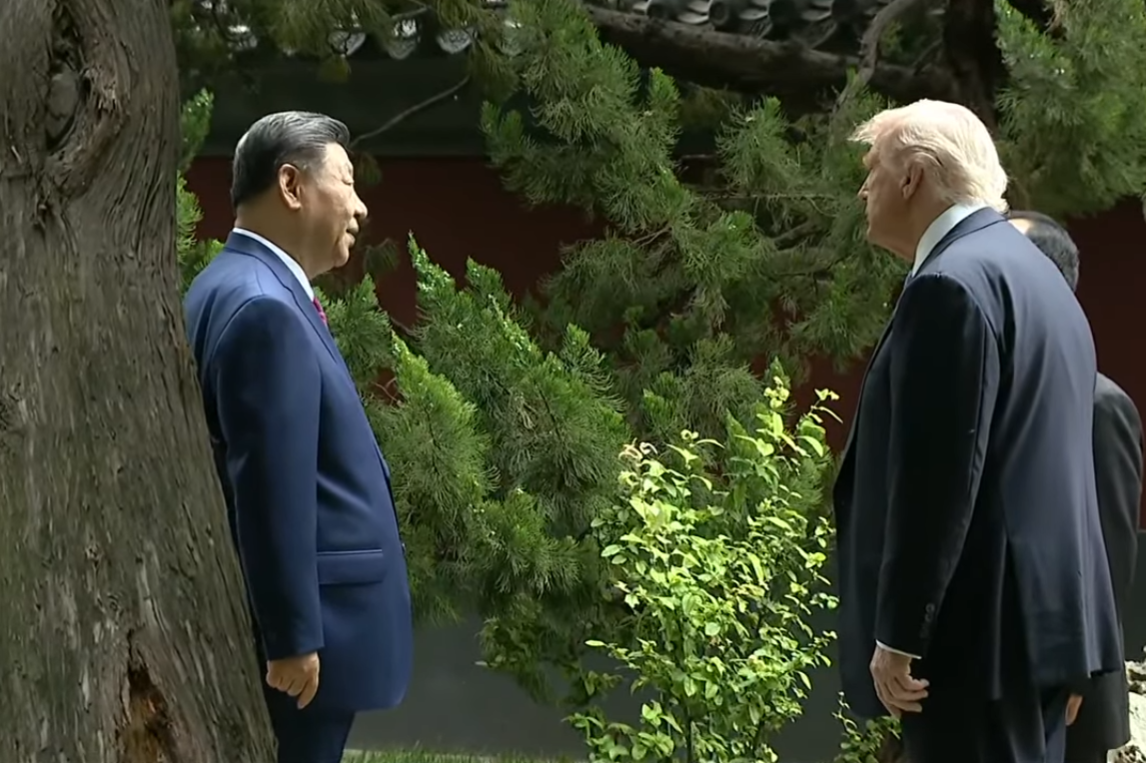
What exactly is this? To me, this approach makes sense given what I view as the big picture behind President Trump’s term.
President Trump is framing out an entirely new geopolitical alignment and both Russia and China are cornerstones in this construct.
President Trump has changed things. The economic world that Beijing planned into their strategy of growth no longer exists the same way. This can be unnerving, especially for China and Chairman Xi. Assurances are needed.
The biggest losers right now, actual economic losers being hammered by the energy sector, are Europe the U.K, and all the British commonwealth countries therein (including Canada). As this unfolds, China is essentially in a period of economic statis, lacking power and influence within this dynamic.
China’s rise to power was through their industrial production plan, which has one fatal flaw, a dependency on customers.
If China’s targeted customers are destabilized their behavior changes.
We saw this play out in 2018 when the G7 in Canada erupted on Trump because their economies were shrinking. Their economies were shrinking because President Trump was confronting China (vis-a-vis tariffs and ASEAN replacement partnerships) and Beijing was responding by lowering prices and, unfortunately for the EU, Chinese companies stopped purchases of industrial equipment while they evaluated Trump’s moves.
In 2018 and 2019 China stopped major purchases of industrial goods from the EU, that hurt the economy badly. That was the background for that infamous picture in Canada at the G7 meeting.
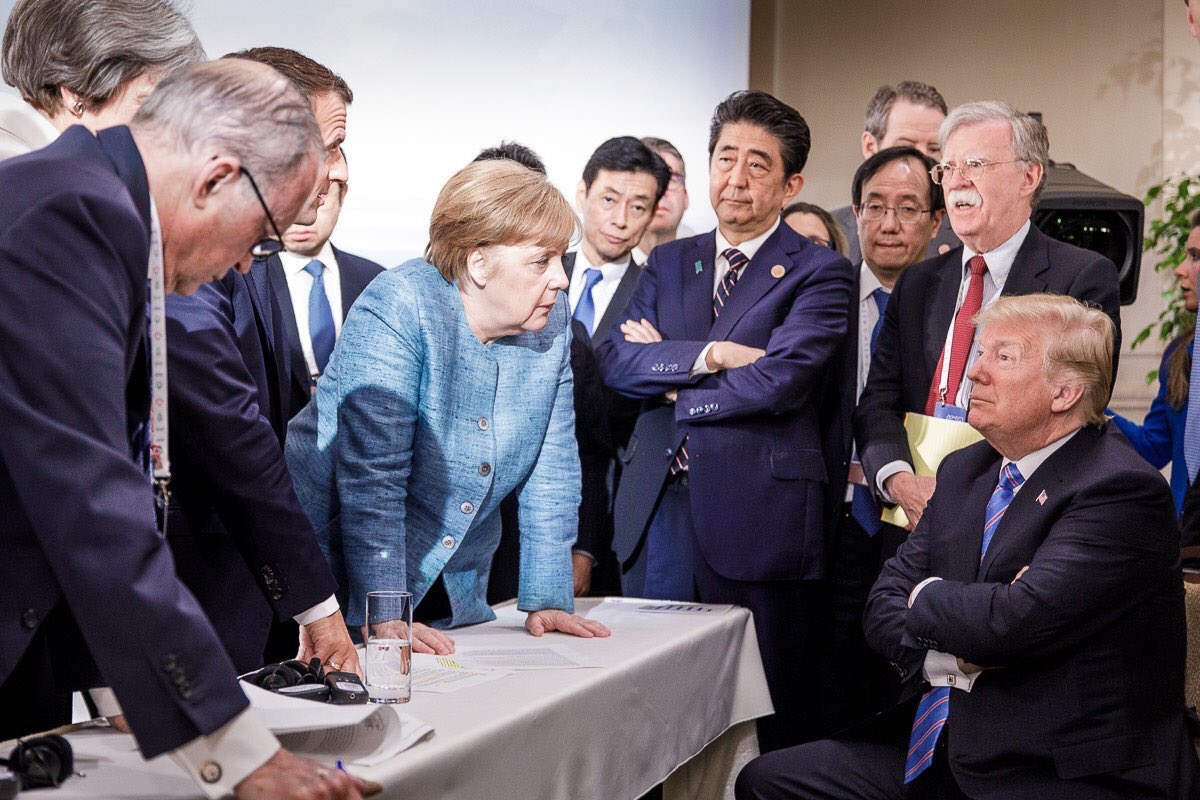
Japanese Prime Minister Shinzo Abe and the Association of Southeast Asian Nations (ASEAN) were fine. Japan, Vietnam, South Korea, Indonesia, Philippines and Thailand all picked up business as President Trump told manufacturers to move production out of China and into ASEAN nations. That process was underway.
However, China started pulling back spending and devalued their currency as a strategy to lower prices and retain those manufacturers despite the tariffs. It is important to understand how this impacted Europe, especially Germany.
Remember, big picture: Europe was angry, Japan and Southeast Asia were not.
Fast forward to 2026 and the current energy issue. Once again President Trump has put the EU into a place of severe compromise, and without Russia filling the void of oil and gas missing from Venezuela and Iran, China would be in trouble.
President Trump and Secretary Bessent lifted the sanctions on Russian oil and gas. Russia is filling that gap into China and Southeast Asia; however, China is now in a position of uncomfortable and unfamiliar dependency.
Thus, with Big Panda experiencing dependency for the first time it becomes critical for Trump to emphasize that all is ok, don’t worry, we’re all friends. Still, when Europe contracts it hits China hard, and when China contracts it hits hard on Europe.
China’s long-term plan always included being able to infiltrate and leverage Europe’s market for their own economic benefit. They have been very successful. However, Trump is changing things and former ‘western’ power centers in Europe, and the UK are losing power rather rapidly now.
The big picture takeaway from this summit is President Trump and Chairman Xi, the two biggest apex predators in the world of economics, talking to each other about the importance of staying deconflicted as this geopolitical realignment takes place. The nature of the relationship then becomes important, and that’s exactly the vibe that comes out of this trip.
In four days, Russian President Vladimir Putin will next visit Beijing.
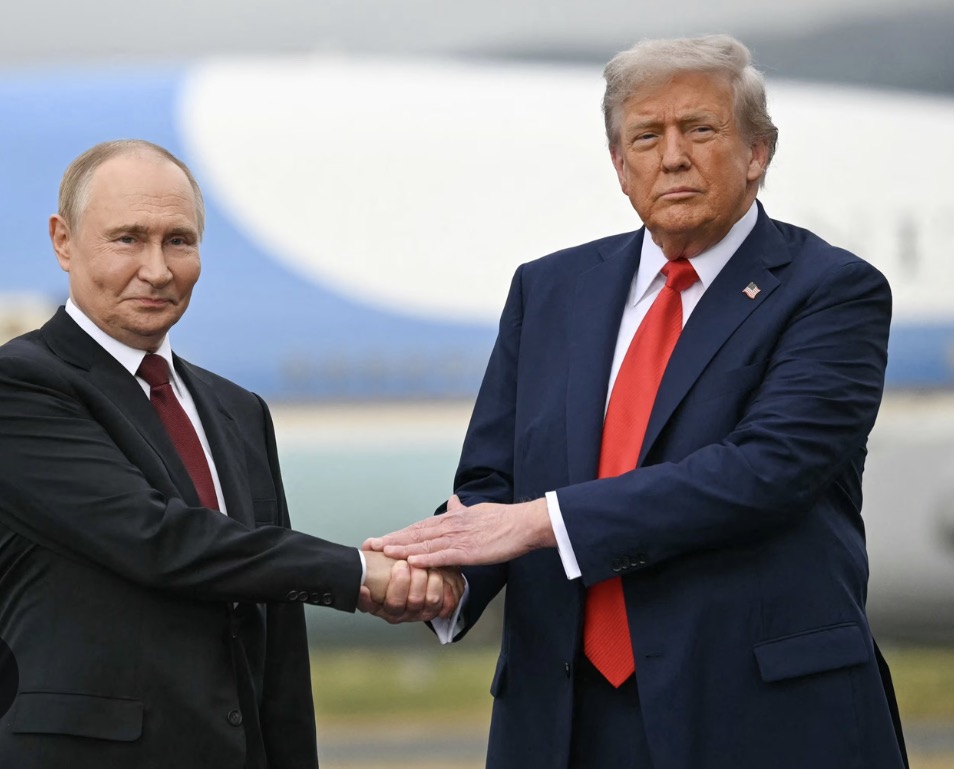
President Trump and Vladimir Putin met in Alaska August 15, 2025. Three days later, August 18, 2025, Russia unexpectedly announced they were restarting their Arctic-2 LNG production facility. Russia would be more than doubling their capacity to generate and store liquified natural gas (LNG).
It absolutely did not make sense that Russia would start producing even more LNG considering the previously imposed western sanctions against them, and the fact that Russia was already overproducing LNG. As noted by analysts at the time.
In August of 2025, Russia was essentially producing more LNG than they could sell into the available market. Russia was storing the overproduction from Arctic-1 on floating storage units “on the water” and slowly selling inventory to countries that did not align with sanctions, specifically China and some Asian buyers. Then suddenly, after the Trump summit, Russia decides to bring Arctic-2 online and produce even more LNG. You can see how this did not make sense.
If they could not even sell all the Arctic-1 LNG output, then why would Russia bring Arctic-2 LNG production online?
Six months pass.
Then, with the military operation in Iran triggered and with Qatar immediately announcing they were shutting down LNG production, there were dozens of new markets for Russian liquified natural gas. And that LNG was now worth 50% more than when Russia inextricably decided to start producing and storing it “on the water”.
Now, there are those who might look at this timing and outcome and be angry at the possibility. However, I would point to something else.
If those anti-Trump criticisms are correct, well, that also means in August of 2025 President Donald J Trump was planning for the moment we are standing in right now.
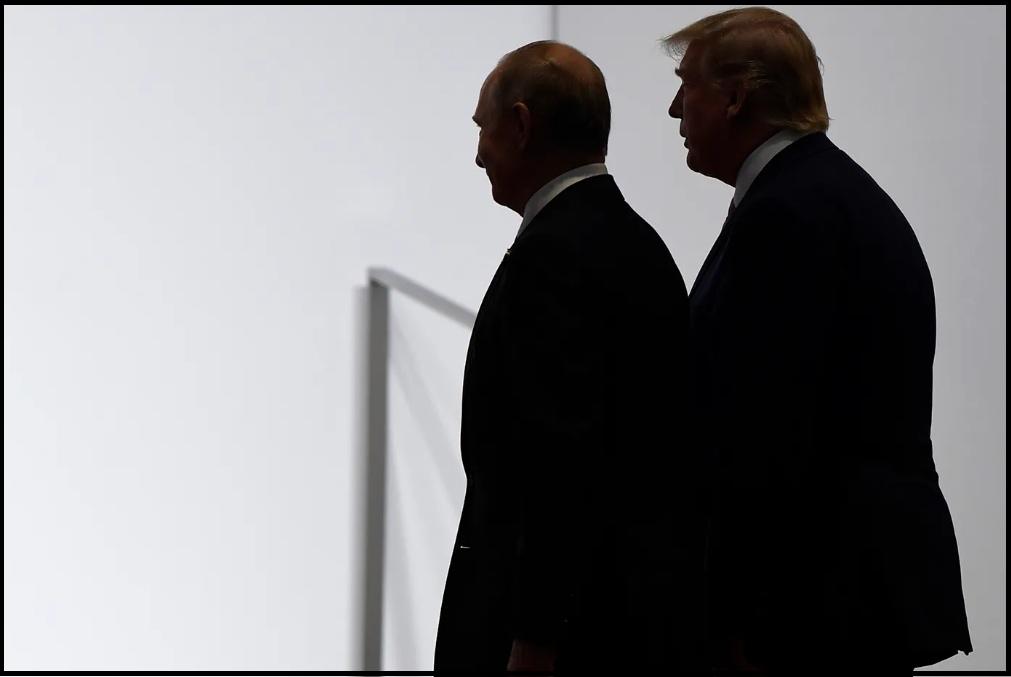
If it was my job to send the invitations to those business guests, I would have choked on a few. Larry Fink, really? I’m surprised Bill Gates isn’t there.
Right. Maybe he and Melinda could have negotiated COVID vaccinations for the Uyghurs.
Agreed….That one puts me on edge as well. Never been a fan of Blackrock…
Me neither but they have deep pockets and global reach. As such, IMO, Fink is there as a “pressure point” nudge to Xi that Trump means serious business. So Xi better hitch his wagon or things could move in a different direction quickly for China.
Relax. Do you really imagine Larry Fink is a match for Trump et. al.? Fink has had a talking to. No more Great Reset for you! He’s obviously chosen the strong horse.
Agree castelletto. See my comment to Remington.
Cheers…
For the same reason that the Epstein ‘files’ will never be released in their uncensored entirety, nor will Barry Soetoro ever be executed for treason.
Larry Fink is highly connected to the real networks which *actually* direct the path of human civilization.
In my view, President Trump is orchestrating the most audacious and consequencial *New World Order* of any other human being to have ever lived.
If successful, what President Trump is doing quite literally will spare the human species a fate worse than death.
Yep! I’m tracking with you Robert. :o)
I sincerely hope you are right.
“Stay elevated. Note the emphasis by Secretary Rubio was on geopolitical relations “
The big problem is, China has broken nearly every trade agreement they’ve ever made.
They promise big and deliver nothing. They promised to end sending pre-cursor chemicals to the cartels. They haven’t stopped. They promised to end stealing our intellectual property. They haven’t stopped. They send spies to steal our technology. They’re flooding Canada with their firetrap EV cars. They’re responsible for not telling the world when COVID escaped in Wuhan. I wouldn’t trust China as far as I could throw them.
And that is precisely why you keep them close.
And President Trump is keeping those “titans of industry” close for much the same reasons. Many, if not all of them, were perfectly happy to have American jobs and production shipped over to China and profit handsomely from it. The wind has shifted because of Trump and those people know it and are positioning themselves and their companies to profit from the shift. But if a different President were to let the winds shift back again toward China, those very same titans will be happy to shift once again. They won’t lose any sleep over it. So Trump brings them along and is keeping them just as close as he is keeping Xi and the Chinese. And it is up to us to make sure the next President supports MAGA and can keep the winds shifted toward the U.S.A.
I disagree because everybody is focused on the Government to Government “agreements” which are nothing but “want to be desires and wish sandwiches” … as China Inc. is clever enough to rarely if ever include anything definitive nor measurable in those agreements.
The REAL agreements that China Inc. very meticulously follows are all the Licensing, Banking and Investment agreements they sign. These are definitive with well defined deliverables … yet it is the Home Country Governments of the BUSINESSES entering these agreements who blindly and foolishly FAIL to control them.
Good thing they need our oil now! President Trump bringing the fire and a handshake. Amazing days we are living in. 🙏🏽😎
We are, after all, the world’s largest producer now. This is why Trump offered Xi i.e., China our Alaskan oil, to hold that position and put Iran down a few more notches on the ME/global oil ladder. Savvy move…
I don’t think Trump would be that naive, Pyrran. Remember Reagan’s invective when dealing with the Soviet Union, “Trust, but Verify?” I’m sure Trump hasn’t.
I suppose we can use the same argument against the US as well, for at least some of the incidents that you list.
I would say that our relationship with China is now under a new contextual shift. I suspect the players will act accordingly….Let’s see what happens…
Instead of “mutually assured destruction” being the guarantee for peace, it looks like the President is trying to create “mutually assured interdependence.” Economic security is national security. If China and Russia see the need to be honest partners with us, whereas the Euros and Five Eyes don’t…
I wish more people had that view of China, also Russia is not to be trusted.
I still do not believe Covid was an accident.
We have the same problem in the U.S. The Democrats never deliver on any of their promises given during an election campaign.
I wouldn’t trust a Democrat as far as I could throw him or her either.
I trust President Trump. He uses different tactics and techniques and language than I would use but I still trust him.
The only more untrustworthy man than a chinese is a muslim.
Good to be alive. 👍🏼
“If those anti-Trump criticisms are correct, well, that also means in August of 2025 President Donald J Trump was planning for the moment we are standing in right now.”
Insert big ol’ grin.
Assemble all the pieces we now know about, spread them out on the table, and begin fitting them together. What does the world look like now, what do we want the world to look like in 2030, and what else do we need to do to get there?
I still say greatest president since Lincoln.
Ain’t that the truth….I feel like the Cheshire cat this morning…
As Sundance said way back, President Trump will deliver optimal solutions, perfection isn’t on the table.
It is also instructive to us: “this doesn’t make sense…..what can Trump be planning?”
Trump is a developer…meaning he is visionary and planning, seeing the moving parts. With years of experiences creating WIN – WIN for multiple parties…..assume something positive is afoot.
“Japanese Prime Minister Shinzo Abe and the Association of Southeast Asian Nations (ASEAN) were fine. Japan, Vietnam, South Korea, Indonesia, Philippines and Thailand all picked up business as President Trump told manufacturers to move production out of China and into ASEAN nations. That process was underway.”
Our government told the manufacturers what to do. When our government tells the banks what to do. They do it. No bank would make a SubPrime Loan to a Borrower that could not afford the purchase with no money down. The government told them to do it. SO when you bad mouth Fink, think Government. The man is a WEF but nobody is WEF in their own operation without the force of government. Capitalism has enough chaos without adding DEI or SubPrime stupidity to the mix.
You see it even in the government sector. How many of you are planning to move to Seattle or Chicago? How about lets go to NYC and live with the Islamist? Who is buying big real estate in those paradises?
“Who is buying big real estate in those paradises?”… This is the most important question, when the cost of living there goes up and people flee, who is buying up the real estate at less than market prices? Soros made his billions by crashing national economies and than buying at rock bottom prices…🖖🏻
“thEn buying…” lol
Laugh all you want, sorry for not proofreading my post better before hitting the bottom but once again I am a grunt not an English major. 🖖🏻
Bottom = button
I agree on the relationship related assertions made by Sundance … between President Trump and CEO of China Inc. XI … However,
Until the Export Licensing Agreements as well as Banking and Investment Agreements NEEDED by every single one of those “US Captains of Industry” from the US Government are; reviewed, modified, reined in, et al …. those Captains of Industry will not consider for a single second anything related to US Main Street Interests.
Brilliant background (Thanks MaineCoon) and synopsis SD. As always satellites seem to align every time you put ink to paper. God bless and may He keep you safe Brother!
Master Class!
Thanks SunDance; we are learning so much.
Our future is brightening and so is the future of the whole world,
as peace, becomes a priority.
How empty and manipulative the old marxist peace symbol
seems now.
And how much more important deep wisdom seems.
“It wasn’t a trip of transactions; the vibe, the frequency of it all, was seemingly dominated by something more important to the moment than dollars and yuan.”
Definitely a Thank You to MaineCoon! Explanations of the video were wonderful!
“no conflict between two superpowers,…”Thus, with Big Panda experiencing dependency for the first time it becomes critical for Trump to emphasize that all is ok, don’t worry, we’re all friends.”
How many times have we heard President Trump say, “we’re all friends.” Truly AMAZING!
AND the picture showing President Trump’s hand on President Putin’s speaks volumes!
Thank You, Sundance!
Still look forward to sitting in your classroom, Professor!
We Truly are living in Amazingly BLESSED Times!
We are living our Best life with The LORD as our Shepherd! AMEN
All true Junebug AMEN
BLESSINGS, REDDOG!
😎
Many aren’t aware of Rubios China “chops” but he wrote a VERY IN DEPTH treatise on China entitled “The World China Made” ….
On Chinas’ (Made in Chine 2025) and follow up “Nine Years Later” since I believe the Made in China 2025 was a 10 year plan/paper.
It was available on his senate website back then but site is gone……but the paper referenced here : ( notice the date)
https://asiatimes.com/2024/11/rubio-brings-china-realism-to-the-state-department/
I believe I have a PDF but likely unable to post it.
INCREDIBLY PRESCIENT and says A LOT about DJT’s foresight.
Found a link for you nerds out there….😉
https://www.americanrhetoric.com/speeches/PDFFiles/Marco-Rubio-The-World-China-Made.pdf
THANK YOU
from this nerd…
ADDED to my NAS Archieves
Now if our schools,universities, really focused on teaching leadership that is what would be taught.
President Trump is a master class on true leadership.
God teaches us the principles of seeking peace but hate evil.
How many humans have such skill?
Unfortunately, Trump keeps saying the quiet part out loud about not caring one bit what his actions have on the average American. Makes it hard to trust his motives especially with his hard turn to the Israel first policies since term 2 started.
Exactly WHEN did Trump say he did not care about the average American? You got a sourced quote?
And again with the Israel first shibboleth 😎 Ag Ian…where’s the beef?
grasshoper..just ask BiB…..
I believe this is what is being referenced. Video clips in articles/ evening news coverage
Many articles and discussions in MSM and Independent media.
Trump says ‘I don’t think about Americans’ financial situation’ in Iran negotiations – ABC News
Trump says he’s not thinking about Americans’ finances ‘even a little bit’ in Iran talks NBC News
Everything POTUS is doing benefits Americans. That idea is his foundation.
The globalist structures erected by the Technocrats (which appear to be continuing) MUST BE TORN DOWN in order for our nation to maintain its independence, liberty, economy and creativity.
Thus we have these new international structures to replace the globalist structures. Trump prefers WIN-WIN whenever possible. Unlike previous globalist agreements, Trumps agreements are designed to benefit both parties to the maximum extant.
I would ask you to consider pulling the scope of your vision back to take in the macro view and understand that a new foundation is being laid. This makes it important for us to consciously now begin to evaluate what persons are best candidates to maintain and possibly increase these same new structures starting with the next term.
Trump assumes that the average American can handle the “bumps” that are occurring during this re-alignment. He told us early on there would be some….analogous to changing lanes on a bumpy road.
God bless.
I’m curious…after the military operation in Iran started, what was the purpose of Qatar immediately shutting down its LNG production? Is that an indication of Qatar being in alignment with Iran?
CIA/DS->Qatar; CIA/DS->Iran?
Iran shut down about half of Qatar’s LNG production facilities for them. The rest is shut down as there is no way to export it.
We are witnesses to History in the making.
If these relationships hold, i.e., China, Russia and the U.S., remain deconflicted, the world will be on the verge of an enlightenment the Age of Enlightenment could only dream of.
Pray the whole world will hear God’s voice! It is our only hope!
Conveniently omitted above is Trump stating Chinese acquisition of farmlands adjacent to military bases is good for farmers.
Ahhhhh, you noticed that too…
100%
Small steps will lead to bigger opportunities for corrections.
$ has no color.
Every one of these international deals seems to come down to more Boeing jets, military equipment, natural gas and soy beans being sold. Yet all my Amazon stuff still comes from China.
I recently purchased some sheets through Amazon..the label on the plastic bag they were in said, “Made in Green.” 😂😂. The sheets are grey, BTW.
Does it go without saying that maybe you are contributing to the problem?
Anyone who remembers the 1973 embargo knows the leverage that PDJT, the United States, and Russia now wield over the EU AND China.
America and Russia are the 21st Century energy superpowers. The others are not.
I have a sense that all of this was touched upon briefly on an Alaskan tarmac last year.
..Oldersoul…do you now we still have to import 15-20 % crude oil…..???
Fracked crude is too light and needs imported heavy to make diesel and kerosene.
The key to any of this..trade, war, espionage, hemispheric ownership, nukes = OIL/ENERGY.
This. True energy self sufficiency has been the defining feature of the great industrial superpowers.
For Nineteenth Century Britain, it was coal. For Twentieth Century America, it was oil.
Those that otherwise aspired, but failed, did so for insufficient energy to power their growth and/or expansion.
It was on PDJT’s watch that the decline that started for America in 1969 has been reversed. America will remain an economic superpower for the foreseeable future.
But it remains China’s Achilles, as it was for Germany and Japan a century ago.
Germany keeps hitting themselves, they’ve learned nothing, and all because someone owns them. They refuse to get off the stupid train. As the saying goes, “They will bite off their nose to spite their face.”
Only President Trump could go to China.
-21st century version
President Trump sees around corners better than almost anyone.
From Promethean Action:
Interesting observations re: what happened between Trump & Xi
https://www.prometheanaction.com/the-saturday-wrap-up-trump-walked-into-china-and-killed-kissingers-thucydides-trap-may-16-2026/?ref=promethean-action-daily-newsletter
APEC…
Asian Pacific Economic Cooperation
😉 😉
May 11-23, 2026 ..happening now.
Meetings/events being hosted by China throughout this year.
21 member countries. Established 1989
Think gigantic job/products…the business and trade
all together…..business leaders and government officials
making deals! 👍
Our Trade and other government officials are scheduled to
participate.🤷♀️
We held the event in DC in 2023 and President Trump gave speech.👏
Is our MSM media silent about coverage of APEC -🦗🦗🤐
same as SCO coverage Shanghai Cooperation Organization?
United States Participates in Second APEC 2026 Senior Officials’ Meetings and Ministerial in Shanghai and Suzhou, China – United States Department of State
Asia-Pacific Economic Cooperation
APEC China 2026 – Wikipedia
I would not have expected President Trump to address the issue of the recently disappeared/ censured/ removed Chinese generals and Politburo members (some of them possibly killed), but wonder, nevertheless – how do both the fact of their disappearance/removal and silence about them fit in the context of the current dialogue … from Xi’s perspective and from that of the United States.
Extracting Maduro, verbally confronting Cuba, and killing terrorists in Nigeria ( https://theconservativetreehouse.com/blog/2026/05/16/president-trump-says-u-s-and-nigerian-military-have-eliminated-isis-second-in-command/ ) – but hands-off re Chinese leadership eliminating their political (and internal opponents in the military? Maybe the silence is simply a pragmatic choice, bearing in mind what the immediate goals are. How do these realities fit with the context of this amazing visit.
I loved the video inside Xi’s home.
I clearly remember what a national shock it was when Henry Kissinger went to China, and when Richard Nixon went. Those were weirdly astounding events. Talk about going into “the great beyond”.
I. Other than Xi and Putin, President Trump must fight several hostilities on many different aeras, like
Added to this are scurile encounters of all kinds and instigated curious legal disputes that tie up many resources.
Three smell tests about mainland China and Hong Kong:
II. Short excerpt of developments in China
[1] for example: Peter Schweizer, The invisible coup: How american elites and foreign powers use immigration as a weapon or
Honeytrapping spies, duping politicians, buying farmland: All the ways Chinese Communists are infiltrating the US
Greatness is a misused application. Jim Thorpe, Ronald Reagan, Wilt Chamberlin, Billy Graham, Patsy Cline, Roger Stauback, Clara Barton. We are living in epic times.
I was looking for more kinetics out of this summit, particularly with the US delegation composition that accompanied our POTUS.
You are SPOT ON, Sundance! This was yet another shaping movement, like the Abraham Accords and Board of Peace, where alternatives to the UN, BRICSA, and Euro-dominated international rules and finance are methodically being put into place.
I am neither a Sino-phile nor a Sino-phobe. I am a Sino-realist, and Team Trump performed magnificently.
Combat pilots use the OODA Loop (Observe, Orient, Decide, Act) to describe gaining the upper hand in aerial combat by cycling faster than your opponent.
Relationships, seeming chaos/change, optics, mastery of the media cycle, OODA, and unflinching determination to persevere in service to the American people are the tools President Trump is wielding on display for all to see.
I said a prayer and breathed a happy sigh of relief when AF-1 touched down with everyone safely home. It was a good day for America and the world.
Upon President Trump’s return, in an interview, he stated he would be reviewing the pending sale of military stuff to Tawain. President Xi has stated to do so would be us into conflict.
Given the Cuban Missile crisis on an island 90 miles from USA; given NATO’s threat to take in Ukraine & be in Russia’s backyard; given USA is selling military stuff to Taiwan which is 59 miles from China; given that President Trump is a peacemaker even if a short term war/incusion is to prevent Iran using nukes; given all this…regardless of our political support of Taiwan, I do not think President Trump should approve military sales to Taiwan as it would be aiding and enabling war between China & Taiwan.
It’s rather hypocritical to say we won’t have Russia in USA’s backyard, including Venezuela, but we are in Russia’s backyard or China’s.
A difficult discision for President Trump after Pelosi did her stint in Taiwan and has given them false hope, but we can not go to war with China over Taiwan any more than we did re: Hong Kong (course, a lease made that a non-negotiable contract).
USA needs to stand down re: further military sales to Taiwan. JMHO.
I understand your logic, however there would be significant opposition in congress and with our allies. Perhaps the only person in congress that would support such a move would be Massie.
I know. President Trump is between a rock and a hard place, but, he said he is the one that has to approve/disapprove it. We’ll see how he resolves this one.
The sweet justice involved in every scintilla of every move of President Trump makes it weep worthy.
Watching the crushing, between his fingers, in retribution for millions and millions of Americans, for omgoodness in some cases 250 years, depending on the country, LOL, is simply the greatest singular event we will witness in our lives.
What makes it all more delicious, is the fact that so few are enjoying the excellence of its divine flavor.
Trying to clarify this.
“Additionally, China has made major purchases for 200 Boeing aircraft and up to 500 jet engines that are worth multi-billions in benefit within the manufacturing sector for the United States. “
Are most of those engines going to be attached to the 200 planes that were sold? I have not heard of planes and engines being separate components before. Usually a few extra are needed for swaps.
They are replacement engines for older Boeing Aircraft in the Chinese fleet and possibly for new aircraft frames being built by China. China builds the aircraft and uses Boeing jet engines.
It’s a lot of engines either way.
The engines are either GE or Pratt and Whitney or Rolls Royce. Perhaps that was a bottleneck for the China aircraft industry? I don’t think they build engines yet.
President Trump mentioned several times in different interviews yesterday that only the United States and China have the technology and equipment to recover Iran’s nuclear material buried under a mountain of granite.
Why would President Trump suggest that China is the only other country besides the US capable of doing this job? Obviously, sending thousands of American contractors, soldiers and nuclear experts into the mountains of Central Iran with a massive amount of logical support, supplies and heavy equipment not to forget housing, food and medical services is not going to happen.
President Trump is suggesting that China remove the nuclear material from Iran and store it for the 20 year compromise period of time. Reports last month stated that China has made the offer!
This may be the off-ramp that ends the conflict!
I missed that report re: China’s offer.
I will look for it though.
I want Rubio for 2028. He will continue the march. Vance coming from poverty and low experience can be overwhelmed by these hawks.
If Trump planned our current position (and Russia’s and China’s and others positions) 6 months ago…. Imagine now his current plans for 6 months into the future.
… just before mid-terms.
Respect given, respect reciprocated.