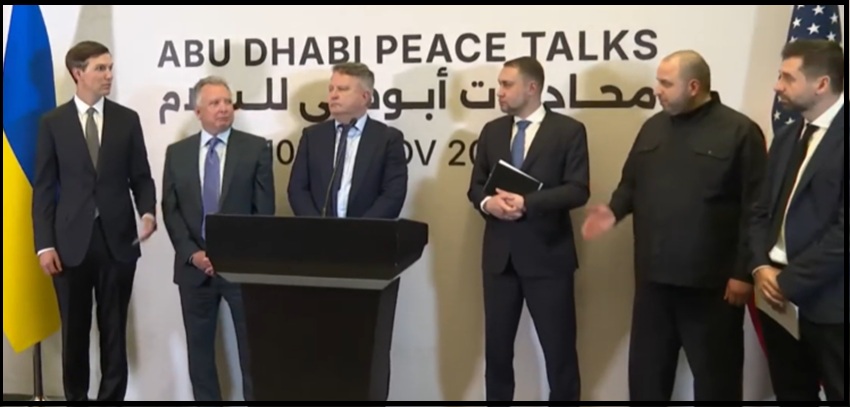
Peace envoy Jared Kushner says the second day of US-Russia-Ukraine peace talks in Abu Dhabi was difficult but productive, revealing plans for himself and Steve Witkoff to travel to Moscow tomorrow to meet again with Russian President Vladimir Putin.
Many people are critical of Kushner, I am not. Kushner is earnestly working through a complicated negotiation strategy, and this renewed session was shifted slightly with both Russia and Ukraine being asked to consider what the post conflict would look like and how would that scenario for each be best achieved. [Begin with the end in mind]
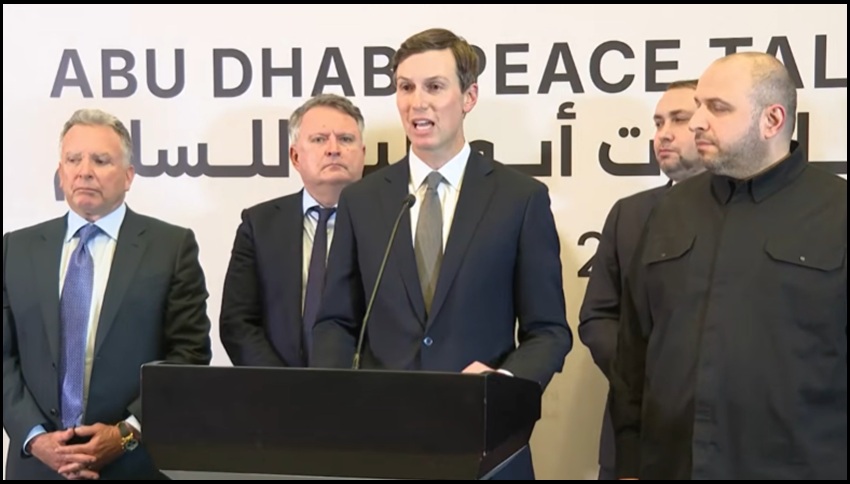
All parties spoke optimistically about a major prisoner exchange becoming more likely, yet territorial disputes remain the toughest obstacle to ending the war. Ukrainian officials welcome progress on security guarantees, where they are requesting the U.S. military backstop the EU alliance therein. This part is touchy.
Ukraine negotiators seek broader European participation in these talks; an issue that Russia has be averse to. From Russia’s former perspective Ukraine is not an EU member state, nor is it a NATO member state, so Russia does not easily accept the EU and/or NATO being involved as they seem to complicate matters.
In a humorous exchange, Kusher was asked if it would be better for Europe to select a single person to represent their interests in the negotiations, as opposed to multiple figures from NATO, the EU, Germany, France, the U.K all sitting outside and awaiting participation. Kushner said, “if Europe could identify one person to speak on their behalf that would be a bigger achievement than getting the Russians to include them in the negotiation.” [09:20] 😬😂
The entire presser is below, and it’s worth watching. However, there are a few dynamics worth discussing that are not directly mentioned and generally missing from western media review.
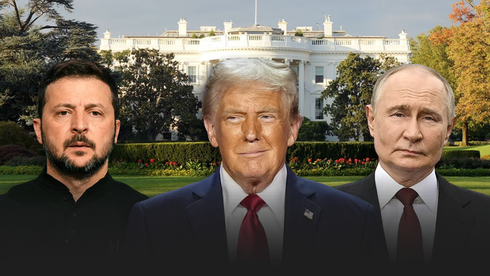 First, people are wondering why President Trump has seemingly backed away slightly from Iran negotiations while focusing more intently on Ukraine and Europe.
There’s good reason for that.
Iran can strike Europe with its remaining arsenal of missiles (quantity unknown).
As long as Europe keeps threatening to engage in expanded conflict with Russia under the auspices of the Ukraine conflict, there is no incentive for Russia to support President Trump’s peace effort in Iran.
According to both, President Trump and President Putin speak frankly with each other. No doubt this issue has been raised in their rather lengthy conversations. Putin is willing to help Trump resolve the Iran problem, but not to the detriment of his own security.
Secondly, as each day passes the inability of Europe to defend itself becomes increasingly clear. Factually, without the United States leading NATO in Europe, the EU is naked to their defined enemy. Despite their incessant drumbeating, the EU simply doesn’t have the resources, capabilities or technology to fight an expanded conflict with Russia.
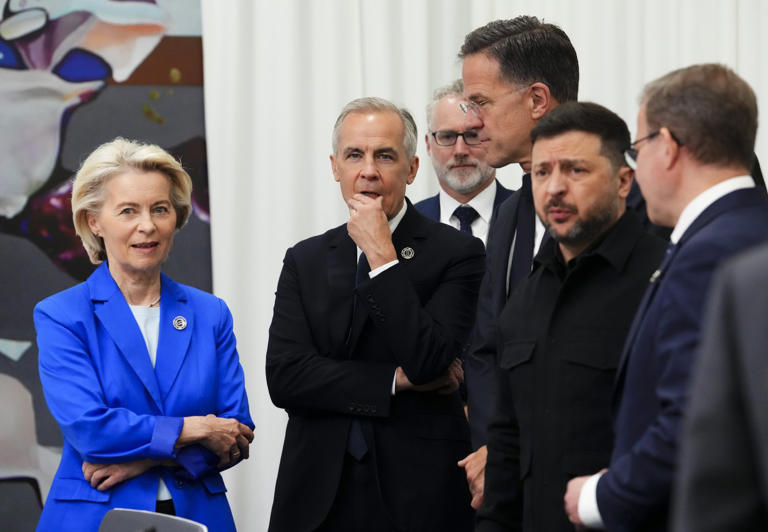 EU/NATO has increased its military spending; however, in an effort to meet their financial obligations the EU has also redefined what “military spending” is to include railroads, bridges, roads and infrastructure. It is somewhat of a slight of hand on the NATO recordkeeping books. Canada is doing the same.
Neither the EU nor Canada is actually putting all of their pronounced spending increases into actual warfighting equipment. Nor do they have a space program, modern satellite communications or missile guidance systems. They are entirely reliant on the U.S. for this.
The EU has the ability to strike at Russia and create some damage, perhaps even a quick win around Kaliningrad is possible; but Brussels putting their military up against Vladimir Putin, while missiles come from the East (Russia) and South (Iran) is not something they can deal with unless the U.S. is involved in their defense. That’s just the brutal reality of the matter and collectively Russia, China and Iran understand this.
In part this is why the pontificating politicos in Europe are demanding a seat at the table within the Ukraine-Russia conflict. Europe only has collective ‘soft power’ to leverage against much harder powers in Russia. The U.K has no serious weaponry to speak of, and Canada is no help in this matter regardless of their ‘associate member’ status or lack therein.
A major theme of the Jared Kushner briefing was that Europe must be involved in any lasting settlement. Kushner argued that European security structures, NATO, and the EU will be essential to implementing any post-war security arrangement and said he hopes Russia will agree to bring Europeans formally into the process.
Asked about a face-to-face meeting between Putin and Zelenskyy, Kushner said such a meeting will likely be necessary to finalize a deal, but Russian officials want more progress at the negotiating table first. He said the framework for a possible agreement appears to be emerging, though significant work remains. WATCH:
[Transcript] – [00:20] Jared Kushner: So we just concluded the second day of discussions. These were very substantive—there were some pretty tough discussions after, I think, almost eight months of not being together. But obviously, there are a lot of very serious issues being discussed. The conversations were very thorough: we covered all the relevant issues, and we were able to do a good exchange of ideas.
In some areas, we see places where we can find compromises; in others, we need to have more discussions. But I think this was a good first step. One of the positives is we agreed that we’re going to have the biggest humanitarian release of prisoners, which we’re going to finalize the numbers for tomorrow.
Steve and I are going to travel to Moscow tomorrow to meet with President Putin to go over what was discussed today and try to make more progress on some of the issues we discussed, because we see some openings and opportunities there. After that, we’re going to fly to Dublin to be with President Zelenskyy to debrief with him and further explore some of the ideas we came up with here today.
One of the goals of the meeting in Moscow—in addition to trying to finalize the humanitarian relief, the release of prisoners, and other humanitarian issues we’re working on together—is going to be trying to see if we can get the Europeans added to the format so we can make this a multilateral format.
At the beginning, the end, and constantly during these sessions, we had very good interaction and discussions with our European partners. We had the EU, NATO, the United Kingdom, Italy, Germany, and France here, and we’re very united in all the discussions we’ve had. So the goal will be to turn this into a multilateral format. We have several topics that we think need to be discussed simultaneously.
The issues covered in these discussions were really post-war security: how do we make sure that once this war ends, it doesn’t start again? That’s very important for Ukraine. They need to go through their security guarantees, which we actually made quite good progress on—understanding how we do de-confliction, how we monitor the ceasefire, and then making sure that we have the right agreements and understandings in place to really do some major post-war de-escalation.
We also discussed the hard issues. No open issues were avoided—including territorial issues, which will be the hardest, but we do believe that as we discuss these other issues, we’ll find a pathway to settle them all at the same time. Having these discussions is very important, but the implementation of post-war security will not occur until there’s an agreement on territory and on all other bilateral issues.
With that being said, I think this was a positive step. When Steve was in Oslo and St. Petersburg, we weren’t sure we’d get to this trilateral format. It’s been a long way to get everyone back to the table, but I think this was a very good first meeting—a tough meeting, but a productive one. I want to thank our Ukrainian partners for their great efforts. They fought very hard for their issues, were very constructive, and I think it was a very productive session.
[03:39] Ukrainian Delegation Representative:
I would like to start with words of gratitude and appreciation to Steve Witkoff, Jared Kushner, and all the team working under the leadership of President Trump. We’ve achieved tremendous results over the last year. We’ve met in different formats, exchanged a lot of prisoners, and this time we are also exchanging—the exact number will be announced a little bit later as Jared mentioned.
Discussions have been done in different formats, including not only the Russian side, but the Europeans who will be included soon. So there is huge progress going on regarding security and prosperity issues. We will be talking about this later on, but once again, I would like to thank the negotiation team for their efforts. I’ll give the floor to our colleagues from the team to add up. Thank you.
[04:51] Ukrainian Negotiator:
Good morning, everyone. First of all, thank you guys for what you did. I’ve been in this process since 2022, and I can fairly say that this was one of the toughest sessions. The Russians came with very strict directives, and it was very hard to soften the discussion. I think the way you structured it around the post-war picture for both countries opened up a dialogue, and we started working more productively.
Secondly, the most important part is the people. We definitely work hard to stop the war for every person in Ukraine. But before the war stops, there are always people in worse conditions—those in prison. Exchanging such a big number is a major achievement in itself; it’s worth having three, four, or five sessions just to release these people. I hope tomorrow’s number will be big. The pre-feeling is that it’s going to be a really big exchange, one of the biggest, if not the biggest.
Six months ago, we thought we couldn’t resume trilaterals before the spring. In Oslo, I was very skeptical—even the day before this meeting—but we resumed them. Moreover, we are working towards the final goal where it shouldn’t just be trilateral, but multilateral. The Europeans have to sit at the table because we are talking about European post-war security. Ukraine is part of Europe, and European countries have to sit at the table with us to discuss what European security will look like. That is a second major milestone we have almost achieved.
Regarding the third point, there are other issues we cannot disclose at the moment, but we made really big progress. I encourage you guys to visit Moscow and then come back to us in Dublin for a second session, and announce the date for the next session as soon as possible. We have good momentum to bring a solution before the new year comes. Thank you.
[07:17] Ukrainian Representative:
I would just like to express words of thanks to all sides who support our country to achieve the end of this war. Thank you to the United States and the United Arab Emirates, and especially to Mr. Jared Kushner and Steve Witkoff—they are doing all the best they can. Thank you to all sides, and we are ready to answer your questions if we have time.
Q&A Session
[07:51] Press Handler:
Jacqueline will run you a mic to ask your questions. Starting with Bloomberg…
[08:03] Bloomberg Journalist:
Did Russia agree to drop its demand for Ukraine to withdraw from the entirety of Donbas, or are they still insisting on it?
[08:49] Ukrainian Representative:
Look, all matters raised in the course of discussion are for the sake of discussing them during these sessions. Once we get to results, those results will be publicized, but we shouldn’t do anything to harm the talks.
[09:13] Politico Journalist (Tim):
If I could address this to Mr. Kushner as well… It sounds like the Russian side has not yet accepted the need for the Europeans to join the process. I’m wondering if it would be better from the point of view of negotiations going forward if Europe could identify one person to speak on their behalf?
[09:43] Jared Kushner:
If Europe could identify one person to speak on their behalf, that would be a bigger achievement than getting the Russians to include them in the negotiation!
Right now, Steve and I have gotten to work very closely with a lot of our European colleagues over the last year. Europe is a very diverse mix of different personalities, perspectives, and interests like most places. Right now, we’ve assembled a really strong way to organize. Obviously, NATO is a very strong pillar and the EU is a very strong pillar of our European engagement. They were both here, and we had very good consultations with them over the last months and hours. We also included the E4 for this talk, but we speak to a lot of different countries—we spoke to Norway and Finland, who have been very involved, as well as others all the time.
Just to be very open about this: both countries want to know what their security posture—and what their opponent’s security posture (hopefully not an enemy after the war)—is going to look like if they end the war. In order to do that, we need to have the Europeans at the table. It’s a discussion where they have to be involved; NATO and the EU will be integral parts. Then we need to find a way to get good consensus among everyone around what the right steps are.
What we’ve told the Russians is that they obviously have their desires and fears, which we discussed in this session. But we also told them that you have to provide different de-escalation proposals if you want Europe to receive those proposals in a good way. The reality is there’s no trust right now between the sides—that’s to be expected after a conflict like this—but we should rely on interests, incentives, and a good architecture to bridge that.
There are good structures in Europe we can build upon, and our plan is to build upon them. But something is clearly not working, which is why we’re in the fifth year of the longest, most costly, deadly, and horrific war Europe has seen in a long time.
Our engagement with Europe on both the Ukrainian and American sides has been quite strong. We’ve relayed to President Putin directly several times, and to his team, that the only way to get this done is to have them by our side. I think they’re receptive to it, and hopefully tomorrow in Moscow, Steve and I will be successful and President Putin will give his blessing for that to occur. If he agrees to that, we’ll be able to make a lot more progress on the issues that matter.
[12:41] Euro News Journalist:
At what point is it time for Zelenskyy to meet Putin face to face?
[12:52] Jared Kushner:
It would be great if they did that at any time; I think that would be a good thing. But to be transparent, what the Russians have said is they’d like to see more progress made before that happens. Clearly, there’s not great trust or love between the leaders.
These deals take time—they are hard deals. When we did the Abraham Accords, it took three and a half years; the USMCA took two and a half years; the Gaza deal took a year. So these deals are very complex. This one is very emotional, complex, and a very hot war.
What we see now—having worked very hard at this for the last stretch—is all the different ingredients to make a deal. We just have to figure out how to refine and organize those ingredients, and create the right structure and pathway to do it. At the right time, it will be very important for the leaders to come together to finalize, because only the leaders can make those final decisions.
In the meantime, we continue to engage very directly with President Zelenskyy—we spoke with him last week, we speak to his team every day, and we’re going to see him in a couple of days. We also engage very closely with President Putin and his team, who we speak to on a daily basis as well. That will be a critical step. We have a little bit more work to do to get it there.
We are pushing a boulder uphill—this is a very, very hard conflict, but a very important one. People really want to see this war end—the people of Ukraine, Russia, Europe, and President Trump all want to see it end. So we’re working very hard to try and make that happen, and a face-to-face meeting will be a critical step towards achieving it.
[14:45] Wall Street Journal Journalist:
All of you mentioned that this was one of the toughest meetings. In what sense was it tough, and what were the sticking points? Also, the timelines aren’t clear here—winter is coming and looks tough with strikes on Ukrainian infrastructure, so how fast are you thinking of overcoming these sticking points?
[15:09] Ukrainian Negotiator:
Why was it tough? Because they brought very strict directives. When you’re told there’s no space for trade, that’s why it’s tough—normally, you come with a corridor of choices, but this time it was very rigid.
As for the next date: we really hope that when Jared and Steve visit Moscow, they bring back a date. Besides the humanitarian part, bringing back a date and finalizing the agreement to put Europeans on board are the two key outcomes everyone is expecting.
Time-wise: every pre-winter period, Russia tries to put maximum pressure because winter is when we are most vulnerable. This year, we are more vulnerable due to a lack of interceptors for objective reasons. Ukraine knows how to sustain the winter, but the hope inside and outside the team is that we can complete everything before the new year—though you never know.
[16:22] Ukrainian Representative:
I would like to add that it’s not only about difficulties; it’s also about the maturity of the conversation. Ukraine and the United States understand each other better now, which allows us to go more comprehensively into negotiations.
Another thing: I heard no ultimatums—neither from the US side, the Ukrainian side, nor the European side. That’s very important to highlight, because I often read in media coverage that there are ultimatums. Neither yesterday nor today did I personally hear any ultimatums.
[17:16] Press Handler:
Last question, if our principals want to give any closing remarks?
[17:22] Jared Kushner:
No, we’ve said it all. We’ll get back to work. Thank you, guys. Thank you so much.
[END TRANSCRIPT]
Fascinating article. A lot of details to be worked out
Why is Zelensky in Dublin? Wasn’t Hunter Biden there as well? 🧐🧐
Euros could use a good beatdown. Their arrogance is unjustified and unfounded. Trump should exclude them publicly and explain why – A weak unarmed EU with no major industry has nothing to contribute to the negotiations, and no recourse if they’re unhappy with the deal. Teach them their place, the one they work towards, the one they seem to want, irrelevant weakness.