For those waiting patiently for the USMCA termination announcement, this is a potential indication and/or signal of pendency.
When President Trump and USTR Jamieson Greer send the official notification, a six-month countdown clock begins running. As of right now there are no official statements that indicate the likely triggering, it’s a guess. However, there are datapoints aligning in that direction.
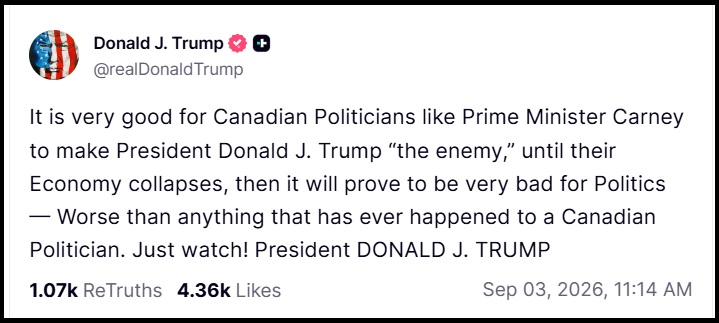
No one outside our assembly has contemplated the termination of the USMCA (CUSMA) or what would occur in the aftermath; however, the Bank of Canada has gamed out the financial consequences, briefly in their forward guidance. The ramifications are significant, perhaps more significant than any other global trade announcement.
[…] “it more likely that a new shock or a combination of shocks could cause several vulnerabilities to crystalize at once. If this were to happen, these vulnerabilities could interact and reinforce each other.
A cascading series of events could cause a sharp loss of investor confidence and lead to a spike in demand for liquidity or rapid asset sales. Funding markets could come under pressure, and stress could spread more broadly.” [SOURCE]
I suggest we keep a close eye on all U.S-Mexico discussions, as well as geopolitical leverage points that might surface in the U.S-Mexico relationship. My best guess is that once the U.S. and Mexico come to renewed terms on the ‘USMCA’ as a potential bilateral free trade agreement, that will be the moment when the planets are aligned for the termination notification.
The financial markets in Canada are tied directly to the independent strength of the Canadian economy. Which is to say, the financial system in Canada is dependent on historic ties to the United States. Pull out all of the dependencies within the economy, a result of a fracturing of the “geopolitical relationship,” and suddenly the Bank of Canada faces a “cascading series of events” they have not previously had to entertain.
A significant number of multinational corporations within Canada are geographically centered due to American proximity and the dependency that has historically been considered a partnership. That relationship has now changed, and despite Mark Carney saying that Canada can be stronger standing alone, there is no economic model for Canada to retain its wealth position without the inherent subsidy that proximity to America provides.
There is no ‘partnership’ with Europe and/or China, or a combination of partnerships, that can replace the one-way nature of the subsidies from the U.S. economy that Canada enjoys.
If the Canadian people, workers and companies therein, have to rely on their own domestic economic activity to fund their GDP, their lifestyle will have to modify in very significant ways.
Now, I want you to think about the Bank of Canada’s previous statement against the backdrop of this announcement yesterday:
The Dutch central bank (DNB) has transferred approximately 86 metric tons of gold out of the U.S. and Canada to the U.K., seeking to shore up its contingency planning in view of “increasing geopolitical unrest.”
Just over one-quarter of the central bank’s gold reserves held in New York and Ottawa had been shifted to London between March and August, DNB said Wednesday. [SOURCE]
Prepare your affairs accordingly.

Let the termination commence!
It’s time for Canada to “get busy living or get busy dying.”
Brooks Hadley knew it.
Think MAID is bad in Canada now? Wait until their economy collapses and they can no longer afford their socialized medicine. Every child with a disability, every adult that cannot contribute, every elderly person will have a target on them.
ouch. great and scary point….
5% of all deaths in Canada are the result of euthanasia. Disgusting!
Wait until the Lazy ass Immigrants can’t get any benefits, then all hell will break loose.
They will probably shift the program to allow beheading of infidels by Muslims immigrants. To save money, of course.
Speaking of…….
https://www.thegatewaypundit.com/2026/09/canadas-assisted-suicide-laws-go-overboard-as-godless/
Well, as long as the MAID “doctors” are bilingual in French and English then all is good. That’s What Matters.
My guess is that the Chinese, India-Indian, and Northern African people will be left alone.
Scary thing, they already have a target drawn on them. 😳
They won’t have to waste any money on the children as the women will take care of that.
Anticipation
https://music.youtube.com/watch?v=BELWbkyOVPQ&si=YTak0u1HKPFy49iO
And all they have to do to avoid the pain is sign the deal they already agreed to with the US, before Carney made up a bunch of “my dog ate my homework” excuses. He clearly takes his orders from London, and has been directed to tank the Canadian economy in their last gasp attempt to stop 47’s reinstitution of the Hamiltonian American System.
I expect 47 is timing the announcement for maximum impact. When would that moment be, to have the most impact? I am not well enough informed to guess.
The next iteration of a trade deal will not be as generous to Canada where their delegation blew it up for domestic politics, among other reasons. And there’s no one else to blame but themselves.
Meanwhile, America is making good deals with other nations that want our business. The longer Canada waits to make an earnest deal, the less of a niche they can reserve that was not already called for by other parties sealing trade deals with America ahead of them.
🎯 The City of London Corporation and the WEF and CCP above that who are Carney’s visible puppet masters.
I don’t want to burden you with yet another of my walls o’ text 😉, so here’s a link to info I’ve gathered on Carney for some more details – 3 posts, if of interest.
It covers his education, high society connections, career in FI, political career and the Great Green Grift he instigated while at Brookfield. This is what he’s currently leveraging as PM to further his goal to become a billionaire at any cost.
https://theconservativetreehouse.com/blog/2026/08/18/president-trump-pauses-50-percent-tariffs-against-canada-hours-before-effect/#comment-12760470
He was told not to sign the deal by the City of London.
It doesn’t affect the city of London as much as it will affect the people in small towns. you pick the town, you pick the province. Those are the ones who will take it in the shorts, with their shorts still pulled up.
I have Canadian relatives and every time we would bring an expensive wedding gift up there, like a Kitchen Aid mixer, we would have to hide them in the car somewhere so the Canadian customs inspectors would not see them and potentially charge us duty. I also noted that cars were more expensive up there than in the States. I would ask my relatives “Why don’t you buy cars down here in the US”? “We don’t because the added duties we would have to pay would exceed the price of the car up here”. I’m going back as far as the late fifties and the early sixties. This trade imbalance has been going on for a very long times.
I remember as a kid my mother would drive us up to see my uncle and cousins in Montreal from Massachusetts.
As a kid I could never figure out what a duty free shop was.
I just remember my mom filling up our gas tank before we got into Canada.
I also remember my uncle would buy everything down here in the states like a VCR and other electronics.
He had one of those old Chrysler vans and he would hide all the stuff in the van.
Fun memories.
What country’s or countries’ gold was it?
Netherlands, Dutch gold
Leprechaun’s
Here is a good, factual breakdown of what the Dutch central bank just did:
No political turmoil in the UK? You may want to re-boot that thought process.
The walls just keep tumbling down—one city, one country at a time.
🧱 🧱 🧱
City of London…
“All the king’s horses,🐎 🐎 🤴
All the kings’s men,
💂🏻♀️💂🏽💂🏽
Couldn’t put Humpty Dumpty back together again!
🍳
Humpty Dumpty insisted on sitting on the wall until it collapsed.
Ten years of zero economic growth in Canada with the moronic Liberals in power, while allowing millions of immigrants to enter the country can only mean a decreasing GDP per capita.
Life is hard, it’s even harder if your stupid,
-The Duke
Sounds kinda like Obama + Biden. TG for PDJT!
I’m not Canadian, but how does one prepare for what appears to be an expected economic collapse?
The movement of the gold could imply that London is actively anticipating it.
How will this affect our stock markets and gas prices. This certainly seems well timed for the our mid terms.
It is shocking to me how openly our governments are working against us. Just because the media is t reporting on it doesn’t mean it isn’t happening.
stacking pm’s is essential
post the upcoming ff, they’ll tank the indexes by 60-80%
it’s not if, but when
plan accordingly
I sincerely appreciate the tip.
Is that for both Canada and US?
I posted yesterday that it seems the globalist actions indicate they are desperate for cash. Stealing the Russian Wealth Fund, false flag operations that bring in immediate cash, nationalizing infrastructure – all follow a same desperate pattern of needing cash.
Are they planning a bank run to grab money from Canadian bank depositors? Did they already steal the depositors money and need a crisis to cover it up?
This seems like increasingly desperate moves to cover their existing losses.
Carney doent care. He can just move back to London and leave Canada in ruins.
Prepare accordingly is the best advice.
Those who don’t pay attention to the world around them will have the toughest time.
Anything Canadian will become a bargain for us as their dollar tanks.
We need to seal the border so we don’t suddenly get millions of economic refugees.
When you say Canadian, what might be a no-brainer choice?
I am on my way South ( it is just a five minute drive😉) We will be looking for a nice place to rent 😎
We here in Canada are in unchartered waters..oddly enough ( or not) our Canadian Bank Stocks, have been on a huge run up of late.
cheers to all the sane Americans here.
The movement of gold is telling.
Though, last I knew silver was undervalued compared to the historical ratios for the spread between gold and silver.
There are other precious metals that might be worth looking into, not that I would have any particular insights regarding detailed pricing points. Those are mostly Platinum group metals that include, rhodium, iridium, ruthenium, palladium and osmium.
Mexico and Canada have nothing at all in common – except for one wee, small thing. Both have been shamelessly used as “cardboard box shuffling services” by China. And, China has convinced both countries to call it, “trade.”
Truth is: it is “exploitation.” And, not by either of them. They are not winning. Their people do not benefit.
These two countries should not attempt to be tied to each other. “One size does not fit all.”
The USA should firmly push back against this “transshipment” practice, and demand that each of these two countries negotiate individual agreements. Ones that are truly appropriate for their situation, and that actually benefit them.
If they “actually win,” so do we.
It really should be obvious how different the two countries are. Mexico is partly tropical, while Canada is partly arctic. As I said, the only thing that has “tied” them is that both possess ports, shipping cartons, strapping tape, and “Made in [X]” stamps that mean nothing. Both of you can do much better than that. “Go ahead. Try …”
Again, it just seems that unless the Canadian leadership is incredibly stupid (I mean really, really stupid) they are hoping for a shift in the political landscape in November to completely neuter the 47 administration. Plus there will be immediate steps taken to remove 47 altogether. Canada and their EU partners will try something, anything because ending the USMCA will cascade across to the EU financially and politically. EU nations are already under tremendous strain on both fronts.
“No one outside our assembly has contemplated the termination of the USMCA(CUSMA)or what would occur on the aftermath….”
NAFTA was an architecturally stupid agreement that only benefited China. Its successor was intended (by the USA) to be a temporary stepping stone.
What now needs to happen, for these very different countries, is two things:
(1) Termination of the “transshipment” deals which do not benefit them at all. If something says “Made in [X],” then it must (gasp!) be actually made there.
(2) Negotiation of real trade terms, two of them. Each of which are tailored to their unique situation, and genuinely(!) “mutually beneficial.”
Leave China by the wayside. They have done absolutely nothing for either of you.
“Make [Canada|Mexico] Great … Again!”
But China has done plenty TO both. In this and in many other ways which are existentialist threatening. Cutting out a cancer completely used to be considered a good thing.
Canada is chocked so full of non-canadian turban wearing, asians and Chinese that it would not surprise me that Canada joins arms completely with China. No one in Canada would know the difference.
China is for all intents and purposes Canada’s Daddy.
Canada will curry flavor with the spy-see Chinese
China doesn’t like Muslims, except as slave labor.
Some of you guys on this website are geniuses when it comes to money.
My question is what investment should be done at the moment to get ahead of this?
Does anyone have good advice for what is happening?
Whether it’s buy or sell?
Thanks for anything you have to offer.
Just got back from getting my new Alberta driver’s license. The whole building was full of “new” Canadians including the staff. I had to show a passport to prove that I was born in Alberta. Feeling a little cranky.
Carney looked a little down in the face this morning on CBC. I think the memes are working.
Think a lot of the outrage is coordinated with team D to try and gain maximum political spin. It will be interesting to see if the tone changes after the midterms.
Also, is the MX agreement finalized? I could see going slowly until that’s done.
Watch all the Pajeets trying to get into the USA.
OMG! They might take over the hotel/motel industry!!!
Oh, wait….
Don’t leave your gold in places where it might get confiscated.
Get your money out while you still can, eh?
The DNB are pretending not to know, that it is the EU that is “increasing geopolitical unrest.”
What has been predictable:
Tariffs: PDJT has had a personal 40-year policy to introduce reciprocal tariffs.
Tariff Escalation: The ‘Reciprocal’ mechanism requires it.
Iran: An ongoing 47-year conflict being brought to a conclusion.
NATO: decades-old talking point about members not contributing appropriately. Now being brought to a conclusion.
Greenland: Denmark admitted the forced sterilisation of thousands of Inuit women, and colonializing Greenland, ‘something’ had to give. PDJT mentioned the idea of buying Greenland, back in 2017.
What has been unpredictable:
The EU is the one that broke a norm. No major power had ever:
Frozen a sovereign’s central bank reserves indefinitelyRedirected the yield to fund a war against that sovereignTied release to a $1 trillion reparations demand
…off topic; apologies; very important:
DEMS VOTE TO PACK THE SCOTUS
“Democrats’ intentions are not disguised. They mean to pack the court the nanosecond they get the chance.”
[…CBS reported, “House rejects GOP constitutional amendment to limit Supreme Court to 9 justices.” Well. More precisely, House Democrats rejected a constitutional amendment to limit justices to nine…
…No Republican voted against it. Only 1 Democrat, Don Davis (D-NC), voted for it, probably because he got confused and thought he was voting for a day of remembrance for George Floyd.
Democrats’ intentions are not disguised. They mean to pack the court the nanosecond they get the chance. Representative Jamie Raskin (D-MD) said, “Trump’s followers in Congress now seek to freeze into place the political court that MAGA built, for decades to come. Thus, they urge us to give away another critical power that the framers vested in us.”
As I suggested yesterday, it is time to bow to the inevitable. How hilarious would it be if today, the Republicans called for a vote on expanding the court? The Democrats “JUST SAID” it was okay. They called it a “critical power” vested in Congress. They suggested 13 total (four new ones), but I think 21 makes more sense. Don’t do it halfway.
According to Democrats, we wouldn’t even need a constitutional amendment. Just a successful bill.
Come on, Republicans. Give the Democrats and the DSA what they want. Then PRESIDENT TRUMP can appoint all the new justices. It’s “win-win!”..]
See more:
https://www.coffeeandcovid.com/p/its-all-about-context-thursday-september
*** *** ***
President Trump will terminate the USMCA before Canada joins the EU.
0.o
Forty years ago, when my husband and I were newly married, we would go to Canada for a vacation because the exchange rate was ridiculously advantageous for us – I seem to remember getting $1.55-1.60 CAD for every $1.00 US. After the passage of NAFTA during the Clinton years, the difference between the two currencies narrowed, and the Canadian government started adding extra taxes onto almost everything so it was no longer the same affordability as it had once been.
While I have sympathy for the relatively small number of Canadians who do understand the situation and are trying to push back, for the most part, their arrogant leadership deserves every bad thing that is coming their way and I, frankly, look forward to the collapse of their economy! Maybe an affordable ski trip to Whistler is in my future after all!
Does anyone else recall when Jeb Bush was running to be the 45th American President?
If you went to his campaign site, you could order a genuine volcanic mortar and pestle for preparing your “Guac” (“Guacamole Dip” for those unfamiliar with it – or perhaps you could also use it in the preparation of masa (when making tortillas or tamales) –
cool, right?
I personally did not think so because to me Jeb Bush represented everything that was NOT America First and why in the double-hockey sticks I am seeing avocadoes from Santa Cruz, Chile in the grocery store when I am almost just down the road from all the beautiful California avocado groves of Fallbrook and surrounding communities?
It just irks me SO much to not have a beautiful Haas avocado grown right here in California. That’s the same thing messing up so much, for a “globalist agenda”.
What do we need SO much from Canada that is better than what we have here that we are willing to sell out our own growers and makers?
I love President Trump and all his great people standing up for “America First”!
It would be another thing if Prime Minister Carney was really for “Canada First” but he is not . . . what a putz!
Its not like Canada hasn’t been given ample opportunities to make things right for their citizens. Or serfs, you pick.
“Prepare your affairs accordingly”. Explain?
What is the significance of gold being moved from Canada and USA to Europe. Does it signify an economic war will ramp up between USA and European Union/China/New World Order?
What will this mean for USA stock market, economy, currency, etc.
Help a newbie out. 🙂 🙏
CACHICOMA (Canada-Chinese Communists Agreement) ahead!